

Revise GCSE Drama No Quiet Space: A Practical Plan
Revise GCSE Drama no quiet space with realistic routines, portable resources, rehearsal ideas and calm ways to prepare when your home is busy or noisy.
A quiet desk is useful, but it is not the entry requirement for effective revision. If your kitchen is busy, siblings share your room or the television seems permanently switched on, the answer is not to wait for perfect conditions. To revise GCSE Drama no quiet space available, divide your work by noise level: use busy periods for practical recall and organisation, save concentrated writing for quieter windows, and borrow suitable spaces at school or in your local community.
The important shift is simple. Stop building a revision plan around the room you wish you had. Build one around the places, times and energy you actually have.
This guide focuses on GCSE Drama, while recognising that Drama sits beside maths and several other subjects in your timetable. Exam arrangements differ across AQA, Pearson Edexcel, OCR and Eduqas, so check your current specification, teacher guidance and assessment materials before deciding what to prioritise.
Your quick revision checklist
When home is noisy, keep the system small enough to use:
- List your Drama assessment areas, including performance, devising or portfolio work, set-text knowledge and live theatre evaluation where required by your specification.
- Match each task to a noise level: busy, moderately quiet or properly quiet.
- Prepare a portable revision kit that can move between rooms and locations.
- Ask school about supervised spaces before school, at lunchtime or after lessons.
- Use short, specific sessions instead of waiting for an uninterrupted evening.
- Rehearse actively rather than only rereading notes.
- Protect genuinely quiet periods for timed written responses.
- Keep your Drama plan alongside your other GCSE commitments so one subject does not absorb every available hour.
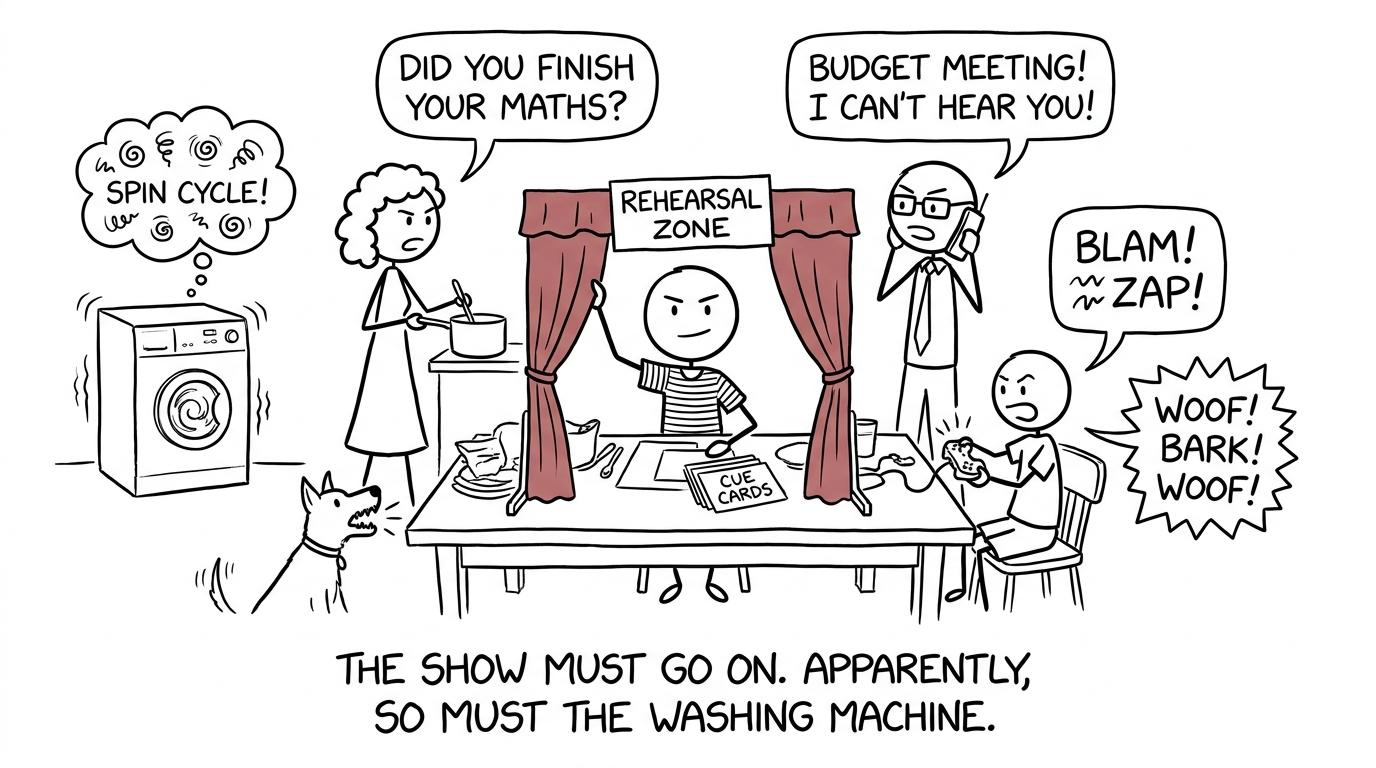 A student creates a rehearsal zone beside a noisy washing machine
Match the Drama task to the noise around you
Not every form of revision requires silence. The mistake is treating all work as though it belongs at the same desk under the same conditions.
Tasks for busy periods
When people are talking or moving around, choose work that survives interruption:
- Sort quotations, characters, themes and design ideas into cue cards.
- Label a script with vocal, physical and spatial choices.
- Create a scene-by-scene timeline for your set text.
- Organise notes from a live theatre production.
- Test key terminology using flashcards.
- Walk through blocking with small movements where it is safe to do so.
- Pack scripts, stationery and rehearsal clothing for the next day.
These tasks still move revision forwards. More importantly, they preserve quieter time for work that genuinely needs deeper concentration.
Tasks for moderately quiet periods
When there is background sound but you can think, try:
- Planning the structure of a written answer.
- Recording yourself explaining a character's motivation.
- Listening back to lines through headphones at a safe volume.
- Sketching costume, lighting, staging or set concepts, then annotating the intended effect.
- Recalling a production from memory before checking your notes.
- Rehearsing facial expression, gesture and posture without speaking.
A pair of headphones may reduce distraction, although it will not transform every environment. Instrumental audio or steady background sound helps some students, while others work better without it. Test the method on a real task and judge it by what you can recall afterwards.
Tasks for genuinely quiet periods
Reserve your best conditions for the most demanding work:
- Timed exam questions.
- Reviewing a mark scheme or teacher feedback in detail.
- Memorising lines that require precise vocal delivery.
- Writing analytical paragraphs without notes.
- Completing portfolio or coursework-related work where your specification and teacher permit it.
If you only get 252525 quiet minutes, do not spend the first 151515 choosing a task. Decide in advance exactly which response, scene or feedback point you will tackle.
Build a portable GCSE Drama revision kit
A fixed study area stores decisions for you: the book is already there, the pen is nearby and the next task may be visible. Without that space, you need a portable version of the same system.
Keep a small folder or bag containing:
- your set text or permitted working script;
- a thin notebook;
- current teacher feedback;
- cue cards held together with a band;
- headphones, if you use them;
- a pencil, pen and highlighter;
- one sheet showing your next few tasks.
Download essential documents while you have reliable internet access if your school's rules allow it. A paper backup is useful when Wi-Fi, battery life or mobile data becomes another obstacle.
The final item, the next-task sheet, matters most. Write actions such as “recall lighting choices for the opening scene” rather than vague instructions such as “revise Drama”. A portable system should allow you to begin within a minute.
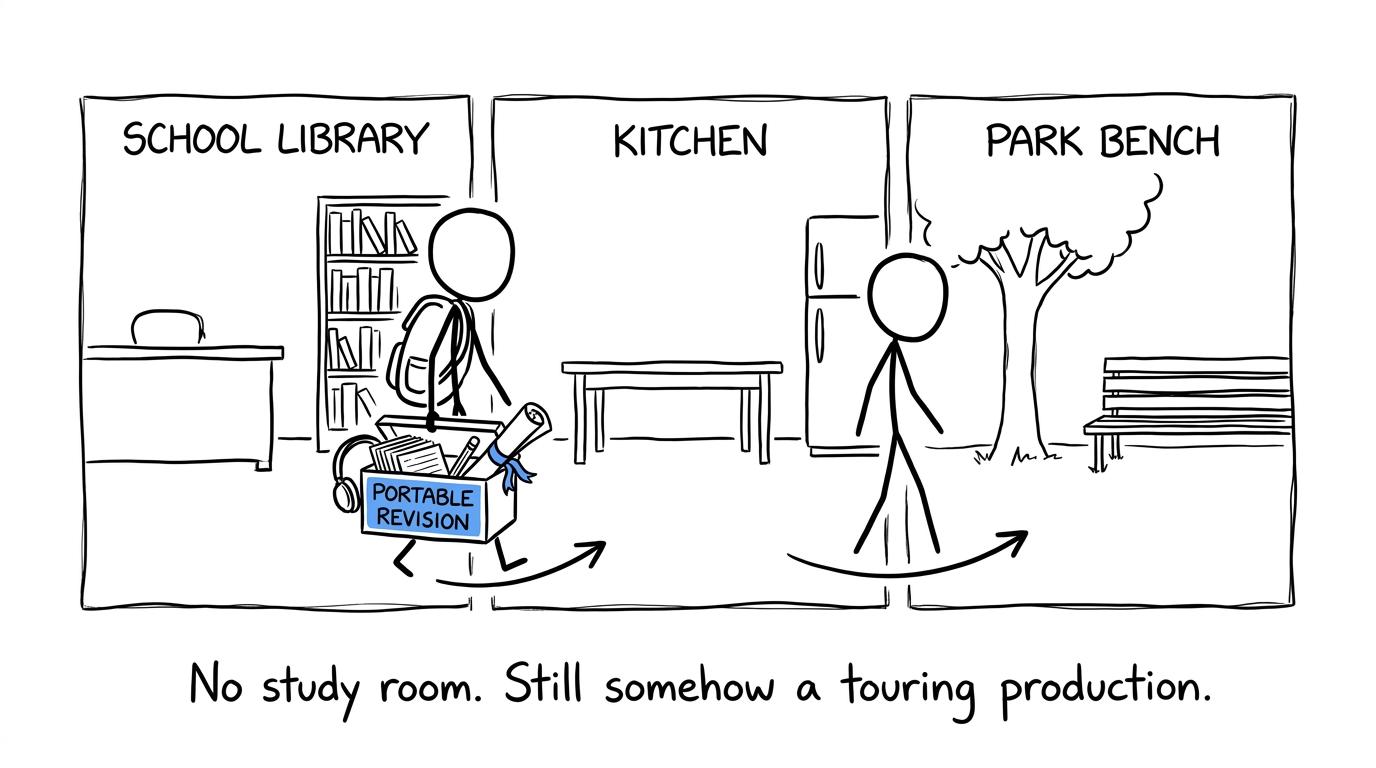 A student carries a portable revision toolbox between several study locations
Find quiet without assuming you can find it at home
Your first alternative should usually be school. Ask your Drama teacher, form tutor, librarian or pastoral team whether there is a supervised room available before lessons, during lunchtime or after school. Schools differ, so ask rather than assuming a room will be open.
A local public library may also offer desks or bookable areas. Check its current opening times, age requirements and rules before travelling. Libraries are suitable for scripts, planning and written practice, but spoken rehearsal may not be permitted.
Other realistic possibilities include a trusted relative's home, a community study session or an agreed period in a shared room before other people need it. Choose places that are safe, permitted and practical. Do not remain alone in a school or community building without an authorised arrangement.
If leaving home is difficult, negotiate a small window rather than requesting total silence all evening. A clear request, “Could I have the table from 6:306{:}306:30 to 7:007{:}007:00 for one timed response?” is easier for other people to understand than “I need everyone to be quiet”.
Revise performance without a rehearsal room
Drama is physical and collaborative, so silent revision cannot replace proper group rehearsal. It can, however, make rehearsal time more productive.
Use reduced-scale rehearsal
Mark movements with your hands, walk a shortened version of the blocking or use objects to represent performers. Concentrate on intention: where does your focus move, why does your character change position, and what should the audience understand?
You can rehearse posture, facial expression and gesture silently. For vocal choices, annotate pace, pause, pitch, tone and emphasis, then test them later in an appropriate space. Avoid repeatedly whispering forcefully, which can strain your voice.
Prepare before meeting your group
Group rehearsal becomes frustrating when everyone arrives needing to rediscover the scene. Beforehand, review:
- your lines and cues;
- the purpose of the scene;
- agreed blocking;
- transitions and entrances;
- moments requiring precise timing;
- feedback from your teacher.
Use scheduled school rehearsal for interaction, spacing and vocal projection, the things that are hardest to reproduce at home. Use noisy home time for preparation around those moments.
 Two students silently rehearse with enormous commitment in a library
Prepare for the written Drama assessment actively
The exact written assessment varies by exam board, but students may need to explain performance or design choices, analyse a set text and evaluate live theatre. Confirm your required texts, command words and assessment objectives with your teacher.
Rereading feels productive because the material looks familiar. The exam, however, asks you to retrieve and apply ideas without the comfort of a highlighted page.
Better quiet-space revision includes:
- Closing the text and reconstructing a scene from memory.
- Turning teacher feedback into a checklist of corrections.
- Planning answers before writing them in full.
- Linking each performance or design choice to its intended audience effect.
- Recalling precise moments from live theatre rather than memorising a generic review.
- Using mark schemes and examiner guidance supplied by your board or teacher.
When concentration is limited, separate planning from writing. You might select evidence and organise ideas during a noisy afternoon, then use a short school study session to produce the response. That is not a compromise in quality. It is sensible task design.
Balance Drama revision with GCSE maths
Students preparing for Drama are rarely preparing for Drama alone. Noise can make the whole timetable feel unstable, especially when maths also requires written practice and careful checking.
Keep one revision plan covering every subject. If you need to diagnose your maths priorities, the GCSE Maths topics by exam board and tier guide can help you distinguish Foundation and Higher content. Then use short MathsGenie revision lessons and practice questions rather than spending scarce quiet time searching for materials.
Full papers need more sustained attention. When you have access to a suitable school or library session, try an Edexcel GCSE Maths past paper or the corresponding paper for your board. The guide to using Edexcel past papers properly explains the useful cycle: complete, mark, diagnose and repair.
If your maths tier is still being discussed, read the Foundation versus Higher maths guide and speak to your teacher. Nearer the exam, a focused GCSE maths night-before plan is safer than trying to recover an entire course in one noisy evening.
The principle is the same in both subjects: use feedback to choose the next task. In Drama, that might mean making an audience effect more specific. In maths, it might mean returning to a topic lesson after losing method marks.
Common mistakes when revising in a noisy home
Waiting for perfect silence
Perfect conditions may never arrive. Identify the smallest useful action you can complete under current conditions, then schedule demanding work somewhere more suitable.
Trying to write through constant interruption
Repeatedly restarting an analytical answer wastes attention. Switch to cue cards, annotation or organisation, and protect another period for writing.
Treating headphones as the whole solution
Headphones may soften distraction, but loud audio can become another distraction. Keep the volume safe and choose a different location when the task requires sustained concentration.
Revising performance only by reading
Drama choices involve voice, body, space and interaction. Use silent physical rehearsal at home, but arrange proper practical rehearsal through school when possible.
Ignoring the exact specification
AQA, Pearson Edexcel, OCR and Eduqas do not label or organise every component identically. Use your teacher's instructions and the current specification for your course rather than copying another student's checklist.
Filling every quiet moment with one subject
A forthcoming performance can feel urgent, but maths and other written exams still need regular practice. A shared timetable prevents the loudest deadline from taking every available session.
Progress does not require a perfect room
A calm room makes revision easier. Its absence does not make revision impossible.
Sort Drama tasks by the concentration they need. Carry a small set of ready-to-use materials. Ask school for supervised rehearsal and study opportunities. Use busy periods for recall, annotation and preparation, then spend quieter windows on timed responses and precise rehearsal.
For the maths part of your GCSE timetable, MathsGenie removes another source of friction. Open a revision lesson, answer the practice questions, use mini tests to check a topic, and build towards past papers and predicted papers. Mark schemes and video solutions then show you what to repair.
Start with one practical action today: prepare your portable Drama kit, ask about a school study space, or choose your next maths topic. A workable routine in an imperfect space is more valuable than a perfect plan that never begins.











