Review Mock Mistakes GCSE English Language and Literature
Review mock mistakes GCSE English Language and Literature: learn when to check feedback, what delay costs, and how to turn errors into stronger answers.
A mock paper can feel strangely heavier after it has been marked. Before marking, it was only a test. Afterwards, it appears to contain a judgement about what you know, how well you write and where your final grade might be heading.
If you want to review mock mistakes GCSE English Language and Literature effectively, the best approach is not to choose between reviewing immediately and waiting several days. Do a short first review as soon as useful feedback is available, make one or two corrections, then return to the same weaknesses after a short delay without relying on your notes.
That combination matters. Immediate review catches misunderstandings while the decisions you made are still familiar. Delayed review tests whether the correction has genuinely become usable knowledge. Waiting is not automatically harmful, but waiting without a planned return usually turns feedback into forgotten paperwork.
The quick answer
Use this sequence after an English Language or Literature mock:
- Pause briefly if you are upset or exhausted. A calm review is more useful than an immediate emotional one.
- Review the paper that day or within roughly 242424 hours of receiving feedback. Identify why marks were lost.
- Correct a small number of important errors. Focus on causes, not every red mark.
- Revisit the skill after 222 or 333 days. Attempt a fresh paragraph, plan or question without copying your correction.
- Check it again about a week later. If the same weakness returns, it belongs in your revision plan.
The principle also transfers directly to maths: mark the attempt, diagnose the error, learn the missing method and then re-test it later. MathsGenie's guide to finding your weakest GCSE topics explains how to turn lost marks into targeted revision rather than vague worry.
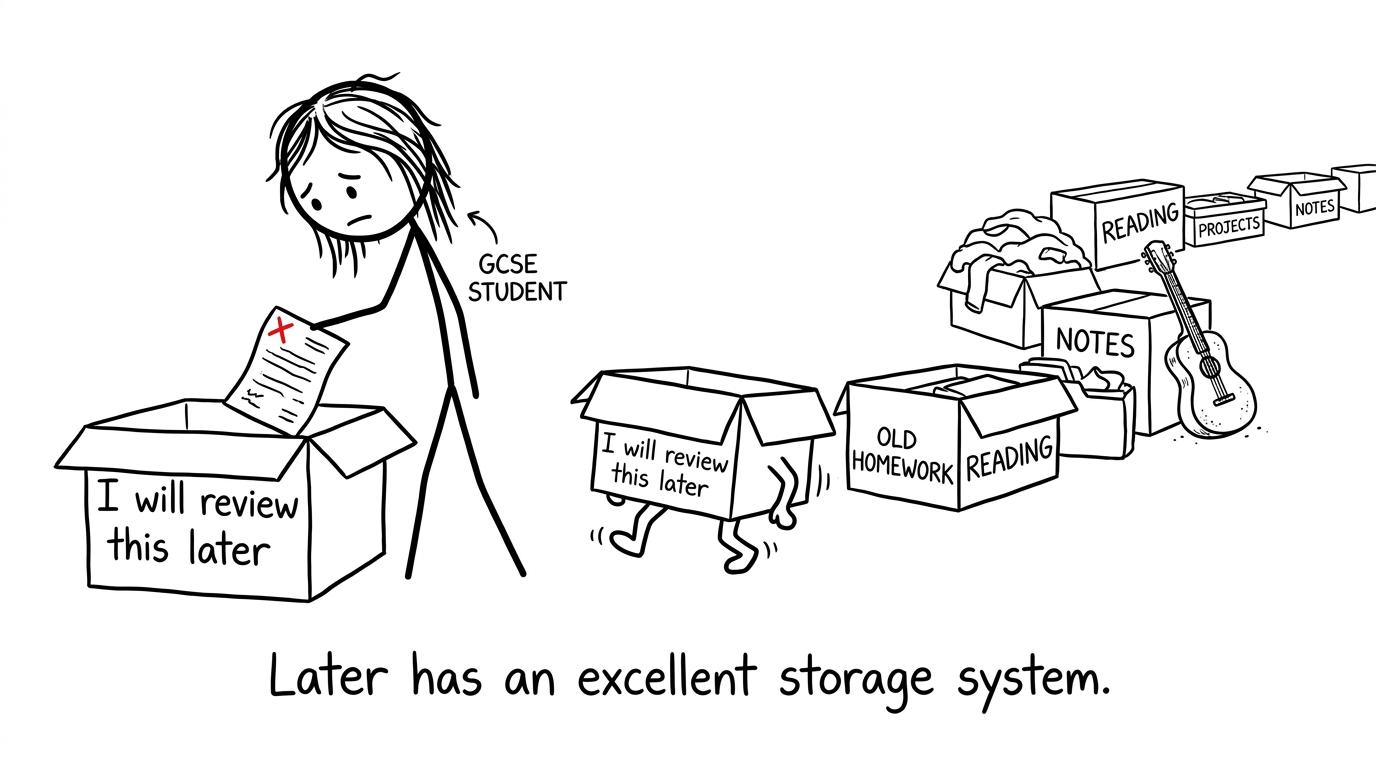 A student discovers that later has an excellent storage system
Why reviewing mock mistakes immediately helps
Immediately does not have to mean the moment you put down your pen. In most schools, you cannot review accurately until you receive the marked script, teacher comments or mark scheme. It means reviewing promptly once that evidence is available.
At that point, you may still remember why you selected a quotation, abandoned a paragraph or rushed the final question. That memory helps you distinguish between several very different problems:
- you did not know the relevant content;
- you misunderstood the question;
- you knew the idea but did not explain it;
- you used evidence without analysing it;
- you spent too long on an earlier section;
- you lacked technical accuracy;
- you did not understand what the assessment objective required.
These causes need different remedies. Rereading a novel will not necessarily fix weak analysis. Memorising more quotations will not solve poor time management. Completing another whole paper may simply reproduce the same habit.
Educational evidence does not support one rigid feedback time for every task and learner. The Education Endowment Foundation reports that feedback can be effective during learning, immediately afterwards or after a short delay. Its guidance emphasises something more important than speed: feedback should be specific, actionable and capable of moving learning forward.
So the value of an early review is not that every correction must be completed instantly. It is that you identify the real gap before the paper disappears into a folder.
Why waiting a few days can still be useful
A delay has one genuine advantage: it creates a test of memory and independence.
If you rewrite a paragraph while your teacher's model is beside you, the improved version may look convincing. But you have not yet shown that you can reproduce the better decision alone. Returning after several days forces you to retrieve the strategy rather than recognise it on the page.
That is why retrieval practice is more than rereading. It asks you to bring knowledge back without being shown it first. Research reviews have found retrieval practice useful across subjects and classroom settings, although the precise timing is less important than making retrieval happen and giving corrective feedback.
A short delay can also help when a disappointing result has made careful thinking difficult. The goal is not to punish yourself with instant analysis. Take the evening if necessary, but schedule the review before stepping away.
The distinction is simple:
- planned delay creates retrieval and perspective;
- unplanned delay creates avoidance and lost revision time.
What does the delay actually cost?
There is no honest formula saying that each delayed day costs a fixed number of marks. Mock papers, feedback quality and individual memory differ too much for that claim.
The cost is practical rather than perfectly measurable.
You lose access to your original thinking
Several days later, you may see that an answer is weak but forget why you wrote it. Did you misunderstand the extract? Run out of time? Forget the quotation? Misread the command word? That missing context makes diagnosis less precise.
Misconceptions remain active
If you wrongly believe that naming a technique automatically counts as analysis, every new paragraph written before correction may rehearse the same shallow pattern. In maths, the equivalent would be repeatedly applying an incorrect procedure. Practice only helps when the method being practised is sound.
Your next revision choice becomes less informed
A mock is diagnostic evidence. Delaying its review means planning revision without using the freshest information available. You may revise comfortable topics while the weaknesses that cost marks remain untouched.
The available improvement window shrinks
Feedback only has value if there is time to act on it. A corrected Literature paragraph needs another attempt. A Language timing problem needs another timed section. A maths misconception needs targeted questions and a later re-test. The closer the next assessment becomes, the fewer complete correction cycles fit into your schedule.
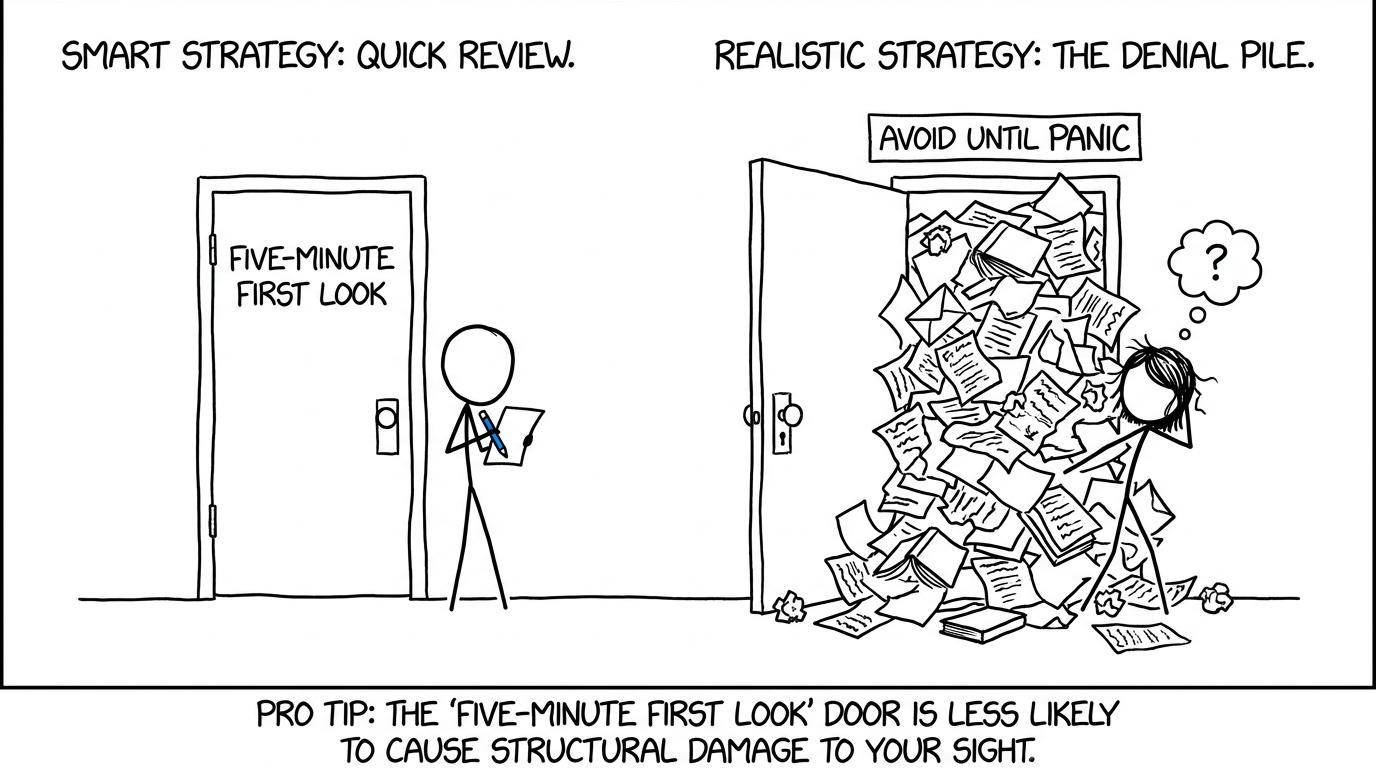 Two very different doors for dealing with mock feedback
A better two-stage review method
The strongest routine separates diagnosis from long-term checking.
The first review
Keep the first review focused. Record:
- the question or section;
- the assessment objective involved;
- what lost the marks;
- whether the cause was knowledge, interpretation, analysis, organisation, accuracy or timing;
- one specific action for the next attempt.
For English Language, relate feedback to the relevant reading or writing assessment objective in your current exam board specification. Depending on the task, this may involve selecting information, analysing language or structure, comparing perspectives, evaluating a text, organising writing or improving technical accuracy.
For English Literature, check whether the weakness concerns response and textual support, analysis of language, form and structure, contextual understanding or written accuracy where assessed. Edexcel, AQA, OCR and Eduqas papers differ in structure, so use the mark scheme for the paper you actually completed rather than a generic online checklist.
Do not copy the entire model answer. Write a short correction that changes the decision responsible for the lost marks.
The delayed return
After a few days, hide the correction and complete a fresh task that uses the same skill. This might be a new paragraph plan, an alternative extract annotation or a timed opening. Then compare it with the mark scheme, success criteria or teacher feedback.
For maths students balancing English with GCSE revision, the same cycle can be built using GCSE mini tests for diagnosis and the GCSE maths revision hub for focused lessons and practice. Once the skill improves, use GCSE past papers to test it under more realistic pressure.
Turn feedback into a revision priority
A mock mark is the headline. The pattern underneath it is more valuable.
One weak answer may be an isolated lapse. The same problem appearing across several questions is a revision priority. Keep a compact mistake log and group errors by cause rather than merely listing question numbers.
| Error pattern | Useful next action |
|---|---|
| Misread question | Underline the task focus and paraphrase it before planning |
| Thin analysis | Explain how the writer's choice creates meaning or effect |
| Unsupported interpretation | Select precise textual evidence before developing the point |
| Weak organisation | Plan the sequence and purpose of paragraphs before writing |
| Technical inaccuracy | Edit a short section specifically for sentences, spelling and punctuation |
| Poor timing | Complete a comparable section with a visible time limit |
Your log should lead to action. If it only records what went wrong, it becomes another description of the past.
MathsGenie's twenty-minute GCSE revision routine uses the same logic: attempt, mark, record a specific fix and choose the next micro-topic. When exams are approaching, a one-month maths revision plan can help you schedule those correction and re-test cycles alongside English preparation.
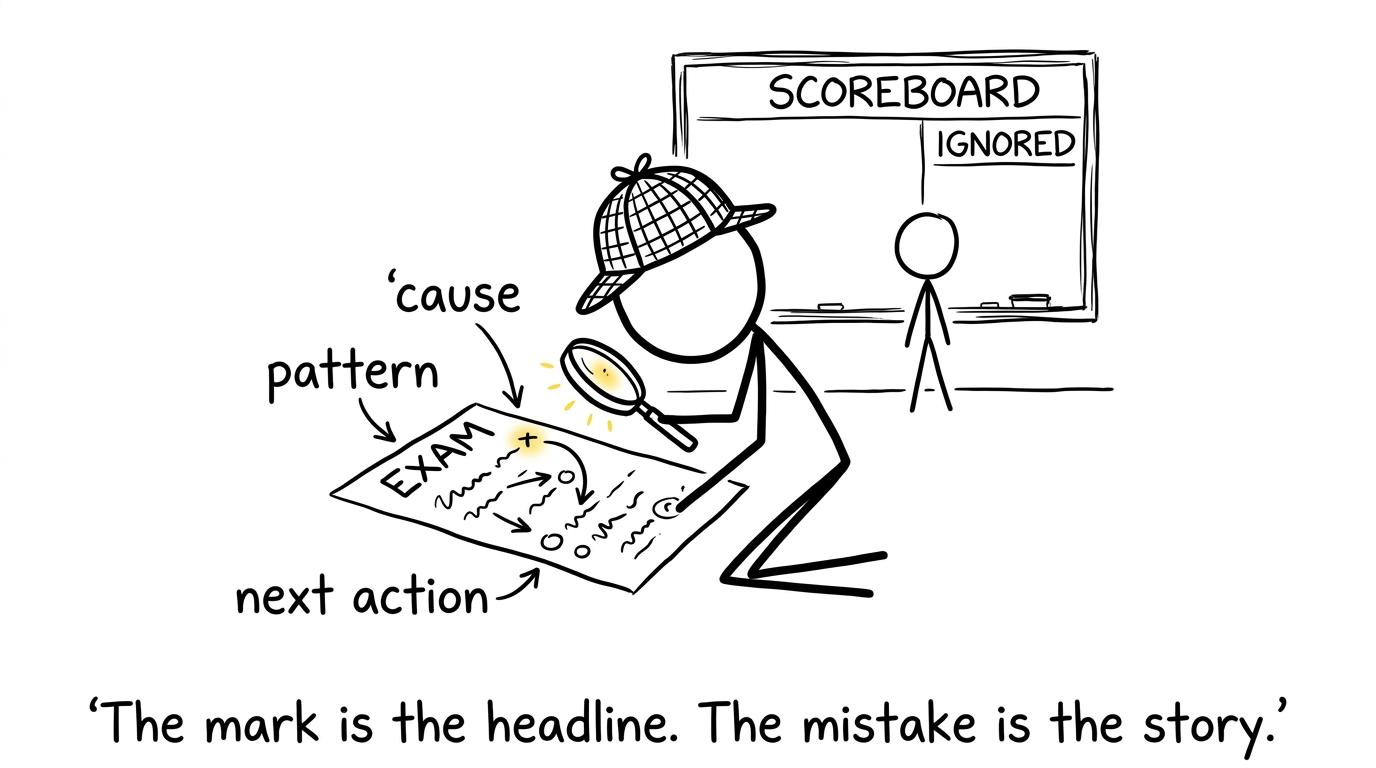 A student detective investigates the story behind a mock mark
Common mistakes when reviewing mocks
Looking only at the total mark
A total tells you the outcome, not the cause. Two students with the same mark may need completely different revision. Examine where marks were lost and what behaviour produced the loss.
Correcting everything in one exhausting session
A paper covered in annotations can create the illusion of improvement. Select the most repeated or costly patterns first. A few corrections that change future performance are more useful than rewriting every answer mechanically.
Reading feedback without producing anything
Feedback becomes useful when it changes an action. After reading it, revise a plan, improve a paragraph, complete a focused task or explain the new strategy from memory.
Waiting until you feel motivated
Motivation is unreliable scheduling software. Choose a date and a short task before closing the paper. Even a brief first review prevents indefinite delay.
Reattempting the identical answer from memory
Repeating the same question can test whether you remember the correction rather than whether the skill transfers. After the initial correction, use a different question requiring the same assessment objective.
Treating the mark scheme as a script
English mark schemes describe qualities and possible content; they are not lists of sentences every candidate must reproduce. Use them to understand what is rewarded, while checking teacher guidance for the specific paper. In maths, mark schemes similarly reveal method and accuracy marks, while video solutions can clarify how a complete method develops.
The best rule is review now, retrieve later
You do not need to choose between immediate feedback and delayed practice. They solve different problems.
Review promptly to preserve the evidence: what you thought, what went wrong and what needs to change. Then wait briefly and attempt a fresh task without support. The first stage creates a correction. The second shows whether that correction can survive on its own.
That is also the rhythm of effective maths revision. Start with free GCSE maths revision lessons, practise the weak skill, use mini tests to check recall, and then move to past papers. For an exam-style review process, follow MathsGenie's guide to using GCSE maths past papers properly.
Do not let a mock become a verdict stored in a drawer. Let it become a map. Open MathsGenie, choose the topic your evidence says matters, and use revision lessons, practice questions, mark schemes, video solutions, mini tests, past papers and predicted papers to complete the next improvement cycle.