Reset After Bad Week GCSE Further Maths: A Plan
Reset after bad week GCSE Further Maths with a calm seven-day plan using short sessions, mistake logs, focused practice, mark schemes and past papers.
A bad revision week can feel larger than it is. A few missed sessions become a story about being behind; one difficult algebra question begins to look like evidence that you have forgotten everything.
If your search was “reset after bad week GCSE Further Maths”, the answer is simple: do not try to repay the missed week in one heroic evening. Reset with one short diagnostic, choose two priority topics, complete a manageable session today, and build back towards exam questions over the next seven days.
The aim is not to catch up with an imaginary perfect timetable. It is to restore a repeatable routine.
Your GCSE Further Maths reset checklist
Use this checklist before building another revision plan:
- Accept that the missed week has finished.
- Check the exact qualification and specification you are taking.
- Complete a short, low-pressure diagnostic.
- Separate method gaps from careless errors and timing problems.
- Choose no more than two priority topics.
- Restart with a session of 202020 to 303030 minutes.
- Mark your work and record why each mark was lost.
- Revisit the same skills later in the week.
- Attempt a timed section only after rebuilding some fluency.
- Protect sleep rather than attempting an all-night catch-up.
You can begin from the AQA GCSE Further Maths revision hub, where lessons, questions and paper resources are organised in one place.
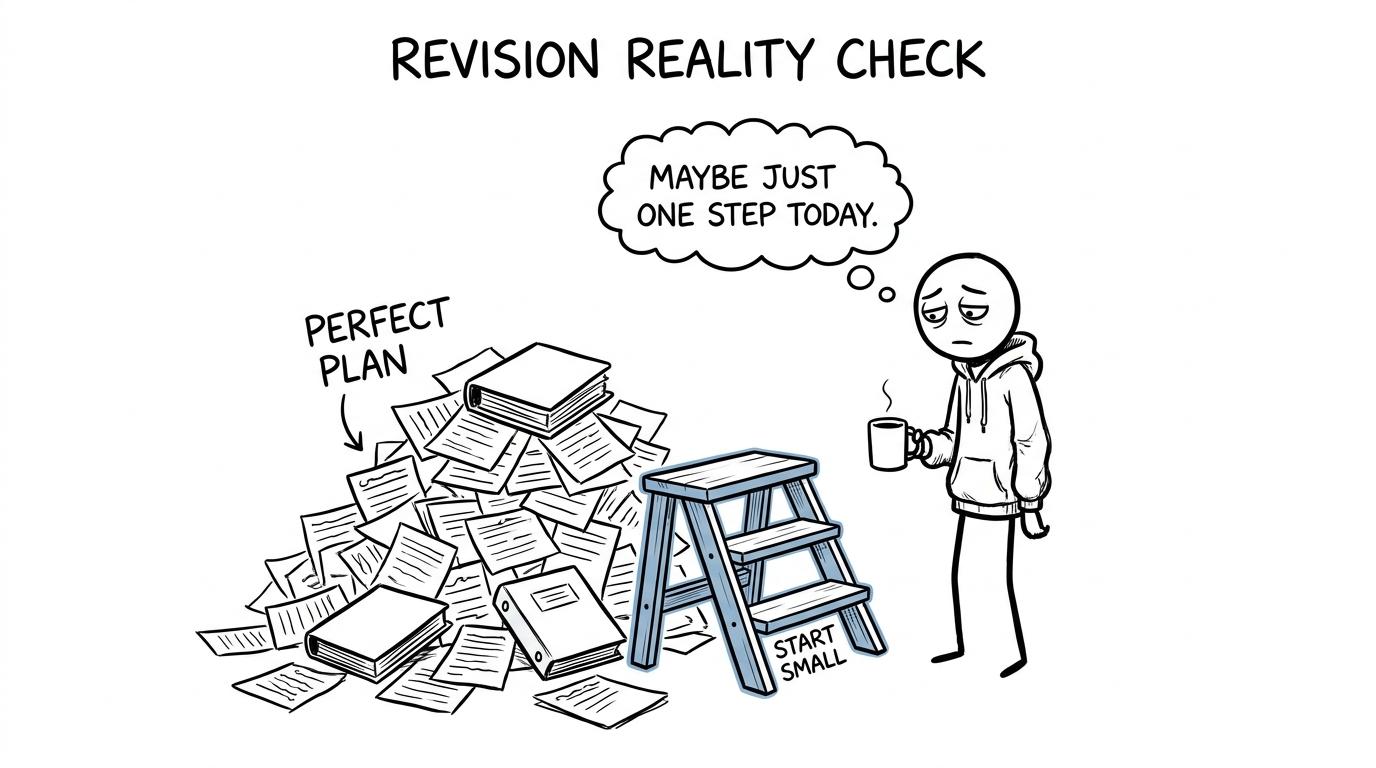 A collapsed perfect revision plan beside a small sturdy starting step
Start with facts, not the feeling of being behind
“Behind” is a feeling, not a useful topic label. It does not tell you what to revise next.
Begin by writing down what actually happened. Perhaps schoolwork took longer than expected, you were unwell, or your plan required more energy than you had. This is not an excuse-making exercise. It is how you avoid rebuilding the same fragile plan.
Then check your course. GCSE Further Maths can refer to different Level 222 qualifications, so use the specification named by your school. MathsGenie’s dedicated Further Maths area currently supports AQA. The official AQA Level 222 Certificate in Further Mathematics specification includes number, algebra, coordinate geometry, calculus, matrix transformations and geometry.
For AQA, the qualification is untiered. It has two papers: Paper 111 is non-calculator and Paper 222 is calculator. Each paper lasts 111 hour 454545 minutes, carries 808080 marks and may assess content from across the specification. That matters because a reset plan should not quietly ignore an entire topic area.
Ordinary GCSE Maths is different: students follow foundation or higher tier and may sit Edexcel, AQA, OCR, Eduqas or another board. If weaknesses in core GCSE skills are blocking Further Maths, use the correct board resources in the GCSE Maths revision hub alongside your Further Maths work.
Run a short diagnostic before making a timetable
A new timetable feels productive because it is neat. A diagnostic is more valuable because it gives you evidence.
Choose a small set of Further Maths questions that covers several skills. Keep it short enough to finish and mark in one sitting. This is not the moment for a complete paper if your confidence and routine have both taken a knock.
For every lost mark, assign one label:
- Knowledge: you did not know the required fact, notation or rule.
- Method: you recognised the topic but could not organise the steps.
- Accuracy: the approach was sound, but algebra, signs or arithmetic failed.
- Interpretation: you misunderstood what the question required.
- Timing: you could probably finish with more time.
This turns “calculus went badly” into something actionable, such as “I cannot recall the differentiation rule” or “I find the derivative but do not answer the question about the gradient”.
A simple priority measure is:
priority score=marks lost+number of repeated errors.\text{priority score}=\text{marks lost}+\text{number of repeated errors}.priority score=marks lost+number of repeated errors.It is not an exam formula. It is merely a way to stop confidence choosing your topics for you. The guide to finding your weakest GCSE topics offers a fuller diagnostic process that can also support the underlying GCSE skills needed in Further Maths.
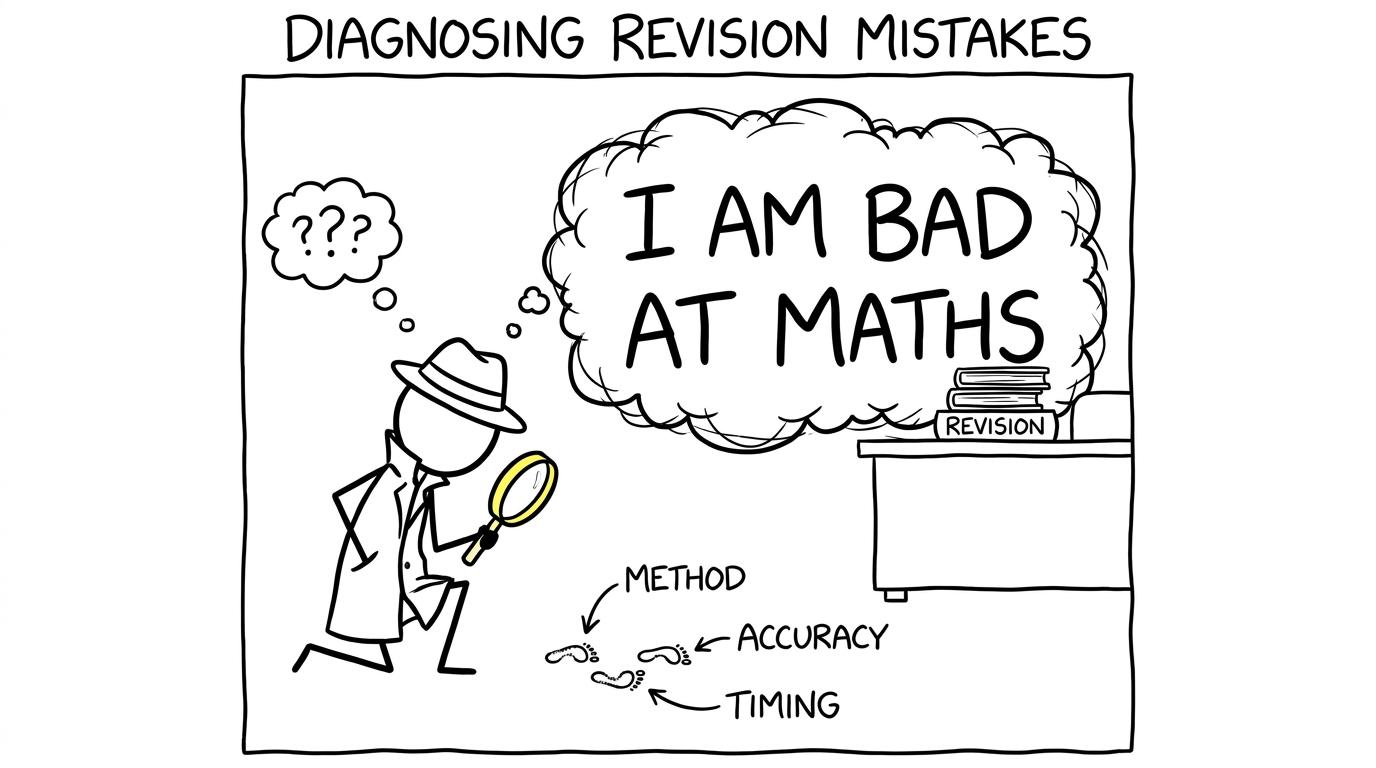 A revision detective follows useful error clues instead of a dramatic confidence cloud
Choose two repairs, not the entire specification
After a poor week, students often create a list containing every topic they have ever found difficult. The list becomes so large that starting feels pointless.
Choose two repairs instead:
- one topic causing substantial mark loss;
- one topic that can provide an achievable return to success.
The first moves your preparation forwards. The second restores the habit of completing work accurately.
Make each target narrow. “Algebra” is too broad. Depending on your specification and diagnostic, a useful target might be rearranging expressions accurately, using the factor theorem, manipulating surds, interpreting matrix transformations or connecting differentiation to gradients.
Your target should describe an observable action:
Complete a short set without notes, mark it, explain each error, then attempt a different set later.
That is stronger than “revise matrices” because it defines what completion looks like.
Use a seven-day GCSE Further Maths reset plan
This plan is deliberately modest. Adjust it around lessons, homework and your exam date, but preserve the sequence: diagnose, repair, retrieve and test.
The first evening: restart gently
Spend 202020 to 303030 minutes on your diagnostic and mistake labels. Stop once you have selected your two priorities and prepared the resource for tomorrow.
If even that feels difficult, follow the 20-minute GCSE maths revision routine. A small completed session is more useful than a two-hour plan that never begins.
Days two and three: rebuild one method
Use a MathsGenie revision lesson or video to refresh the method, then close the explanation and answer questions independently. The MathsGenie lessons library is useful when you need to see a process explained before practising it.
A balanced session can be expressed as:
30 minutes=8 minutes reviewing+17 minutes practising+5 minutes marking.30\text{ minutes}=8\text{ minutes reviewing}+17\text{ minutes practising}+5\text{ minutes marking}.30 minutes=8 minutes reviewing+17 minutes practising+5 minutes marking.The exact split is less important than including independent questions and feedback. Educational evidence on retrieval practice stresses the value of actively trying to remember, followed by feedback. Reading a solution can support understanding, but it does not show that you can reproduce the method alone.
Day four: retrieve without support
Return to the first priority topic without opening your notes. Write down the relevant facts, steps or diagrams from memory, then complete a few fresh questions.
Record whether each earlier error has disappeared, changed or remained. Planning, monitoring and evaluating your own learning are central parts of effective self-regulated revision. In practical terms, ask:
- What was I trying to improve?
- What can I now do without help?
- Which error still costs marks?
- What should the next question set test?
Day five: repair the second topic
Repeat the learn-practise-mark process with your second priority. Keep the first topic alive with one or two retrieval questions rather than abandoning it entirely.
This spacing matters because a method that feels clear immediately after watching a video may be harder to recall later. Delayed retrieval gives you a more honest test.
The weekend: add controlled exam pressure
Complete a timed section from the AQA GCSE Further Maths past papers. Choose questions that include your repaired topics, or attempt a manageable section rather than forcing a full paper too soon.
Mark it strictly. Use the mark scheme to see where marks are awarded, then correct your working without copying. Video solutions can help when the mark scheme is too compressed to explain the reasoning.
Full papers have an important place, but timing matters. The guide to starting GCSE past papers explains how shorter tests and paper sections can lead into complete timed practice.
Build a routine that survives ordinary life
The best reset is not the most ambitious one. It is the one that can survive another busy Wednesday.
Set a minimum session that still counts on a difficult day. That might be:
- one retrieval task;
- a few exam-style questions;
- immediate marking;
- one written action for next time.
On better days, do more. On difficult days, protect the minimum. This avoids the all-or-nothing cycle in which missing a long session appears to invalidate the entire week.
Keep resources easy to reach. Decide the topic and open the relevant page before the session begins. If you need a broader structure around Further Maths and your main GCSE Maths course, adapt the one-month GCSE maths revision plan rather than constructing a complicated system from scratch.
Sleep also belongs in a serious revision plan. NHS guidance says most teenagers need around 888 to 101010 hours a night and warns that all-night cramming is usually a poor strategy. A stopped session can be continued tomorrow. An exhausted exam brain is harder to repair.
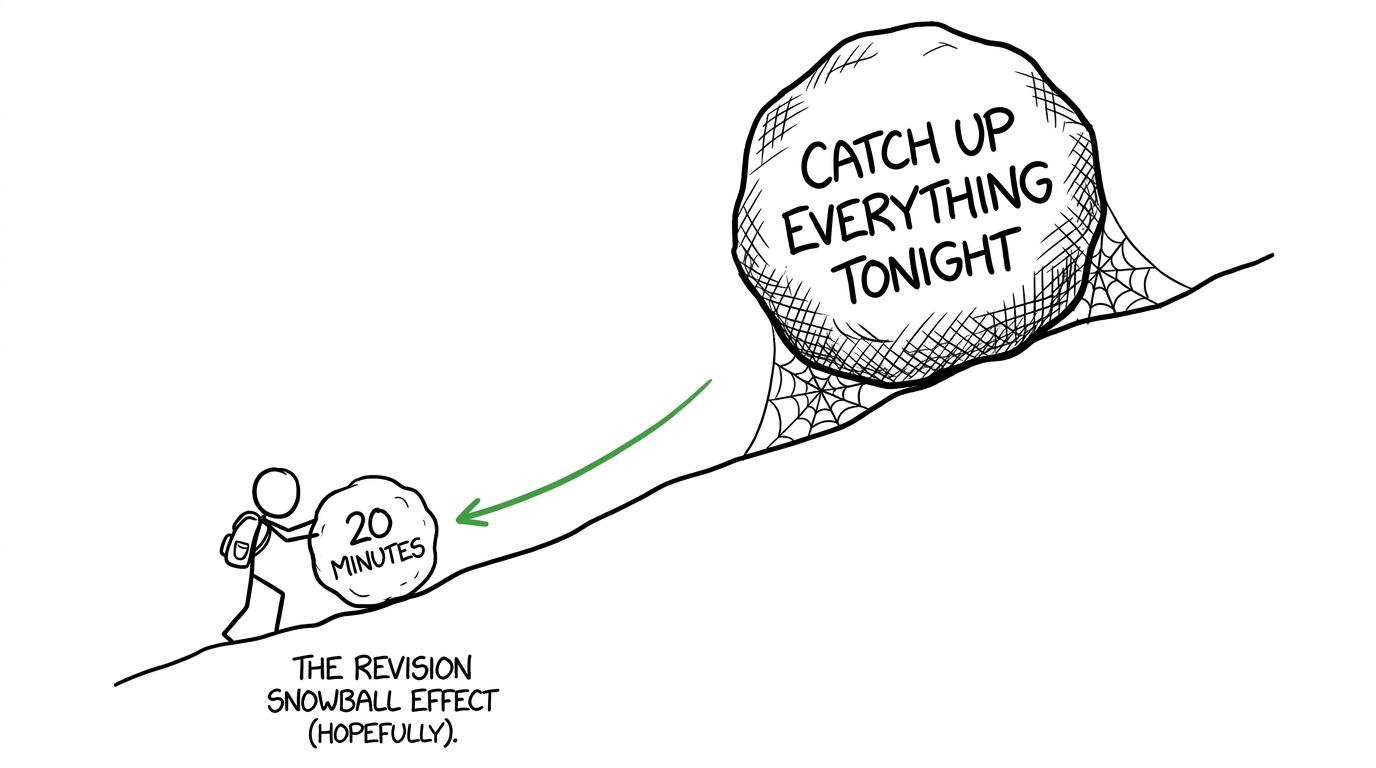 A small revision snowball begins moving while an impossible catch-up boulder remains stuck
Common mistakes when resetting Further Maths revision
Trying to recover every missed hour
Missed revision is not debt with interest. Adding last week’s sessions to this week usually creates another impossible plan. Recover the most important learning, not every minute.
Starting with a full paper to punish yourself
A paper should collect evidence or rehearse exam conditions. It should not be a penalty. Begin with focused questions if a full paper would only confirm that your routine is rusty.
Revising only comfortable topics
Confidence matters, but comfort cannot choose the whole plan. Pair one confidence-building topic with one high-priority weakness.
Watching solutions without independent practice
A clear video can make a method feel familiar. Familiarity is not the same as recall. Close the explanation, answer a fresh question and then mark it.
Recording scores but not causes
A score tells you how the attempt went. An error label tells you what to do next. Keep a short marks-leak list containing the topic, cause and planned repair.
Ignoring the main GCSE Maths foundations
Further Maths extends familiar algebra, geometry and graphical reasoning. If manipulation of fractions, quadratics or equations is unstable, repair that foundation through MathsGenie’s GCSE resources rather than repeatedly struggling with the extension topic.
Your next session is the reset
A bad week does not need a dramatic comeback. It needs one completed loop:
diagnose⟶practise⟶mark⟶correct⟶retest.\text{diagnose}\longrightarrow\text{practise}\longrightarrow\text{mark}\longrightarrow\text{correct}\longrightarrow\text{retest}.diagnose⟶practise⟶mark⟶correct⟶retest.Open the AQA GCSE Further Maths revision hub, choose one narrow topic and begin with a short session today. Then use MathsGenie’s free revision lessons, practice questions, mark schemes and video solutions to repair the gaps. As your routine returns, add past papers and predicted papers to develop timing, accuracy and exam confidence.
You do not have to rescue the whole term tonight. You only have to make the next revision session useful.