

Remote Learning and GCSE Astronomy Results
Remote learning GCSE astronomy results explained: what Pearson data reveals about school closures, grading changes and practical revision for today's exams.
There is a tempting story about school closures: lessons moved online, practical work became harder, and GCSE results fell. But the evidence is more complicated. The remote learning GCSE astronomy results data does not show a simple before-and-after collapse. It shows disrupted teaching, cancelled summer exams, temporary grading arrangements and, eventually, a return to normal assessment.
The clearest conclusion is that remote learning probably weakened some students' mathematical and observational preparation, but published grade outcomes cannot isolate its effect. GCSE Astronomy results were also shaped by changing grading policies and different cohorts. By 2023, outcomes were close to their 2019 profile, while the proportions achieving higher grades rose in 2024 and 2025.
The evidence at a glance
- Normal summer GCSE examinations were cancelled in 2020 and 2021.
- Centre-assessed grades were used in 2020, followed by teacher-assessed grades in 2021.
- Ofqual's research found widespread disruption, with maths and practical skills among the areas reported as most affected.
- Written examinations returned in 2022, but grading was deliberately more generous than before the pandemic.
- Pre-pandemic grading standards broadly returned in 2023, with protection for the disrupted cohort.
- Pearson's subject statistics show no lasting collapse in GCSE Astronomy grade outcomes through 2025.
- Results alone cannot prove how much remote learning caused because assessment, grading and candidate groups changed.
What happened to GCSE Astronomy during school closures?
GCSE Astronomy is unusually exposed to disruption. It combines scientific knowledge with calculations, graphs, geometry and observational work. A recorded lesson can explain the orbit of a planet, but it cannot guarantee clear skies, access to a telescope or immediate feedback while a student configures equipment.
The current Pearson Edexcel GCSE Astronomy specification is non-tiered. It has two externally examined papers: Naked-eye Astronomy and Telescopic Astronomy. Each paper lasts 111 hour 454545 minutes, is worth 100100100 marks and contributes 50%50\%50% of the qualification. Students must also undertake at least one aided and one unaided observation, with their observational understanding assessed in the written papers.
During the public-health restrictions, temporary regulatory arrangements allowed observational work to be observed or completed through virtual or simulated means when normal activity was impossible. That preserved access to the qualification, but it was not identical to repeatedly planning, conducting and evaluating observations in ordinary conditions.
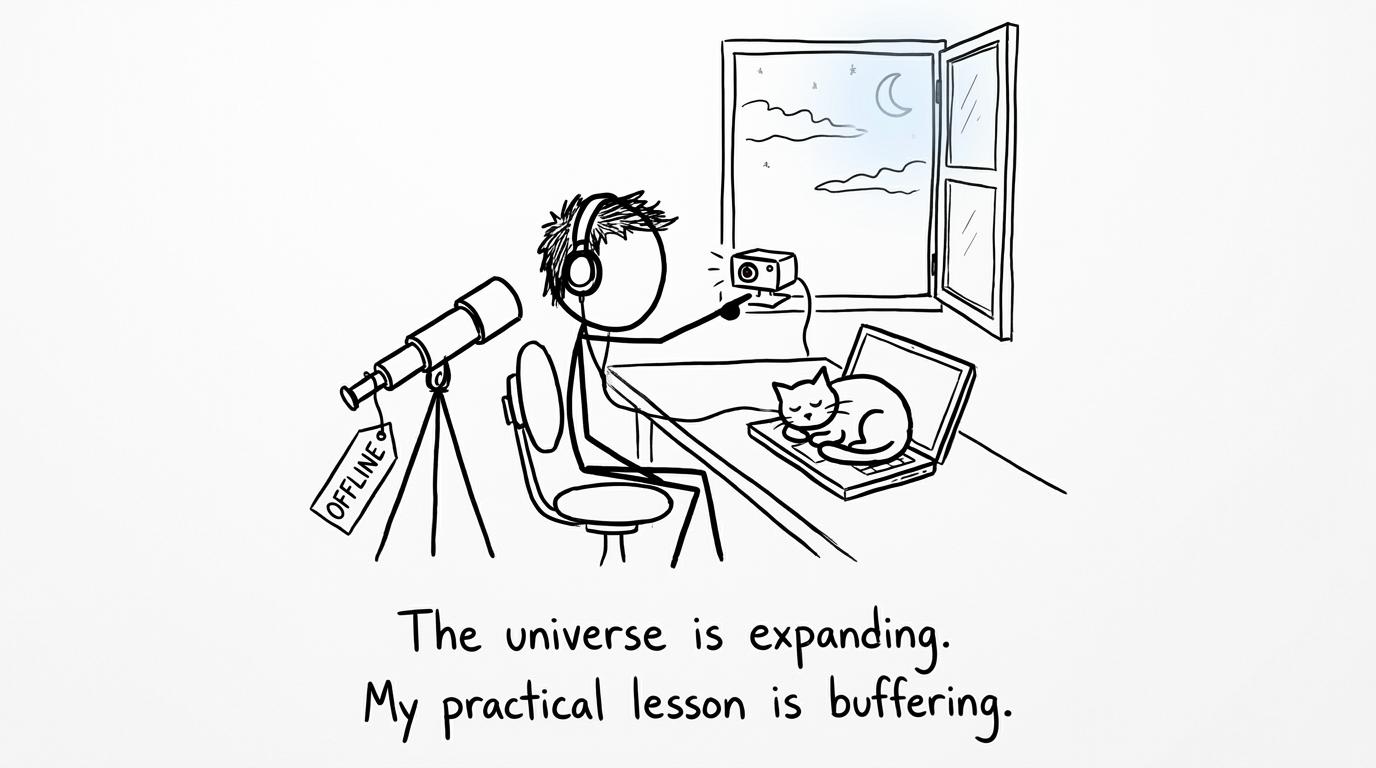 A remote astronomy lesson encounters clouds, buffering and a determined cat
Ofqual's review of learning during the pandemic found that most students experienced some disruption. Teachers particularly reported gaps in maths, literacy and practical skills. The review also stressed that experiences varied greatly: remote provision improved during the later closure period, and some students adapted more successfully than others.
That variation matters. There was no single remote-learning experience shared by every GCSE Astronomy candidate.
What the GCSE Astronomy results data shows
The following figures come from Pearson's final grade statistics for its GCSE Astronomy qualification. Percentages are cumulative, so the grade 777 column means the proportion receiving grade 777 or above.
| Summer series | Candidates | Grade 777 or above | Grade 444 or above | Assessment context |
|---|---|---|---|---|
| 2019 | Not shown here | 27.3%27.3\%27.3% | 75.6%75.6\%75.6% | Normal examinations |
| 2022 | 980980980 | 45.6%45.6\%45.6% | 85.5%85.5\%85.5% | Exams returned with transitional grading |
| 2023 | 118411841184 | 26.2%26.2\%26.2% | 75.2%75.2\%75.2% | Return to pre-pandemic grading, with protection |
| 2024 | 143814381438 | 28.7%28.7\%28.7% | 71.9%71.9\%71.9% | Normal exam-based assessment |
| 2025 | 138913891389 | 33.6%33.6\%33.6% | 73.7%73.7\%73.7% | Normal exam-based assessment |
The table tells three useful stories.
The 2022 rise was not proof that remote learning improved attainment
The proportion achieving grade 777 or above rose from 27.3%27.3\%27.3% in 2019 to 45.6%45.6\%45.6% in 2022. Read without context, that looks like a dramatic improvement.
However, Ofqual intentionally set 2022 grading at a transition point between the unusually high results of 2021 and pre-pandemic standards. Students also received assessment support as the normal examination system resumed. The 2022 figures therefore cannot be treated as a clean measurement of learning gained or lost during school closures.
Results returned close to the pre-pandemic pattern in 2023
In 2023, 26.2%26.2\%26.2% achieved grade 777 or above, compared with 27.3%27.3\%27.3% in 2019. At grade 444 or above, the figures were 75.2%75.2\%75.2% and 75.6%75.6\%75.6% respectively.
That does not prove that disruption had disappeared. Ofqual used prior-attainment evidence and protections when restoring pre-pandemic standards. It does show that the published outcome distribution did not settle into a prolonged post-pandemic decline.
Recent outcomes have been mixed but broadly resilient
The grade 444 rate fell to 71.9%71.9\%71.9% in 2024 before rising to 73.7%73.7\%73.7% in 2025. Meanwhile, grade 777 or above increased to 28.7%28.7\%28.7% and then 33.6%33.6\%33.6%.
These shifts may reflect exam difficulty, candidate characteristics, teaching and annual awarding decisions. They should not be assigned to one cause. What can be said is narrower but still encouraging: by 2025, GCSE Astronomy had not experienced the persistent results collapse that a simple remote-learning narrative might predict.
For the raw-mark context behind these grades, MathsGenie's GCSE Astronomy grade boundaries show how the thresholds changed between exam series.
Why the data cannot measure remote learning on its own
Results data describes outcomes. It does not automatically explain them.
First, the 2020 and 2021 grades were produced through different assessment systems. In 2020, centres submitted assessed grades; in 2021, teachers assigned grades using available evidence. Comparing those outcomes directly with written examination results would confuse changes in learning with changes in measurement.
Second, GCSE Astronomy has a relatively small and changing entry compared with subjects such as GCSE Maths. A shift among several schools or centres can therefore move the national percentages more noticeably.
Third, the candidates were not the same people each year. Differences in prior attainment, centre type, course delivery and voluntary subject choice can all affect outcomes.
Finally, grade boundaries are not fixed measures of question difficulty. Senior examiners set boundaries after reviewing students' work and statistical evidence. A higher boundary does not automatically mean teaching improved, just as a lower one does not automatically mean the paper was easier.
The responsible answer is therefore cautious: school closures disrupted learning conditions, but GCSE Astronomy grade statistics do not reveal a precise causal effect or a single number for marks lost.
What has changed since remote learning?
The emergency assessment period has ended. Full written examinations have returned, complete subject content is expected, and the usual observational requirements apply. GCSE Astronomy students now need to prepare for two substantial papers rather than assembling evidence for a teacher-assessed grade.
The mathematical demands are easy to underestimate. Questions can require scale, angular measurement, rearranging formulae, standard form, proportional reasoning, graphs and trigonometry. These skills are also valuable for students preparing for GCSE Maths and later A Level subjects.
MathsGenie can help you rebuild them systematically:
- Use the Edexcel GCSE Maths revision hub for board-aligned lessons and practice questions.
- Strengthen astronomical calculations with standard form revision.
- Review angles and ratios through the exact trigonometric values guide.
- Build timing with MathsGenie's past-paper platform, including mark schemes and selected worked solutions.
- Use GCSE predicted papers after repairing topic gaps, not as a replacement for full revision.
Your exam board for GCSE Maths may be Edexcel, AQA, OCR or Eduqas. Check the correct board and foundation or higher tier before choosing maths questions. GCSE Astronomy itself is non-tiered.
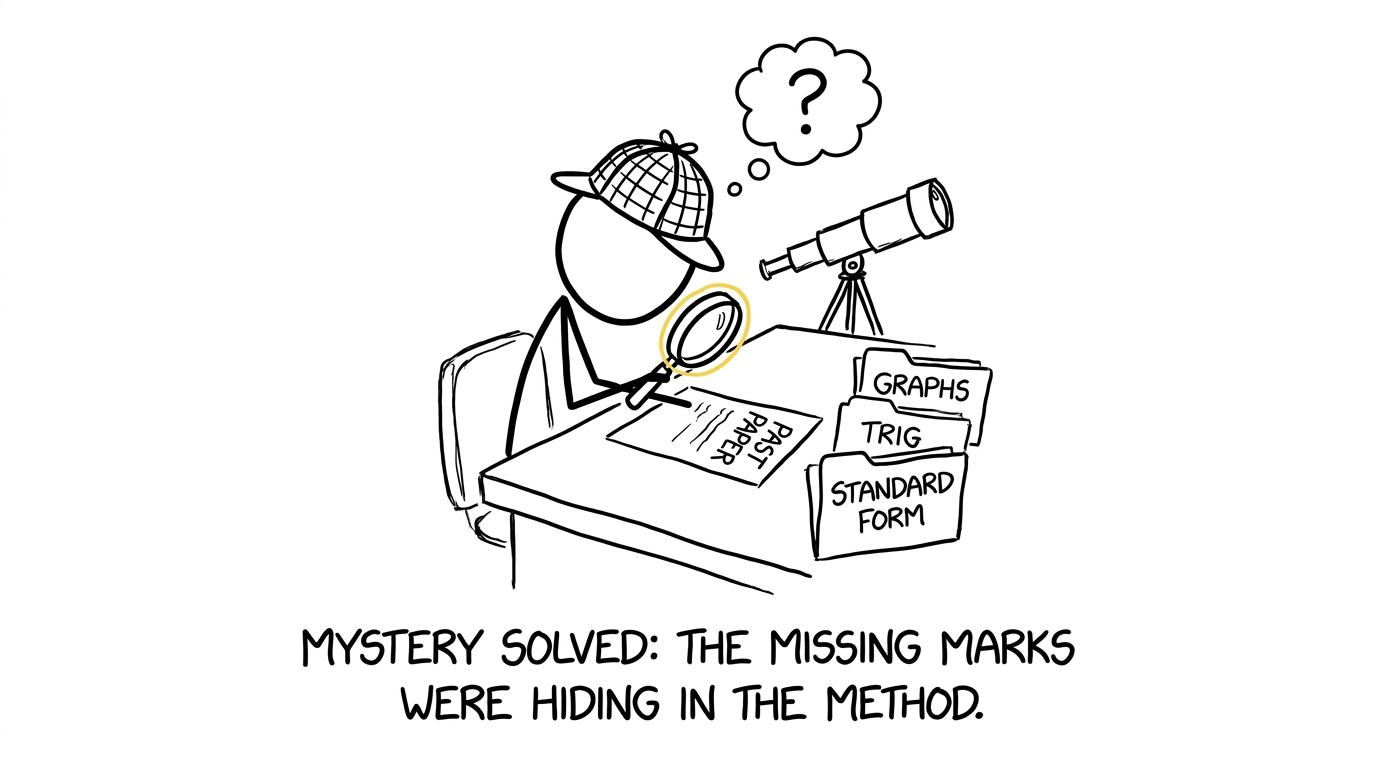 A GCSE revision detective discovers where the missing marks went
A practical revision response
Pandemic statistics describe a cohort. They do not decide your result. Your useful evidence is the work in front of you now.
Start with a short timed set and mark it honestly. Classify every lost mark as astronomy knowledge, mathematical method, observational reasoning, accuracy or exam technique. The guide to finding your weakest GCSE topics explains how to turn those errors into a focused plan.
Then use a simple cycle:
- relearn one method through a revision lesson;
- answer practice questions without notes;
- check the mark scheme and video solution;
- write one precise correction;
- retest the skill after a short gap;
- finish with mixed questions or a timed paper.
A realistic schedule matters more than an ambitious one that lasts three days. MathsGenie's GCSE maths revision timetable guide can help you balance topic repair, mini tests and paper practice.
Common mistakes when interpreting the results
Treating grades as direct measures of learning
Grades depend on assessment and awarding arrangements as well as what candidates know. The unusual 2022 profile must be read alongside transitional grading.
Comparing 2020 and 2021 directly with exam years
Those summer grades were not produced through normal written examinations. They belong to a different assessment context.
Assuming correlation proves causation
A result changing after school closures does not prove that closures caused the whole change. Cohort composition, grade boundaries and examination difficulty also matter.
Ignoring the practical side of Astronomy
Watching demonstrations is useful, but observation also involves planning, recording conditions, analysing data and evaluating limitations. Current candidates should understand the full observational cycle.
Revising Astronomy facts while neglecting maths
Knowing the science is not enough if graph reading, scale, units or formula manipulation costs marks. Diagnose mathematical weaknesses separately and practise them until the method is reliable.
The lesson for today's students
Remote learning affected the conditions in which GCSE Astronomy was taught, particularly access to practical experience and consistent mathematical support. Yet the results data does not show a simple or permanent fall. Once grading returned towards its pre-pandemic standard, 2023 outcomes resembled 2019, and the share achieving higher grades increased in the next two summer series.
The past deserves careful interpretation, not panic. Your next mark will be shaped more by what you practise now than by a national percentage from several years ago.
Make MathsGenie your revision base: learn with free revision lessons, repair gaps through practice questions and mini tests, then build exam confidence with past papers, mark schemes, video solutions and predicted papers. Attempt, mark, correct and return. That quiet loop is how uncertain preparation becomes dependable performance.










