How to Plan Revision Around a Saturday Job
How to plan revision around a Saturday job with a realistic weekly routine, focused sessions, recovery time and practical GCSE and A Level revision tips.

A Saturday job changes the shape of your week. It does not remove your chance of revising well.
Imagine a student called Sam. This is a hypothetical situation, but the tension is familiar. Sam works most Saturdays, has homework during the week and keeps looking at friends' revision timetables built around long weekend sessions. By Sunday evening, Sam feels behind before revision has even begun.
The answer to how to plan revision around a Saturday job is not to squeeze Saturday's missing hours into exhausted evenings. It is to treat work as a fixed commitment, protect recovery time and distribute short, purposeful sessions across the rest of the week.
Your practical revision checklist
A workable plan should:
- block out your job, travel, school and sleep first
- use shorter weekday sessions for focused topic revision
- reserve Sunday for one larger task and weekly planning
- match each session to a specific outcome
- revisit topics instead of covering them only once
- include spare capacity when a shift changes or homework grows
- protect at least one genuine period of rest
The broader GCSE maths revision timetable guide explains how to build a complete timetable. Here, the focus is the particular problem created by Saturday work.
Start with the hours you cannot move
Sam's first mistake is planning revision as though the job were an interruption. It is not. It is part of the week.
Put fixed commitments into your timetable before adding revision:
- school or college
- Saturday working hours
- travel to and from work
- regular homework
- meals and sleep
- clubs, caring responsibilities or appointments
This reveals your real capacity. That capacity may look smaller than you hoped, but an honest plan is more useful than an ambitious one you abandon by Wednesday.
Do not assume every free hour is available for concentrated work. A student returning from a busy shift may technically have time on Saturday evening, yet lack the attention needed for demanding algebra or essay planning. Rest is not time stolen from revision. It helps make the next session usable.
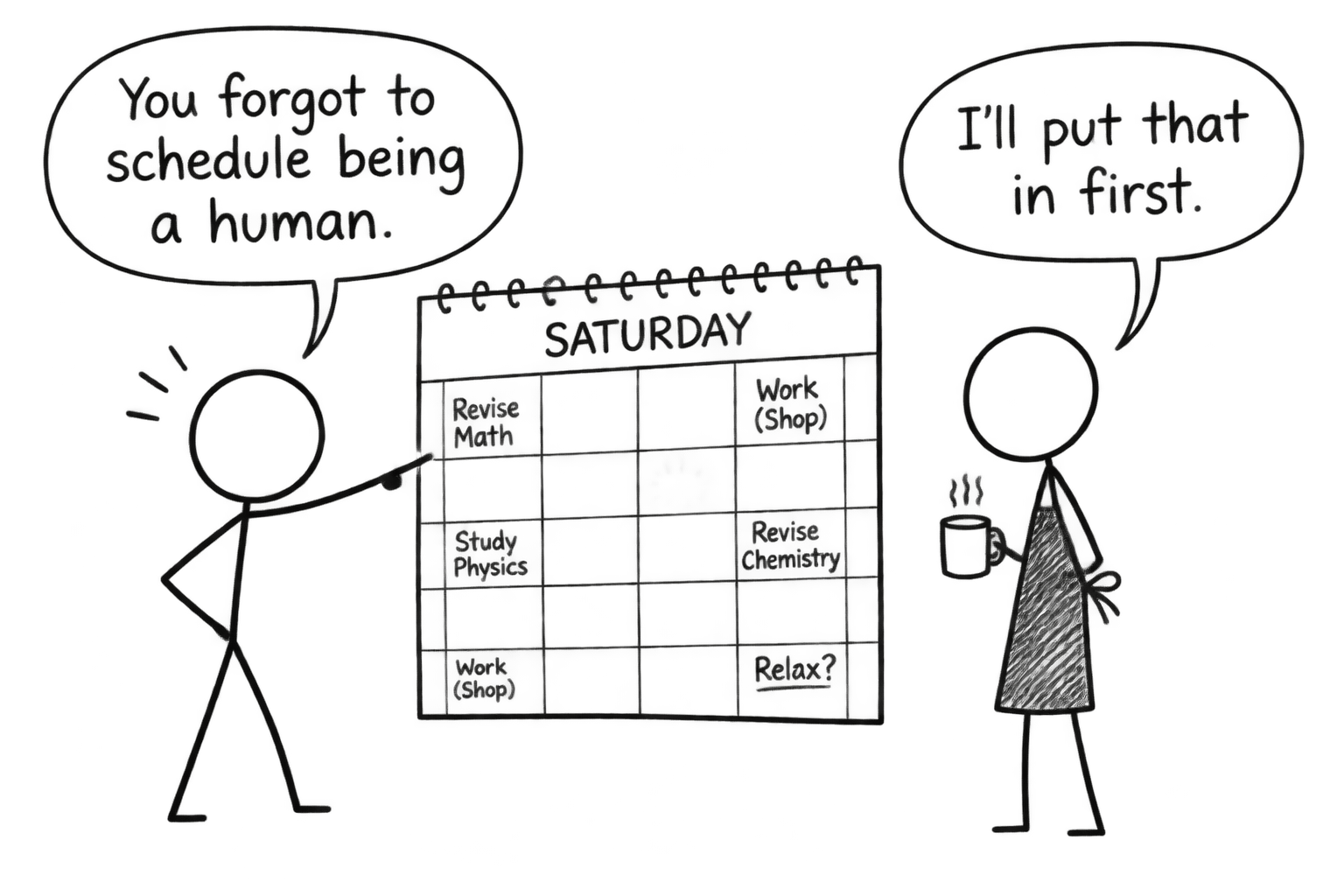 A student remembers to schedule time for being human
Build the week around three types of session
Rather than making every revision block identical, give each one a purpose.
Short weekday sessions
Use 25-40 minutes after school for contained tasks. Suitable activities include:
- completing practice questions on one topic
- recalling definitions or formulae without notes
- correcting mistakes from a mini test
- watching one revision lesson and answering its questions
- planning an exam response
For maths, Sam might use the free GCSE Maths revision resources or A Level Maths revision resources to choose one topic rather than vaguely deciding to “do maths”. A clear finish line makes starting easier.
One deeper Sunday session
Sunday can hold the task that needs sustained concentration. This could be a timed section of a paper, an extended science topic or an essay completed under exam conditions.
A full paper is not always necessary. Students who are ready for exam practice can work from Edexcel GCSE Maths past papers or Edexcel A Level Maths past papers, then use the mark scheme to identify what needs attention next.
A weekly review
Keep 15 minutes on Sunday evening to ask:
- What did I complete?
- Which mistakes kept appearing?
- What needs another attempt?
- Is next week's work shift different?
- Which school deadlines are approaching?
This is where revision planning becomes adaptive. The timetable should respond to evidence, not punish you for failing to predict every busy evening.
Once you have listed these sessions, you can build the week in the MathsGenie Revision Planner instead of arranging every block by hand.
A realistic weekly pattern
Sam's original timetable demanded two hours every evening and four more after Saturday's shift. The revised plan is less dramatic and more repeatable.
| Day | Suggested focus |
|---|---|
| Monday | Short recall session on a previously revised topic |
| Tuesday | Focused practice on one weak area |
| Wednesday | Rest, light homework or a brief review |
| Thursday | Exam questions followed by marking |
| Friday | Short recap and preparation for the following week |
| Saturday | Paid work and recovery |
| Sunday | One deeper session, one shorter session and weekly planning |
This is a pattern, not a rule. An A Level student with independent study periods may move some work into the school day. A GCSE student may need to alternate subjects so that no course disappears for several weeks.
The important principle is that Saturday's job should be visible in the plan. You are designing around reality rather than repeatedly colliding with it.
Choose a study technique that fits the available time
A busy timetable makes passive revision especially costly. Reading notes can feel comfortable, but it does not always show whether you can retrieve or apply the material independently.
Try this structure for a short session:
- Recall: write or say what you remember before opening your notes.
- Check: compare your answer with trusted notes, a specification or mark scheme.
- Practise: answer questions without copying a model.
- Correct: identify the exact step or fact that caused each mistake.
- Schedule: return to the topic later rather than assuming it is finished.
Spacing revision across several days and retrieving knowledge from memory are established approaches to strengthening retention. They also suit students with Saturday jobs because they do not depend on one enormous weekend session.
For exam papers, timing matters too. The guide to when to start GCSE past papers can help you decide when topic practice should begin turning into broader exam practice.
Plan for changing shifts and difficult weeks
Saturday jobs are not always predictable. Your shift may become longer, move to Sunday or expand during school holidays. A rigid timetable breaks when life changes; a resilient one has a backup rule.
Choose one of these rules in advance:
- If Saturday work changes, move only the highest-priority session.
- If homework expands, replace revision rather than stacking both late at night.
- If you miss a session, place it in the next open space instead of doubling tomorrow's workload.
- If several sessions are missed, reduce the plan and prioritise weak or frequently examined material.
Also distinguish between urgency and importance. Tomorrow's assessed homework is urgent. A weak topic that appears across several papers is important. Your week needs room for both.
Common revision-planning mistakes
Treating Saturday evening as guaranteed revision time
Work can be physically and mentally tiring. Keep Saturday evening flexible unless experience shows that you can concentrate reliably after your shift.
Planning subjects instead of tasks
“Revise chemistry” gives you no obvious starting point. “Recall electrolysis rules, then answer five exam questions” tells you what completion looks like.
Copying somebody else's timetable
A classmate without a job has a different week. Compare methods and resources, not raw hours.
Moving every missed task to Sunday
This turns Sunday into a backlog and creates anxiety. Move only the most important task, then let lower-priority work go or reschedule it later.
Confusing time spent with progress made
An hour of highlighting may produce less useful evidence than 30 minutes of retrieval and marked questions. Judge sessions by what you can now recall, explain or answer.
Protect work, revision and recovery
Sam does not need to choose between being a responsible employee and a serious student. The useful shift is smaller: Saturday stops being treated as failed revision time.
A good plan gives paid work a firm boundary, assigns demanding tasks to better moments and leaves enough recovery for the routine to survive. It may contain fewer hours than an idealised timetable, but the sessions have clearer purposes.
Build your schedule around your Saturday job
You now know how the weekly structure works, but knowing the plan and consistently following it are different things. Sam's schedule becomes easier to manage once the fixed Saturday shift, shorter weekday tasks and Sunday review sit in one plan that can guide the next action. Exams have fixed dates, so every unplanned week reduces the time available to revisit weaker topics.