Revision Planning for GCSE Students with Long Commutes
Revision planning for GCSE students with long commutes: use travel time for active revision while protecting energy, rest and focused maths practice at home.
A long journey to school changes the shape of revision. An hour on a bus or train may look like available time, but noise, tiredness and unreliable internet make it different from an hour at a desk. Effective revision planning for GCSE students with long commutes means matching tasks to where they can realistically be completed.
Use the commute for short retrieval tasks, save demanding questions for home, and keep some journeys free for rest. Travel time should support revision without turning every part of the day into school.
Imagine Maya, a hypothetical Year 11 student travelling an hour each way. Her first timetable treats both hours as perfect revision time. By Wednesday, she has carried three textbooks across town and completed half a page. The problem is the plan.
The long-commute revision checklist
A workable plan should:
- separate commute-friendly tasks from desk-based work
- give each session one clear outcome
- allow for delays, standing and poor internet
- test recall rather than rely on rereading
- protect sleep, meals and recovery
- leave longer questions and past papers for home
Start with the GCSE maths revision timetable guide if you need a wider structure for your week.
Build around energy, not empty minutes
Adding up every travelling minute ignores how attention changes throughout the day. Maya might recall familiar methods comfortably in the morning but struggle after lessons and activities. A useful timetable recognises that difference.
Light commute tasks
Choose activities requiring little equipment: flashcards, definitions, recalling method steps or reviewing yesterday's errors. If listening to an explanation, pause and predict the next step so that you actively engage with it.
Focused commute tasks
A quiet seat may suit short question sets, a mini test or explaining a topic without notes. Keep the task small enough to finish before your stop, and leave written work for occasions when you have enough space.
Desk-based tasks
Reserve full past papers, extended calculations, unfamiliar higher-tier problems and careful marking for a stable workspace. These need room for working and time to investigate mistakes.
Maya could recall factorising methods during travel, then complete questions from the GCSE maths revision resources at home. The same division applies to students using the A Level maths revision resources.
Keep the connection between these sessions explicit. A topic recalled on the bus should lead to written practice when you next have a desk. Remembering a method is useful, but solving questions independently shows whether you can choose and apply it under exam conditions.
A weekly revision plan for a long commute
Build a timetable you can repeat when transport is crowded or you feel tired. This example leaves several journeys unplanned deliberately.
| Journey | Revision task | Approach |
|---|---|---|
| Monday morning | Recall last week's material | Flashcards |
| Monday afternoon | Rest | No planned revision |
| Tuesday morning | Review one topic | Recall, then check |
| Tuesday afternoon | Correct mistakes | Use an error list |
| Wednesday morning | Retrieval practice | Short questions without notes |
| Wednesday afternoon | Rest | Preserve energy for home |
| Thursday morning | Revisit Tuesday's topic | Test recall again |
| Thursday afternoon | Plan home revision | Choose questions in advance |
| Friday morning | Weekly mini test | Mix recent topics |
| Friday afternoon | Rest | Finish the week deliberately |
Returning to a topic after a gap introduces spacing. Trying to answer before checking introduces retrieval practice. Together, these approaches help reveal which material needs another visit.
Read the guide to spaced repetition for GCSE revision for more detail. Near exams, the one-month GCSE maths revision plan can help you prioritise topics.
Use the MathsGenie Revision Planner to organise commute, desk and rest sessions around your actual commitments.
Before adding these sessions, enter homework deadlines, school activities and existing commitments. Then choose which subject most needs each available slot. Maths should have a clear place in the week, while leaving enough room for the rest of your GCSE subjects and unexpected schoolwork.
Choose techniques that survive disruption
Give each session a finish line
“Revise algebra” leaves too many decisions. “Recall the index laws” or “review yesterday's errors” gives you a clear task. If the journey ends early, you can see what remains unfinished.
Plan around the shortest normal version of your journey. Extra time is a bonus, not something your timetable depends on.
Prepare resources before leaving
Save materials in advance where possible, take screenshots of short question sets or carry physical flashcards. Check that anything you need opens without a connection.
MathsGenie's free revision resources include revision lessons, practice questions, mini tests, past papers, mark schemes and video solutions. Choose the resource beforehand so that finding material does not consume the session.
Keep a precise error list
After home revision, record specific mistakes. “Fractions” is too broad; “forgot to find a common denominator” gives your next session a purpose. Try the idea again from memory before reading the correction.
Use the journey's final minutes to choose your evening topic and questions. Arriving with that decision made makes starting easier.
When checking an answer, record whether the difficulty was remembering a fact, choosing a method or carrying out the calculation. Those problems need different responses. A forgotten fact may suit a flashcard; an uncertain method needs further explanation and written practice when you get home.
Protect rest without feeling guilty
Maya's revised timetable leaves several journeys empty. Those gaps make the planned sessions easier to sustain.
If you are standing, feeling travel sick or struggling to concentrate, stop. Rest may leave you better prepared for focused work later. Keep sleep protected rather than extending revision into an earlier start or later bedtime.
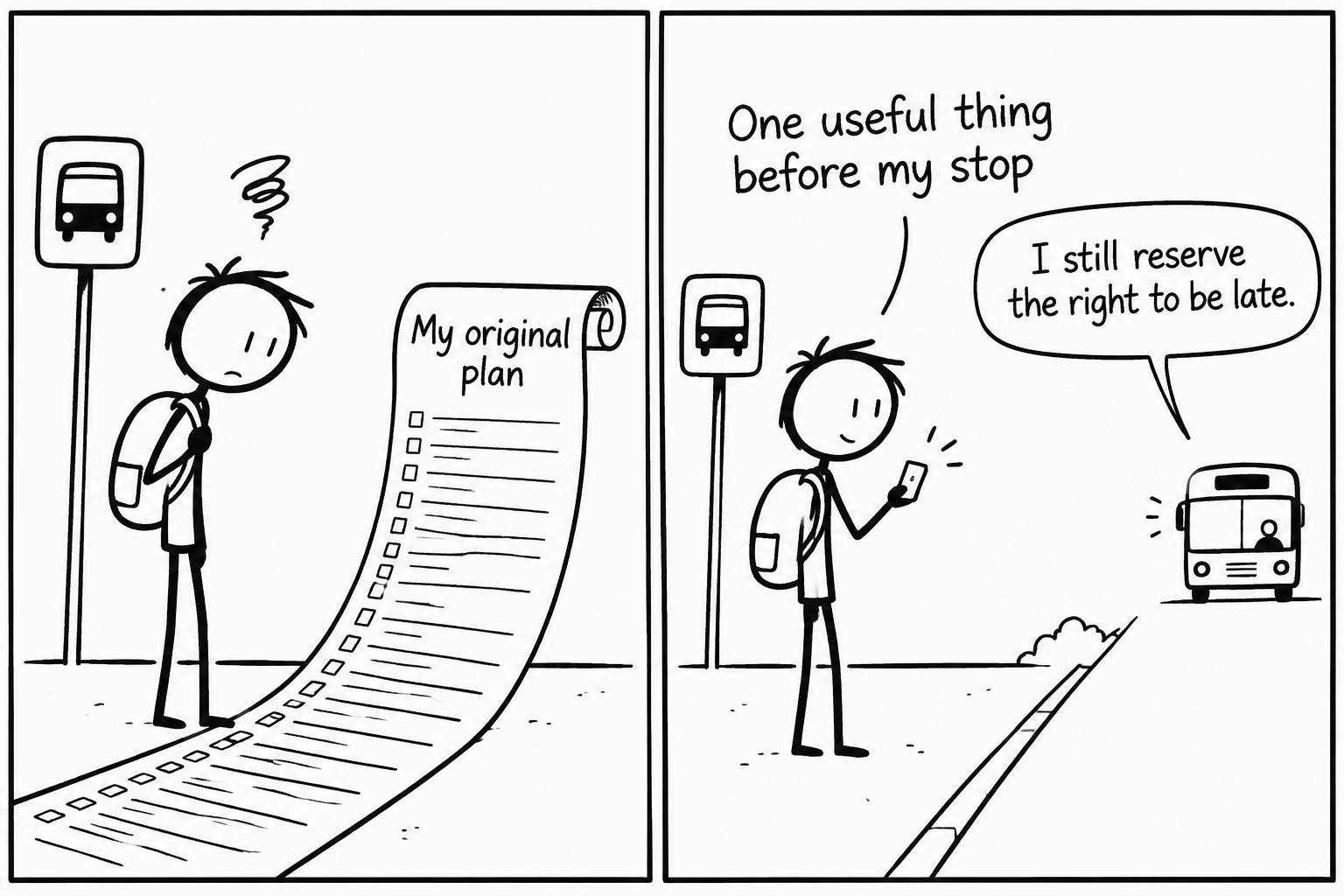 A student replaces an enormous commute revision scroll with one manageable task
Common revision planning mistakes
- Making every journey compulsory: select particular sessions and preserve recovery time.
- Attempting full papers while travelling: review errors during travel and complete papers at a desk.
- Rereading without checking recall: close the notes, answer from memory, then check.
- Overloading disrupted days: reschedule the priority task instead of automatically doubling tomorrow's workload.
Make the routine repeatable
A useful commute plan gives each journey a realistic purpose: recall, preparation or rest. Review it after a week. Keep sessions you completed comfortably and shorten those that repeatedly failed.
Build your long-commute schedule in the MathsGenie Revision Planner, then pair manageable travel tasks with focused practice at home.