How to Revise Maths When You Only Have Weekends
How to revise maths when you only have weekends: use a focused Saturday and Sunday plan to target weak topics, practise questions and review errors.
When weekdays are full of lessons, homework and other commitments, revision plans that assume five free evenings can feel impossible. The practical answer to how to revise maths when you only have weekends is to give Saturday and Sunday distinct jobs: identify a weakness, practise independently, correct mistakes and revisit earlier learning.
You do not need to squeeze an entire week into two days. You need a repeatable routine that turns limited time into useful feedback.
Your weekend maths revision checklist
Build each weekend around five essentials:
- Choose one weak topic.
- Review the method with a short lesson or video.
- Attempt exam-style questions without notes.
- Mark your answers and correct mistakes.
- Return to an older topic.
This structure suits GCSE foundation and higher tier students, as well as A Level students. The questions change, but the cycle stays useful. For broader advice, read the guide to revising maths efficiently.
A realistic Saturday and Sunday plan
A weekend becomes easier to manage when every session has one clear purpose.
| Session | Purpose | What to do |
|---|---|---|
| Saturday morning | Diagnose | Attempt a short test and identify a weak topic. |
| Saturday afternoon | Learn and practise | Review the method, answer questions and mark them. |
| Sunday morning | Retrieve | Attempt similar questions without notes. |
| Sunday afternoon | Review and plan | Revisit an older topic and choose next weekend's focus. |
Blocks of around 45-75 minutes are a starting point, rather than a requirement. Shorten them if necessary, while preserving time for marking. Unmarked practice shows that you worked; marked practice helps you decide what comes next.
For shorter sessions, adapt the 20-minute maths revision routine. Put your chosen blocks into the Revision Planner before the weekend begins.
Saturday: find the gap and practise
Begin with evidence from a recent assessment, topic test or the GCSE maths revision resources. Choosing familiar work can feel reassuring, but it may leave the most important weakness untouched.
Classify your mistakes before deciding how to revise:
- Knowledge gap: you did not know the rule or formula.
- Method gap: you recognised the topic but could not complete the process.
- Application gap: you knew a method but did not recognise when to use it.
- Accuracy gap: arithmetic, algebra or notation disrupted an otherwise sound approach.
The distinction matters. A revision video may help with missing knowledge. Rushed substitution needs careful independent practice and checking.
Use a MathsGenie lesson or video solution to clarify the method, then close it and attempt questions. If you become stuck, identify the precise step causing difficulty before checking the explanation.
Mark the set while your thinking is fresh. Correct each unsuccessful answer fully and record the cause in a short phrase. That record gives Sunday's session a useful starting point.
Sunday: retrieve before adding more
Start Sunday with a few questions on Saturday's topic, keeping notes closed. Recognising a solution while watching it is different from producing the method yourself.
If the method comes back reliably, move to mixed questions. If it does not, revisit the troublesome step and try again independently.
Next, return to something covered one or two weekends earlier. Leaving a gap before revisiting material gives you an opportunity to check what you can still recall. The guide to spaced practice explains how to organise these returns.
GCSE students can use topic-focused mini tests for a manageable check or 45-minute GCSE tests when more time is available. Select materials appropriate to your tier and specification.
End by recording what improved, what remains uncertain and where you will begin next weekend. This small decision removes the need to plan from scratch every Saturday.
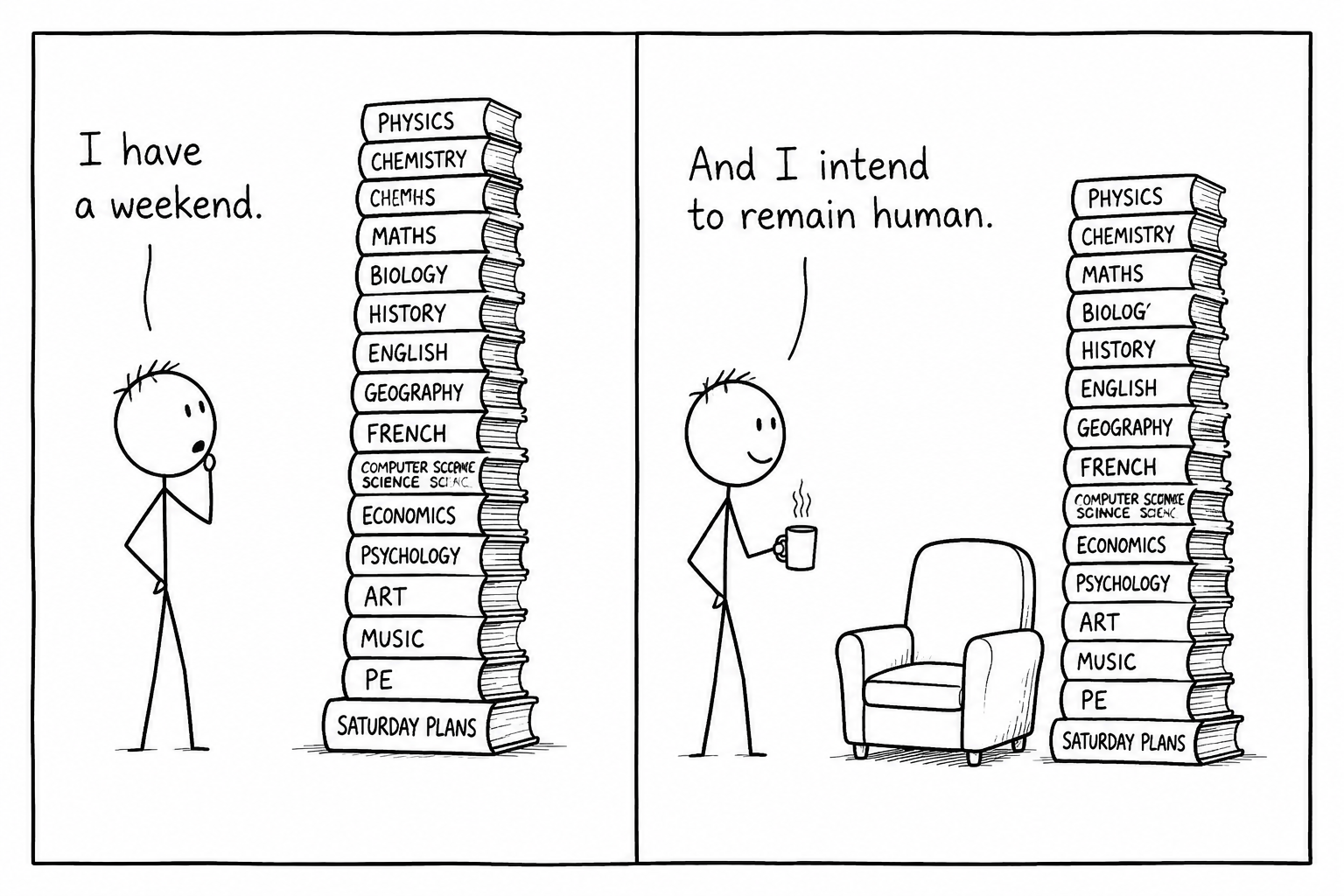 A student protects their weekend from an absurd revision pile
When to use past papers
Past papers help you practise choosing methods and managing time. However, if several topics remain insecure, targeted questions give you more opportunities to repair those gaps.
Begin with topic practice and short mixed tests. As your understanding improves, introduce paper sections, then full timed papers. Allow enough time afterwards to mark the work and investigate lost marks.
Use the GCSE papers organised by exam board to find relevant practice resources. Check whether you need Edexcel, AQA, OCR or Eduqas materials, alongside the correct tier. A Level students should likewise match papers to their specification. Predicted papers provide additional practice; they cannot guarantee exam content.
Treat the score as a starting point. Identify the skills behind lost marks, compare your working with the mark scheme and choose follow-up questions.
Protect your limited revision time
Choose one main topic and one older review topic rather than filling the weekend with an ambitious list. Prepare your worksheet, calculator and mark scheme beforehand, and leave room for breaks, other subjects and rest.
As exams approach, use the one-month GCSE maths revision plan to help prioritise the remaining weekends. Adjust the workload to your starting point and available time.
Common weekend revision mistakes
Making notes for the whole session. Keep notes brief and give substantial time to answering, checking and correcting questions.
Delaying all marking. Mark focused sets promptly so you can connect errors with the thinking that caused them.
Choosing only comfortable topics. Let assessment results and recurring mistakes guide your priorities.
Completing papers without reviewing them. Protect time for corrections and follow-up practice.
Planning every minute. Leave flexibility for difficult questions. If you miss a weekend, carry the most important task forward without doubling every session.
Make next weekend easier to start
Progress becomes easier to track when every session leaves evidence for the next. Use MathsGenie's free revision lessons, practice questions, mark schemes and video solutions to follow that evidence. Choose your first topic, schedule your blocks and begin with a plan you can repeat.