Regret Picking GCSE Polish? What to Check
Regret picking GCSE Polish? Discover why speaking it at home may not make the exam easy, what the four assessments involve and what to check first.

Choosing a GCSE can feel strangely permanent. A subject that looks manageable on options evening may occupy hundreds of hours once lessons, homework and exam preparation begin. If you already regret picking GCSE Polish, the likely problem is not that Polish is a bad qualification. It is that speaking Polish socially and earning marks in a formal language exam are different challenges.
GCSE Polish assesses listening, speaking, reading and writing equally. Familiar conversation helps, but it does not remove the need for accurate spelling, grammar, translation, formal vocabulary and exam technique. Before committing, check your ability in all four skills, the support available and how the extra workload will fit beside compulsory subjects such as maths.
The checklist before choosing GCSE Polish
Ask these questions before submitting an options form or arranging an additional GCSE entry:
- Can I read unfamiliar Polish confidently, not just messages from relatives?
- Can I write accurately without relying on autocorrect or another person?
- Can I discuss unfamiliar topics using different tenses and justified opinions?
- Who will teach me the specification and mark my practice?
- Where and how will the speaking assessment be conducted?
- Will I have regular lessons, independent tuition or mainly self-directed revision?
- Can I protect enough time for English, science and GCSE maths revision?
- Have I attempted official-style tasks under timed conditions?
A confident answer to the first question alone is not enough. The qualification measures a collection of skills, not simply whether Polish feels familiar.
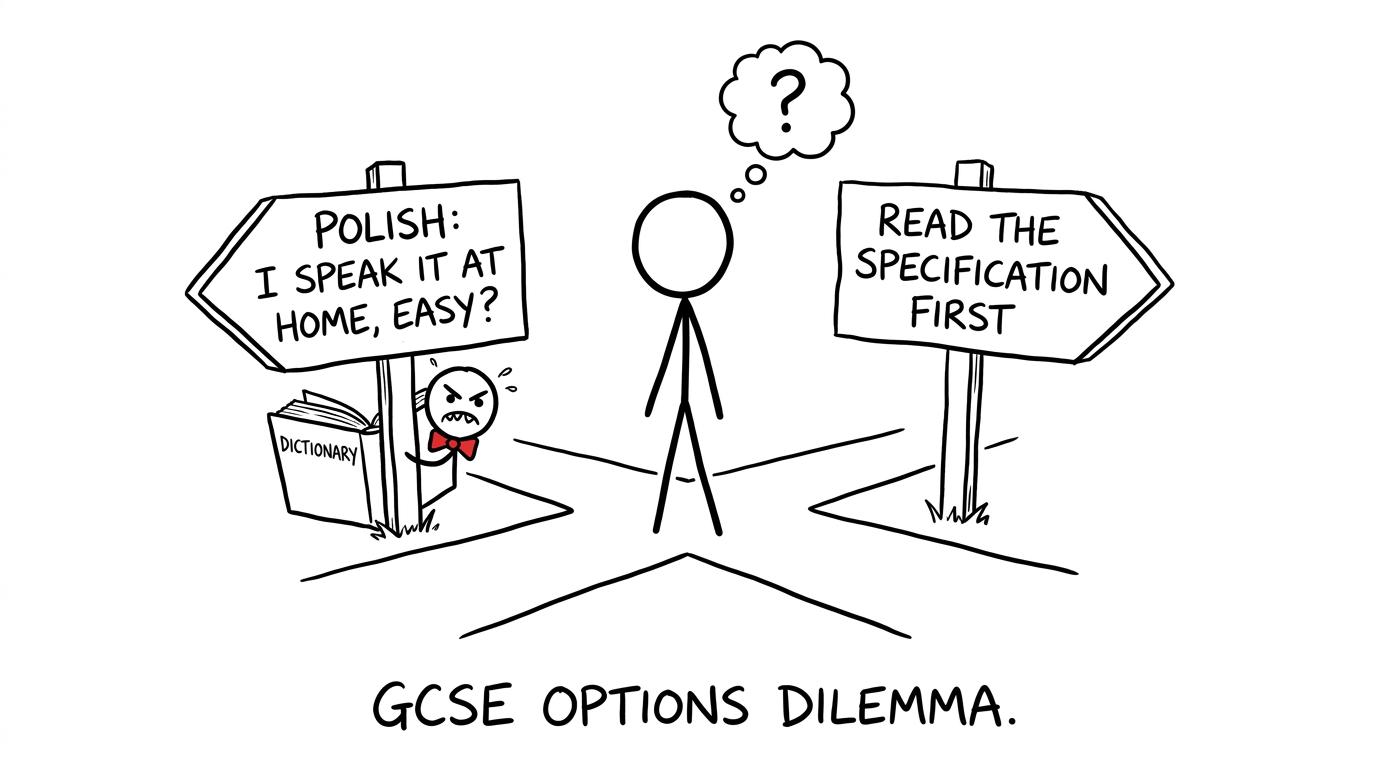 A student meets a grammar monster at the GCSE options crossroads
Why some students regret picking GCSE Polish
There is no single official survey establishing why students regret the subject, so broad claims about every candidate would be misleading. However, the structure of the qualification reveals several predictable reasons why expectations and reality can separate.
Speaking Polish at home creates false confidence
Heritage speakers often possess an important advantage: they may understand natural speech, respond quickly and pronounce words confidently. Those strengths matter, especially in listening and speaking.
But home language can be concentrated around familiar people and situations. An examination may require discussion of education, employment, social issues, technology, travel or the environment. A student who speaks effortlessly over dinner may still lack the vocabulary needed to explain an opinion precisely or sustain a formal conversation.
Fluency can also hide errors. If family members understand you, they may rarely correct endings, agreement or register. An examiner, however, awards marks according to stated assessment criteria. Being understood is valuable, but range and accuracy matter too.
Spoken fluency does not guarantee accurate writing
This is perhaps the biggest expectation gap. Polish contains grammatical features that demand careful control, including noun cases, gender, agreement and verb forms. Students who learnt mostly through conversation may know what sounds plausible without knowing how to spell or construct it accurately on paper.
The current AQA GCSE Polish qualification includes writing in Polish and translation from English into Polish. At Higher tier, students also face extended writing. That means punctuation, spelling, grammatical range and the ability to organise ideas all become visible.
A useful pre-course test is simple: write a sustained response without a phone, dictionary or family assistance, then ask a qualified teacher to assess it. The purpose is not to prove that you are already exam-ready. It is to discover the distance between conversational confidence and assessed writing.
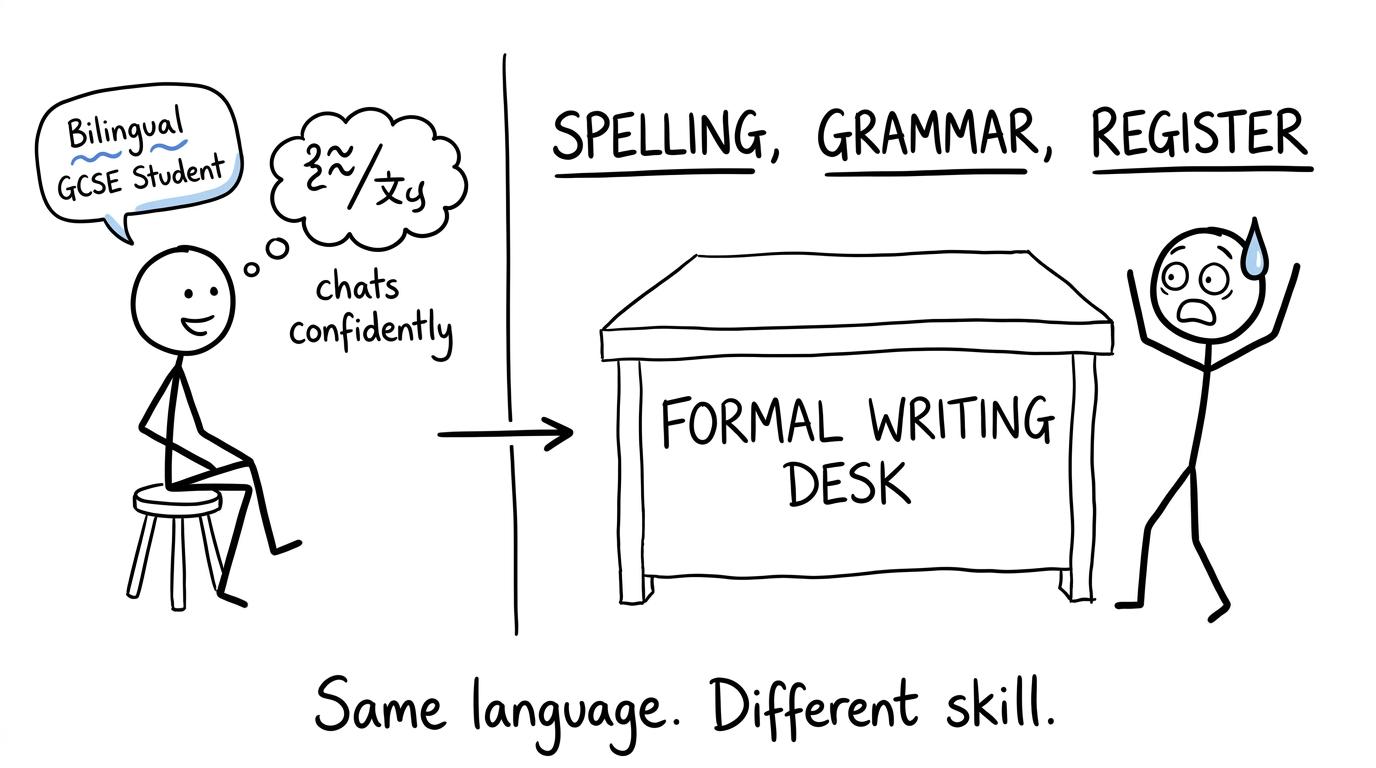 A fluent speaker discovers that formal writing is a different skill
Every skill contributes equally
Under the current AQA specification, listening, speaking, reading and writing each contribute 25%25\%25% of the qualification:
25%+25%+25%+25%=100%.25\% + 25\% + 25\% + 25\% = 100\%.25%+25%+25%+25%=100%.This equal weighting matters. You cannot assume that strong speaking will fully compensate for weak literacy. A student who is excellent in conversation but much less secure in reading and writing still has substantial areas to prepare.
The qualification is tiered. Foundation tier covers grades 1-5, while Higher tier covers grades 4-9, and all four assessments must be taken at the same tier in the same exam series. Tier choice therefore needs to reflect your complete profile, not only your strongest paper.
The examination is more structured than expected
GCSE Polish is a linear qualification, so the assessments are completed at the end of the course. Current AQA arrangements include:
| Component | What it assesses | Weighting |
|---|---|---|
| Listening | Understanding and responding to spoken Polish | 25%25\%25% |
| Speaking | Role-play, photo card and general conversation | 25%25\%25% |
| Reading | Understanding texts and translating into English | 25%25\%25% |
| Writing | Written communication and translation into Polish | 25%25\%25% |
On Higher tier, listening lasts 45 minutes, reading lasts one hour and writing lasts one hour and 15 minutes. The speaking assessment lasts 10-12 minutes, in addition to supervised preparation time. Foundation assessments are shorter, but they still test all four skills formally.
Students sometimes prepare for the language while neglecting the format. Knowing Polish is not the same as knowing how to cover every bullet point, manage a role-play, respond spontaneously or budget time across an extended response. Past-paper practice exposes that difference early.
Teaching and feedback may be limited
Unlike a large French or Spanish class, GCSE Polish may be arranged outside the normal timetable. Provision varies by school. Some students receive regular teaching; others prepare independently, attend a supplementary school or work with a tutor.
Independent preparation can succeed, but it creates hidden jobs. Someone must explain the specification, correct writing, rehearse the speaking tasks and identify recurring grammatical errors. Reading notes alone cannot provide that feedback.
Before committing, ask your school’s examinations officer or languages department who will supervise the course and speaking assessment. Confirm the exam board, entry tier, deadlines and centre arrangements. Do not assume that speaking Polish automatically guarantees an entry or that every school offers the qualification in the same way.
The workload can compete with maths revision
The problem is rarely one difficult evening. It is the accumulation of small demands. Vocabulary practice, written corrections and speaking preparation arrive alongside algebra, science assessments and English coursework or revision.
A student has a fixed amount of attention. Adding a subject does not add more hours to the week. It divides the existing hours more finely.
That matters if maths is already fragile. GCSE maths is compulsory, and gaps in connected topics can grow when practice becomes irregular. Use a realistic GCSE maths revision timetable before deciding whether an additional language fits. If exams are close, the one-month maths revision plan can help you estimate the time your core preparation genuinely requires.
The answer is not necessarily to reject Polish. It is to budget honestly. Put Polish speaking, writing and vocabulary sessions on the same calendar as maths topic practice and papers. If the timetable only works by sacrificing sleep or repeatedly postponing compulsory subjects, the plan is not yet sustainable.
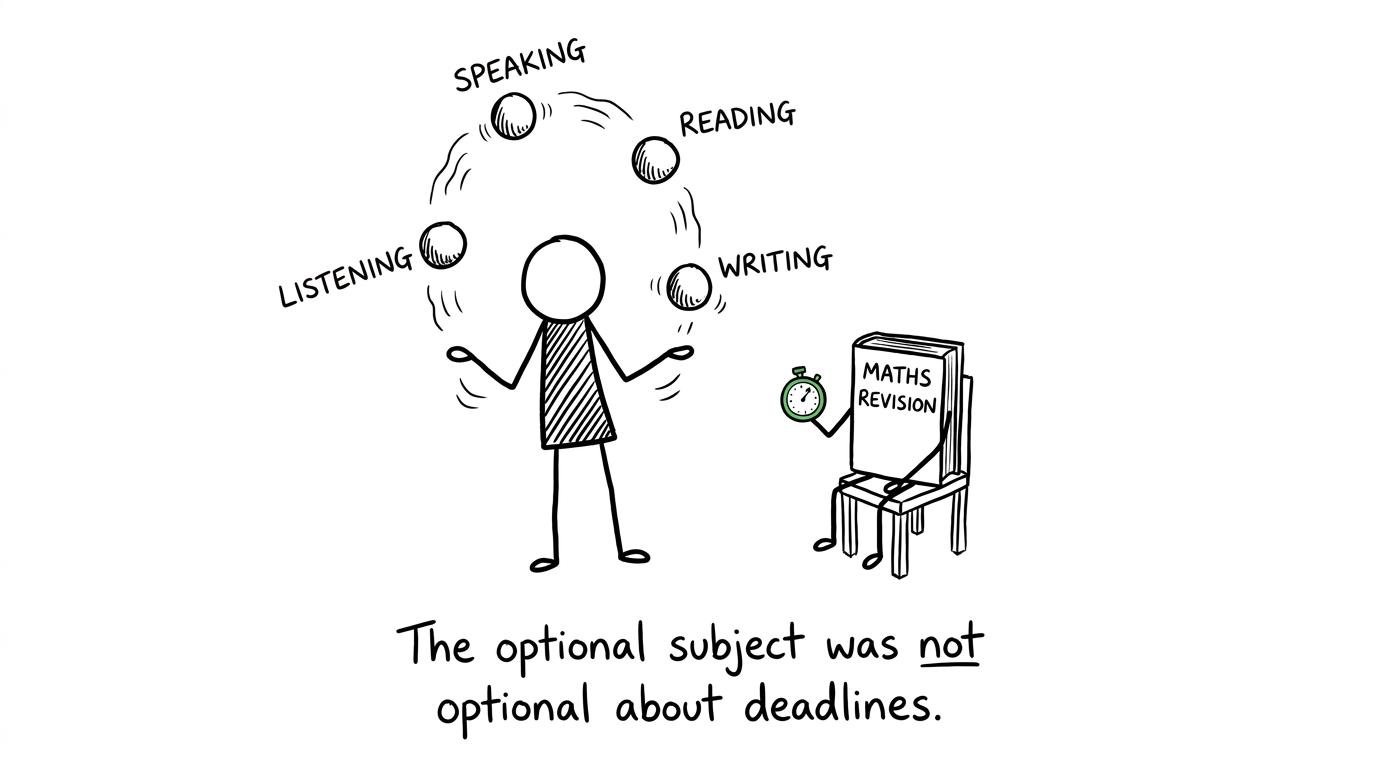 A student juggles four language skills while maths waits with a stopwatch
What to check before you commit
Check the specification, not the reputation
“Easy for Polish speakers” is a reputation. The specification is evidence. Review the themes, grammar requirements, task formats, timings and mark schemes for your intended examination series. Assessment arrangements can change, so confirm the current details with your school and AQA rather than relying on an older video or a relative’s experience.
Test all four skills independently
Try representative listening, speaking, reading and writing tasks. Complete them without informal assistance and obtain informed feedback. Record strengths separately rather than reducing everything to “good at Polish”.
A useful diagnostic might reveal:
- strong listening but slow reading;
- fluent speaking but limited topic vocabulary;
- accurate ideas but weak spelling;
- good Polish-to-English translation but difficulty translating into Polish.
That profile gives you something practical to plan around.
Confirm who will help you improve
Feedback is especially important for writing and speaking. Ask who will correct your work, how often you will practise the assessed speaking format and whether you can access current materials. A plan based entirely on “my family can help” may be too vague unless someone understands the examination criteria.
Compare the opportunity cost
Every option has a cost measured in time, energy and attention. Consider whether Polish supports your interests and future plans, but also ask what will receive less attention as a result.
You can make the maths side measurable. Complete a short test from the MathsGenie GCSE revision hub, record your weak topics and estimate the weekly practice required. Students preparing independently can use the self-study GCSE maths plan to build a repeatable routine.
Common mistakes when deciding or preparing
Choosing on spoken confidence alone. Conversation is evidence of one strength, not proof of readiness across four equally weighted skills.
Leaving writing until late. Writing improves through correction and redrafting. It is difficult to repair years of informal spelling habits in the final fortnight.
Ignoring the examination format. Role-plays, photo cards, translations and bullet-point tasks each reward particular behaviours. Practise the task, not only the language.
Assuming entry arrangements will happen automatically. Confirm the centre, tier, speaking assessment and deadlines early with your school.
Using an outdated paper as the whole revision plan. Older material may still provide useful language practice, but your preparation must match the specification and arrangements for your exam series.
Letting an optional subject crowd out maths. Diagnose your maths gaps early and begin past-paper practice at the right time. Near the examinations, GCSE predicted papers can provide fresh practice, but they should complement official past papers rather than replace them.
If you already regret your choice
Regret is information, not a final verdict. First identify the precise cause: weak writing, limited teaching, overloaded revision or anxiety about one assessment. A specific problem can lead to a specific response.
Speak to your teacher, languages department or examinations officer as early as possible. Ask what changes are actually available and what deadlines apply. Do not stop attending or preparing because you assume the decision cannot be reviewed.
If you remain entered, build a small weekly cycle: practise one skill, receive feedback, correct mistakes and revisit the same weakness. Protect compulsory-subject revision at the same time. When the exam period is close, MathsGenie’s one-week maths revision plan can help you prioritise without trying to relearn everything at once.
Make the choice with evidence
GCSE Polish can be a valuable option for a student who understands its demands and has appropriate support. The regret usually begins when familiarity is mistaken for exam readiness, or when the workload is treated as invisible.
Check all four language skills. Read the current specification. Confirm the assessment arrangements. Build a timetable that protects your core subjects. Then decide from evidence rather than reputation.
For maths, make MathsGenie’s free GCSE resources your starting point. Use revision lessons and practice questions to repair weak topics, mini tests to check recall, and past papers, mark schemes, predicted papers and video solutions to prepare for exam conditions. A thoughtful option choice matters, but so does having a calm system for the subjects already on your timetable.