

Regret Picking GCSE Bengali? What to Check
Regret picking GCSE Bengali? Learn why speaking at home may not be enough, what AQA assesses, and what to check before choosing this option at school.

Choosing GCSE Bengali can look like the safest decision on an options form. You may speak Bengali with relatives, understand family conversations and feel more confident than you do in another language. Then the course begins, and the gap between speaking a language and being examined in it becomes visible.
Students who regret picking GCSE Bengali often discover the same underlying problem: familiarity was mistaken for exam readiness. The qualification can be an excellent choice, but success requires formal reading, accurate writing, listening, spontaneous speaking and knowledge of the specification. Before committing, check your ability across every skill, the support your school provides and the effect on your wider revision timetable.
The quick GCSE Bengali checklist
Before choosing the subject, find clear answers to these questions:
- Can you read Bengali confidently without relying on context?
- Can you write accurately and at a suitable academic level?
- Are you comfortable speaking spontaneously, not only in familiar conversations?
- Which qualification will your school enter you for?
- Will you receive timetabled teaching or be expected to prepare independently?
- Who will conduct and organise the speaking assessment?
- Can you access suitable past papers, audio materials and feedback?
- How will Bengali revision fit alongside English, science and GCSE maths?
A confident answer to each question matters more than the idea that the subject should be easy because it is spoken at home.
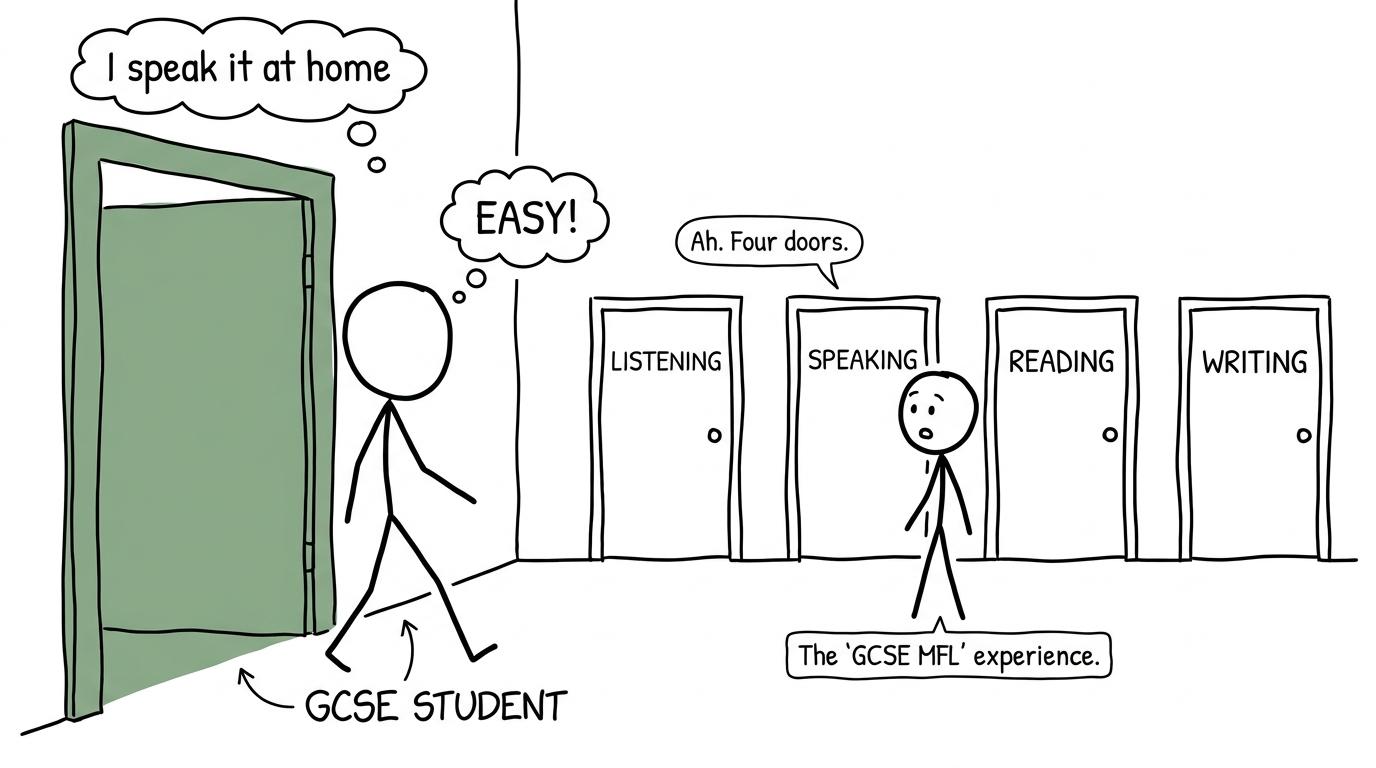 A student discovers that home-language confidence leads to four separate exam skills
Why some students regret picking GCSE Bengali
There is rarely one dramatic reason. Regret usually grows from several small assumptions that were never tested before the entry was made.
Speaking at home is not the whole qualification
Everyday fluency is valuable, but a language GCSE measures more than conversation. Under the current AQA GCSE Bengali specification, listening, speaking, reading and writing each contribute approximately 25%25\%25% of the qualification.
That balance matters. Strong speaking cannot completely hide weak reading or writing. Students must understand language in unfamiliar contexts, express and justify opinions, translate material and communicate with enough range and accuracy for the selected tier.
Home conversations may also rely on shared context, gestures and familiar expressions. An examination recording gives you none of those advantages. Similarly, being able to send informal messages does not automatically prepare you to produce structured Bengali under timed conditions.
Reading and writing can be much weaker than speaking
A heritage speaker may understand a great deal while reading slowly or spelling inconsistently. That is not unusual, but it becomes important when the clock is running.
The writing paper requires students to communicate in Bengali, while the reading paper includes comprehension and translation. Dictionaries are not permitted during the AQA assessments. You therefore need secure vocabulary, grammatical control and enough reading speed to process the questions independently.
Before choosing the course, try an official sample or past paper under quiet, timed conditions. Do not ask only, “Can I understand this?” Ask:
- Can I read it quickly enough?
- Can I identify precise details?
- Can I write an accurate response without help?
- Can I translate meaning rather than guess from isolated words?
A realistic diagnostic is more useful than reassurance based on conversational fluency.
The Bengali used at home may not match the exam register
Languages naturally vary between families, regions and communities. A student may use a regional variety at home while having less experience of the standard written forms and formal vocabulary expected in assessment.
This does not make the student’s Bengali incorrect. It means exam preparation may involve learning when a familiar expression is appropriate and when a more standard or formal construction is needed. That adjustment requires teaching, corrective feedback and regular exposure to written Bengali.
If nobody is available to explain those differences, the course can feel unexpectedly lonely.
Some courses involve substantial independent preparation
Not every school teaches Bengali as a normal timetabled option. Some schools support it as a home, heritage or community language qualification, with preparation completed partly or mainly outside lessons.
That distinction should be made clear before you commit. Independent preparation may mean finding suitable materials, practising audio tasks, arranging feedback on writing and preparing for speaking alongside your normal GCSE timetable.
Ask exactly what “support” means. A school agreeing to enter you for an examination is not necessarily the same as providing weekly teaching.
The exam format was not checked carefully
In England, the currently accredited GCSE Bengali qualification is offered by AQA. Pearson also offers an International GCSE in Bangla, but that is a different qualification with a different assessment structure. Materials for one should not be assumed to match the other.
For AQA GCSE Bengali, students take listening, speaking, reading and writing at the same tier. Foundation tier covers grades 111 to 555, while higher tier covers grades 444 to 999. The qualification is linear, so the assessments are completed in the same examination series.
This is why the exam board, qualification title and tier must be confirmed. Revising from the wrong specification can create work without creating marks.
The hidden cost: pressure on your other GCSEs
An option does not need to be impossible to become expensive. It only needs to take more time than expected.
A student preparing Bengali independently may give up evenings that were supposed to be used for algebra, science or English literature. The problem is not Bengali itself. The problem is an options decision made without accounting for the full workload.
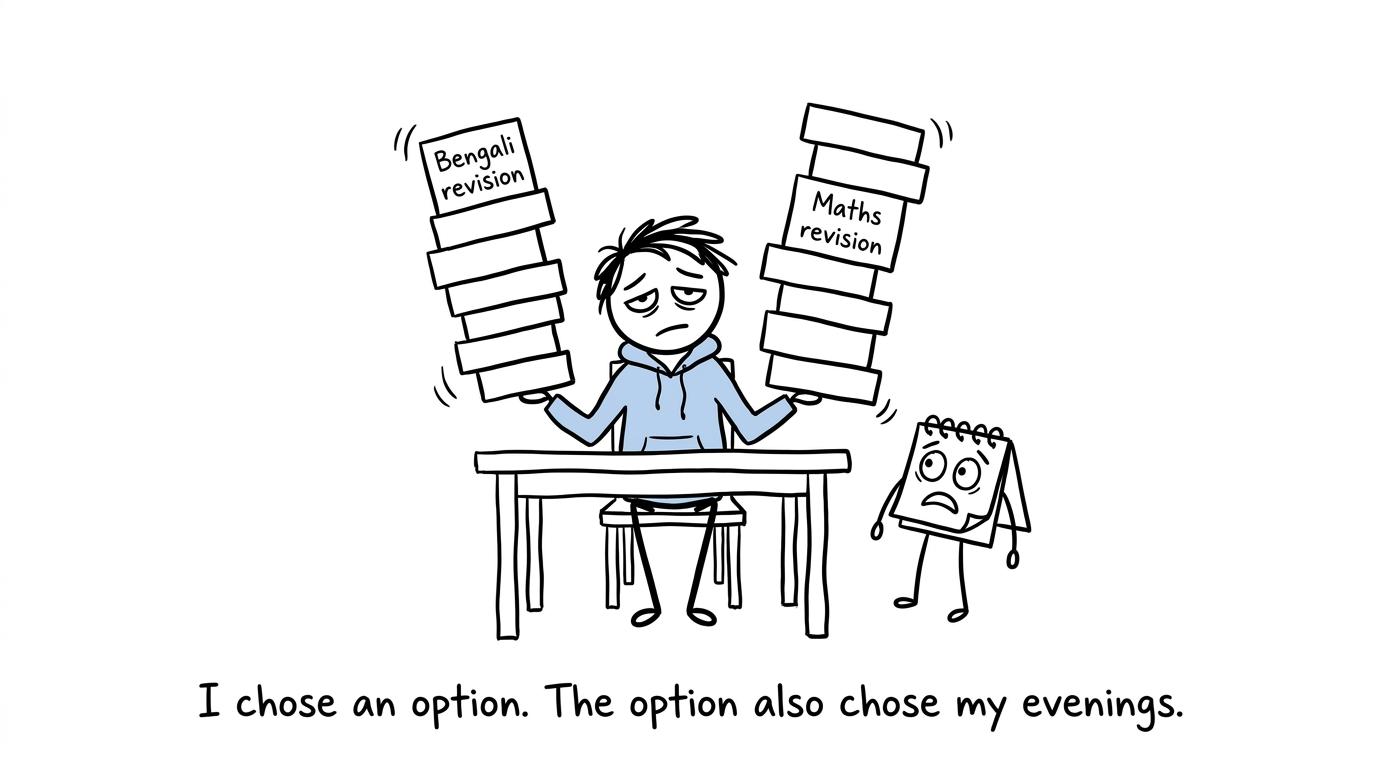 A GCSE student balances Bengali and maths revision while the calendar watches nervously
Create a weekly plan before choosing. Include lessons, travel, homework, reading, writing practice, speaking practice and recovery time. Then protect regular maths sessions rather than leaving maths for whatever time remains.
The GCSE maths revision hub helps you organise revision by exam board and topic. If your schedule already feels crowded, use the GCSE maths revision timetable guide to build a routine you can genuinely sustain.
A useful revision cycle is simple:
- identify one weak skill;
- learn or review the method;
- complete focused questions;
- mark the work immediately;
- record the reason for each lost mark;
- return to the skill later.
You can apply that cycle to languages as well as mathematics. For maths, the guide to finding your weakest GCSE topics prevents a demanding option subject from turning maths revision into vague last-minute practice.
What to check before you commit
Test all four skills separately
Do not give yourself one overall label such as “fluent”. Rate your listening, speaking, reading and writing separately, then ask a qualified teacher or experienced tutor for an honest assessment.
A student can be strong in two skills and underprepared in the other two. Finding that out before choosing is useful evidence, not failure.
Confirm the practical arrangements
Ask your school:
- whether the entry is AQA GCSE Bengali or another qualification;
- whether you will sit foundation or higher tier;
- who will teach and assess the course;
- how speaking practice will be organised;
- whether audio materials and past papers are available;
- when internal deadlines and speaking assessments are likely to occur;
- what happens if specialist support becomes unavailable.
Get specific answers. “We usually sort it out” is not a revision plan.
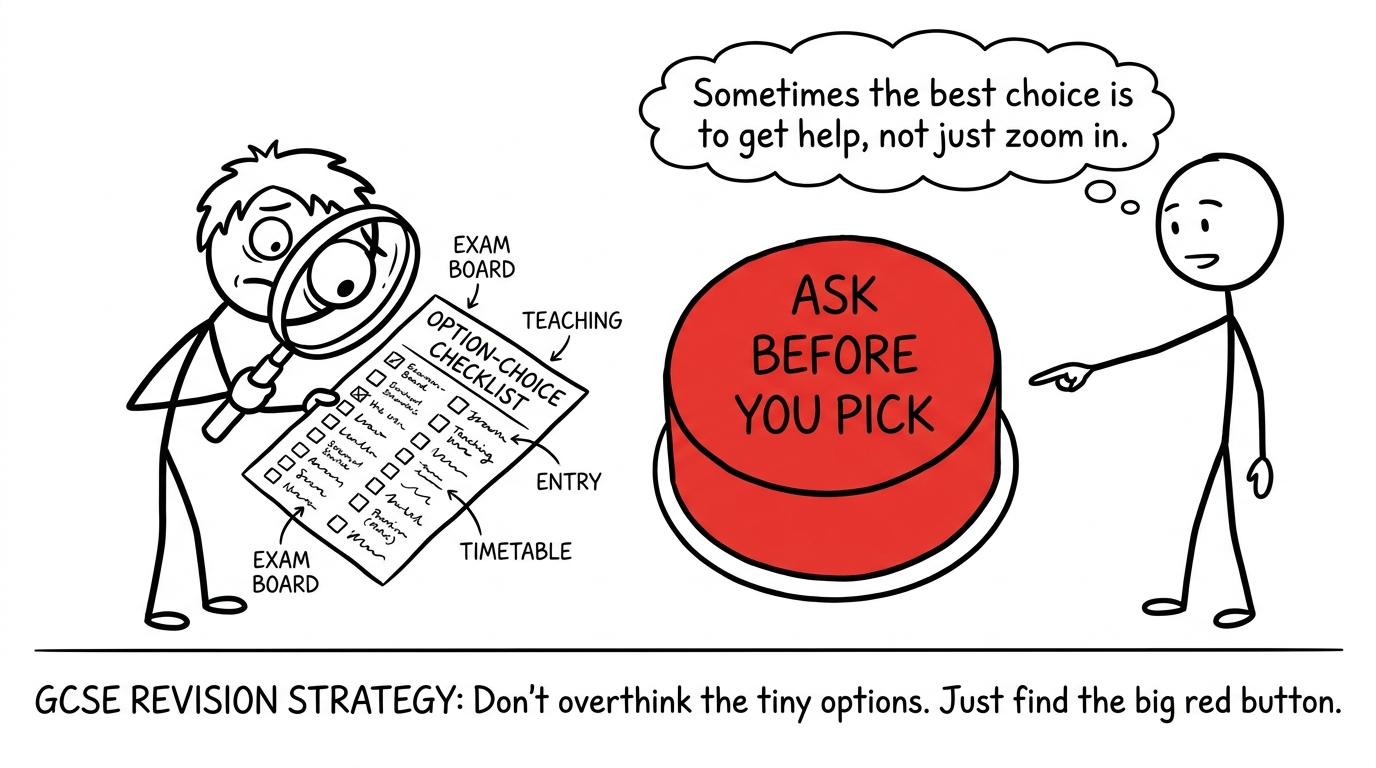 A student investigates GCSE option details before pressing the decision button
Compare the opportunity cost honestly
Ask what you would choose instead and what each subject requires. Do not choose Bengali only because someone describes it as a free GCSE. No examined subject is free if it needs months of independent preparation.
Equally, do not reject it simply because it requires work. If your literacy is strong, teaching is available and you value developing the language, Bengali may be a thoughtful and rewarding choice.
Build a trial timetable
Run a trial for two weeks before the final decision if your school’s options process allows it. Include Bengali reading, writing, listening and speaking, plus your normal homework.
For maths, follow a compact structure using efficient GCSE maths revision. If exams are approaching, the one-month GCSE maths revision plan provides a more intensive framework.
The aim is not to fill every evening. It is to discover whether the plan survives ordinary school life.
Common mistakes when choosing GCSE Bengali
Assuming fluency guarantees a high grade
Conversational confidence is a starting advantage, not a predicted result. Read and write under timed conditions before judging your readiness.
Choosing because of pressure from other people
Family encouragement can be valuable, but you will complete the preparation and sit the assessments. Make the decision using evidence about your skills, support and workload.
Ignoring the exact qualification
AQA GCSE Bengali and Pearson Edexcel International GCSE Bangla are not interchangeable. Check the full title, specification and assessment format used by your centre.
Waiting until Year 11 to investigate weak skills
Reading speed and accurate writing improve through repeated practice. They are difficult to repair in a few rushed weeks.
Letting one option consume every revision session
Protect your core subjects. Use GCSE predicted papers and past-paper practice only after repairing the individual maths topics that repeatedly cost you marks. Near an examination, the GCSE maths night-before plan can help you avoid an unproductive final panic.
Make the decision with evidence, not assumptions
Regret usually begins where information ends. Students hear “you already speak Bengali” and imagine that most of the work has been completed. The specification asks a more precise question: can you listen, speak, read and write effectively under assessment conditions?
If the answer is yes, and the teaching and examination arrangements are secure, GCSE Bengali may be a strong choice. If your literacy needs significant development or the course depends on unsupported self-teaching, pause before committing. Ask more questions, attempt real assessment materials and calculate the effect on your wider timetable.
Whatever option you choose, keep maths revision steady. Start with MathsGenie’s free GCSE maths revision resources, use revision lessons and practice questions to close topic gaps, then build confidence with mini tests, past papers, predicted papers, mark schemes and video solutions. A good options decision protects your time. A good revision system makes that time count.










