How to Recover from a Bad GCSE Statistics Mock
Recover from a bad GCSE Statistics mock with a calm plan to diagnose lost marks, rebuild weak topics and improve your performance in the real exam.
A disappointing mock result can feel strangely final. You see the grade before you see the evidence, and your mind quickly turns one difficult morning into a prediction about the summer.
But a mock is not a verdict. The most useful way to recover from a bad GCSE Statistics mock is to analyse every lost mark, identify the few weaknesses responsible for most of them, practise those skills and then test them again under timed conditions. Your result has already done one valuable job: it has shown you where to begin.
The aim is not to revise everything in a panic. It is to turn disappointment into a specific, repeatable plan.
Your recovery checklist
Start with these actions:
- Wait until you can review the paper calmly.
- Record your raw mark as well as the indicative grade.
- Check each answer against the mark scheme.
- Sort lost marks by topic and reason.
- Choose the two or three weaknesses costing you most.
- Relearn each skill before attempting exam questions.
- Re-test those skills without notes.
- Complete timed, mixed practice once the foundations improve.
- Ask your teacher about answers or mark-scheme wording you do not understand.
The MathsGenie GCSE Statistics revision hub brings together exam-board resources, worksheets, questions and past papers, so you can move from diagnosis to practice without collecting materials from several places.
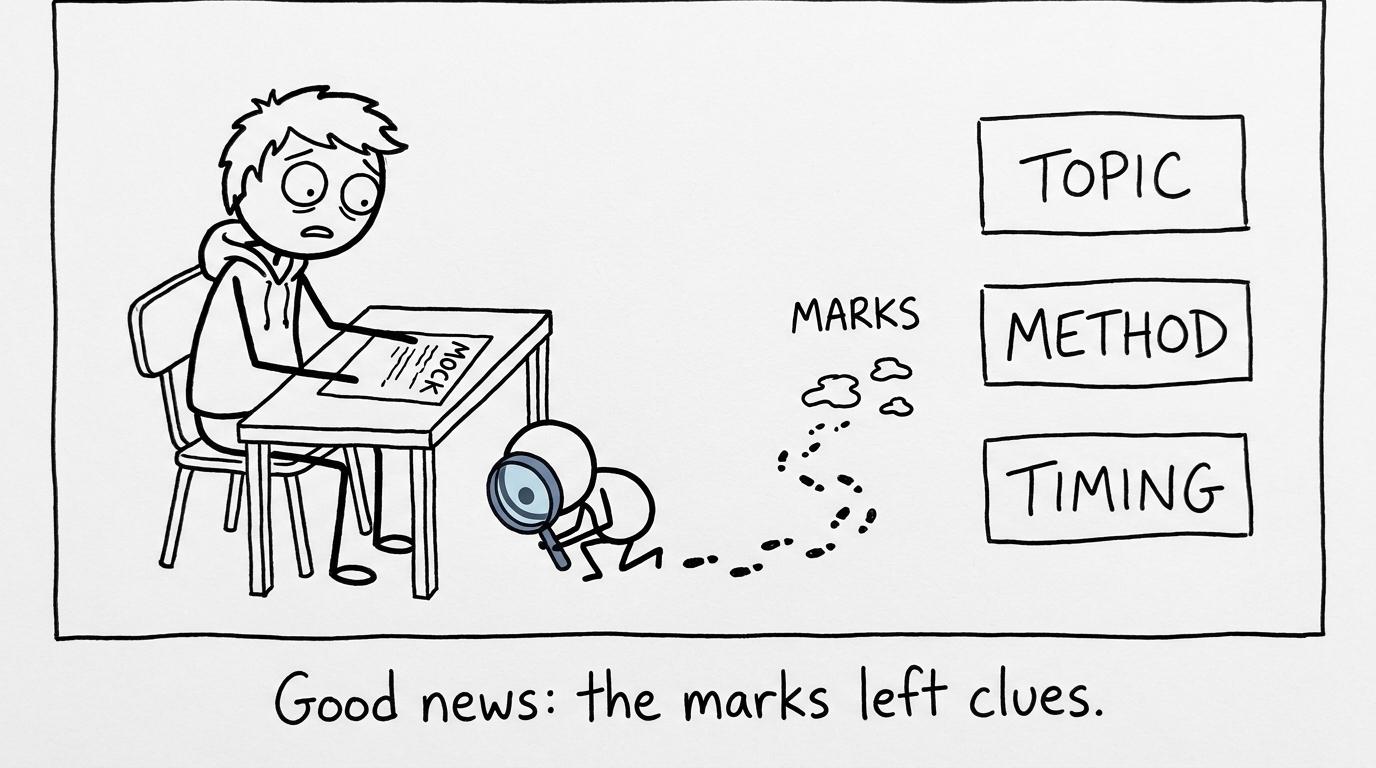 A student and a tiny detective investigate escaped marks from a mock paper
Treat the mock result as evidence, not identity
A grade compresses an entire paper into one symbol. That makes it convenient, but not especially informative.
Two students can receive the same mock grade for completely different reasons. One may understand the content but rush the final questions. Another may calculate accurately yet struggle to interpret results in context. Their revision plans should not look alike.
There is another reason to be cautious. GCSE grade boundaries are not fixed permanently in advance; they can vary with the demand of a live paper. A school must also choose how to convert a mock mark into an indicative grade. The grade matters as feedback, but the raw answers reveal far more about what to do next.
GCSE Statistics assesses more than calculations. Across current specifications, the assessment objectives include:
- knowledge of statistical techniques, terminology and notation;
- interpretation of statistical information in context;
- evaluation of methods and conclusions through the statistical enquiry cycle.
That distinction is important. If you lost marks because a conclusion ignored the context, memorising another formula will not solve the problem. You need to practise explaining what a result means.
Audit every mark you lost
Do not simply read the correct answers. Conduct a mark audit.
For each dropped mark, write the question number, topic and main reason for the error. Use four categories:
Missing knowledge
You did not know the relevant fact, definition or technique. Examples might include sampling methods, cumulative frequency, probability rules or the stages of a statistical enquiry.
Incorrect method
You recognised the topic but selected or applied the wrong process. Perhaps you confused frequency with frequency density, chose an unsuitable average or used the wrong denominator.
Weak interpretation
Your calculation may have been correct, but your conclusion was vague, unsupported or disconnected from the context. GCSE Statistics rewards careful language: describe the evidence, answer the question and recognise limitations where relevant.
Avoidable exam error
You misread a scale, omitted units, rounded too early, entered a calculator value incorrectly or ran out of time. These errors still cost marks, but their solution is usually a better checking routine rather than more content revision.
Once the audit is complete, total the marks lost in each category. Also group them by topic. This tells you whether your biggest problem is knowledge, application, interpretation or exam control.
Build a marks-leak list
Your marks-leak list should be short enough to act on. Avoid entries such as “data” or “probability”. They are too broad.
Write precise targets instead:
- distinguish population, sample and sampling frame;
- evaluate whether a sampling method may introduce bias;
- choose an appropriate measure of central tendency;
- interpret correlation without claiming causation;
- calculate and use cumulative frequency;
- explain a conclusion in the context of the data;
- leave enough time for extended-response questions.
Prioritise the targets that appeared repeatedly or cost several marks. One weakness can travel through a paper in different disguises. Misunderstanding grouped data, for instance, may affect estimated means, histograms and cumulative frequency.
This is why focused repair tends to be more useful than restarting the entire course. If averages caused trouble, use the averages from frequency tables resources. If graph interpretation was weaker, review scatter graphs and lines of best fit.
Turn each weakness into a revision loop
A reliable revision loop has four stages: understand, practise, mark and re-test.
Rebuild the idea
Begin with a revision lesson, guide or video solution. Keep this stage brief but attentive. Your goal is to explain the method and recognise when it applies, not merely to watch someone else complete it.
For probability gaps, revisit the GCSE probability revision guide. For grouped data, the cumulative frequency revision guide clarifies the connection between running totals, quartiles and graphs.
Practise without support
Attempt a small group of exam-style questions with your notes closed. Revision becomes useful when you must retrieve and apply the idea yourself.
Do not abandon a topic after one correct response. Look for consistency across differently worded questions, including those that require interpretation rather than a calculation.
Mark for information
Use the mark scheme carefully. Check whether your answer contains the required method, notation, units and contextual statement. When you lose a mark, write one sentence describing the correction.
“Careless mistake” is rarely specific enough. “I read the horizontal scale in intervals of 111 instead of 0.50.50.5” gives you something concrete to check next time.
Re-test after a gap
Return to the topic several days later. Complete fresh questions without first rereading the guide. If the method has disappeared, it was temporarily familiar rather than secure.
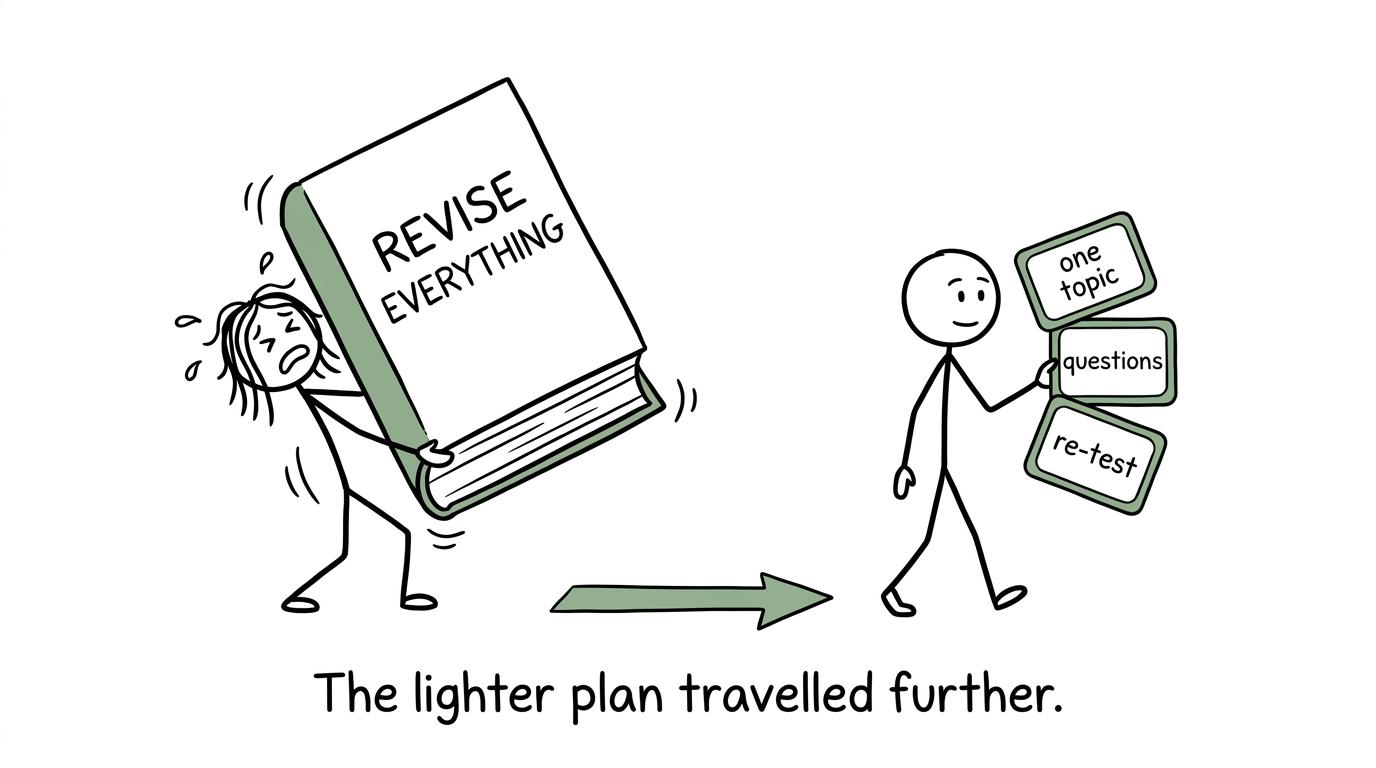 One student struggles with a huge revise-everything book while another carries a small practical plan
Make a realistic two-week recovery plan
A plan should be small enough to survive ordinary school weeks. You do not need to respond to one disappointing paper with hours of daily revision.
During the first week, use short sessions to repair your highest-priority topics. A session might contain:
- 101010 minutes reviewing the idea;
- 202020 minutes answering questions;
- 101010 minutes marking and recording corrections.
During the second week, re-test those topics and add mixed questions. Finish with a timed section rather than immediately sitting another complete paper.
For example, your schedule could focus on one content target and one exam skill at a time: interpreting data on one day, probability on another, then extended responses and timing later in the week. The GCSE one-month revision plan can help you place this recovery work inside a broader revision timetable.
Use a revision planner to record the task, date and result of each re-test. “Revise statistics” is not a plan. “Complete a histogram question set, mark it and retry errors on Friday” is.
Move from topic practice to exam conditions
Topic practice repairs individual tools. Timed papers teach you to choose and use those tools while the clock is moving.
Do not begin with repeated full papers if several topics remain insecure. That can reproduce the same mistakes without fixing them. Once your priority areas are improving, move through three stages:
- untimed mixed questions;
- a timed paper section or mini test;
- a complete paper in exam conditions.
When you attempt a full paper, use the correct specification, tier and exam board. GCSE Statistics arrangements are not identical across boards, so check whether you take AQA or Edexcel and whether you are entered for foundation or higher tier. The Edexcel GCSE Statistics revision page provides relevant worksheets, question practice and papers for Edexcel students.
Keep some unseen past papers for realistic practice. After each paper, repeat the audit: mark it, classify the errors and compare the new pattern with your mock. Improvement is not only a higher total. It may first appear as fewer blank answers, clearer conclusions or better timing.
 A dramatic exam clock fails to frighten a student using a calm checklist
Improve interpretation and extended responses
Students sometimes revise GCSE Statistics as though it were a list of calculator procedures. That misses a large part of the subject.
When interpreting a result, ask:
- What does the value or pattern show?
- Which data support that statement?
- Does the conclusion answer the original question?
- Is the sample representative?
- Could the collection method introduce bias?
- Does an association justify a causal claim?
- Are there outliers or other limitations?
Avoid stock phrases that could be attached to any question. A statement such as “the sample is biased” needs a reason grounded in the method given. Similarly, correlation alone does not establish causation.
If histograms were a weak area, the histograms revision guide reinforces why bar area represents frequency and why frequency density matters. Understanding that relationship is safer than relying on a half-remembered rule.
Common mistakes when recovering from a bad mock
Revising everything equally
Equal revision feels organised, but it ignores the evidence in your paper. Give more time to repeated, expensive errors while keeping stronger topics active through brief retrieval.
Chasing an unofficial grade boundary
A mock grade is indicative. Concentrate on gaining raw marks and improving the quality of your answers rather than trying to predict precisely where a future live boundary will sit.
Reading instead of answering questions
Notes and videos can rebuild understanding, but they do not prove independent recall. Every revision session should move into active questions.
Marking only the final answer
Method, notation, explanation and context can all matter. Study how the mark scheme awards marks, especially on multi-stage and evaluation questions.
Repeating full papers without repairing gaps
A past paper diagnoses weaknesses. Topic practice repairs them. Another timed paper then checks whether the repair survives under pressure.
Ignoring calculator and timing errors
Calculator fluency, scale reading and sensible time decisions are trainable skills. Practise them deliberately rather than dismissing every slip as carelessness.
Your mock can become the start of the plan
The uncomfortable part of a bad result is that it feels like evidence about your ability. The useful part is that it is actually evidence about your current preparation.
Those are not the same thing.
Take the paper apart. Find the marks that leaked through missing knowledge, weak methods, unclear interpretation or poor exam control. Repair the largest leaks first, re-test them and gradually return to timed papers.
Start now with the MathsGenie GCSE Statistics hub. Choose your exam board, revisit weak areas through free revision lessons and guides, then use practice questions, mark schemes and video solutions to make the methods secure. When you are ready, add mini tests, past papers and predicted papers to build timing and confidence. The mock has already told you what went wrong. Your next few revision sessions can decide what happens next.