Recover from a Bad GCSE Art and Design Mock
Recover from a bad GCSE Art and Design mock with a calm feedback plan, stronger portfolio evidence and a balanced GCSE maths revision routine that works.
A disappointing mock can make months of work feel as though they have been reduced to one number. That feeling is real, but the conclusion is usually wrong. To recover from a bad GCSE Art and Design mock, first separate the result from the evidence behind it: identify which assessment objectives were weakest, ask for precise feedback, improve the most valuable pieces and protect time for your other GCSEs.
A mock is diagnostic. It is not your final moderated result. Its value lies in showing where your portfolio, preparatory work or sustained response is not yet communicating what you can do.
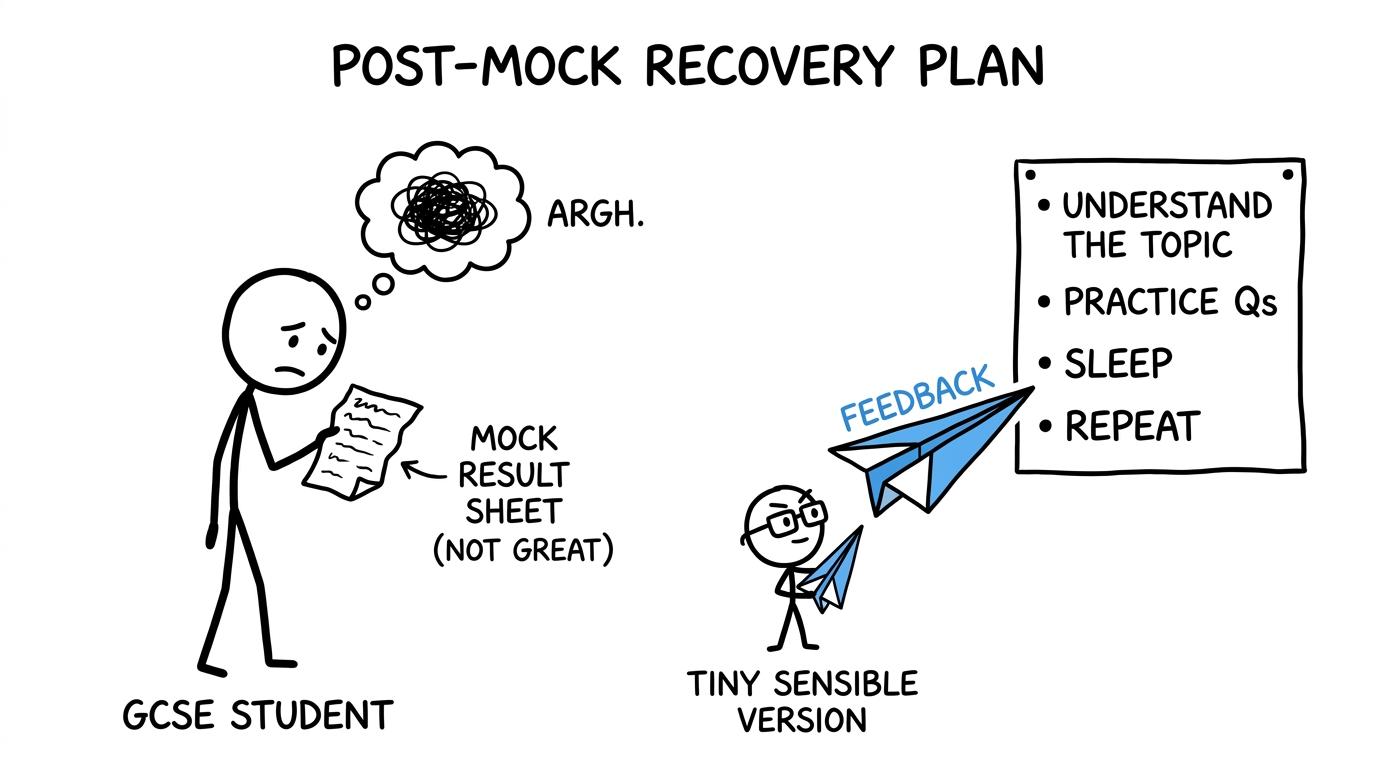 A student turns an upsetting mock result into useful feedback
Your recovery checklist
Start with this short plan:
- Wait until the first emotional reaction has settled.
- Ask for your marks or feedback by assessment objective.
- Compare the comments with the actual evidence in your work.
- Choose a small number of high-impact improvements.
- Confirm what may still be changed with your teacher.
- Put each task into a realistic weekly timetable.
- Keep maths and your other examined subjects moving.
- Review the work again with your teacher before the deadline.
The aim is not to remake everything. It is to make your artistic journey clearer, more intentional and better evidenced.
Understand what the mock was measuring
GCSE Art and Design is not judged simply by whether the final piece looks attractive. Across AQA, Edexcel, OCR and Eduqas specifications, assessment is built around four objectives. Each contributes 25%25\%25% overall:
- AO1: Develop ideas. Investigate relevant artists, designers, craftspeople and other sources, then use that research critically.
- AO2: Refine work. Explore and select media, materials, techniques and processes while improving ideas.
- AO3: Record ideas. Capture observations, intentions and insights as the work develops.
- AO4: Present a response. Produce a personal and meaningful outcome that realises your intentions and demonstrates visual understanding.
The qualification normally gives 60%60\%60% of its weighting to the portfolio component and 40%40\%40% to the externally set component. The exact component titles and raw marks vary by exam board, so use the specification and assessment grid provided by your school.
This structure matters because a low result may not mean that your practical ability is poor. You might have a technically strong final piece but limited experimentation. You may have researched an artist without showing how that research changed your own decisions. You might have produced useful photographs and sketches but failed to connect them visibly to the final response.
A general comment such as “develop this further” is difficult to act on. An AO-based diagnosis is much more useful.
Turn feedback into an evidence audit
Ask your teacher questions that lead to actions rather than reassurance:
- Which assessment objective restricted my mark most?
- What evidence is missing or underdeveloped?
- Which page or piece should I improve first?
- Is the problem quality, quantity, relevance or presentation?
- What can I still amend under the rules and school deadline?
- Can you show me what stronger development looks like without telling me what to create?
Then audit your work from beginning to end. Imagine that the moderator cannot hear you explain it. Can the pages themselves show where the idea began, what you investigated, which experiments succeeded or failed, why you changed direction and how the final response emerged?
That visible chain is important. A sketchbook should not feel like unrelated attractive pages. It should reveal decisions.
Look for broken connections
For each project, check whether the following links are clear:
- source investigation to initial idea;
- initial idea to first-hand recording;
- recording to material experiments;
- experiments to refinement;
- refinement to final intentions;
- intentions to the completed response.
When one link is missing, the project can look less developed than it really was. Your recovery task is often to expose the thinking that already happened, then add genuinely necessary development where it did not.
Improve each assessment objective deliberately
Strengthen AO1 without filling pages with biography
Artist research should help your work move. A long account of where an artist was born is rarely as valuable as focused analysis of composition, colour, texture, scale, process, meaning or context.
Explain what you noticed, what you tested and what you accepted or rejected. Make the connection to your own intentions explicit. The goal is not to imitate a source. It is to show critical understanding and use that source as part of an independent investigation.
Strengthen AO2 by showing refinement
Do not hide every unsuccessful experiment. Carefully selected trials can demonstrate that you compared possibilities and made informed decisions.
Test variations with a purpose: different materials, surfaces, arrangements, scales, colour palettes or processes. Annotate what each trial taught you and how it affected the next stage. Refinement means development through judgement, not merely producing several versions of the same thing.
Strengthen AO3 with relevant recording
Recording can include observational drawing, photography, notes, colour studies, compositional sketches and other forms appropriate to your title. First-hand material is particularly useful when it gives your project specificity.
Choose recordings that advance your intentions. A large collection of images is not automatically strong evidence. Selection matters. Explain why a viewpoint, object, texture or moment belongs in your project and how you intend to use it.
Strengthen AO4 by reconnecting the outcome
A final response needs to feel personal and meaningful, but it also needs roots. Return to the earlier pages and ask whether the outcome visibly draws together your sources, recordings, experiments and decisions.
If that connection is weak, the answer is not always to begin again. Better selection, additional refinement or clearer preparatory links may be more useful. Confirm the permitted next steps with your art teacher before altering assessed work.
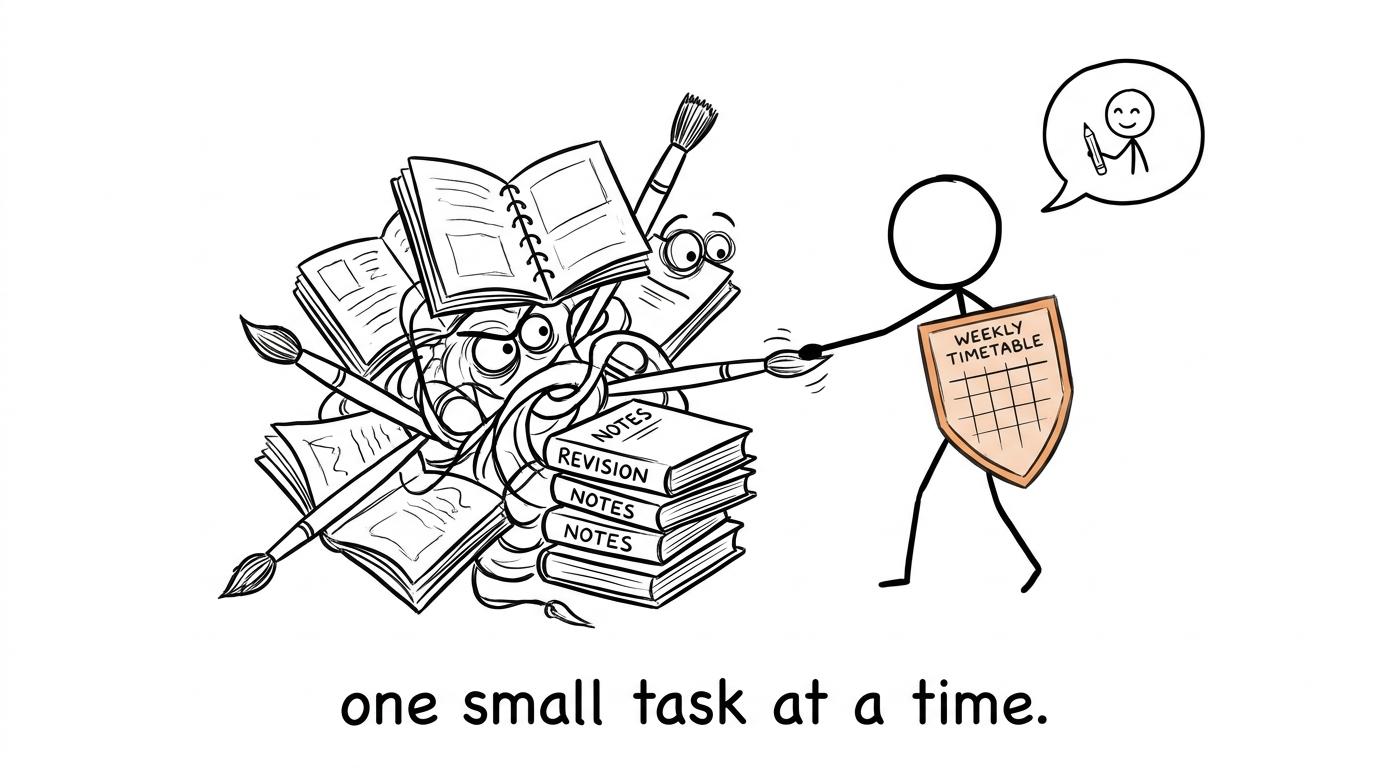 A student defeats the revision desk monster one small task at a time
Build an actual recovery plan
A plan should describe finished actions. “Do art” is not a useful task. “Complete two composition trials and annotate which arrangement best communicates isolation” is specific enough to start and finish.
Divide your list into three groups:
- Essential: missing evidence or weak work directly identified in feedback.
- Valuable: improvements that strengthen links across several objectives.
- Optional: presentation changes that matter only after the evidence is secure.
Give priority to tasks that improve more than one objective. For example, a purposeful observational study could strengthen recording while informing later refinement. An experiment connected clearly to source research may support both investigation and creative development.
Set short review points with your teacher. A small correction made early is cheaper than discovering after several evenings that you misunderstood the feedback.
Protect your GCSE maths revision
Art can expand to fill every available hour because there is always another page that could be adjusted. Maths is different: progress often comes from frequent, focused practice. Your timetable needs boundaries for both.
Keep a few non-negotiable maths sessions each week. Start at the GCSE Maths revision hub, choose the correct exam board and work at your foundation or higher tier. If you are unsure where marks are disappearing, use the weak-topic diagnostic approach rather than revising comfortable material.
A balanced week might contain short art repair tasks alongside maths topic practice, followed by one longer session for each subject. MathsGenie's Target Tests and mini tests are useful when time is limited because they provide a defined stopping point.
As exams approach, move from individual topics to GCSE past papers for different exam boards. Edexcel students can use the dedicated Edexcel GCSE Maths past papers, with mark schemes and worked solutions where available. The guide to efficient GCSE maths revision can help you build a repeatable learn, practise, mark and fix routine.
The important boundary is simple: do not let guilt about art erase maths revision, and do not use maths panic to avoid opening the sketchbook. Give each subject a defined next action.
Common mistakes after a bad mock
Starting the whole portfolio again
This creates work, but not necessarily better evidence. Diagnose first. Preserve strong material and repair the weakest links.
Chasing appearance instead of assessment evidence
Decorative layouts cannot replace investigation, experimentation, recording or a meaningful response. Presentation should make evidence easier to follow, not disguise its absence.
Writing annotations that only describe
“This is a pencil drawing” adds little. Explain intention, influence, decisions, evaluation and the next step. Annotation should reveal thinking that the image alone cannot communicate.
Copying an artist too closely
Research should inform an independent response. Use sources to provoke choices, comparisons and experiments rather than producing a near-copy with no personal direction.
Trying to repair everything in one weekend
Exhaustion makes judgement worse. Use a weekly plan with clear stopping points. If the wider exam season feels unmanageable, adapt the structure in the one-month GCSE maths revision plan across your subjects.
Ignoring teacher and assessment restrictions
Rules about assessed work, supervision, deadlines and access can depend on the component and your school's arrangements. Always ask before taking work home, replacing pages or changing material that may be under assessment controls.
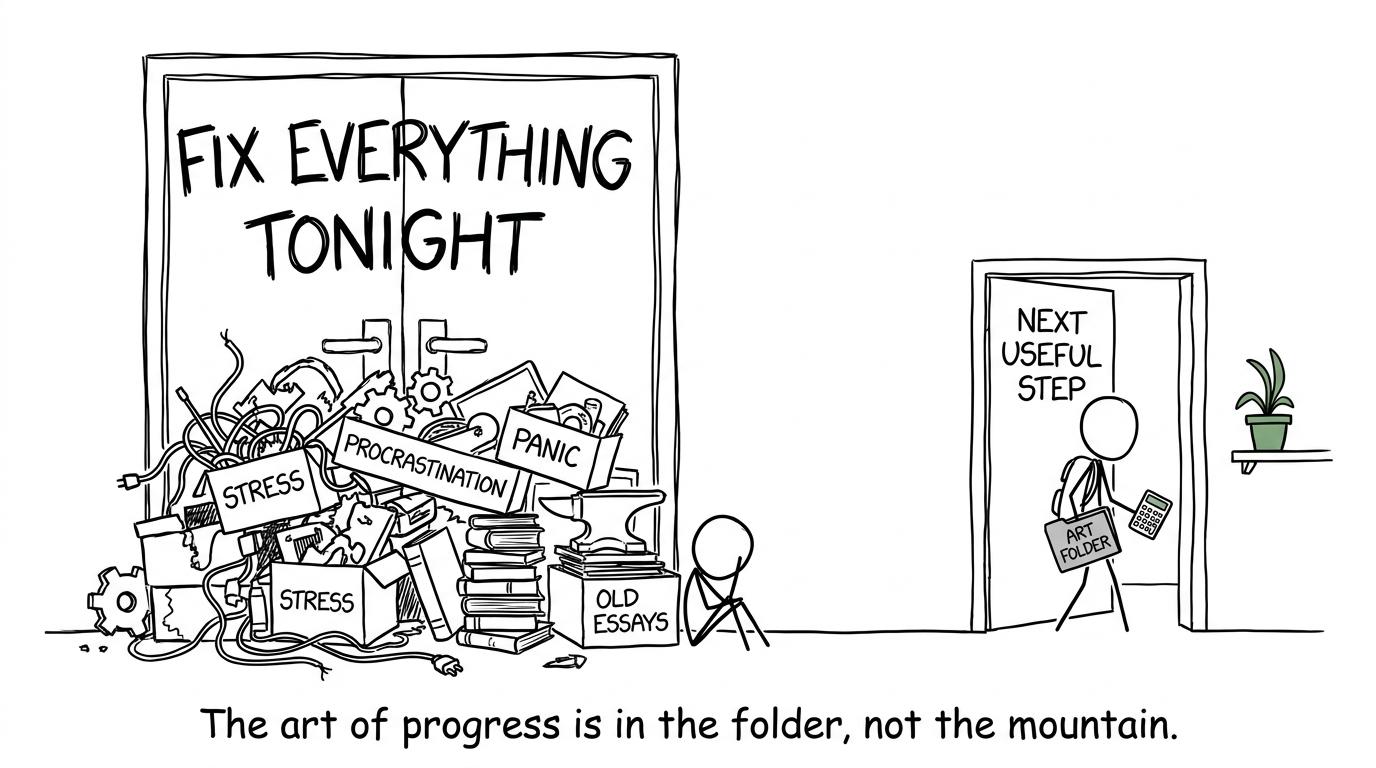 The next useful step is easier to enter than the door marked fix everything tonight
A disappointing result can become useful evidence
A bad mock hurts because it appears to close the argument: this is your level. In reality, a mock is most valuable when it begins a better argument. It shows what your current evidence communicates, where the chain of development breaks and what needs to happen next.
Recover calmly. Translate each comment into a visible task, improve the work with the greatest assessment value and ask for another review. Then keep the rest of your GCSE preparation alive.
For maths, let MathsGenie provide the structure: begin with free revision lessons, move into practice questions and mini tests, check your thinking with mark schemes and video solutions, then build exam confidence through past papers and predicted papers. You do not need to fix everything tonight. You need to complete the next useful step.