How to Rebuild Confidence After GCSE Art and Design Exam
Rebuild confidence after GCSE Art and Design exam stress with a calm plan for the weeks before results day, while protecting your remaining maths revision.
Finishing an Art and Design assessment with the feeling that it went badly is unusually difficult. In maths, you can sometimes remember an answer and check it. In art, judgement feels less certain, so your mind may keep replaying every unfinished detail.
The quickest way to rebuild confidence after a GCSE Art and Design exam is not to convince yourself that it secretly went brilliantly. It is to separate what has happened from what remains controllable: report any genuine assessment-day problem, stop repeatedly reviewing the work, restore your routine and redirect your attention towards the GCSE maths exams still ahead.
Confidence does not have to mean certainty about your grade. For now, it can simply mean trusting yourself to take the next useful step.
Your immediate confidence checklist
- Give yourself at least one evening without an exam post-mortem.
- Write down facts rather than predictions about what happened.
- Tell your teacher or exams officer promptly if illness or another serious event affected the assessment.
- Confirm your remaining GCSE maths dates, exam board and tier.
- Restart with one short, achievable maths task.
- Build a repeatable weekly routine rather than attempting a dramatic comeback.
- Make a practical results-day plan, then return your attention to the present.
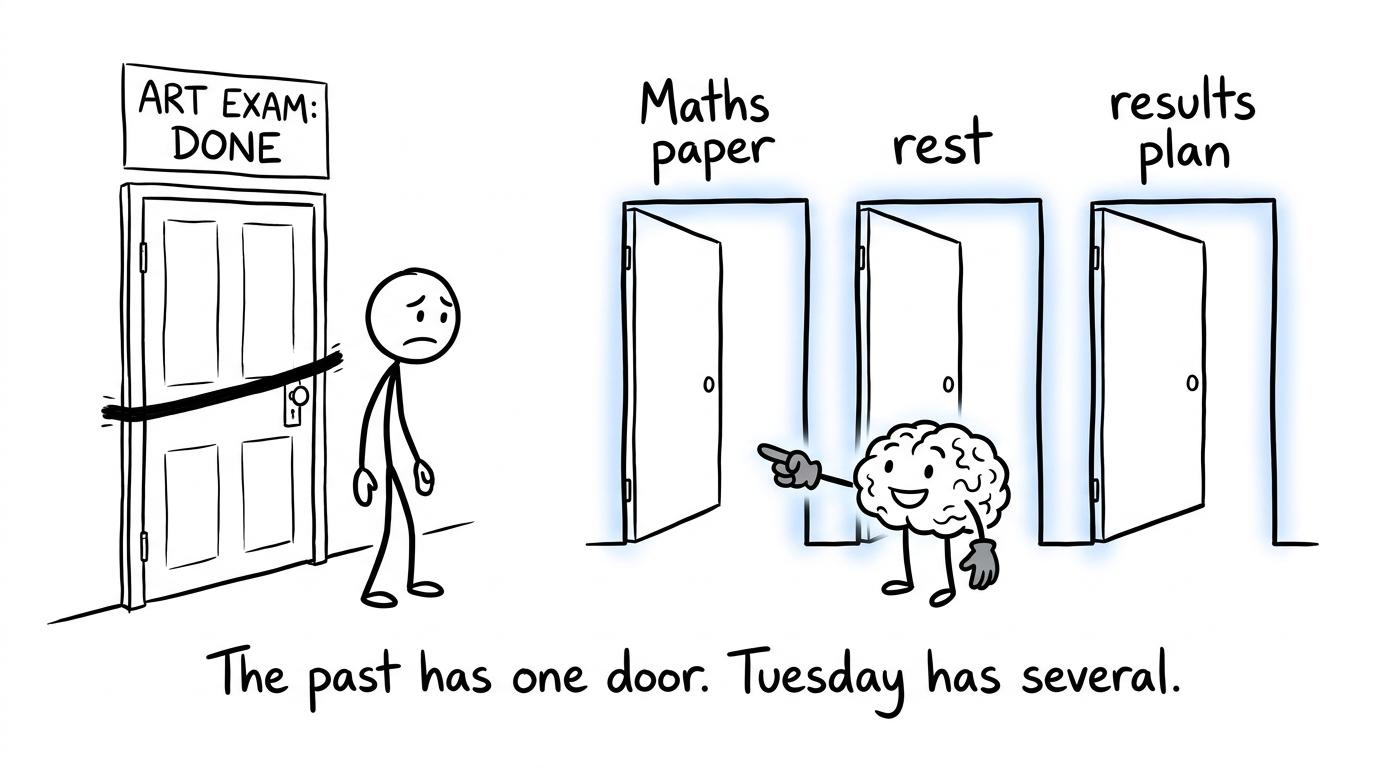 A student leaves the completed art exam behind and notices several useful doors still open
First, distinguish a bad feeling from a known result
An assessment can feel bad for several reasons. You may have run short of time, changed your idea late, compared your final piece with somebody else's or simply noticed every imperfection because you had been looking at the work for hours.
Those feelings are real, but they are not a mark scheme.
GCSE Art and Design is also broader than one final session. On specifications such as AQA and OCR, the portfolio contributes 60%60\%60% of the qualification and the externally set assignment contributes 40%40\%40%. Both components are assessed against defined objectives and moderated by the exam board. Precise arrangements vary, so check your own Edexcel, AQA, OCR or Eduqas specification with your teacher.
This does not prove that the assessment went well. It does show why one disappointing period should not automatically be translated into a prediction about your entire GCSE grade. Your portfolio evidence still matters, and your teacher's assessment will consider more than the single detail now occupying your thoughts.
Try dividing a page into two columns:
- Known: what happened, what you completed and whether an unusual event affected you.
- Imagined: the grade you fear, what an examiner might think and how everybody else supposedly performed.
Act on the first column. Do not build a revision strategy around the second.
What to do during the first two days
Close the assessment properly
Give yourself one brief opportunity to record anything important. If your school asks for reflections, follow its instructions. Otherwise, avoid conducting a detailed comparison with classmates or trying to reconstruct every decision.
There is a difference between reflection and rumination. Reflection produces a useful action. Rumination repeats the same worry without changing anything.
Unless your school explicitly tells you that work can still be completed under the assessment rules, do not assume that you can return to or alter it. Once the relevant supervised period or submission process has ended, the safest approach is to ask your teacher rather than guessing.
Report exceptional circumstances quickly
Feeling disappointed is not grounds for special consideration. However, temporary illness, injury, bereavement, a serious disturbance or another event outside your control may be relevant if it materially affected your performance.
Speak to your teacher or exams officer as soon as possible. Schools and colleges submit special consideration requests to awarding organisations, and official guidance warns against waiting until results are released. Explain what happened factually and provide any evidence your centre requests. The exam board, not the student, determines whether the published criteria are met.
Restore the physical basics
After an intense practical assessment, recovery is productive. Eat normally, move, spend time away from the work and protect your sleep. NHS guidance says most teenagers need around 888 to 101010 hours of sleep each night, and also recommends supportive conversation and physical activity during exam periods.
Rest is not surrendering the next exam. It is part of preparing for it.
Turn the remaining weeks towards GCSE maths
A difficult art assessment can create a dangerous thought: “Perhaps all my exams will go like that.” The best response is not an argument. It is evidence gathered through small, completed tasks.
Start by opening the GCSE Maths revision hub and checking that you know your board, tier and remaining papers. Edexcel, AQA, OCR and Eduqas organise their papers differently, while foundation and higher tier require different levels of content. The GCSE maths topics by exam board and tier guide can help you confirm the right path.
Choose a minimum you can complete on a difficult day
Your first maths session does not need to repair the entire course. Choose one modest action:
- complete a mini test;
- watch one revision lesson and answer the linked questions;
- mark a previously completed paper;
- practise one weak topic for 202020 to 303030 minutes;
- correct three questions from your error log.
A small task matters because it changes the story from “I am losing control” to “I completed what I planned”. That is how confidence usually returns through proof rather than positive slogans.
If you need a broader structure, use the GCSE maths revision timetable guide or adapt the one-month GCSE maths revision plan to the time you have left.
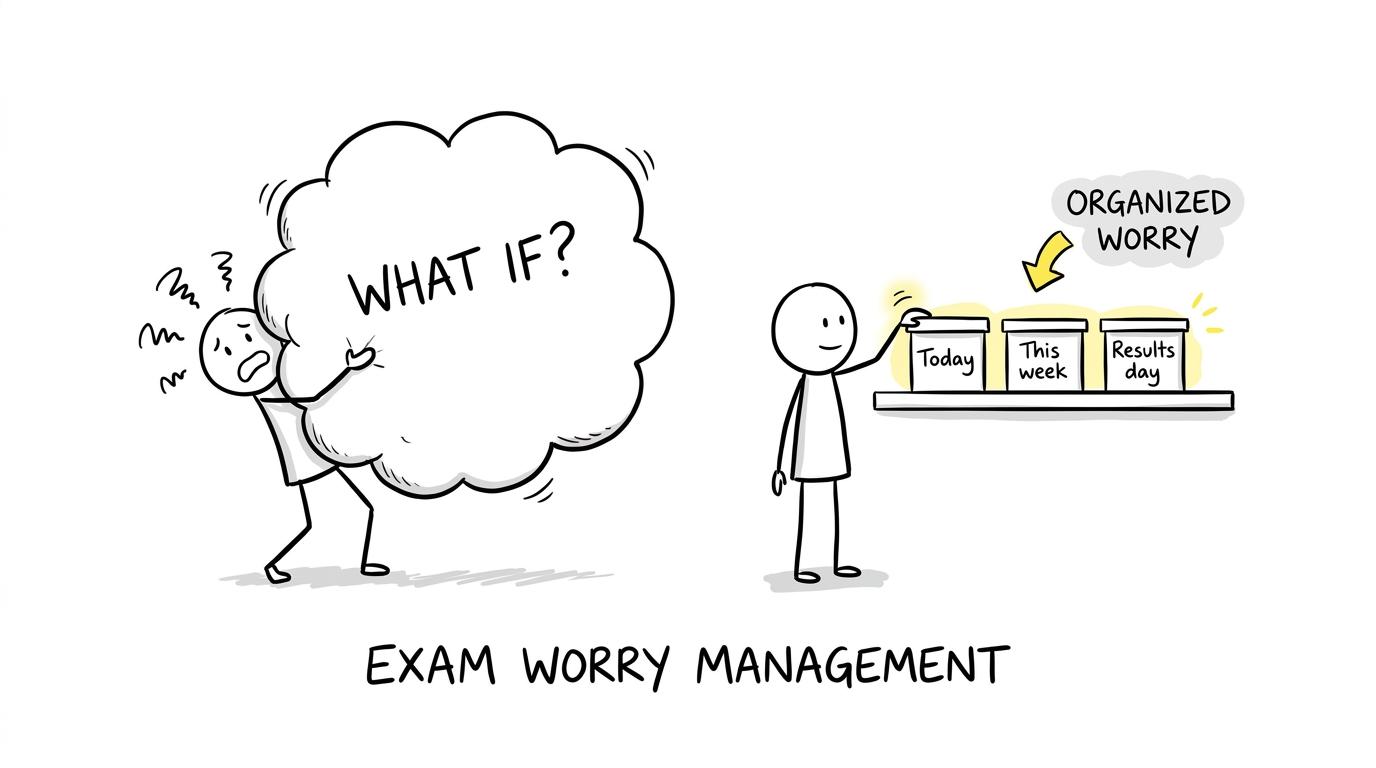 A student organises a giant worry cloud into manageable boxes
Use a learn, practise, mark and fix cycle
Passive revision can feel safe after a bad exam, but it provides little evidence of improvement. Use a short feedback loop instead:
- Learn: revisit one method using a MathsGenie revision lesson.
- Practise: answer questions without copying the method.
- Mark: use the mark scheme or video solution immediately.
- Fix: identify the precise reason for each lost mark.
- Retest: attempt a similar question on another day.
Choose your priorities from evidence. An AQA student can begin with the AQA GCSE Maths revision resources, while Edexcel students can use the Edexcel GCSE Maths past papers with mark schemes and available solutions.
Do not use the mark scheme as a verdict on your intelligence. Use it as a map of what earns marks.
Let paper practice rebuild exam trust
When one assessment has felt chaotic, predictable practice becomes valuable. Start with a short timed section or mini test before attempting a complete paper. Then progress to past papers and predicted papers that match your board and tier.
The useful rhythm is:
paper to mark to identify two weaknesses to practise to retest
The guide to using GCSE past papers properly explains how to turn every paper into targeted revision rather than simply collecting scores. If recall keeps fading between sessions, use the strategies in how to stop forgetting GCSE maths content.
Give worry a boundary
Trying never to think about results usually makes the thoughts louder. A better approach is to give them a limited appointment.
Set aside perhaps 101010 minutes in the early evening. Write down each worry and one action, if an action exists. For example:
- If the concern involves exceptional circumstances, contact your school.
- If it involves an entry requirement, check the requirement and identify whom to speak to on results day.
- If nothing can be done before results arrive, label it “wait for evidence”.
Outside that period, gently return to the task in front of you. This is not pretending the worry does not exist. It is refusing to let an unknown Art and Design mark consume the preparation time for known maths papers.
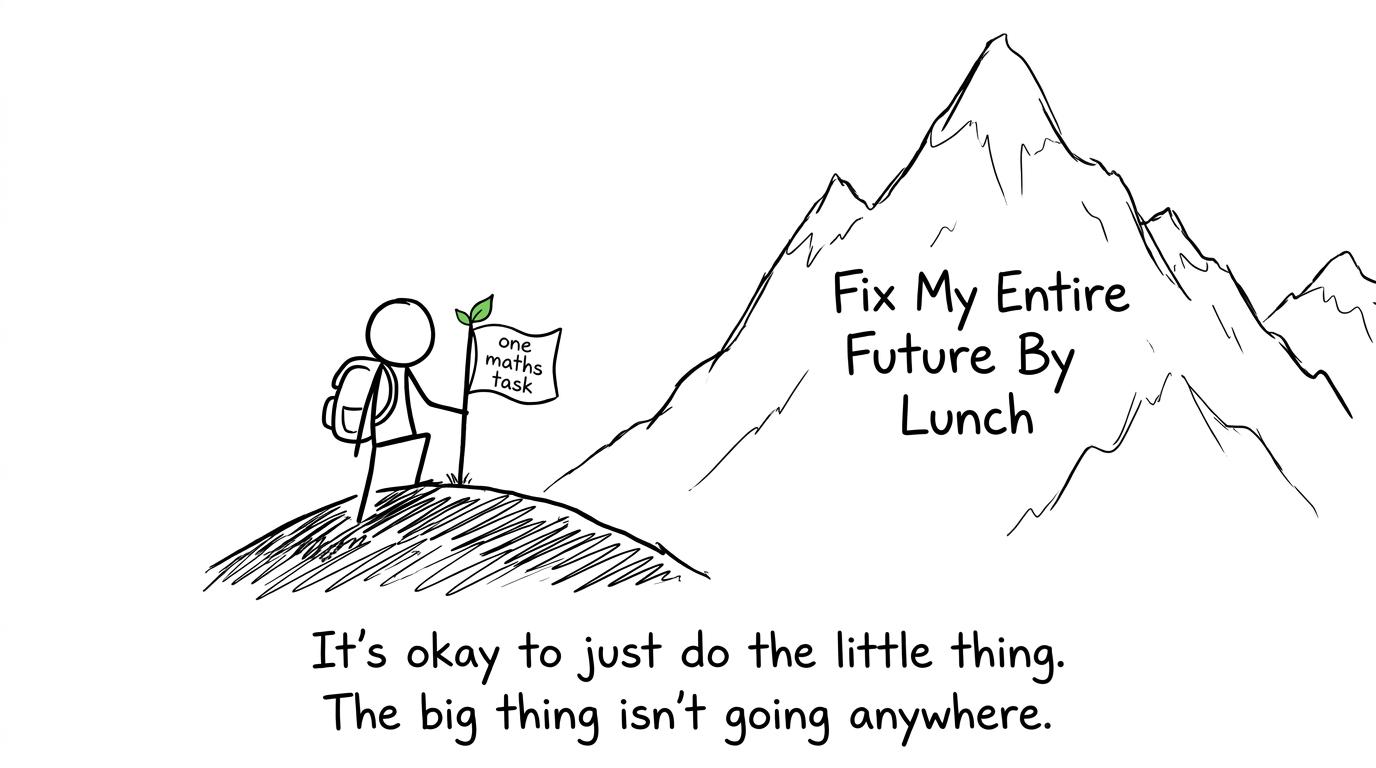 A student chooses one achievable maths task instead of fixing an entire future by lunchtime
Prepare for results day without living there
A results-day plan should reduce uncertainty, not become another revision project. Before the day, know:
- when and how your school releases results;
- which supportive person you want nearby;
- the entry requirements for your intended sixth form, college or course;
- whom to ask about component marks and post-results options;
- one realistic alternative if the result is lower than expected.
For summer 202620262026, GCSE results in England are released to students on Thursday 20 August. Follow your school's collection instructions because arrangements vary.
If your Art and Design result is surprising, speak to your teacher before assuming that a review is the answer. Art and Design components commonly involve centre marking and external moderation, so the relevant post-results process may differ from a review of marking for a written paper. Your school can examine the available mark information, advise whether a review of moderation is appropriate and explain the possible outcomes.
Having a plan matters. Spending every day rehearsing the worst outcome does not.
Common mistakes after a disappointing art assessment
Treating your feeling as a grade prediction
Students see the rushed corner or abandoned idea. Assessors consider evidence across the relevant component and assessment objectives. Wait for the actual result before making conclusions.
Comparing final pieces without comparing the full evidence
A classmate's work may look immediately impressive, but appearance alone does not reveal how the assessment objectives have been evidenced. Comparison offers very little reliable information and often damages concentration.
Allowing one exam to contaminate every remaining subject
An Art and Design assessment and a GCSE maths paper demand different skills. A difficult experience in one does not predict the other. Return to board-specific maths questions and create fresh evidence.
Revising maths for hours to punish yourself
An extreme timetable may feel like taking control, but exhaustion quickly reduces accuracy and attention. Choose a routine you can repeat, including breaks, meals and sleep.
Waiting to mention a serious assessment-day problem
If illness or an unforeseen event genuinely affected the assessment, tell your school promptly. Do not wait until results day and assume the process can easily be corrected afterwards.
Confidence returns through the next useful action
You cannot edit an assessment that has finished, and you cannot know its final moderated result in advance. But you can decide what the weeks before results day contain.
Let them contain rest, sensible conversations and maths revision that produces visible evidence of progress. Start with one lesson. Answer the practice questions. Check the mark scheme. Use a mini test to confirm the skill, then build towards board-specific past papers and predicted papers.
MathsGenie's free GCSE maths resources bring revision lessons, practice questions, mini tests, past papers, predicted papers, mark schemes and video solutions together. Choose one manageable task today. Confidence rarely returns all at once; it returns each time you keep a small promise to yourself.