Ready for GCSE Engineering Early Sitting?
Ready for GCSE Engineering early sitting? Use this evidence-based checklist to assess exam knowledge, practical work, maths skills and maturity.
There is a large difference between wanting to finish a GCSE early and being ready to finish it well. Enthusiasm can get you to the workshop. It cannot complete the prototype, explain a manufacturing process or recover marks under timed pressure.
If you are asking whether you are ready for GCSE Engineering early sitting, the short answer is this: you need consistent evidence across the written paper, non-exam assessment, engineering maths and independent decision-making. One strong mock or a finished-looking product is not enough. Your teacher and exams officer must also confirm that an early entry is practical under your specification and school policy.
This guide focuses on AQA GCSE Engineering, currently the main GCSE Engineering specification in England. Always check the exact qualification you are taking before making plans.
The early-sitting readiness checklist
You are more likely to be genuinely ready if you can:
- cover the complete specification rather than only your favourite areas
- produce stable results across several timed assessments
- explain engineering choices using evidence and technical vocabulary
- complete the correct non-exam assessment under the required conditions
- use measurements, units, formulae, graphs and tolerances accurately
- work safely and independently during practical activity
- identify weaknesses without waiting for a teacher to find them
- manage Engineering alongside GCSE Maths and your other subjects
- accept that delaying may be the stronger decision if the evidence is mixed
The central idea is simple: readiness is a pattern, not a feeling.
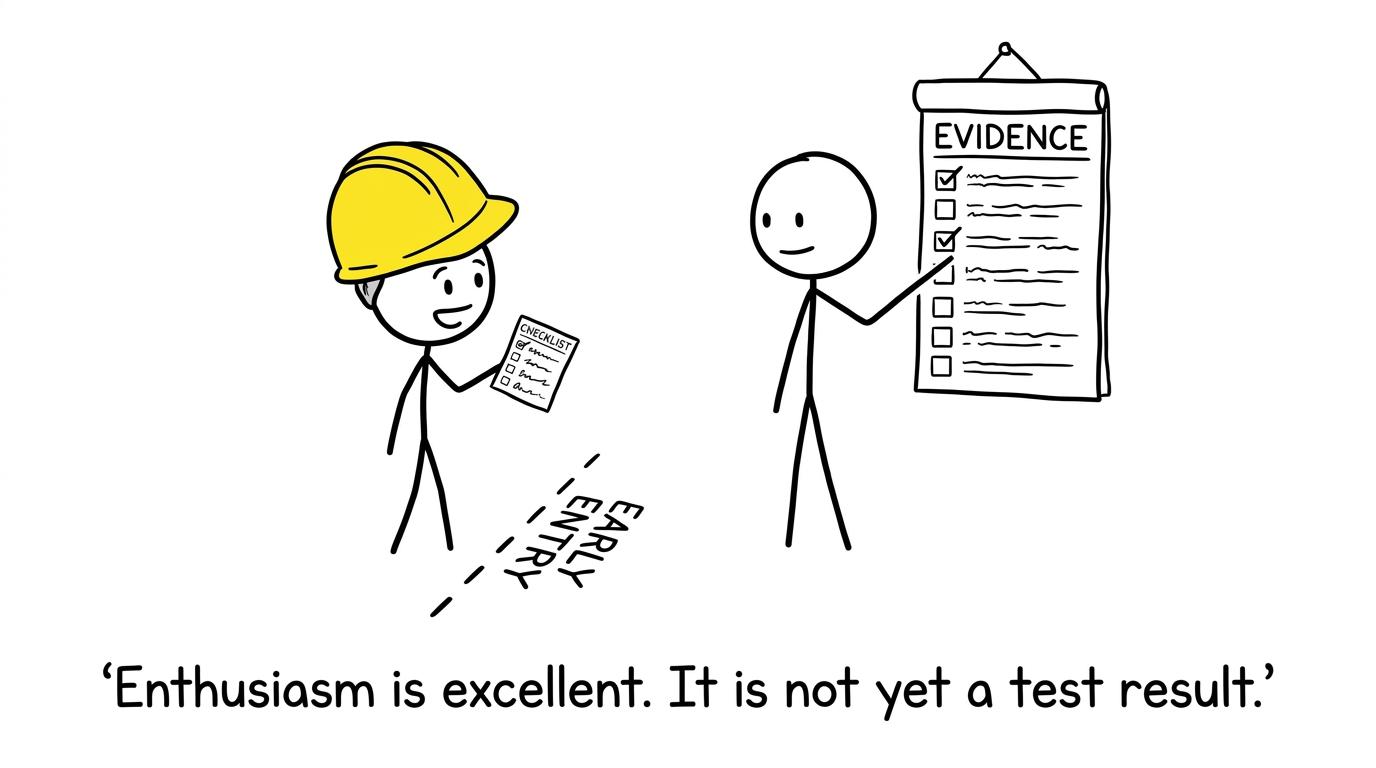 A keen student discovers that enthusiasm and evidence are different things
First understand what must be completed early
AQA GCSE Engineering is a linear qualification designed to be taught over two years. Linear means that the written examination and non-exam assessment must be completed for certification in the same exam series.
The assessment has two components:
- a written paper lasting two hours, worth 120120120 marks and 60%60\%60% of the qualification
- a practical engineering non-exam assessment, worth 808080 marks and 40%40\%40% of the qualification
The non-exam assessment is a design-and-make activity based on an annual brief. AQA indicates that it should take approximately 303030 hours and include a working prototype alongside a concise portfolio. The work covers areas such as investigation, problem-solving, engineering drawings, production planning, manufacturing, testing and evaluation.
That structure matters. Sitting early does not mean taking only the written paper ahead of schedule. You must have completed the appropriate brief for your intended exam series, and your work must meet the supervision and authentication requirements. AQA also states that this specification is not available to private candidates, so an early entry needs to be arranged through a school or college offering the course.
Before revising harder, ask your teacher three practical questions:
- Which exam series would I enter?
- Can the correct non-exam assessment be completed and authenticated in time?
- Does the school support the entry after considering my full timetable?
Without clear answers, early sitting is only an idea.
Genuine readiness shows up across the whole specification
A student who is merely keen often races ahead through visible content. They may know several materials, enjoy practical work and speak confidently about designs. A ready student can also handle less exciting demands: quality control, process selection, technical communication, environmental considerations, systems and detailed evaluation.
Use the official specification as a coverage document. For every area, classify yourself as:
- secure without support
- partly secure
- not yet secure
Then test those judgements with closed-book questions. If your confidence says “secure” but your answers repeatedly lose marks, trust the answers.
This is the same discipline used in effective maths revision. The GCSE Maths revision hub helps you move from a lesson to practice questions and then to exam evidence, rather than mistaking recognition for recall.
Your results should be stable, not spectacular once
One high mark can be encouraging, but it may reflect familiar questions, generous marking or a topic that suited you. Readiness appears across several assessments completed on different days.
Record your percentage on each suitable mock or past paper using:
Percentage score=marks achievedmarks available×100\text{Percentage score}=\frac{\text{marks achieved}}{\text{marks available}}\times 100Percentage score=marks availablemarks achieved×100Do not invent a personal “safe grade boundary” from one historical paper. Grade boundaries can vary between exam series. Instead, ask your teacher to review several scripts and judge whether your performance is consistently appropriate for your target grade.
The pattern inside the marks matters too. A total can hide recurring weaknesses in calculations, extended responses or unfamiliar practical contexts. The guide to using GCSE past papers properly explains how to mark strictly, create an error log and retest weak skills.
Your non-exam assessment must demonstrate engineering thinking
A polished prototype can distract from a weak process. GCSE Engineering rewards more than the final object: it assesses how you investigate, plan, produce, test and evaluate a solution.
Strong readiness signs include being able to:
- interpret the brief without repeatedly asking what to do next
- compare possible solutions against relevant criteria
- communicate ideas through suitable engineering drawings and diagrams
- select materials and processes for defensible reasons
- plan a logical production sequence
- use tools and equipment safely
- apply quality control and work to appropriate tolerances
- design meaningful tests linked to the requirements
- evaluate limitations honestly and recommend precise improvements
Your work must also be your own and capable of authentication. Being ready therefore includes knowing when feedback is permitted, recording assistance correctly and resisting the temptation to let someone else solve a difficult design decision.
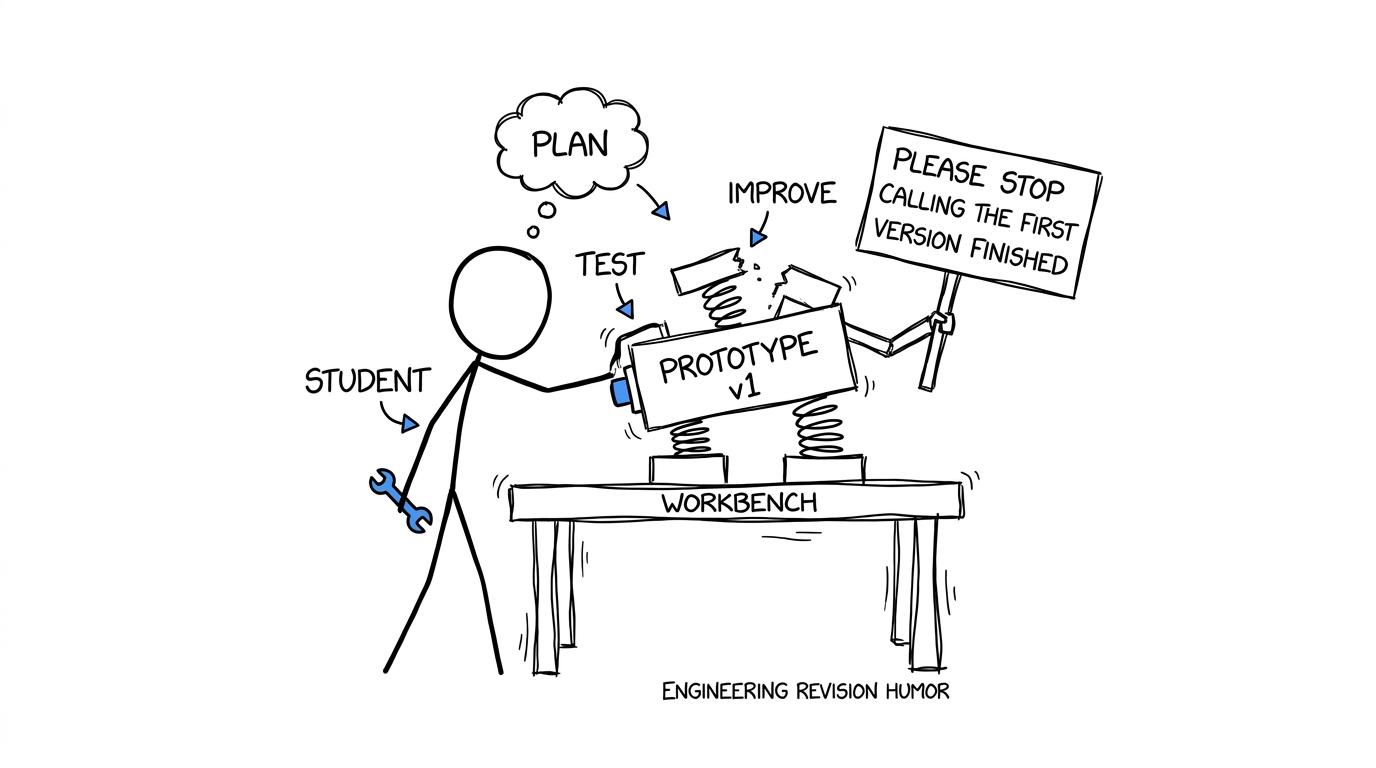 A prototype objects to being called finished before testing
Engineering maths should feel dependable
The written paper includes calculations in engineering contexts, so mathematical fluency is part of readiness. You should be comfortable using formulae, rearranging equations, converting units, reading graphs, interpreting scale drawings and working with dimensions, area and volume.
Accuracy with units is especially important. A numerical answer without the required unit may be incomplete, while an incorrect conversion can make an otherwise sensible design unusable.
Test whether you can:
- substitute values into formulae accurately
- rearrange a simple formula without relying on a memorised example
- calculate percentages and proportional changes
- use ratio and scale
- find perimeter, area, surface area and volume
- interpret gradients and information from graphs
- round to a degree of accuracy justified by the context
- check whether an answer is physically reasonable
MathsGenie organises these skills by board and tier. You can use the AQA GCSE Maths past papers for timed practice or check the full GCSE Maths topics by exam board and tier to locate gaps. Your Engineering qualification is not divided into foundation and higher tiers, but your separate GCSE Maths course will be, so practise at the tier your school has entered you for.
Readiness includes time, stamina and judgement
Early entry creates an opportunity cost. Every extra hour spent accelerating Engineering is an hour unavailable for Maths, English, science or rest. The question is not simply, “Can I pass early?” It is, “Can I prepare early without weakening the rest of my GCSE programme?”
A ready student can follow a realistic plan for several weeks. They do not depend on last-minute bursts or sacrifice sleep whenever a deadline approaches. They can sit a full two-hour assessment, remain accurate near the end and still maintain their other subjects.
Create a weekly plan that includes specification review, timed questions, non-exam assessment commitments and maths maintenance. The GCSE Maths revision timetable guide offers a useful model for balancing focused practice with paper work and review.
Maturity matters as well. Genuine readiness sounds like: “My testing evidence is weak, so I need to improve it.” Mere keenness sounds like: “I enjoy the subject, so I will probably be fine.” The first statement invites action. The second protects confidence from evidence.
Run a readiness trial before deciding
Use a short trial period agreed with your teacher rather than making the decision after one conversation.
Over several weeks:
- complete multiple timed written assessments without notes
- have them marked using the relevant mark schemes
- record every lost mark by topic and reason
- revisit weak knowledge and retest it later
- ask your Engineering teacher to audit your specification coverage
- review whether the correct non-exam assessment can be finished properly
- monitor the effect on Maths and your other GCSE subjects
- hold a final meeting with your teacher, parent or carer, and exams staff where appropriate
A useful error log separates missing knowledge from poor application, unclear written communication, calculation errors and time pressure. MathsGenie’s guide to finding your weakest GCSE topics shows how to turn lost marks into a focused practice plan.
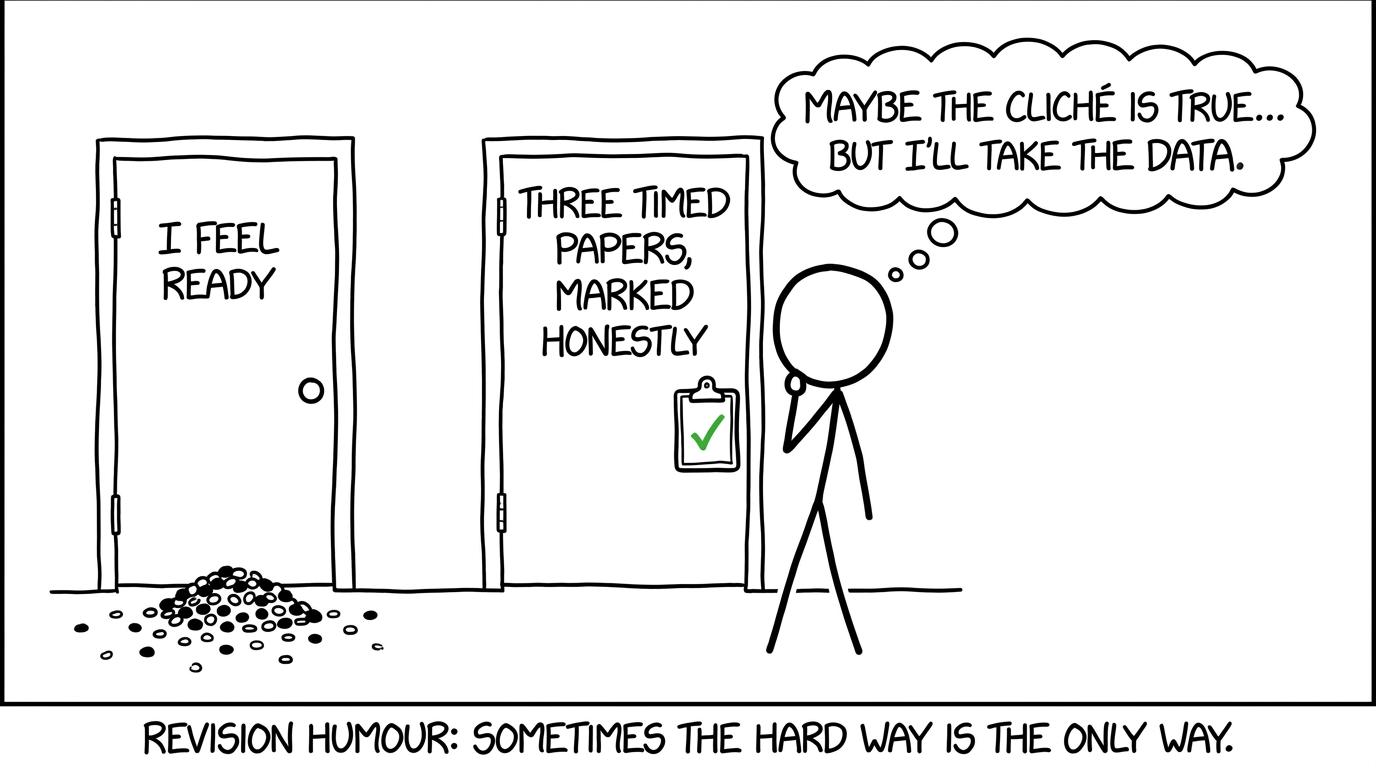 A student chooses measured evidence over a confident feeling
Common mistakes when considering an early sitting
Confusing interest with complete preparation
Enjoying practical engineering is valuable, but the written paper also demands knowledge, application, analysis and extended explanation. Audit every specification area.
Judging readiness from one mock
A single result is a snapshot. Use several timed assessments, marked consistently, and look for repeated strengths and weaknesses.
Treating the prototype as the whole assessment
The portfolio, planning, drawings, testing and evaluation all matter. A product that works does not automatically demonstrate a strong engineering process.
Ignoring the annual brief and entry arrangements
The non-exam assessment must match the intended series and follow the required conditions. Your school must be able and willing to administer the qualification correctly.
Neglecting calculation skills
Students sometimes revise technical facts while postponing unit conversions, formulae and graphs. Use short, regular maths checks. Edexcel GCSE Maths mini tests are useful if Edexcel is your Maths board, while students on other boards should select matching resources from the main hub.
Assuming an early result is automatically better
An early certificate does not compensate for a lower grade or unnecessary pressure. There is no weakness in taking a two-year qualification over two years. Sometimes patience is the most engineering-minded decision because it gives you more time to test, refine and improve.
Make the decision from evidence
Being ready to sit GCSE Engineering early is not about being the fastest student in the room. It is about having enough knowledge, practical competence, mathematical accuracy and personal organisation for your performance to survive unfamiliar questions and real deadlines.
Start by asking your Engineering teacher to check the specification, annual brief and entry arrangements. Then gather evidence through timed assessments, honest marking and a review of your non-exam assessment progress. If the pattern is secure and your other subjects remain healthy, an early sitting may be reasonable. If the pattern is uneven, you have learned something useful before the result became permanent.
Use MathsGenie’s free GCSE Maths resources to strengthen the calculations behind Engineering. Combine revision lessons with practice questions, mark schemes and video solutions, then use mini tests, past papers and predicted papers to check whether your skills hold under pressure. Enthusiasm starts the journey. Evidence tells you when you are ready.