Read Answers Aloud GCSE Statistics: Does It Help?
Read answers aloud GCSE statistics guide: learn how your voice exposes missing comparisons, weak evidence and vague conclusions before the exam.
A statistics answer can look perfectly sensible when you have just written it. Your brain knows what you intended, so it quietly supplies connections that never reached the page. The examiner, unfortunately, cannot see those invisible connections.
So, does it help to read answers aloud GCSE statistics students have written? Yes, particularly when checking comparisons, conclusions, evaluations and explanations. Hearing an answer can expose missing evidence, vague references and sudden leaps in reasoning that silent reading overlooks. It will not correct faulty mathematics by itself, but it is a useful proofreading tool when combined with a mark scheme and fresh practice.
The important distinction is simple: reading aloud does not create statistical understanding. It helps you inspect how clearly that understanding has been communicated.
The quick answer-checking checklist
Use this approach after completing an extended statistics question:
- Read the question again and identify its command word.
- Read your answer aloud exactly as written; do not improve it while speaking.
- Pause wherever the logic feels abrupt or the sentence becomes difficult to say.
- Check that every claim is supported by a statistic, graph feature or sampling fact.
- Add the context of the question rather than writing only about anonymous “values”.
- Compare your response with the mark scheme.
- Rewrite it once, then test the same skill on a fresh question.
This works especially well for questions involving data comparisons, sampling, correlation, conclusions and reliability. Start with the free GCSE Statistics revision hub to find exam-board-specific resources and questions.
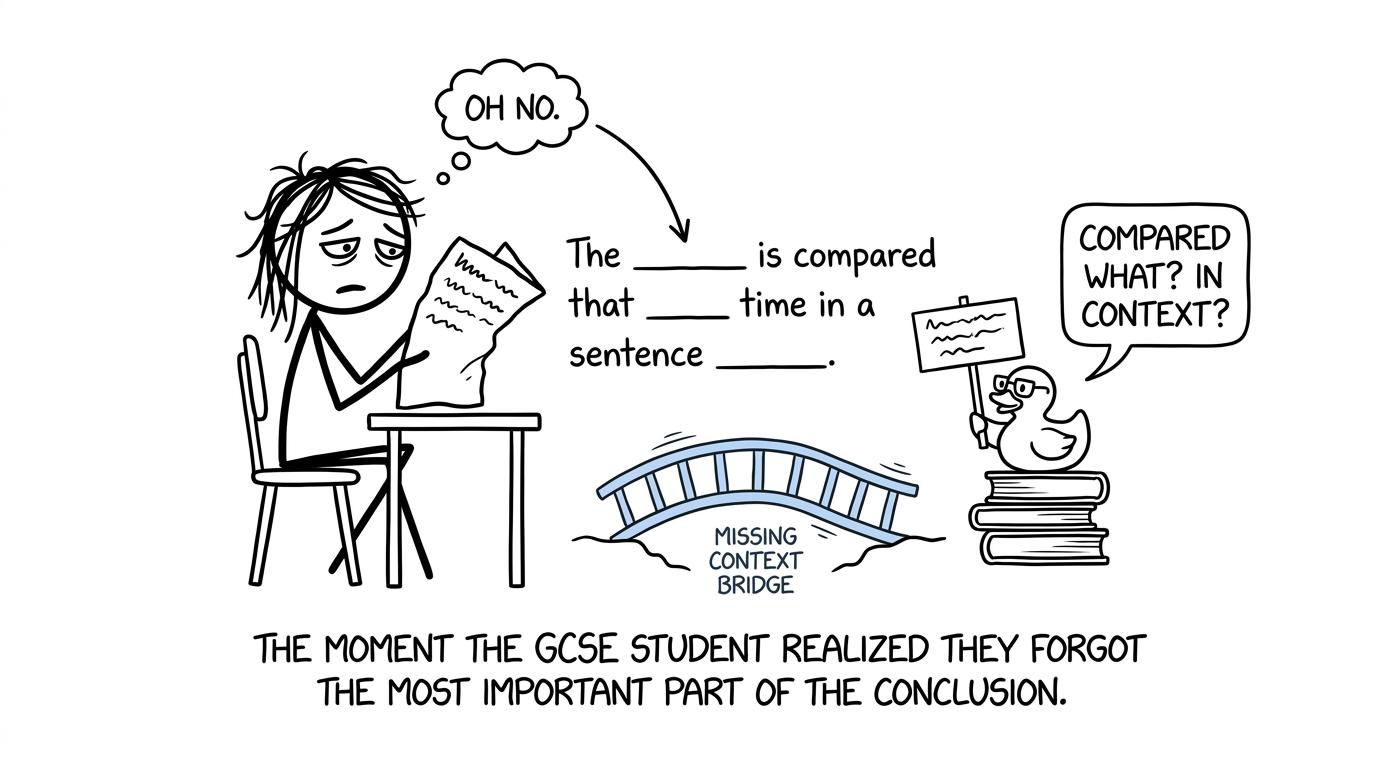 A student discovers a missing logical bridge while reading a statistics conclusion to a rubber duck
Why silent reading can miss structural problems
When you reread your own answer silently, you are not approaching it as a new reader. You remember the graph, the calculation and the conclusion you meant to express. That familiarity encourages the brain to move quickly over gaps.
Suppose your intended argument has this structure:
evidence⟶interpretation⟶conclusion\text{evidence} \longrightarrow \text{interpretation} \longrightarrow \text{conclusion}evidence⟶interpretation⟶conclusionIf the written answer contains only the evidence and conclusion, you may still experience the complete argument because the interpretation remains in your head. An examiner receives only what appears on the page.
Reading aloud slows the process down. You must produce each word in sequence, and your ears receive the sentence as a listener would. A missing comparison, unexplained pronoun or unsupported conclusion often becomes more noticeable.
Controlled research into proofreading has found that reading aloud can improve error detection compared with silent reading. Research on the broader “production effect” also suggests that spoken material can become more distinctive in memory. However, recent evidence does not show that reading a passage aloud automatically improves deeper comprehension. That limitation matters: the technique should supplement mathematical revision, not replace it.
What reading aloud can reveal in statistics answers
A comparison with only one side
A common answer says that one group has a higher median and then stops. That may identify a difference in typical value, but a fuller comparison question can also require an appropriate measure of spread.
For box plots, the relevant measures may include:
IQR=Q3−Q1\operatorname{IQR}=Q_3-Q_1IQR=Q3−Q1and
range=maximum−minimum.\text{range}=\text{maximum}-\text{minimum}.range=maximum−minimum.When spoken, an incomplete response can sound noticeably one-sided: “Group A has a higher median.” Higher than what, and what does that mean in context? If spread is relevant, has it also been compared?
The box plots revision guide can help you review the mathematical content before using the aloud check on your written comparisons.
Evidence without interpretation
A value is not yet a conclusion. An answer may quote a median, percentage or correlation but fail to explain its significance.
Read the sentence and ask:
- What does this value show?
- Which group or variable does it describe?
- Does it answer the original question?
- Have I used the units or context?
GCSE specifications require students to interpret statistical information, reason from it and draw conclusions in context. In the separate GCSE Statistics qualification, communicating findings and evaluating reliability are particularly important parts of the statistical enquiry cycle.
A conclusion stronger than the data supports
Statistics answers often need cautious language. A sample can provide evidence about a population, but its reliability depends on how that sample was selected. Correlation describes an association; it does not, by itself, establish causation.
The sentence “this proves that one variable causes the other” sounds confident. Once spoken, it may also sound suspiciously absolute. A more defensible conclusion will match the strength and limitations of the evidence.
When revising paired data, use the scatter graphs revision guide to review correlation, lines of best fit, interpolation and the dangers of extrapolation.
Missing context
Students sometimes write technically correct but context-free statements such as “the second group is more consistent”. A reader still needs to know what was measured and which real groups are being discussed.
Reading aloud makes repeated phrases such as “it”, “they” and “the data” easier to notice. Replace unclear references with the actual variable, population or group. This does not mean making every sentence long. It means giving the statistical statement somewhere to belong.
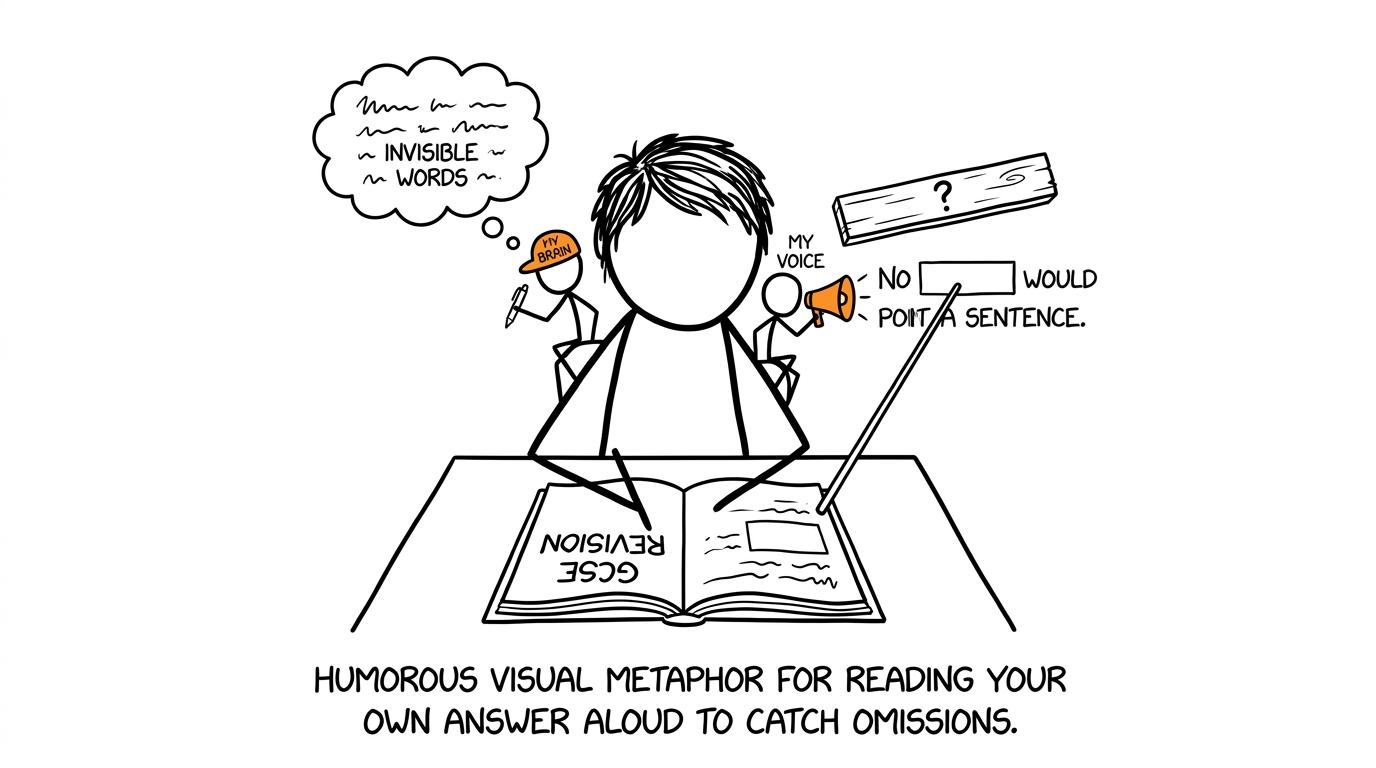 A student's voice catches omissions that the brain tries to fill in
A practical read-aloud routine for GCSE revision
Choose answers where communication matters
Do not read every line of arithmetic aloud. The method is most useful for responses containing words such as:
- compare;
- explain;
- interpret;
- evaluate;
- justify;
- comment;
- conclude.
Use questions from the Edexcel GCSE Statistics revision page, or select statistics questions from your own AQA, Edexcel, OCR or Eduqas GCSE Maths materials. Match the resource to your specification and tier.
Leave a short gap before checking
Immediate proofreading is difficult because the intended answer is still vivid. When revision time allows, complete another question before returning. Even a short separation can make the wording feel less familiar.
Then cover the graph or source material temporarily and read only your response. Does the argument still make sense? Uncover the information afterwards and verify every numerical claim.
Read exactly what is on the page
This is the hardest rule. If you automatically insert a missing word while speaking, the technique loses much of its value.
Use a pen to follow each phrase. If you stumble, underline the spot rather than repairing it immediately. A stumble does not always mean the mathematics is wrong, but it can signal an overloaded sentence, omitted link or unclear reference.
Use an evidence, meaning, and context test
For each conclusion, look for three parts:
- Evidence: the relevant value, feature or property.
- Meaning: what that evidence indicates.
- Context: the variable, group or population involved.
This is a checking framework, not a sentence template to reproduce mechanically. Statistical questions vary, and mark schemes reward relevant reasoning rather than memorised filler.
For graphical comparison practice, the cumulative frequency revision page brings together lessons, questions and revision resources on medians, quartiles and spread.
Check the mathematics separately
A fluent sentence can still contain the wrong statistic. After the aloud check, verify calculations, graph readings and terminology. For instance, an estimated mean from grouped data uses class midpoints and remains an estimate:
estimated mean=∑fx∑f.\text{estimated mean}=\frac{\sum fx}{\sum f}.estimated mean=∑f∑fx.Use averages from frequency tables practice to strengthen that underlying skill. Reading aloud may help you notice that you forgot to say “estimate”, but only mathematical checking confirms that your calculation is valid.
Compare with the mark scheme
Your voice identifies places worth investigating. The mark scheme tells you what the assessment required.
After marking, label each lost mark as one of the following:
- knowledge;
- calculation or method;
- interpretation;
- context;
- evaluation;
- unclear communication.
Then rewrite only the weak section. This turns proofreading into targeted improvement rather than endless polishing.
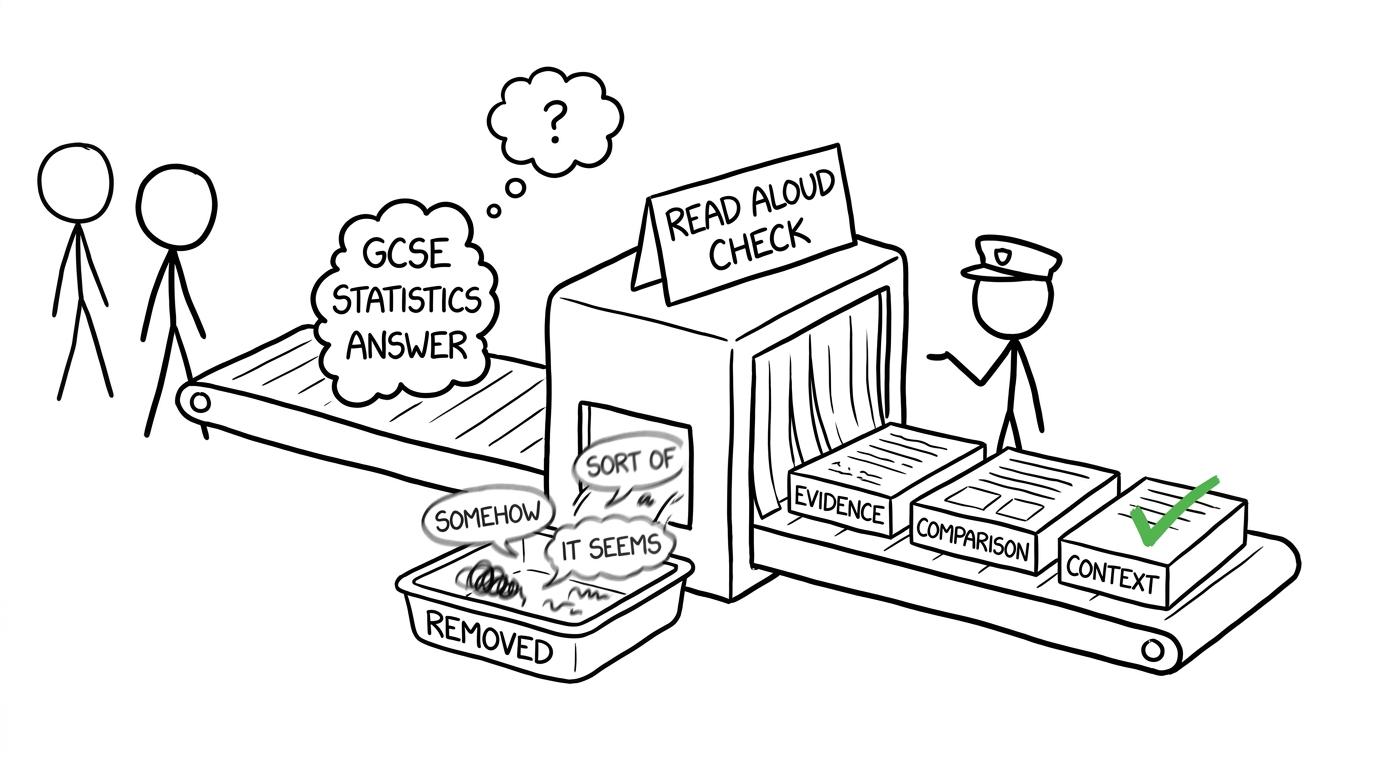 A playful read-aloud security check removes vague words and unsupported leaps
How this fits into effective revision
Reading aloud is an editing technique, not a complete revision strategy. Its value appears after you have attempted a question independently.
A productive cycle is:
attempt⟶read aloud⟶mark⟶correct⟶reattempt.\text{attempt} \longrightarrow \text{read aloud} \longrightarrow \text{mark} \longrightarrow \text{correct} \longrightarrow \text{reattempt}.attempt⟶read aloud⟶mark⟶correct⟶reattempt.That final reattempt matters. If you only rewrite the old answer while looking at the mark scheme, you may improve one paragraph without becoming better at the next question.
Use topic practice first, followed by mixed questions and timed papers. The guide to using GCSE Maths past papers properly explains how to turn mistakes into focused revision. Near the exam, Edexcel GCSE Maths predicted papers can provide fresh questions, but predicted papers should test your progress rather than replace full specification coverage.
In a live examination, follow the invigilator’s instructions and check silently so that you do not disturb anyone. Train the spoken routine during revision; in the exam, recreate its questions internally: Where is my evidence? What does it mean? Have I answered in context?
Common mistakes when using the technique
Reading fluently instead of accurately
Students often say what they meant rather than what they wrote. Track the words with your pen and stop whenever your spoken version differs from the page.
Treating awkward wording as the only problem
A polished sentence can hide an incorrect median, unsuitable average or biased sample. Complete a separate mathematical check after proofreading.
Adding memorised phrases
Writing “correlation does not mean causation” earns little if causation is irrelevant to the question. Every sentence must respond to the actual data and command word.
Making the answer unnecessarily long
Reading aloud may reveal repetition as well as omissions. GCSE statistics answers should be sufficiently complete, not inflated. Remove any sentence that repeats the same evidence without adding interpretation.
Using the method without feedback
Reading aloud helps you notice possible weaknesses, but it cannot tell you exactly how marks are awarded. Always use mark schemes, teacher feedback or MathsGenie solutions to confirm your correction.
Make your statistics reasoning visible
The gap between knowing and communicating can be surprisingly small: one missing comparison, one unsupported leap, one conclusion detached from its context. Silent reading often steps over that gap because your mind remembers the bridge. Your voice is less forgiving.
Use reading aloud for extended answers during revision, then verify the mathematics and assessment detail with a mark scheme. Begin at MathsGenie’s GCSE Statistics revision hub, choose your exam board, and combine revision lessons with practice questions, worksheets and past papers. Add mini tests, video solutions and predicted papers where available, and place each reattempt in your revision planner.
The aim is not merely to make an answer sound better. It is to make every stage of your statistical reasoning visible to the person awarding the marks.