

Read Answers Aloud: GCSE Computer Science Revision
Read answers aloud in GCSE Computer Science to expose missing links, vague terms and weak structure, then improve responses with a focused review routine.
A GCSE Computer Science answer can look complete when you have just written it. You know what you intended to say, so your mind quietly supplies connections that never reached the page. The examiner cannot do that for you.
This is where the read answers aloud GCSE Computer Science technique can help. Reading a response aloud during revision often reveals unfinished reasoning, vague terminology and abrupt jumps that silent reading misses. It is particularly useful for longer questions, but it is a checking tool rather than a substitute for subject knowledge, mark schemes or exam practice.
The short answer is yes: reading your work aloud can improve it, provided that you listen for meaning and then rewrite what is unclear.
The quick answer-checking routine
After completing an exam-style Computer Science question:
- Put the answer aside briefly if time allows.
- Read the question again, including its command word.
- Read your response aloud exactly as written.
- Mark every place where you pause, improvise or feel tempted to add an explanation.
- Check technical terms against the mark scheme or specification.
- Rewrite the weakest sentence rather than merely rereading it.
- Compare the revised response with the mark scheme.
- Record the problem in an error log and test it again later.
That final step matters. Detection is not correction. Hearing that a sentence sounds weak only helps if you change it.
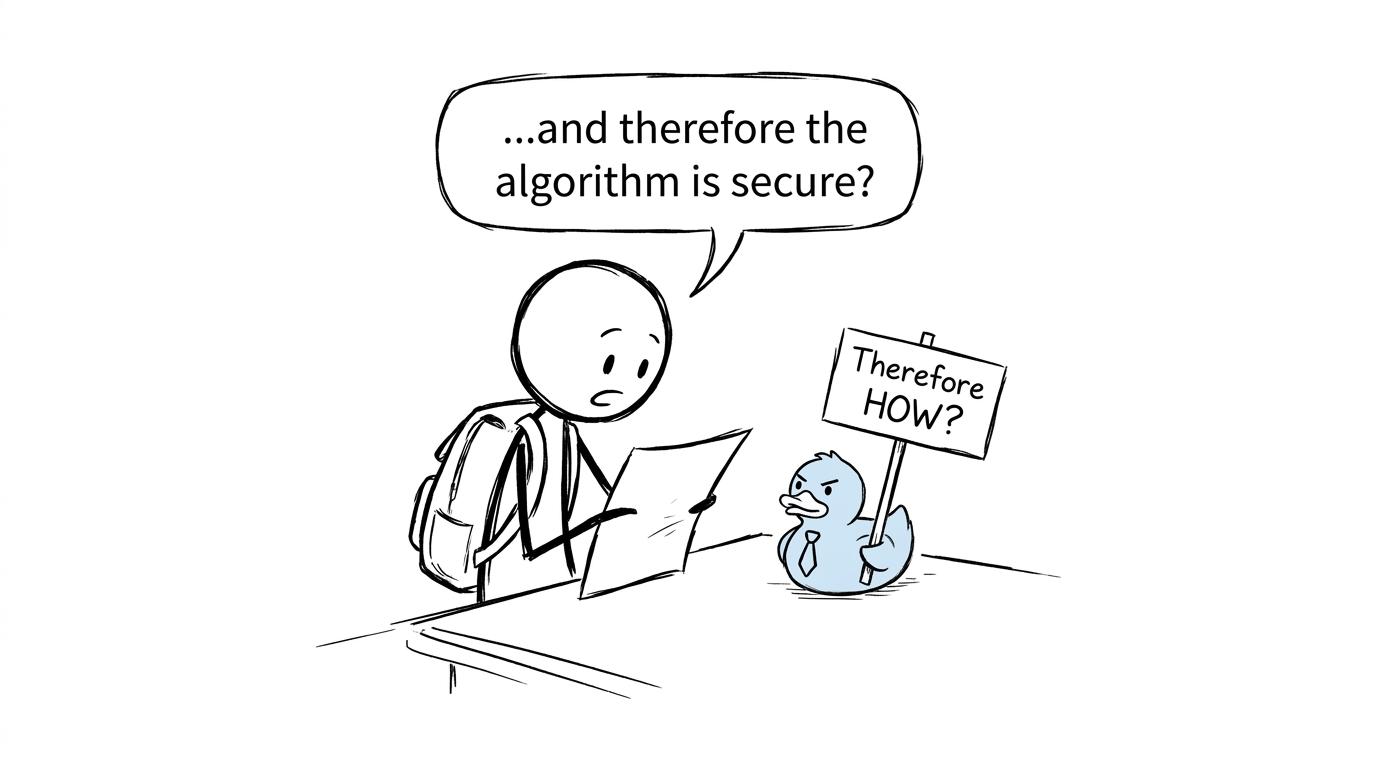 A student discovers that an examiner duck wants to know how the conclusion follows
Why reading your own answers aloud can work
Controlled proofreading research has found that reading aloud can improve the detection of spelling, grammar and word-choice errors compared with silent reading. Separate research on the production effect suggests that material spoken aloud can sometimes become more distinctive in memory.
Those findings need careful interpretation. They do not prove that speaking automatically creates deeper Computer Science understanding. Nor do proofreading studies show that every missing technical point will suddenly become obvious. Reading aloud is best treated as an extra route into your answer: you see the words, produce them and hear them.
The practical benefit is distance. Silent reading is fast and familiar. Your eyes can move over a sentence while your memory supplies the argument you meant to include. Speaking forces the wording to unfold at a slower, less forgiving pace.
Your voice exposes missing connections
A strong extended response is not simply a pile of correct facts. Its ideas need to connect.
When reading aloud, listen for places where your answer suddenly moves:
- from a feature to a claimed benefit;
- from a threat to a security measure;
- from an algorithmic choice to its effect;
- from an ethical issue to its consequence;
- from data collection to a conclusion.
If you hear yourself mentally inserting words such as “because”, “therefore” or “which means”, check whether the written answer actually contains that link. The examiner marks what is present, not what was intended.
This is especially relevant to extended responses. Current GCSE Computer Science assessments from boards including AQA, OCR and Pearson Edexcel use combinations of short, medium, longer or extended-response questions. OCR, for example, describes extended response as an opportunity to construct and develop a sustained, coherent line of reasoning. Always check the current specification for your own board, including Eduqas, because formats and wording differ.
Awkward phrasing becomes easier to hear
Technical sentences can be grammatically acceptable but difficult to follow. Common causes include:
- several ideas packed into one sentence;
- pronouns such as “it” with no clear reference;
- repeated claims with no development;
- a conclusion appearing before its supporting reason;
- specialist vocabulary inserted without explaining its relevance.
A useful test is simple: if you cannot say the sentence naturally in one clear thought, the examiner may also have to work too hard to interpret it. Split the sentence or make its logical connection explicit.
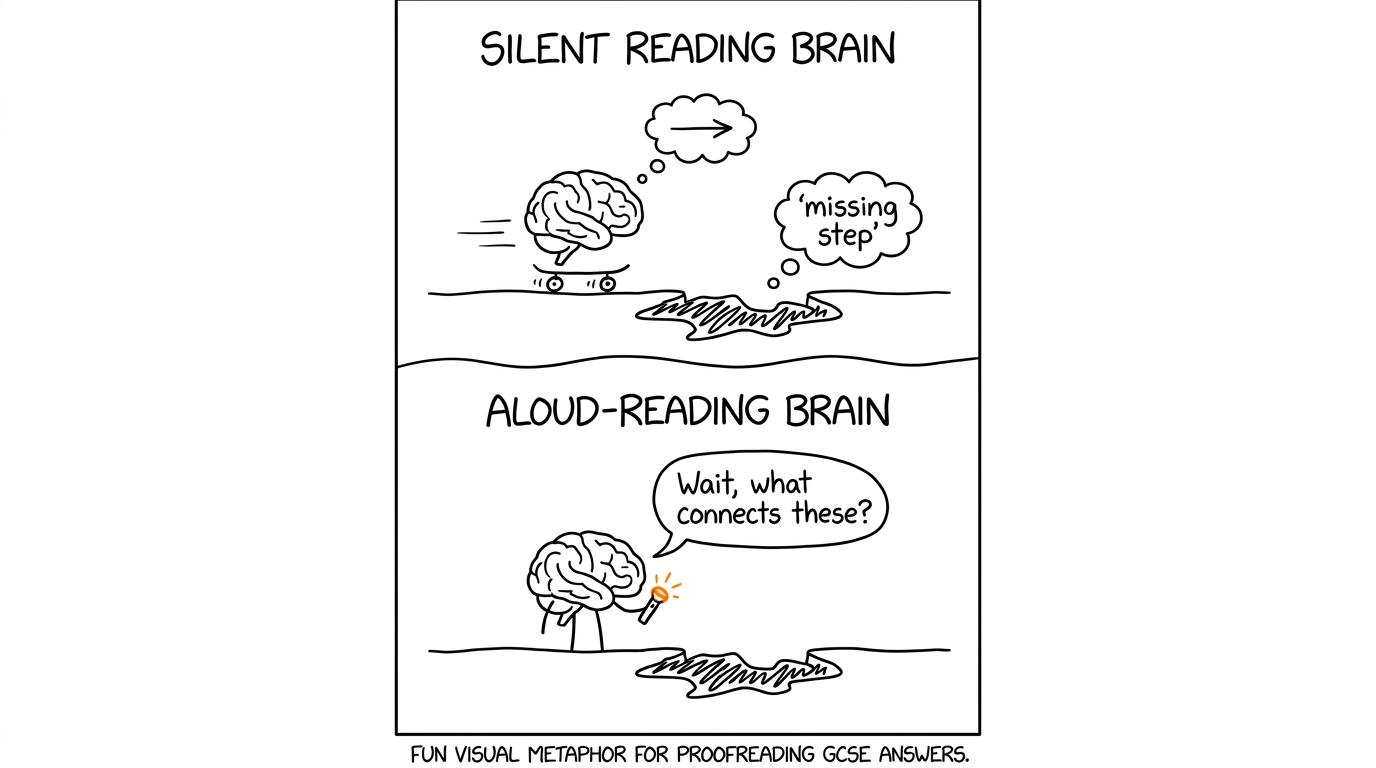 Silent reading passes a missing step while aloud reading stops to investigate
What to listen for in GCSE Computer Science answers
Reading aloud becomes far more effective when you know what you are trying to detect. Do not listen only for whether the answer “sounds good”. Listen against a defined checklist.
Does the response answer the command word?
A response can contain accurate knowledge and still fail to do what the question asks.
Listen for the difference between these demands:
- State or identify: give the required fact concisely.
- Describe: set out the relevant characteristics or process.
- Explain: connect a point to a reason, mechanism or consequence.
- Compare: address both items through meaningful similarities or differences.
- Discuss or evaluate: consider relevant arguments and reach a supported judgement where required.
Command-word conventions can vary between exam boards and questions, so use your board's materials rather than memorising a generic formula. When reading aloud, ask whether every sentence contributes to the requested task.
Are technical terms precise?
Computer Science contains pairs of ideas that sound related but are not interchangeable. If you use a term loosely, saying the sentence aloud may reveal that it lacks precision.
Check whether you have:
- named the correct concept;
- used specialist vocabulary in the right context;
- distinguished cause from effect;
- described what a process does rather than merely naming it;
- avoided everyday wording where a precise technical term is required.
Reading aloud will not tell you whether your definition is correct. That requires reliable notes, the specification and mark-scheme feedback. The method exposes uncertainty; subject resources resolve it.
Is the reasoning complete?
Pause after each sentence and ask:
- What claim did I just make?
- Have I explained why it matters here?
- Does the next sentence follow logically?
- Have I applied the point to the scenario in the question?
- Am I repeating myself instead of developing the answer?
This resembles the review process used in good maths revision. A line of algebra may look familiar while concealing a missing operation; a written explanation may look polished while concealing a missing logical step. MathsGenie's guide to using GCSE mark schemes effectively explains how to classify lost marks and rewrite a stronger response instead of simply checking a score.
A revision routine that turns listening into improvement
Use the technique on one or two carefully chosen answers, not every sentence you write. Longer responses and questions where your mark was lower than expected are the best candidates.
Attempt the question without help
Complete the response under realistic conditions. Looking at notes while writing can hide what you can actually retrieve. This principle also underpins effective GCSE past-paper practice: attempt first, then use feedback.
Create a little distance
Immediately after writing, your intention is still louder than your wording. Move to another question or take a short break before reviewing the answer. Even a small gap can make you a more attentive reader.
Read exactly what is on the page
Do not silently repair the sentence while speaking. If a word is missing, let it sound missing. If you accidentally add an explanation that is not written down, mark that point. The improvised words may be precisely what the answer needs.
Annotate structural problems
Use a small set of labels:
- Q: not answering the question;
- T: technical term is uncertain or vague;
- L: logical link is missing;
- R: repetition;
- A: application to the scenario is absent;
- E: expression is difficult to follow.
This transforms a vague feeling into a repair plan. A similar diagnostic approach appears in MathsGenie's guide to finding your weakest GCSE topics: classify the reason for lost marks, then practise that specific weakness.
Use the mark scheme after your own review
Now compare your response with the official mark scheme or examiner guidance. Ask two separate questions:
- Did reading aloud expose a communication problem?
- Did the mark scheme expose missing or inaccurate knowledge?
Keep those diagnoses separate. A beautifully structured answer can still be technically wrong, while a knowledgeable response can lose clarity because its reasoning is poorly organised.
Rewrite and retest
Rewrite the answer while the feedback is fresh. Later, attempt a different question testing the same skill. MathsGenie's simple GCSE revision loop follows the same pattern: attempt, mark, fix and repeat.
How this helps with GCSE maths revision
Although the technique is especially natural for written Computer Science responses, it can support students preparing for maths exams too.
Reading a mathematical explanation aloud may reveal that you have stated a result without justifying it, confused a reason with a conclusion or failed to answer the context of a problem. It can be useful for reasoning, proof and interpretation questions. It is less useful for checking arithmetic, algebraic manipulation or calculator input, where recalculation and a mark scheme are stronger tools.
Use the GCSE Maths revision hub to pair this communication check with topic lessons, practice questions, mini tests and video solutions. You can then apply the same review routine to GCSE predicted papers, where mixed questions test whether your methods and explanations remain clear under time pressure.
The deeper habit is transferable: do not ask only, “Is this answer correct?” Ask, “Can another person follow why it is correct?”
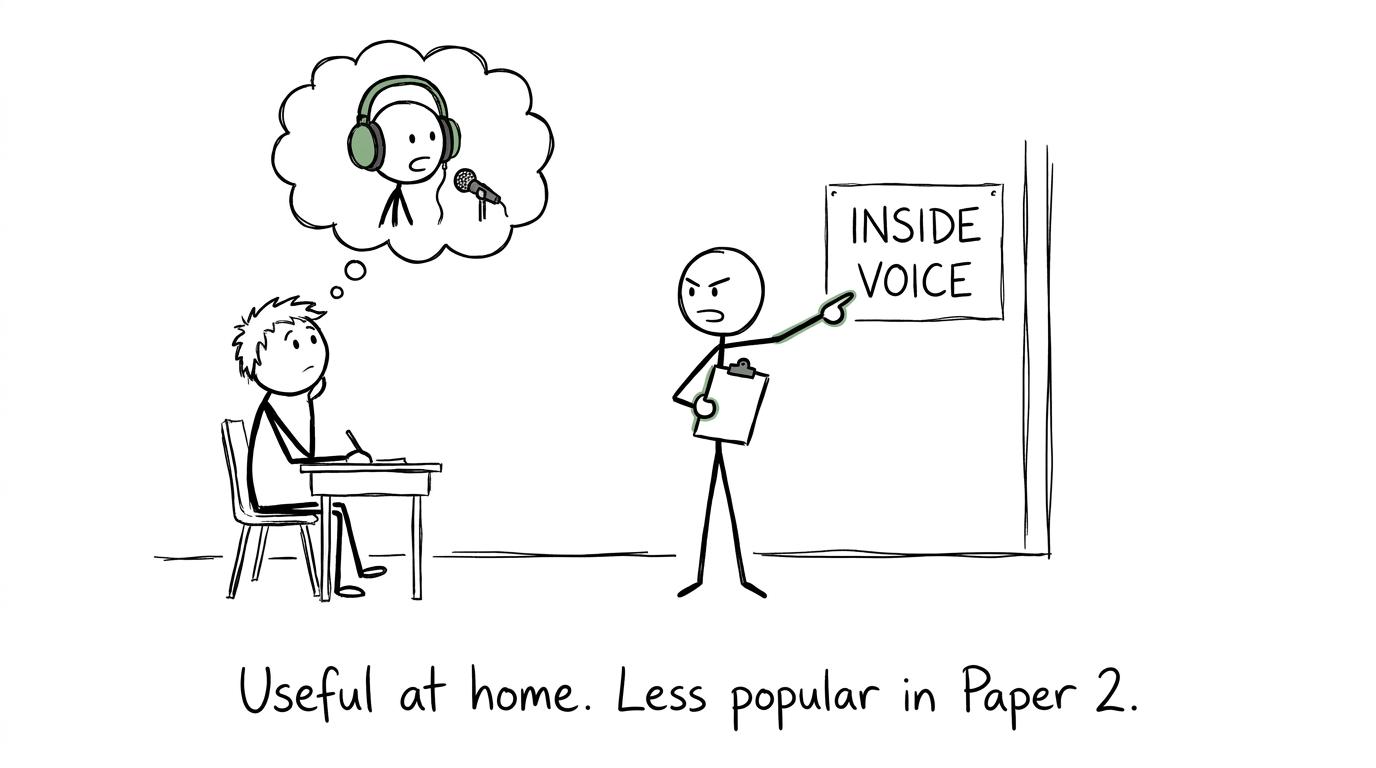 A student remembers that reading aloud belongs in revision rather than a silent exam hall
Common mistakes when reading answers aloud
Reading without listening
Simply vocalising every word is not enough. Pause at the end of each idea and identify what it contributes.
Correcting the answer verbally
If you say words that are absent from the page, underline the gap. Do not let your spoken version receive credit that your written version has not earned.
Focusing only on grammar
Grammar matters because it protects meaning, but the larger prize is structure. Check the command word, sequence of reasoning, technical accuracy and application.
Assuming a smooth answer is a correct answer
Confidence and fluency can make inaccurate claims sound convincing. Always follow the aloud review with a mark scheme, teacher feedback or an authoritative specification.
Trying to use the technique during the examination
GCSE examination rooms must remain quiet, so this is a revision method. In the exam, recreate the habit silently: read the response slowly, track each line and ask what connection comes next.
Reviewing everything equally
Not every response deserves a full spoken review. Prioritise longer answers, recurring weaknesses and questions with several linked points. For efficient mixed practice, combine focused review with the best order for learning GCSE maths topics and then test your progress under timed conditions.
Make your answers easier for an examiner to follow
Reading your own GCSE Computer Science answers aloud is valuable because it interrupts familiarity. It makes missing links audible. It shows where your voice supplies reasoning that your pen left behind.
But the voice is only the detector. Improvement comes from the next actions: checking technical accuracy, consulting the mark scheme, rewriting the response and attempting another question.
Bring that same discipline to maths. Start with MathsGenie's free GCSE Maths revision resources, learn or repair one topic, complete practice questions and check the mark scheme or video solution. Build towards past papers, mini tests and predicted papers. Each answer you review should make the next one clearer, more accurate and easier to award marks.











