Pomodoro Technique GCSE Combined Science: Does It Work?
Pomodoro technique GCSE Combined Science: learn when 25-minute bursts help, when longer sessions work better and how to revise effectively for exams.

Revision often fails before the first question is attempted. You sit down to cover Biology, Chemistry and Physics, see the size of the task, and decide to check your phone for a minute. Somehow, the minute expands.
The Pomodoro technique GCSE Combined Science approach can help with this problem. Working for 252525 focused minutes and resting for 555 minutes makes revision easier to begin and can limit distraction. But the timer itself does not make you remember science. It works only when each interval contains active recall, exam questions, marking and correction.
Short bursts are particularly useful for learning equations, reviewing one specification point or repairing a weak maths skill. Longer sessions are still needed for full past papers, connected topics and exam stamina. The best approach is not short or long revision. It is choosing a session length that matches the task.
The quick verdict
Use Pomodoro-style revision when you need to:
- overcome procrastination and start promptly;
- focus on one small Combined Science topic;
- retrieve definitions, equations or practical steps;
- complete a short set of exam questions;
- mark answers and update an error log;
- practise a supporting maths skill such as ratio or formula rearrangement.
Choose a longer, less interrupted session when you need to:
- complete a full or substantial section of a past paper;
- write extended responses under timed conditions;
- connect several ideas across a topic;
- analyse a required practical in depth;
- build concentration for the real examination.
MathsGenie's free GCSE Science revision hub is a useful starting point because you can choose your exam board before selecting revision guides, questions and papers.
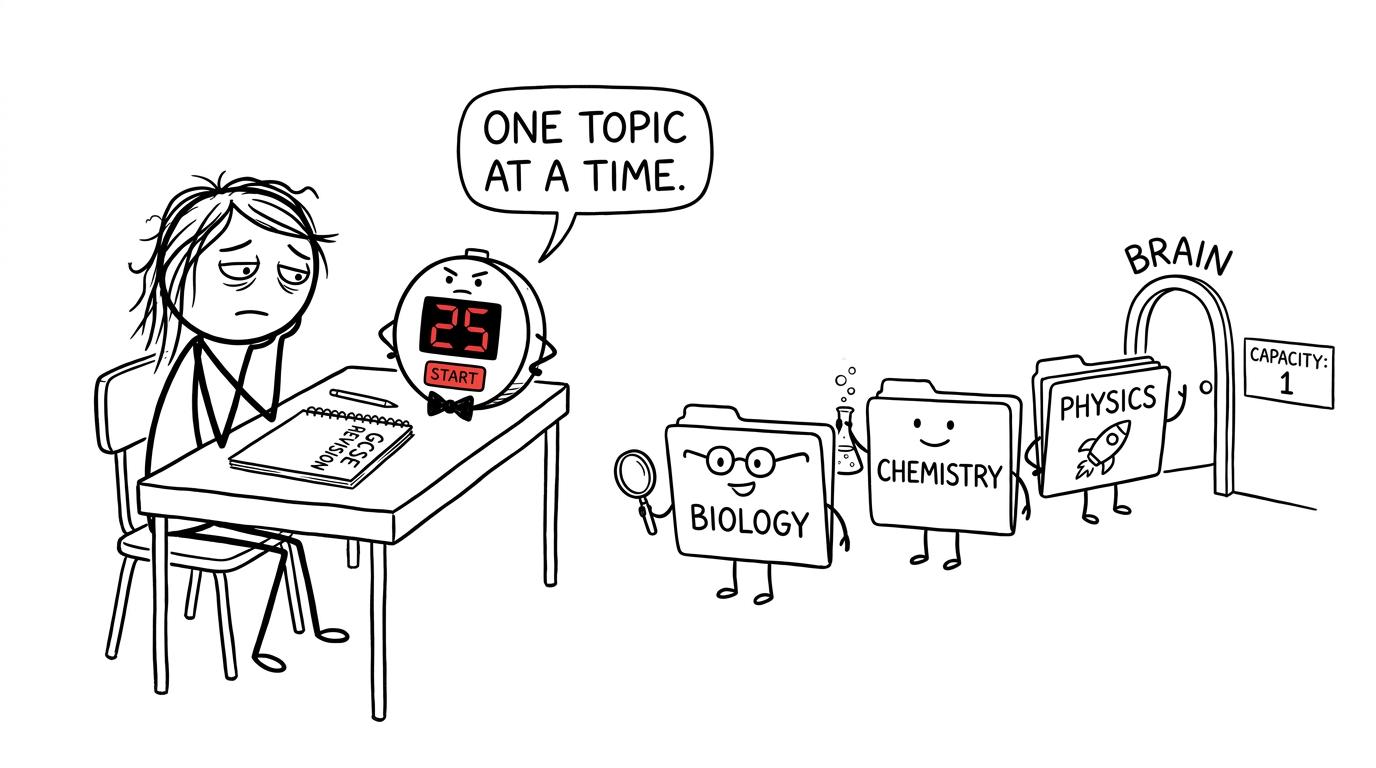 A revision timer allows one science topic through at a time
What does the evidence say about the Pomodoro Technique?
The traditional pattern is 252525 minutes of focused work followed by a 555-minute break. After several cycles, the learner takes a longer break. It is a time-management system, not a learning method in its own right.
Research specifically involving GCSE Combined Science students is limited, so claims that Pomodoro is uniquely effective for this qualification would be too strong. The available evidence mostly comes from university students and other learning settings.
A 202320232023 study involving 878787 university students compared self-regulated breaks with predetermined break schedules. Students using systematic breaks reported less fatigue and distraction, with better concentration and motivation. Task completion did not differ significantly, although the structured groups completed similar amounts of work in shorter sessions.
A separate 202520252025 study of 949494 university students found no overall advantage for Pomodoro, Flowtime or self-regulated breaks in productivity, task completion or flow. This matters. A popular routine can be helpful without being universally superior.
The sensible conclusion is that Pomodoro may improve the conditions for revision by making the task feel bounded and reducing decisions about breaks. There is less direct evidence that the timer alone improves examination performance.
What happens inside the interval matters more. Wider educational evidence supports retrieval practice, in which you recall information without looking, and spaced practice, in which you revisit learning across different days. Reading the same page repeatedly for 252525 minutes remains passive revision, however impressive the timer looks.
Why short bursts can suit Combined Science
Combined Science contains a large number of ideas spread across Biology, Chemistry and Physics. A vague instruction such as “revise Chemistry” creates too many choices. A narrow instruction such as “retrieve the factors affecting rates of reaction, then answer four questions” gives the interval a finish line.
This is where short sessions earn their place. They convert a large subject into manageable actions.
Match one interval to one clear outcome
Before starting, write a result you can check. For example:
- recall a process without notes;
- complete a diagram from memory;
- answer questions on one specification point;
- explain the variables in a required practical;
- mark a question set and record every lost mark;
- revisit mistakes from yesterday.
AQA students could use one interval to review a narrow section from the AQA Combined Science Key Ideas guide. OCR students working on investigations can use the OCR Combined Science practical skills guide.
The resource matters, but the action matters more. Finish the interval with evidence: answers on paper, marked questions or a short list of corrections.
Put retrieval before review
Begin by closing your notes. Spend the first part of the session writing what you remember about the selected topic. Then check the revision guide and correct what was missing.
This order can feel less comfortable than rereading. That discomfort is useful information. It shows the difference between recognising a fact on a page and producing it independently in an examination.
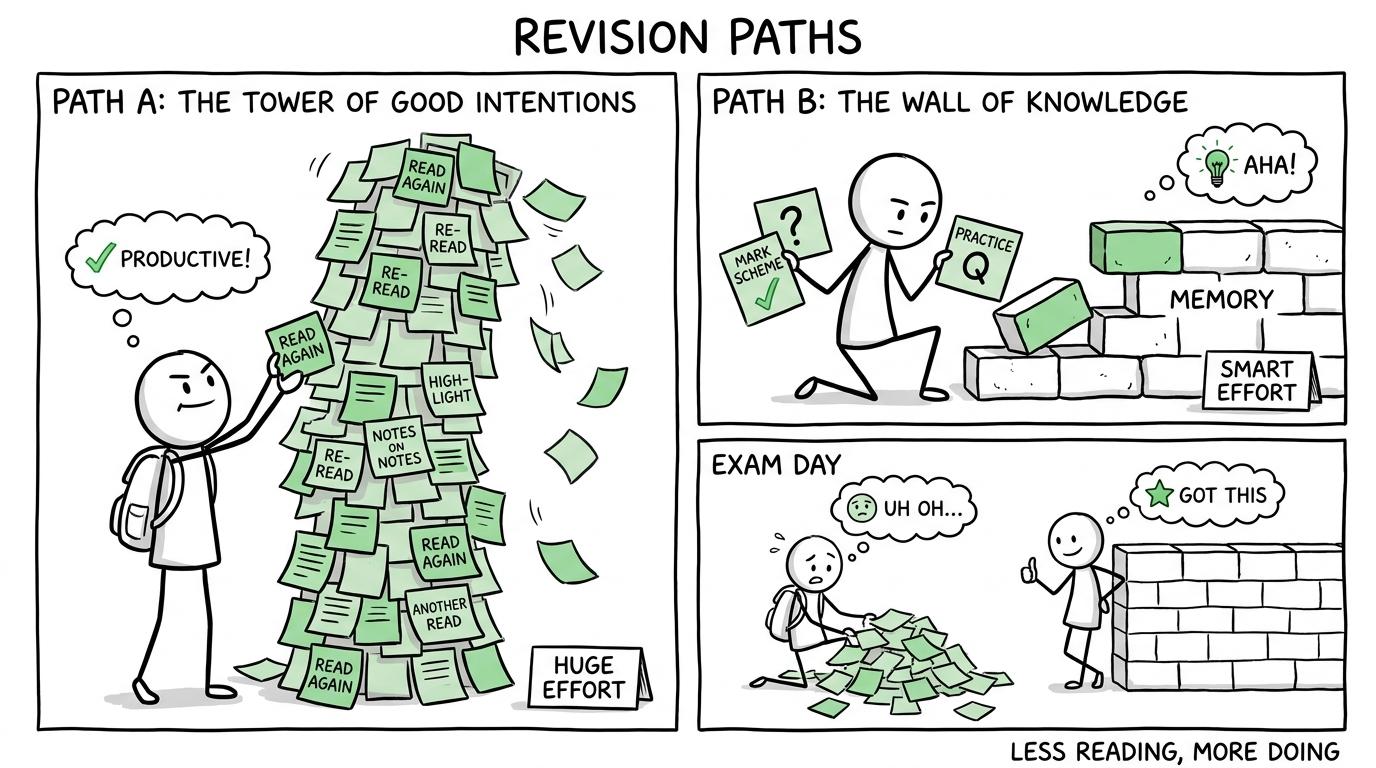 A student builds memory with questions while another constructs a tower of reread notes
Include exam questions and feedback
A timer can create the illusion of progress because it records time rather than learning. Exam questions correct that illusion.
Complete questions without notes, then mark them immediately. Record whether each lost mark came from:
- missing scientific knowledge;
- weak application;
- an incomplete explanation;
- a maths or graph error;
- units, rounding or significant figures;
- misunderstanding a practical method.
You can apply this cycle to specification-matched AQA Combined Science past papers. Early in revision, use selected questions. Closer to the examination, reserve complete papers for longer timed sessions.
Why Combined Science sometimes needs longer sessions
The Pomodoro alarm should support concentration, not interrupt it. If you are halfway through interpreting a graph, evaluating a practical or constructing a six-mark response when the timer rings, stopping immediately may break useful thought.
Longer blocks are better for tasks in which continuity matters. That includes:
- completing a paper under realistic conditions;
- linking particle models to changes of state and energy;
- analysing results, anomalies and improvements to a practical;
- comparing several explanations;
- practising how quickly you can move between different question types.
A real examination will not pause every 252525 minutes. As exams approach, gradually include sessions that match the sustained attention required by your papers. The MathsGenie past-paper tools can help you combine realistic timing with official mark schemes and worked solutions where available.
A flexible rule works better than blind obedience: use a timer to begin, but finish the question or logical section before taking the break. A 353535- or 454545-minute focus block may suit you better than the traditional duration. The exact number is not sacred.
Use Pomodoro to strengthen the maths in science
GCSE Combined Science specifications include mathematical requirements such as standard form, ratios, percentages, means, graphs, gradients, area, volume, substitution and changing the subject of a formula. The required level depends on the science subject and tier, but these skills are examinable rather than optional decoration.
Short, focused intervals are well suited to repairing one mathematical weakness at a time. If formula rearrangement is costing marks in Physics, use a MathsGenie changing the subject of a formula revision page before returning to science questions.
Keep the science context and maths diagnosis separate. “I am bad at Physics calculations” is too broad. “I substitute correctly but forget to convert units” is a problem you can practise. So is “I cannot identify the gradient from a graph”.
For shorter timed checks, Edexcel GCSE Maths mini tests can help students build the underlying fluency needed in science. Use the resources matching your own maths exam board and tier whenever possible.
A practical Combined Science revision pattern
A productive session can combine short and long blocks rather than committing to one format all evening.
On an ordinary school day
Use two or three focused intervals:
- retrieve one narrow Biology, Chemistry or Physics topic;
- answer specification-matched questions;
- mark the work and write one correction;
- schedule the topic for another day.
Rotate the sciences across the week rather than trying to fit all three into every evening. Spacing the return to a topic is more useful than completing several identical intervals in one sitting.
At the weekend or near examinations
Use a longer block for a mixed question set or paper section. Mark it, identify the largest weaknesses, then use shorter intervals to repair them. This creates a simple loop:
attempt, mark, diagnose, practise, retest.
If you are unsure where to begin, the MathsGenie guide to finding your weakest GCSE topics explains how to turn lost marks into specific revision priorities.
Make the breaks genuinely restorative
A 555-minute break can easily become a 353535-minute disappearance. Social media, games and videos do not have natural stopping points, so they are risky break activities.
Instead, stand up, get water, stretch, look away from the screen or prepare the next question set. Keep the timer visible and leave your revision materials ready. The aim is to reduce fatigue without making the next start harder.
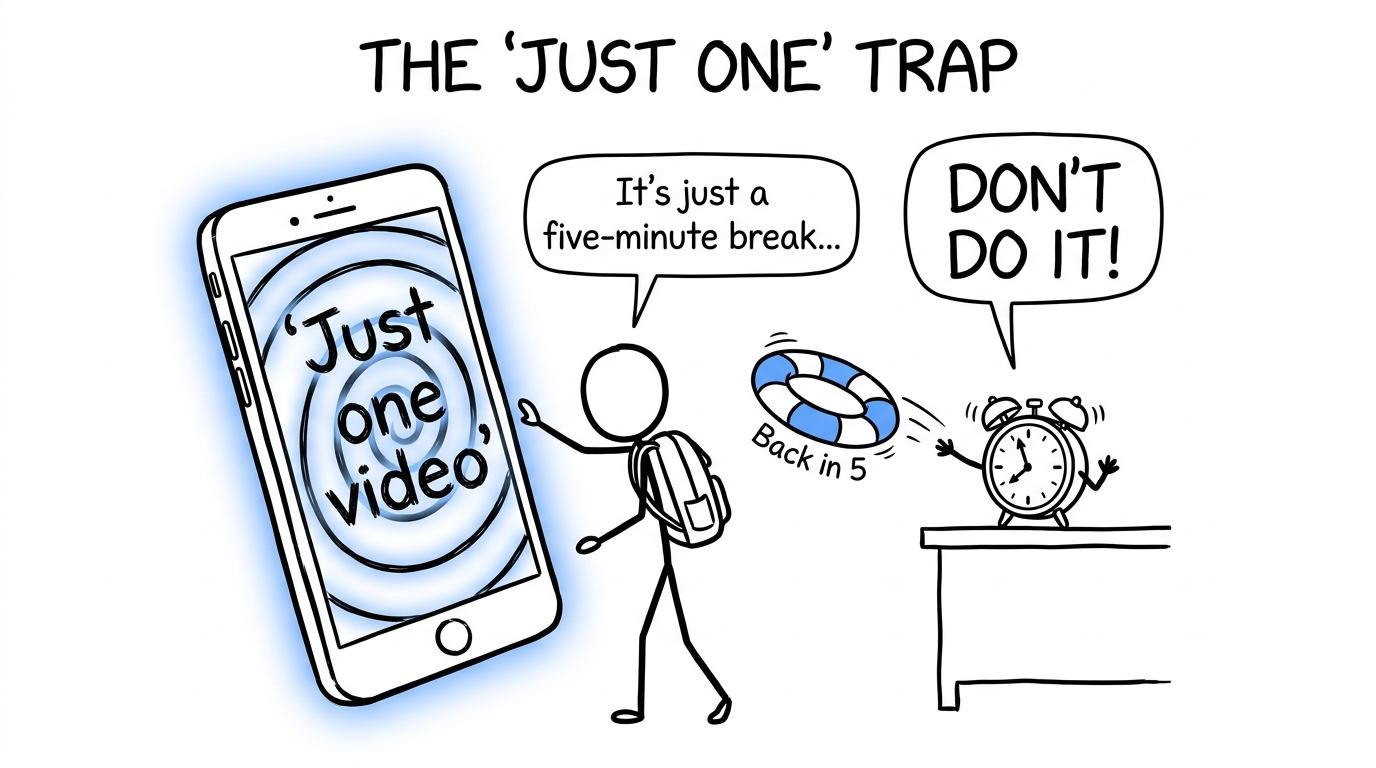 A revision student escapes the just-one-video phone whirlpool
Common Pomodoro revision mistakes
Treating time as proof of learning
Completing six intervals does not prove that you can answer an examination question. Track questions attempted, marks gained and mistakes corrected as well as minutes spent.
Choosing a task that is too broad
“Revise Physics” has no clear endpoint. Select one equation family, practical, concept or question type before starting the timer.
Rereading for every interval
Notes can correct gaps, but they should not occupy the whole session. Retrieve first, check second and answer questions third.
Stopping at an unhelpful moment
Do not abandon a nearly completed calculation or explanation merely because the alarm sounds. Finish the logical unit, then rest.
Using only short sessions
Pomodoro can build consistency, but it cannot fully reproduce an examination. Include longer paper practice so that timing, concentration and switching between topics also improve.
Ignoring your exam board and tier
AQA, Edexcel, OCR and Eduqas specifications are not organised identically. Foundation and higher tier questions also differ in demand. Use resources that match the papers you will actually sit.
The timer opens the door, but practice moves you forward
The Pomodoro Technique can work for GCSE Combined Science when the main obstacle is starting, staying focused or breaking a large specification into manageable tasks. It is less suitable when a rigid alarm interrupts connected thinking or prevents realistic paper practice.
Use short sessions for retrieval, targeted questions, corrections and maths skill repair. Use longer sessions for practical analysis, extended responses and complete papers. Above all, judge revision by what you can recall and apply, not by how long the timer has been running.
Start with MathsGenie's free GCSE Science revision resources, choose the correct exam board, and select one weak topic. Learn it through a revision lesson, practise it with exam questions, check the mark scheme and use video solutions where available. Then move towards mini tests, past papers and predicted papers. A timer can help you begin. MathsGenie gives each minute something worthwhile to do.