Physical Flashcards vs App for GCSE Psychology
Physical flashcards vs app GCSE psychology: compare recall, focus, cost and convenience, then build a practical revision system that fits your exams.
The first flashcard often feels productive. So does the fiftieth. Then you look at the clock, realise the evening has disappeared, and wonder whether making the cards has replaced actually learning them.
That is the real question behind physical flashcards vs app GCSE psychology revision. The short answer is that neither format is automatically better. Paper gives you control, fewer distractions and the useful friction of writing. An app gives you portability, search, progress tracking and automated scheduling. For many students, the strongest choice is a hybrid: create a small number of important cards by hand, then use an app for regular, spaced retrieval.
The format matters less than what you do before turning the card over. If you genuinely attempt to recall the answer, check it promptly and return to difficult material over time, either system can work.
The quick decision checklist
Choose physical flashcards if you:
- concentrate better away from a screen;
- remember information more clearly after writing it;
- want to sketch simple study layouts or organise cards physically;
- are likely to be distracted by messages, videos or games;
- prefer seeing the size of each topic as a real stack.
Choose a flashcard app if you:
- revise in short periods while travelling or waiting;
- want cards scheduled automatically;
- need to search, edit and reorganise a large collection;
- regularly lose paper resources;
- will actually follow the app's review schedule.
Choose a hybrid system if you want the focus of paper without manually managing hundreds of review dates. This is often the most practical answer for a student balancing Psychology with GCSE Maths and other subjects.
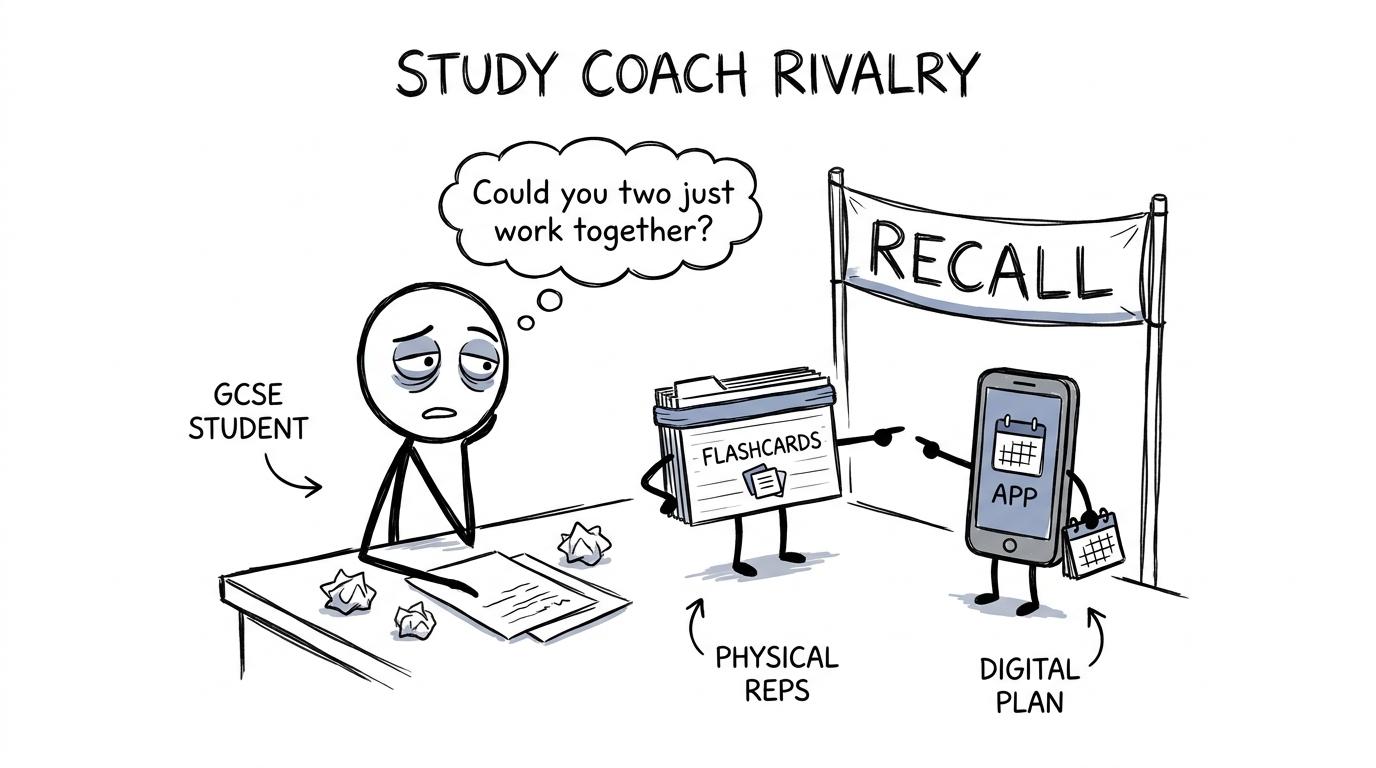 A paper flashcard and revision app agree to work together
What the evidence really says about paper and apps
Research on learning consistently supports two ideas: retrieval practice and spacing. Retrieval practice means bringing information to mind before checking it. Spacing means revisiting it across separate sessions rather than cramming the same deck repeatedly in one evening.
Direct comparisons of paper and digital flashcards have often found broadly similar learning outcomes, although results vary by device, platform, learner and task. Some studies report greater satisfaction or perceived control with paper, while digital systems can make repeated scheduling easier. Much of this research uses vocabulary learning or university students rather than GCSE Psychology candidates, so it should not be treated as proof that one format will produce a particular GCSE grade.
The safest conclusion is also the most useful: how you use a card is more important than what the card is made from.
A beautifully written card that you reread passively is weaker revision than a plain digital card that makes you retrieve, check and correct an answer. Equally, an advanced app cannot help much if notifications interrupt every session or if you tap “easy” without attempting the question.
The real advantages of physical flashcards
Writing creates useful friction
Handwriting is slower than copying and pasting. That can be an advantage when it forces you to select the essential idea, shorten a definition and decide what belongs on each side.
But handwriting is not magical. Copying an entire textbook paragraph onto card is still copying. The benefit comes from making decisions about the material, not from owning several coloured pens.
Paper creates a visible revision environment
A physical deck can be divided into simple piles such as:
- secure;
- uncertain;
- incorrect;
- revisit tomorrow.
That physical movement makes your judgement visible. It can also prevent an easy card from appearing as frequently as one you repeatedly miss.
Paper works without batteries, accounts or internet access. It may also fit school rules more easily where pupils cannot use phones during the school day.
Paper reduces digital distraction
A phone contains your revision app, but it also contains almost everything capable of interrupting revision. If opening the app regularly becomes opening messages or social media, paper has a practical advantage that no sophisticated algorithm can cancel.
This is less about willpower than environment. A quiet desk with one small deck gives your attention fewer places to escape.
The real advantages of a flashcard app
Scheduling is easier
Paper cards require you to remember when each pile should return. Many apps can bring back difficult material sooner and delay cards you know securely. This reduces the organisation needed to maintain spaced practice across several Psychology topics.
The feature is only valuable if you use it consistently. An automated schedule ignored for two weeks becomes a very organised list of cards you have not revised.
Digital decks are portable and editable
GCSE Psychology includes terminology, theories, research methods, studies and evaluative ideas. As your understanding improves, a definition may need tightening or a confused pair of concepts may need separating. Digital cards make those edits quick.
Apps also make it easier to search for every card relating to validity, memory or sampling. That becomes useful when preparing for questions that connect knowledge across topics.
Progress is easier to see
Digital statistics can reveal cards repeatedly marked incorrect. Treat this information as a diagnostic tool, not a score to collect. A high daily total can feel impressive while hiding shallow answers.
Maths revision benefits from the same honesty. MathsGenie's guide to finding your weakest GCSE topics explains how evidence from questions should direct the next session. Whether the subject is Psychology or Maths, weakness data matters only when it changes what you practise.
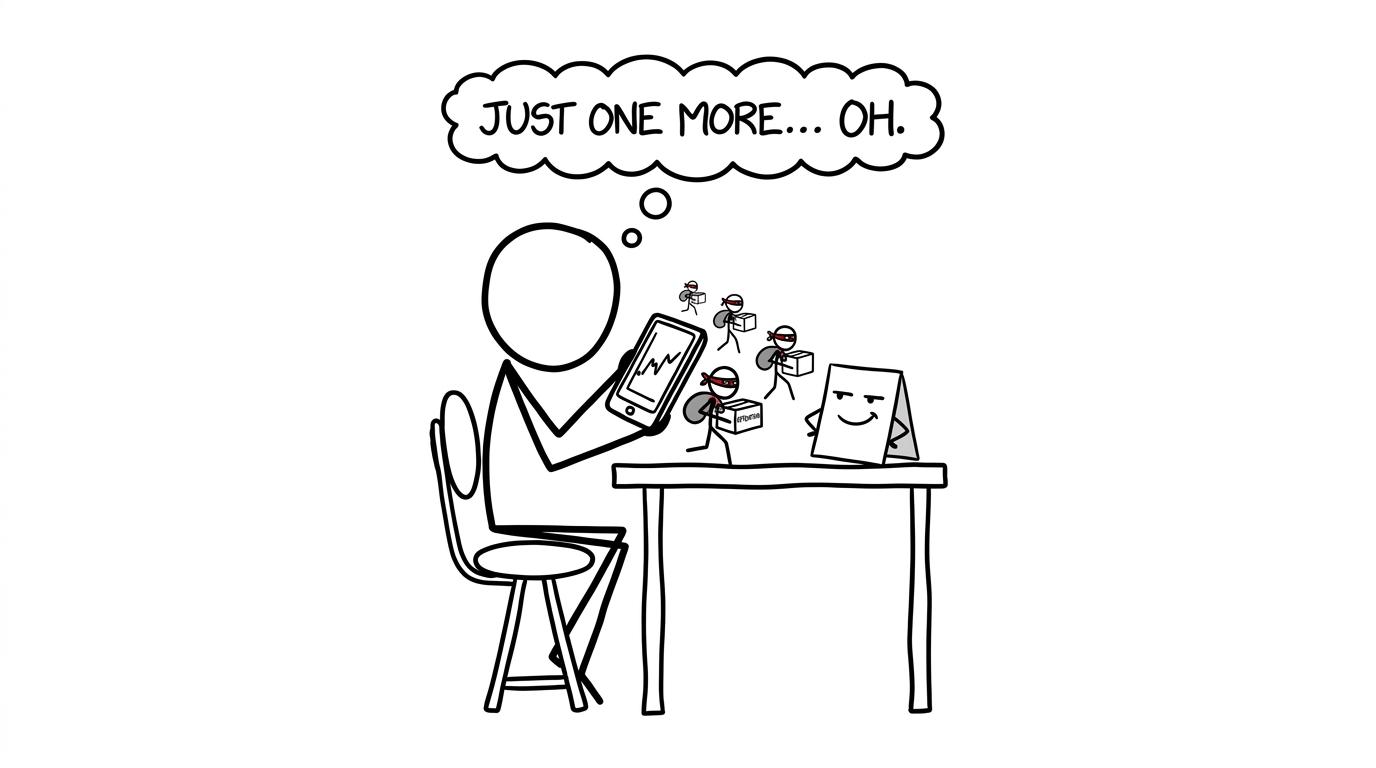 Notifications steal boxes of attention from a revising student
Match the card to GCSE Psychology assessment
Flashcards are particularly useful for precise knowledge: definitions, named concepts, features of theories, research terminology and concise strengths or limitations. They are less suited to practising a complete extended response.
For example, AQA GCSE Psychology uses multiple-choice, short-answer and extended-writing questions across two written papers. Pearson Edexcel also includes multiple-choice, short open, open-response, extended-writing and calculation questions. Your exact content and assessment structure depend on your exam board, so build decks from the current specification supplied by your teacher or exam board rather than an unverified public deck.
A balanced Psychology deck might contain:
- definition cards asking for one precise term;
- distinction cards asking how two ideas differ;
- study cards separating aim, procedure, findings and conclusion;
- application prompts asking you to identify a concept in a brief scenario;
- evaluation prompts asking for one developed strength or limitation;
- research-method cards covering variables, sampling, ethics and data.
Keep each prompt narrow enough to answer from memory. If the back contains half a page, the front probably asks too much.
Flashcards should then feed into exam questions. Knowing a definition is not the same as applying it to unfamiliar material or developing an evaluation. Cards build the ingredients; written practice teaches you how to assemble them under exam conditions.
A hybrid system that works across Psychology and Maths
A sensible system does not force every subject into the same tool.
For Psychology, use paper cards when creating difficult concepts or comparing theories. Transfer the facts you repeatedly forget into an app, then follow a spaced review schedule. Once recall becomes secure, answer proper Psychology questions without the cards.
For Maths, flashcards are useful for formulae, vocabulary and prompts such as “What should I check first?” However, Maths is procedural. You must solve questions and show working. Start from the free GCSE Maths revision hub, use revision lessons to refresh a method, and then move directly into practice questions.
A repeatable session could look like this:
- brief flashcard retrieval from an older topic;
- one focused lesson or explanation;
- exam-style questions completed without notes;
- immediate checking with a mark scheme or video solution;
- one difficult idea scheduled for another day.
MathsGenie's 20-minute GCSE revision routine shows how retrieval can sit beside exam practice rather than replacing it. The same principle helps when several GCSE subjects compete for one evening.
How to make either format effective
Answer before revealing
Say or write the answer before turning over a paper card or tapping the screen. A vague feeling of recognition is not recall. If you cannot produce the key detail, mark the card incorrect.
Keep one question per card
Avoid prompts such as “Everything about reconstructive memory”. Break broad content into focused questions. Smaller prompts make gaps visible and reduce the temptation to award yourself credit for remembering only one part.
Give immediate corrective feedback
Check the answer straight away. Correct mistakes while the attempted response is still in mind. If wording matters, compare your answer with the specification, trusted class material or teacher guidance.
Space sessions across the week
Do not keep cycling through the same easy cards in one sitting. Return later, when retrieval requires effort. MathsGenie's advice on stopping GCSE content from being forgotten applies the same learn, retrieve, mark and revisit rhythm to Maths.
Move from cards to exam conditions
Flashcards test fragments. Exams test whether you can select, connect and communicate those fragments. In Maths, that means progressing to Edexcel GCSE Maths past papers or the appropriate board resources. Nearer the exams, Edexcel predicted papers can provide another timed rehearsal.
The important loop is paper, mark, fix and retest. Read the guide to using GCSE past papers properly if practice papers currently end with a mark and no follow-up action.
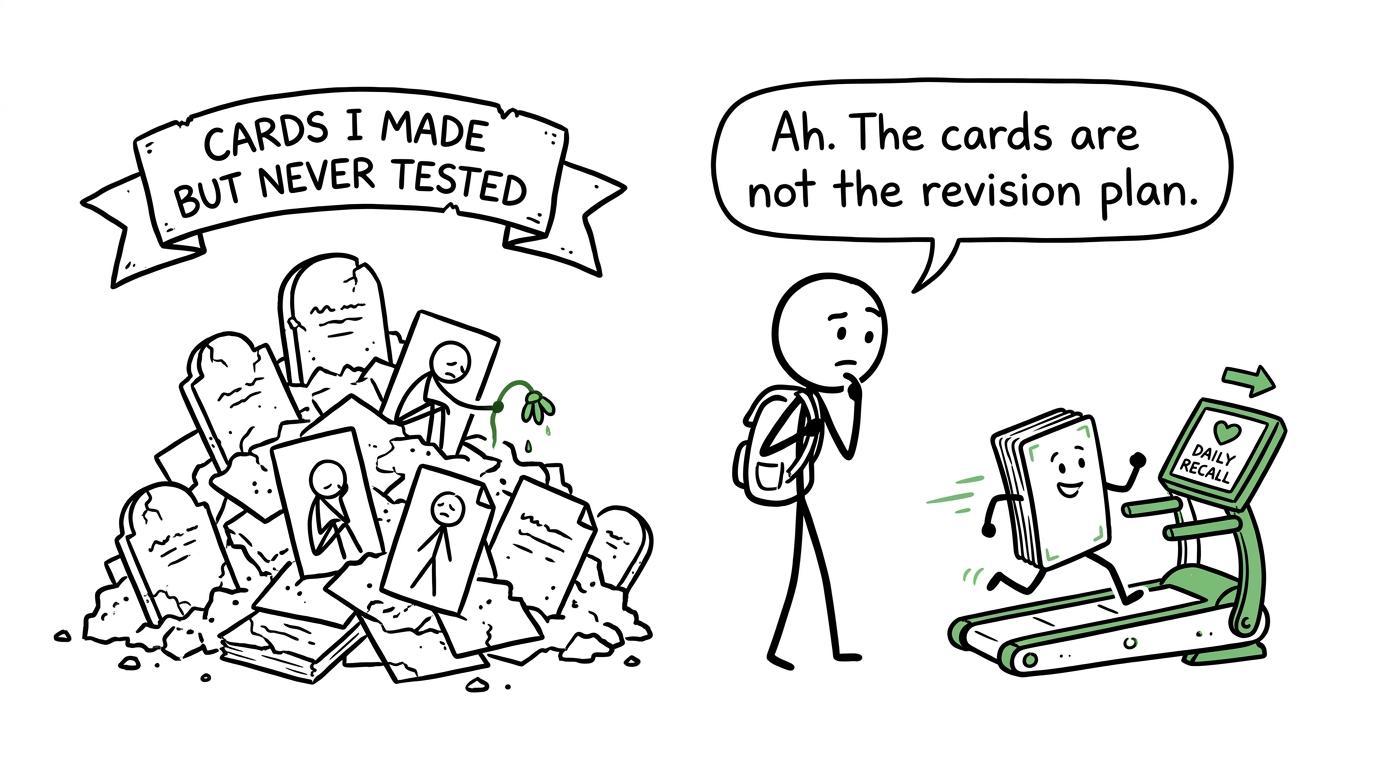 A forgotten card collection watches a smaller deck exercise daily
Common mistakes with Psychology flashcards
Spending too long making them
Cards are a tool, not the finished revision. Set a limit on creation time. If decorating a card takes longer than testing it several times, appearance has probably overtaken purpose.
Downloading a deck without checking the specification
A public deck may belong to another exam board, an older specification or a different teacher's optional topics. Compare every deck with your own course requirements before trusting it.
Putting too much on the back
Dense cards encourage recognition rather than precise recall. Split long answers into components and use exam questions for full extended responses.
Removing a card after one correct answer
One successful retrieval does not prove durable learning. Revisit the card after a delay and in a different order.
Using cards as the whole revision plan
Psychology requires application and evaluation as well as knowledge. Maths requires sustained problem-solving. Neither subject can be prepared for entirely by flipping cards.
A broader schedule such as MathsGenie's one-month GCSE Maths revision plan helps place recall alongside topic practice, mini tests and timed papers.
Make the format serve the habit
Physical cards win when they help you focus, think while writing and revise without digital interruption. Apps win when portability, editing and automated scheduling make regular recall more likely. A hybrid system wins when it takes the strongest feature from each without doubling your workload.
Choose one approach for the next week. Track whether you genuinely retrieved answers, corrected mistakes and returned after a delay. Keep the system that produces consistent action, not the one that merely looks organised.
Then connect recall to the task that earns marks. For Maths, use MathsGenie's free revision lessons, practice questions, mini tests, past papers, predicted papers, mark schemes and video solutions. Flashcards can remind you what you know. Exam practice proves that you can use it.