

Percentage Change GCSE Maths: Examples and Practice
Percentage change GCSE maths explained with clear worked examples, common mistakes and exam-style questions to help you choose the original value correctly.
You subtract the two prices, divide, multiply by 100100100, and still get the wrong answer. Percentage change GCSE maths questions often go wrong because of one quiet decision: which number belongs underneath the fraction?
To calculate percentage change, divide the change by the original value, then multiply by 100100100. State whether the result is an increase or a decrease.
Imagine a student called Sam who keeps dividing by the final price. This is a hypothetical example, but the difficulty is familiar. Sam knows the calculation involves a fraction. What has not clicked yet is what that fraction means.
The turning point is a question: “Compared with what I started with, how much has changed?”
Percentage change GCSE maths: the essential method
A percentage change describes an increase or decrease relative to the starting amount. The original value represents 100%100\%100%.
Use this checklist:
- Identify the original value and the new value.
- Find the positive difference between them.
- Divide that difference by the original value.
- Multiply by 100100100 and label the answer as an increase or decrease.
Here, “size of change” means the positive difference. This keeps the calculation straightforward, while the words “increase” or “decrease” describe the direction.
Before calculating, underline the starting amount. Words such as “originally”, “last year” and “before the sale” help you identify it.
If the conversion between decimals and percentages feels uncertain, MathsGenie’s fractions, decimals and percentages revision covers that foundation.
Start with MathsGenie’s Percentage Change Lessons, then use the Question Bank to practise choosing the original value yourself.
Percentage change worked examples
A price increase
A jacket increases in price from £40£40£40 to £50£50£50. Work out the percentage increase.
Find the change:
£50−£40=£10£50-£40=£10£50−£40=£10Divide by the original price:
1040=0.25\frac{10}{40}=0.254010=0.25Convert to a percentage:
0.25×100%=25%0.25\times100\%=25\%0.25×100%=25%The price increased by 25%25\%25%.
Sam initially divides by 505050 and gets 20%20\%20%. That calculation measures the increase as a percentage of the final price. The question asks for the increase compared with the starting price, so the denominator must be 404040.
A quick check helps: £10£10£10 is one quarter of £40£40£40, and one quarter is 25%25\%25%.
A decrease with rounding
A club’s membership falls from 240240240 members to 206206206 members. Calculate the percentage decrease, giving your answer to one decimal place.
Find the decrease:
240−206=34240-206=34240−206=34Compare it with the original membership:
34240×100%=14.1666…%\frac{34}{240}\times100\%=14.1666\ldots\%24034×100%=14.1666…%Round at the end:
Percentage decrease=14.2%\text{Percentage decrease}=14.2\%Percentage decrease=14.2%Keep the calculator value until the final step. Rounding the fraction too early can affect the answer.
Sam now writes “original” beside 240240240 before touching the calculator. The arithmetic has barely changed. The decision that controls it has become clearer.
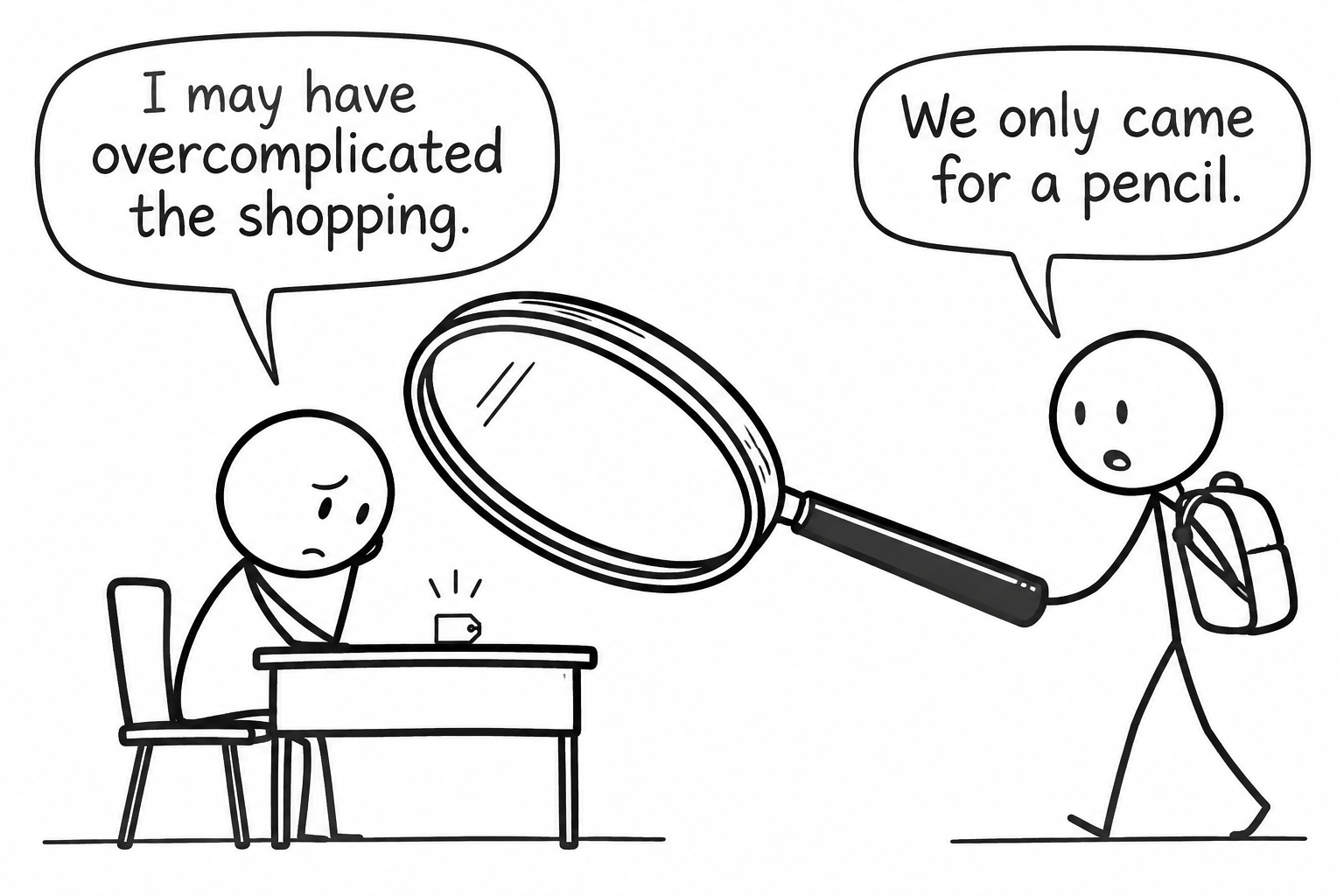 Stick-figure students overthink a shopping trip with an enormous detective magnifying glass
Finding a new amount
Some questions give the percentage change and ask for the final value. That requires a different calculation.
A bicycle costs £320£320£320. Its price increases by 15%15\%15%. Find the new price.
The original price is 100%100\%100%, so the new price is:
100%+15%=115%100\%+15\%=115\%100%+15%=115%As a decimal, 115%=1.15115\%=1.15115%=1.15. Therefore:
£320×1.15=£368£320\times1.15=£368£320×1.15=£368The multiplier includes both the original price and the increase. Multiplying by 0.150.150.15 would give only the extra amount.
For a decrease of r%r\%r%, the multiplier is:
1−r1001-\frac{r}{100}1−100rFor an increase of r%r\%r%, it is:
1+r1001+\frac{r}{100}1+100rMathsGenie’s percentage change revision guide brings these methods together for revision.
Choose the method from the missing information
Before starting a question, ask what you need to find.
Two amounts given, percentage missing: use the change divided by the original amount.
Original amount and percentage given: use a multiplier to find the new amount.
Final amount and percentage given: find the original amount by dividing by the multiplier. This is covered in reverse percentages revision.
This small pause matters because similar wording can hide different tasks. “Find the percentage increase” asks for a percentage. “Increase the price by a percentage” asks for an amount of money.
Sam’s useful habit is to write the expected answer type before calculating: percentage, pounds or another quantity. It gives the working a destination.
Common mistakes and how to catch them
Dividing by the new value
The denominator must be the original amount. Check it by completing this sentence: “The change is being compared with ___.” Fill the gap with the starting value.
Stopping after subtraction
The difference gives an amount, such as £12£12£12 or 343434 members. A percentage needs a comparison with the original quantity. Subtraction is only the first step.
Assuming opposite changes cancel
An increase of 20%20\%20% followed by a decrease of 20%20\%20% does not return an amount to its starting value:
1.20×0.80=0.961.20\times0.80=0.961.20×0.80=0.96The final amount is 96%96\%96% of the original, an overall decrease of 4%4\%4%. The second change acts on a different starting amount. The repeated percentage change guide develops this idea.
Treating percentage points as percentage change
If an attendance rate rises from 60%60\%60% to 75%75\%75%, the difference is 151515 percentage points. The percentage increase in the rate is:
75−6060×100%=25%\frac{75-60}{60}\times100\%=25\%6075−60×100%=25%The wording determines which comparison you need.
Exam-style percentage change questions
Try these without looking back at the examples. Show the difference, the original value and the percentage calculation where appropriate.
- Question A: A train fare rises from £24£24£24 to £30£30£30. Calculate the percentage increase.
- Question B: A school reduces its weekly paper use from 750750750 sheets to 615615615 sheets. Calculate the percentage decrease.
- Question C: A laptop costs £480£480£480 before a discount of 15%15\%15%. Find its sale price.
- Question D: A club’s membership rises from 848484 to 979797. Calculate the percentage increase to one decimal place.
Answers and checks
Question A:
30−2424×100%=25%\frac{30-24}{24}\times100\%=25\%2430−24×100%=25%The fare increased by 25%25\%25%.
Question B:
750−615750×100%=18%\frac{750-615}{750}\times100\%=18\%750750−615×100%=18%Paper use decreased by 18%18\%18%.
Question C:
£480×0.85=£408£480\times0.85=£408£480×0.85=£408The sale price is £408£408£408.
Question D:
97−8484×100%=15.476…%≈15.5%\frac{97-84}{84}\times100\%=15.476\ldots\%\approx15.5\%8497−84×100%=15.476…%≈15.5%Membership increased by 15.5%15.5\%15.5%.
When checking, identify the first step that went wrong. A denominator error needs a different correction from a rounding error. Rewrite that step, then attempt the question again without copying the solution.
Make the original value your first thought
In Sam’s hypothetical revision session, the useful change is simple: label the original amount, choose the method, then calculate. You can understand that routine and still need practice recognising it in unfamiliar wording. Your turn: start with Percentage Change Lessons, then practise applying the method in the Percentage Change Question Bank.















