- How to spot the original amount, final amount, and amount of change.
- How to use percentage multipliers for increases and decreases.
- How to work backwards when you are given the price after a change.
- How to handle questions where you are given the increase or discount amount.
Reverse percentages are about finding the amount before a percentage change happened.
Reverse percentage
A reverse percentage question gives you information after a percentage increase or decrease, and asks you to find the original amount.
For example, if a price increased by 10% and is now £110, the original was not £100 because we “take off 10%” from £110. The 10% increase was based on the old price, not the new one.

Percentages are based on the original amount
In reverse percentage questions, the percentage change is always a percentage of the original amount, even if the question gives you the final amount.
A percentage means “out of 100”. So 25% means 25 out of 100, or one quarter.
Finding a percentage amount
A bike helmet normally costs £40. It is reduced by 15%. Work out the discount.

-
Convert 15% to a decimal:
15%=15100=0.1515\%=\frac{15}{100}=0.1515%=10015=0.15
-
Multiply the original price by 0.15:
40×0.15=640 \times 0.15 = 640×0.15=6
-
The discount is £6.
A multiplier is the number you multiply by to increase or decrease an amount in one step.
Percentage multiplier
A percentage multiplier tells you what fraction of the original amount is left after the percentage change.
For an increase:
- Increase by 8% means you have 100% + 8% = 108%.
- The multiplier is 1.08.
For a decrease:
- Decrease by 20% means you have 100% − 20% = 80%.
- The multiplier is 0.80.
Using a multiplier for an increase
A phone bill of £50 increases by 6%. Work out the new bill.

-
Add the increase to 100%:
100%+6%=106%100\%+6\%=106\%100%+6%=106%
-
Convert 106% to a decimal multiplier:
106%=106100=1.06106\%=\frac{106}{100}=1.06106%=100106=1.06
-
Multiply by the original amount:
50×1.06=5350 \times 1.06 = 5350×1.06=53
-
The new bill is £53.
Quick multiplier method
For an increase, your multiplier is bigger than 1. For a decrease, your multiplier is smaller than 1.
The main formula is:
F=O×mF = O \times mF=O×m
where:
- FFF is the final amount.
- OOO is the original amount.
- mmm is the multiplier.
If you need the original amount, rearrange the formula:
O=FmO = \frac{F}{m}O=mF
So in words:
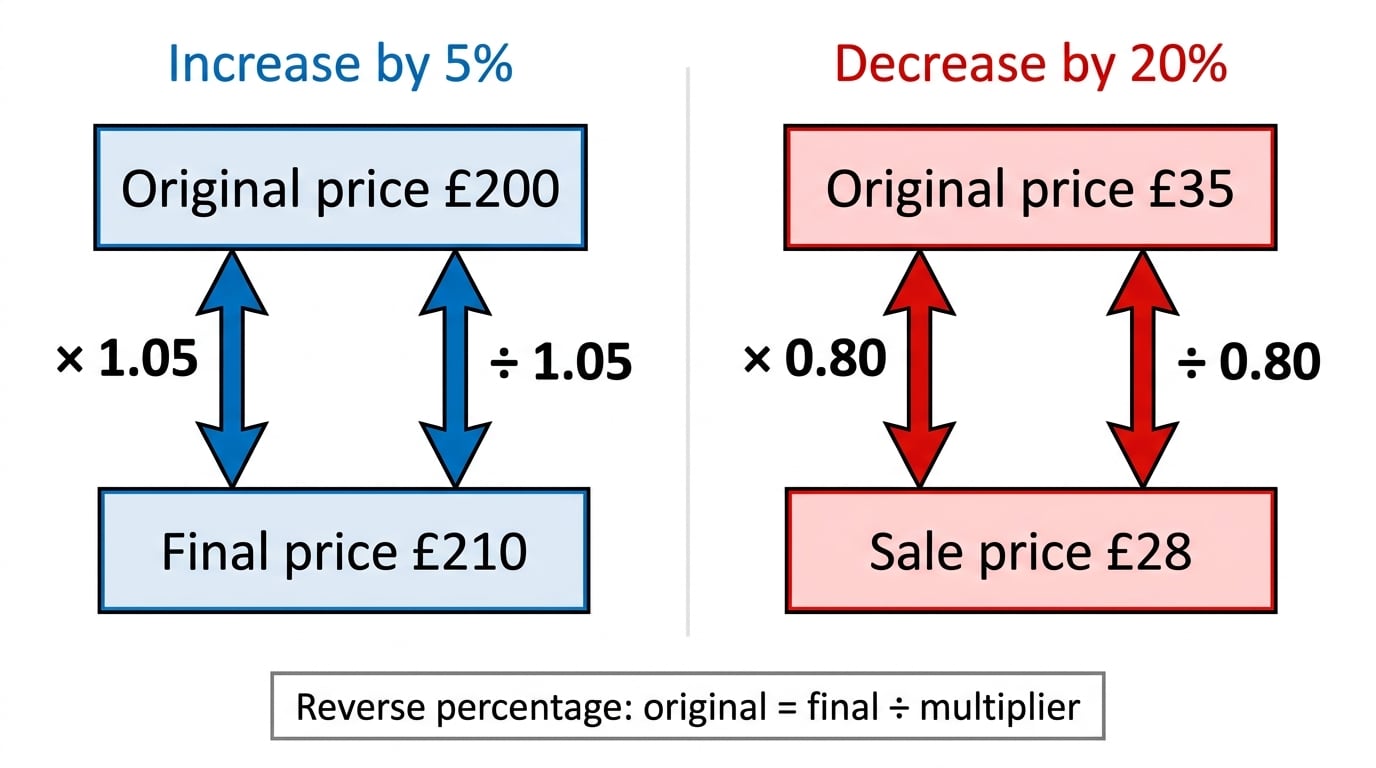
original = final ÷ multiplier
Finding the value before an increase
A flat increased in value by 5%. It is now worth £210,000. Work out its value before the increase.

-
A 5% increase means the final value is 105% of the original.
-
Convert 105% to a multiplier:
105%=105100=1.05105\%=\frac{105}{100}=1.05105%=100105=1.05
-
Divide the final value by the multiplier:
210000÷1.05=200000210000 \div 1.05 = 200000210000÷1.05=200000
-
The flat was worth £200,000 before the increase.
Finding the normal price before a sale reduction
A video game is reduced by 20% in a sale. The sale price is £28. Work out the normal price.

-
A 20% reduction means 80% of the original price is left.
-
Convert 80% to a multiplier:
80%=80100=0.8080\%=\frac{80}{100}=0.8080%=10080=0.80
-
Divide the sale price by the multiplier:
28÷0.80=3528 \div 0.80 = 3528÷0.80=35
-
The normal price was £35.
Subtracting the percentage from the final amount
If something is reduced by 20%, do not find 20% of the sale price and add it back on. The 20% was taken from the original price, not the sale price.
Sometimes the question does not give the final price. Instead, it tells you how much the price increased or decreased by.
In these questions, the increase or decrease amount is the percentage part.
For example:
- If a bill increased by 4% and the increase was £32, then £32 is 4% of the original bill.
- If a coat was reduced by 30% and the reduction was £18, then £18 is 30% of the original price.
So use:
original = change amount ÷ percentage as a decimal
Finding the original amount from an increase amount
A yearly subscription increased by 6%. The increase was £18. Work out the cost before the increase.

-
The £18 increase is 6% of the original cost.
-
Convert 6% to a decimal:
6%=6100=0.066\%=\frac{6}{100}=0.066%=1006=0.06
-
Divide the increase by 0.06:
18÷0.06=30018 \div 0.06 = 30018÷0.06=300
-
The subscription cost £300 before the increase.
Finding the normal price from a discount amount
A bag is reduced by 15% in a sale. The discount is £9. Work out the normal price.

-
The £9 discount is 15% of the normal price.
-
Convert 15% to a decimal:
15%=15100=0.1515\%=\frac{15}{100}=0.1515%=10015=0.15
-
Divide the discount by 0.15:
9÷0.15=609 \div 0.15 = 609÷0.15=60
-
The normal price was £60.
Ask yourself: what have I been given?

If you are given the final amount after an increase or decrease, use:
original=finalmultiplier\text{original}=\frac{\text{final}}{\text{multiplier}}original=multiplierfinal
If you are given the amount of increase or decrease, use:
original=changepercentage as a decimal\text{original}=\frac{\text{change}}{\text{percentage as a decimal}}original=percentage as a decimalchange
Sanity check
After an increase, the original should be smaller than the final amount. After a decrease, the original should be bigger than the final amount.
In the exam
-
Decide whether the number given is the final amount or the amount of change.
-
Write the multiplier clearly: for example, 7% increase gives 1.07, and 25% decrease gives 0.75.
-
Check your answer by doing the percentage change forwards to see if it matches the question.
Check yourself
-
If a price is reduced by 30%, what multiplier should you use?
-
If a bill increases by 5% and the increase is £12, what percentage of the original is £12?
-
Why is it usually wrong to subtract 20% from the sale price to find the normal price?