Parents Involved: GCSE Engineering Revision Guide
Parents involved GCSE engineering revision can help with planning, questions and calm support. Learn where parents should assist, and when to step back.
Revision can turn an ordinary kitchen table into a negotiation. A student wants independence. A parent wants reassurance. Both want the same result, yet even a harmless question such as “Have you revised?” can create more heat than light.
So, should parents get involved in GCSE Engineering revision? Yes, but mainly by creating structure, encouraging independent practice and asking useful questions. Parents involved GCSE Engineering revision should not become substitute teachers, complete assessed work or control every session. The most effective role is closer to a project sponsor: interested, informed and supportive, but not holding the pencil.
That balance matters because Engineering combines technical knowledge, practical decision-making and applied maths. Support can remove obstacles. Too much intervention can remove ownership.
The short answer: what helpful involvement looks like
A parent or carer can usually help by:
- agreeing a realistic revision routine with the student;
- providing a reasonably quiet place and the necessary equipment;
- checking deadlines without repeatedly chasing;
- asking the student to explain an engineering idea aloud;
- helping to organise specification topics and practice papers;
- encouraging breaks, sleep and consistency;
- directing subject questions back to the teacher or an approved resource;
- recognising when the student needs space.
Parents should avoid writing answers, redesigning coursework, correcting every line in real time or treating each practice-paper mark as a verdict. At secondary level, evidence on parental engagement supports routines, goal-setting and independent learning more strongly than direct parental participation in homework tasks.
Students can begin by opening the free AQA GCSE Engineering revision hub, then agreeing exactly what kind of support would be useful.
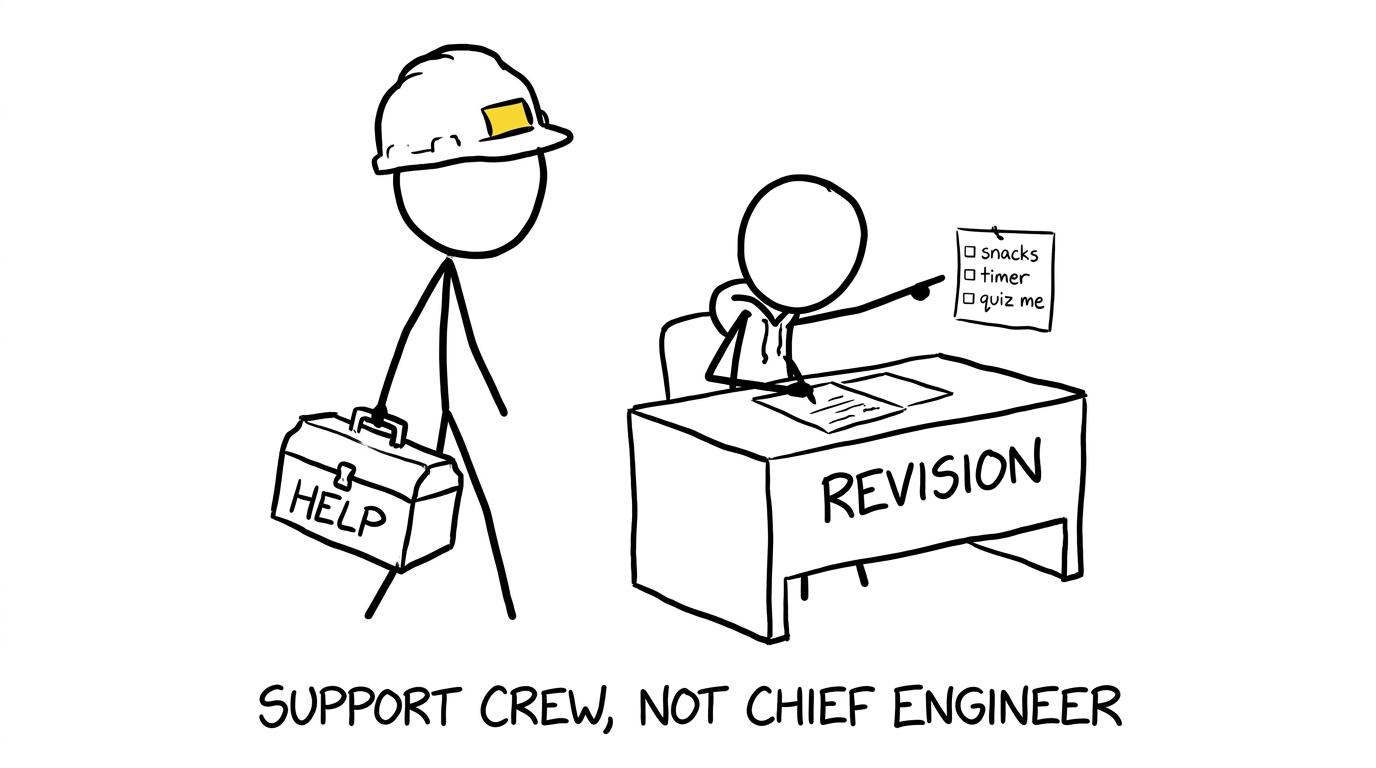 A parent arrives with an oversized revision toolbox while a student requests simple support
Why GCSE Engineering needs a particular kind of support
The current AQA GCSE Engineering specification, code 885288528852, has two distinct components. The written paper is worth 120120120 marks and contributes 60%60\%60% of the qualification. The non-exam assessment, or NEA, is worth 808080 marks and contributes 40%40\%40%.
That distinction changes what parental involvement should mean.
For the written examination, parents can support retrieval practice, timed questions, organisation and reflection. For the NEA, boundaries must be much firmer. Submitted work must be the student’s own, additional assistance must be recorded where required, and assessed practical work is conducted under the supervision arrangements set by the school and exam board.
A parent may ask, “What testing evidence do you still need to collect?” They should not decide the test, produce the analysis or improve the prototype on the student’s behalf. Questions preserve ownership. Answers supplied by somebody else weaken it.
Students should always confirm their exact qualification, specification and assessment arrangements with their school. Engineering courses are not interchangeable, and advice for the AQA GCSE should not automatically be applied to another technical award.
Where parental involvement genuinely helps
Building a routine without taking control
A revision plan works best when the student helps to design it. Parents can make the process concrete by discussing school commitments, deadlines and available time, then letting the student choose the order of work.
The free MathsGenie revision planner can turn a vague intention into visible sessions. A useful Engineering session might contain:
- a short recall of terminology or processes;
- one focused specification area;
- exam-style questions or a paper section;
- immediate checking with a mark scheme;
- one written action for the next session.
The parent’s job is not to police every minute. It is to help make the plan realistic and notice when it has quietly become impossible. A missed session can be rearranged. A timetable that assumes perfect energy every evening will eventually be abandoned.
Asking questions that expose understanding
Parents do not need an engineering background to quiz effectively. In fact, not knowing the content can sometimes help because it forces the student to explain rather than recite.
Useful prompts include:
- “What does that term mean in this context?”
- “Why would an engineer choose that material or process?”
- “Which evidence supports your conclusion?”
- “What units should the answer use?”
- “How could you check whether the result is sensible?”
- “Which part would earn the mark?”
These prompts test reasoning without feeding the answer. If the explanation becomes unclear, that is useful diagnostic information. The student can return to the lesson, specification or practice questions rather than entering an argument about who remembers the method correctly.
Supporting the maths inside Engineering
Engineering maths is not separate from GCSE Maths. It puts familiar skills into technical contexts: ratios, percentages, area, volume, standard form, graphs, significant figures, trigonometry, Pythagoras’ theorem, substitution and changing the subject of a formula.
The AQA specification includes relationships such as density,
ρ=mV,\rho = \frac{m}{V},ρ=Vm,stress,
σ=FA,\sigma = \frac{F}{A},σ=AF,and Ohm’s law,
I=VR.I = \frac{V}{R}.I=RV.A parent can ask the student to identify the subject, quantities and units before calculating. They can also encourage a reasonableness check afterwards. They should not take over the algebra.
If the underlying skill is weak, use the GCSE Maths revision hub to find board-appropriate lessons and questions. For an Engineering problem involving right-angled triangles, for instance, the SOHCAHTOA revision guide can repair the mathematical method before the student returns to its technical application.
This is especially valuable for students preparing for their separate GCSE Maths papers. Revising formula rearrangement or graphs through Engineering provides another context, while Maths practice builds the fluency needed in Engineering calculations.
Helping students learn from practice papers
A practice paper becomes useful after it is marked. Parents can protect the time needed for a timed attempt, but the richer conversation happens afterwards:
- Which marks were lost through missing knowledge?
- Which were lost through inaccurate calculation?
- Were units, significant figures or working omitted?
- Did the student misread a command word?
- Which topic should be revisited next?
The student should lead the marking wherever possible. The parent can help maintain honesty and stop the total mark becoming the only thing discussed. MathsGenie’s guide to using past papers properly explains the paper, mark, fix and retest cycle.
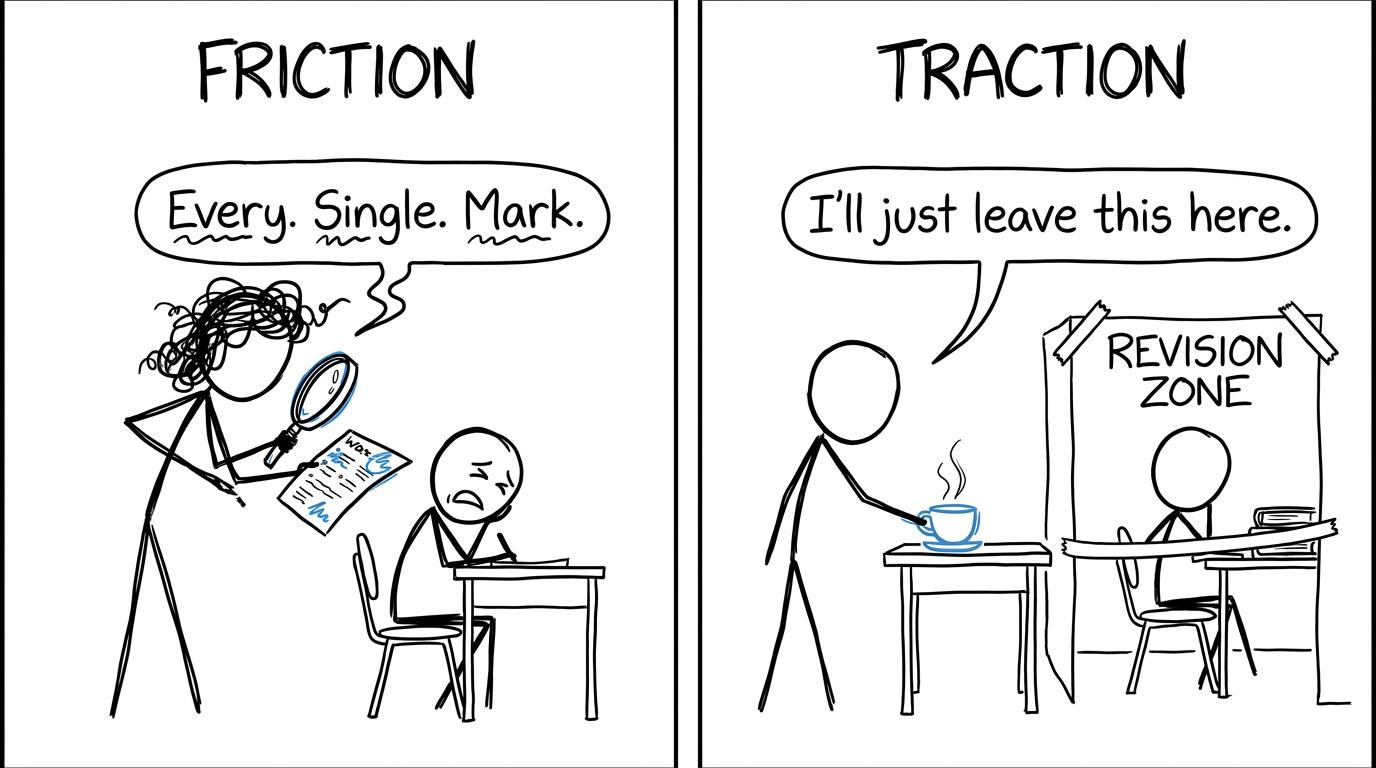 A hovering parent creates friction while quiet practical support creates traction
Where involvement creates more friction than progress
Constant monitoring
Repeated questions about revision can communicate anxiety rather than support. They also shift responsibility from the student to the parent: revision happens because somebody is watching, not because the student has learned to manage it.
Agreeing one brief weekly check-in is often calmer than asking for updates every evening. The discussion can cover what was completed, what changed and what support is needed next.
Correcting during every question
Immediate interruption prevents productive struggle. A student needs time to choose a formula, test an approach and notice that something has gone wrong. Parents who correct each hesitation can accidentally teach dependence.
A better boundary is to wait until the end of the question or session. If the student is genuinely stuck, use the mark scheme, teacher feedback or a revision lesson rather than improvising an explanation that may conflict with the required method.
Turning marks into emotional weather
One low score should generate a revision decision, not a family crisis. Marks from practice are information about current performance under particular conditions. They are not fixed predictions.
The useful response is specific: identify two weaknesses, practise them and retest. MathsGenie’s guide to finding weak GCSE topics provides a practical diagnostic approach.
Taking over the NEA
This is the clearest boundary. Parents must not produce, manufacture, edit or substantially direct work submitted as the student’s own. Even technically excellent help can compromise authenticity.
Questions about organisation and wellbeing are appropriate. Decisions about assessed design, manufacture, testing, analysis and evaluation belong within the student’s authorised school support.
A simple agreement for students and parents
Before revision becomes tense, agree three things.
What the student owns
The student chooses the topic, completes the work, marks it honestly and records mistakes. They also say when help is useful and when concentration requires quiet.
What the parent provides
The parent helps protect time, reduce practical distractions, notice deadlines and offer encouragement. If asked, they can quiz from student-prepared notes without supplying technical explanations.
When both step back and ask the school
Questions about NEA assistance, assessment conditions, specification interpretation, access arrangements or conflicting technical guidance should go to the teacher. A parent’s confidence is not a substitute for the school’s assessment responsibilities.
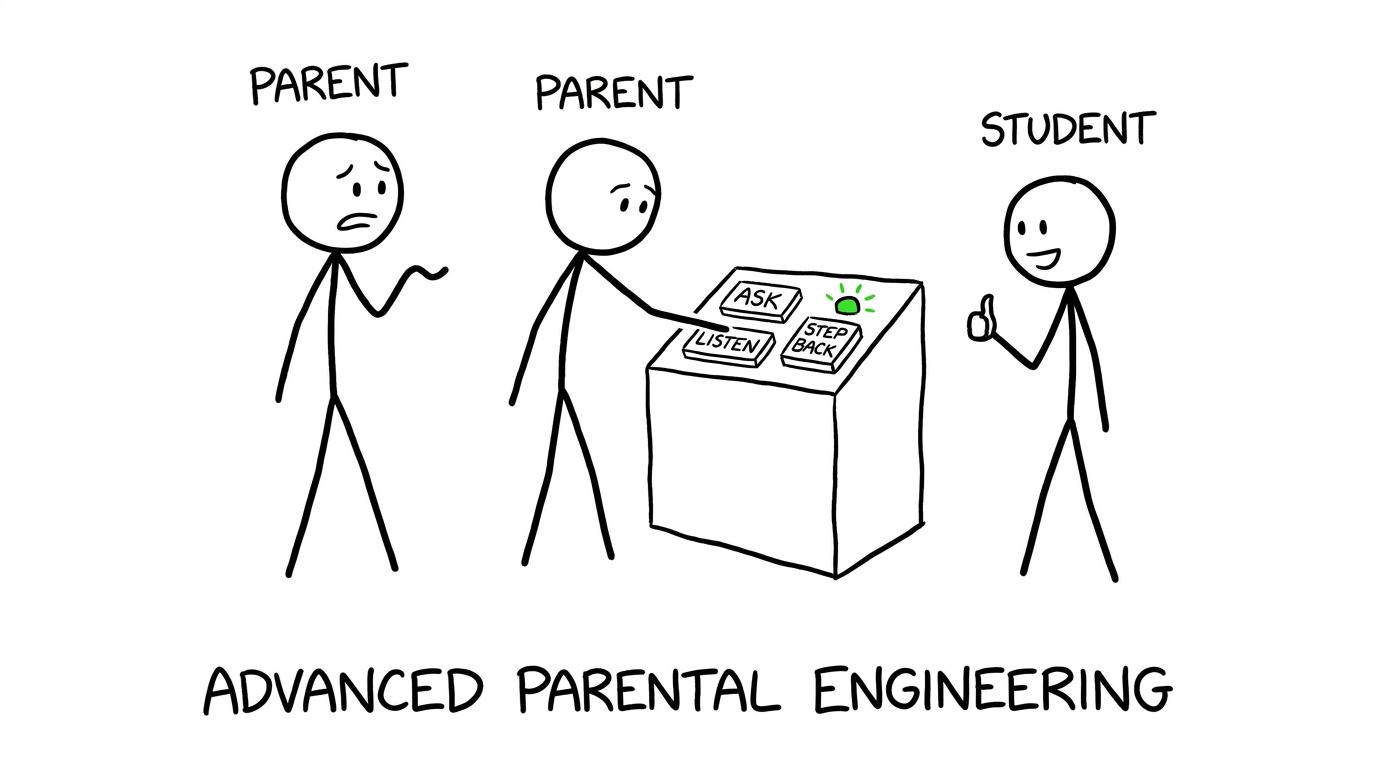 A student and parent use the advanced control panel buttons ask, listen and step back
Common mistakes to avoid
Revising what feels comfortable: Students may repeatedly review familiar materials while avoiding calculations, systems or longer responses. Use marked questions to choose priorities.
Building an overcrowded timetable: A plan with no room for schoolwork, rest or delays soon creates conflict. The GCSE maths revision timetable guide shows how to build repeatable sessions around genuine weaknesses.
Letting a parent reteach unfamiliar content: Good intentions do not guarantee specification-accurate advice. Use the teacher, revision lesson and mark scheme as the authority.
Focusing only on final answers: Engineering calculations require correct substitution, units, sensible precision and communicated working. A wrong final answer may still reveal a sound method; a correct number reached through unclear reasoning may conceal a fragile understanding.
Using predicted papers as promises: Predicted papers provide fresh practice, not advance knowledge of an examination. For separate Maths preparation, Edexcel GCSE Maths predicted papers should complement specification coverage and official past papers rather than replace them.
Confusing help with ownership: The student must remain responsible for revision and assessed work. The goal is not simply to survive one examination season. It is to build the independence needed for sixth form, an apprenticeship, A Level study or future technical training.
Support should make independence more likely
The best parental involvement is often almost invisible. A quiet room appears. A deadline is remembered. A difficult mark is met with curiosity instead of panic. Then the parent steps back and the student does the thinking.
Start with the MathsGenie AQA GCSE Engineering resources, identify one weak area and agree one useful form of support. Use revision lessons to rebuild understanding, practice questions to develop accuracy, and past papers with mark schemes to reveal what needs attention next. For GCSE Maths, add mini tests, video solutions and predicted papers as the examination approaches.
Parents do not need to become engineers. They need to help create the conditions in which a student can learn to think like one.