Parents Involved in GCSE Chemistry Revision?
Parents involved GCSE Chemistry revision can help with planning, quizzing and maths practice, but too much control creates stress. Find the right balance.
Revision can turn an ordinary question, “How is Chemistry going?”, into an argument about timetables, phones and unfinished practice papers. Both sides usually want the same thing. The student wants to do well; the parent wants to help. The difficulty is deciding what help should look like.
So, should parents get involved in GCSE Chemistry revision? Yes, but mainly as organisers, questioners and sources of calm. The best approach to parents involved GCSE Chemistry revision is support without takeover: help the student make a realistic plan, provide materials, quiz from an agreed source and notice when a maths skill is blocking the chemistry. Teaching unfamiliar content, monitoring every minute or comparing results usually creates more friction than progress.
The short answer: what helpful involvement looks like
A useful parental role can be summarised in six actions:
- Agree what help the student actually wants.
- Protect a regular, manageable revision time.
- Quiz using notes, flashcards or a mark scheme rather than improvising questions.
- Help classify mistakes as knowledge, application, maths or exam technique.
- Encourage the student to ask their teacher when an explanation remains unclear.
- Step back once the session has started.
This balance matters because parental engagement is not automatically effective in every form. The Education Endowment Foundation reports a positive average relationship between parental engagement and progress, but also notes that evidence about the most effective approaches is mixed and less extensive for secondary pupils. Practical support for independent learning is more defensible than simply increasing supervision.
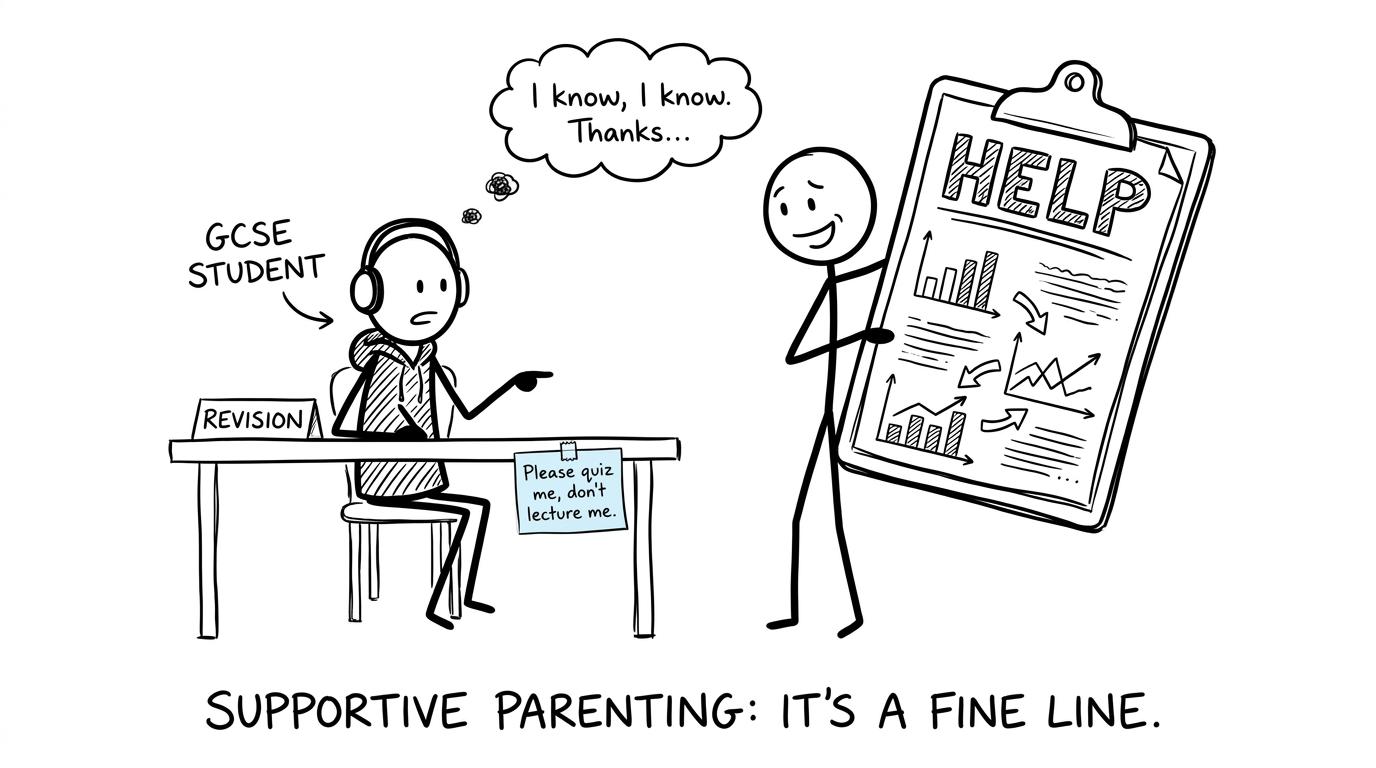 A student asks a well-meaning parent to quiz rather than lecture
Where parents can genuinely help with Chemistry revision
Creating structure without controlling every session
A parent can reduce the number of decisions surrounding revision. That matters because deciding when to start, which topic to choose and what resource to open can consume the energy that should have gone into the work.
A simple weekly conversation is often enough:
- Which Chemistry topics need attention?
- Is the student taking separate Chemistry or Combined Science?
- Which specification and exam board applies: AQA, Edexcel, OCR or Eduqas?
- Is the next task recall, calculation practice, required practicals or exam questions?
- When will the work be marked and reviewed?
The student should make the final choices wherever possible. A plan works better when it feels owned rather than imposed. Parents can check that it is realistic, particularly when Chemistry must fit alongside maths and other GCSE subjects.
For the maths part of that plan, the free GCSE Maths revision hub provides board-specific revision materials, questions and papers. It can turn a vague target such as “improve calculations” into a precise task.
Quizzing without pretending to be the teacher
Parents do not need strong Chemistry knowledge to quiz effectively. In fact, not knowing the answer can be useful because it forces the student to explain clearly.
The safest method is to work from a trusted source. The student gives the parent flashcards, a knowledge organiser or questions with answers. The parent reads the prompt, listens and checks against the supplied wording. If the response is incomplete, ask:
- “What key term is missing?”
- “Can you explain why?”
- “What evidence would support that conclusion?”
- “Which unit should appear?”
This keeps the conversation focused on retrieval and explanation. It avoids a common problem: an adult confidently teaching a remembered version of Chemistry that does not match the student’s current specification or mark scheme.
Helping to diagnose lost marks
A raw score tells you how a paper went. It does not tell you what should happen next.
After marking a Chemistry question set, each lost mark can be placed into one of four categories:
| Type of mistake | Sensible next action |
|---|---|
| Missing knowledge | Review the precise specification point, then test recall |
| Weak application | Practise unfamiliar exam-style contexts |
| Maths error | Repair the underlying calculation skill |
| Exam technique | Compare the response carefully with the mark scheme |
A parent can help maintain this mistake log without turning it into a judgement sheet. The purpose is to locate the next useful action, not to produce a running verdict on the student.
MathsGenie’s guide to finding weak GCSE topics explains how to convert lost marks into focused revision. Although the paper may be Chemistry, the same diagnostic logic applies.
Chemistry revision often reveals a maths problem
Chemistry is not maths with test tubes, but quantitative questions require dependable mathematical habits. Official GCSE Chemistry requirements include ratios, fractions, percentages, standard form, significant figures, substitution, rearranging equations and interpreting graphs. The exact content and tier demand depend on the qualification and specification.
That makes parental support especially useful when a student understands the science but repeatedly loses calculation marks.
Spotting the actual barrier
Suppose a student knows which Chemistry relationship is relevant but cannot isolate the required quantity. Revising the scientific explanation again may not fix anything. The underlying gap is changing the subject of a formula.
The same distinction applies when a student struggles with:
- reacting-mass relationships because ratio is insecure;
- percentage yield or atom economy because percentages are insecure;
- particle quantities because standard form is insecure;
- rates data because graph interpretation is insecure;
- concentration calculations because units and substitution are insecure.
Parents do not need to teach these skills themselves. They can help name the bottleneck and direct the student towards a focused resource. Useful MathsGenie starting points include changing the subject of a formula, ratio revision, percentages practice and standard form revision.
Checking method rather than supplying answers
A productive calculation check follows a consistent sequence:
- Identify the quantity being found.
- Write the relevant relationship.
- Rearrange if necessary.
- Convert units before substitution where required.
- Substitute values carefully.
- Calculate without rounding prematurely.
- state the unit and use the requested precision.
For percentage change, for example, the general relationship is:
percentage change=changeoriginal value×100\text{percentage change} = \frac{\text{change}}{\text{original value}} \times 100percentage change=original valuechange×100This is not a worked Chemistry example; it is a checking framework. The parent’s job is to ask which stage failed. Supplying the final answer removes the very thinking the student needs to practise.
Graph-based Chemistry questions may also depend on gradients, scales and lines of best fit. Students who need to strengthen those foundations can use MathsGenie’s drawing linear graphs resources.
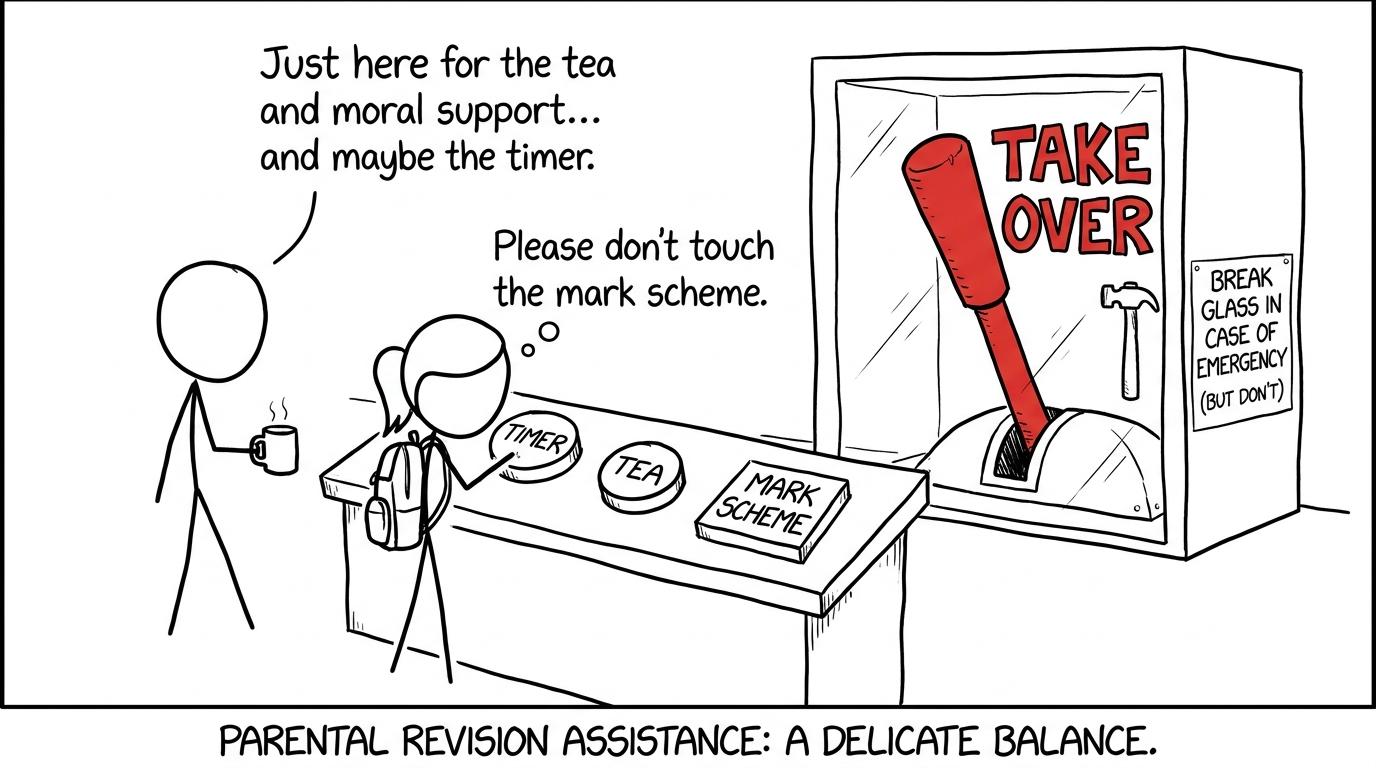 A parent and student use timer, tea and mark scheme controls while avoiding the take-over lever
Where parental involvement creates friction
Turning revision into surveillance
Repeatedly asking whether revision has begun may produce visible activity without useful learning. A student can sit at a desk for an hour and achieve very little if the aim is merely to prove compliance.
Agree checkpoints instead. A parent might ask to see the weekly plan on Sunday and discuss one marked task later in the week. Between those points, the student controls the process. Independence is not the absence of accountability; it is accountability with room to act.
Teaching beyond the parent’s confidence
GCSE Chemistry specifications contain precise terminology, practical methods and assessment expectations. Advice based on distant memories can conflict with what the student has been taught. If parent and teacher explanations differ, the specification, teacher guidance and official mark scheme should lead.
A good sentence is: “Let’s write that down and ask your teacher.” Uncertainty handled calmly is more helpful than certainty performed badly.
Focusing only on grades and hours
Grades 999 to 111 matter, but they are lagging indicators. They show the result of many smaller habits. Conversations are more productive when they focus on controllable evidence:
- Was the session completed?
- Were answers marked honestly?
- Was each mistake understood?
- Was the weak skill practised again?
- Can the student explain the idea without notes?
Hours are equally misleading. Thirty focused minutes of retrieval and marked questions may be more valuable than two hours of copying notes.
Using predicted papers as predictions of certainty
Predicted papers can provide fresh exam-style practice, but they cannot guarantee which Chemistry or maths topics will appear. They should supplement specification-wide revision, not replace it.
For maths preparation alongside science, Edexcel GCSE Maths predicted papers are most useful after topic gaps have been addressed. Complete them under timed conditions, use the mark scheme and feed every error back into the revision plan.
A low-friction parent and student routine
A short agreement can prevent many arguments. Before the week begins, decide:
- Student responsibility: choose topics, attempt questions independently and identify unclear areas.
- Parent responsibility: protect time, provide agreed resources and quiz only when asked.
- Shared responsibility: review one marked task and decide the next action.
- Teacher responsibility: resolve specification questions or persistent misconceptions.
During a session, the parent can help with timing or remove distractions, then leave the student to work. Afterwards, a five-minute conversation is enough: what improved, what remains uncertain and what happens next?
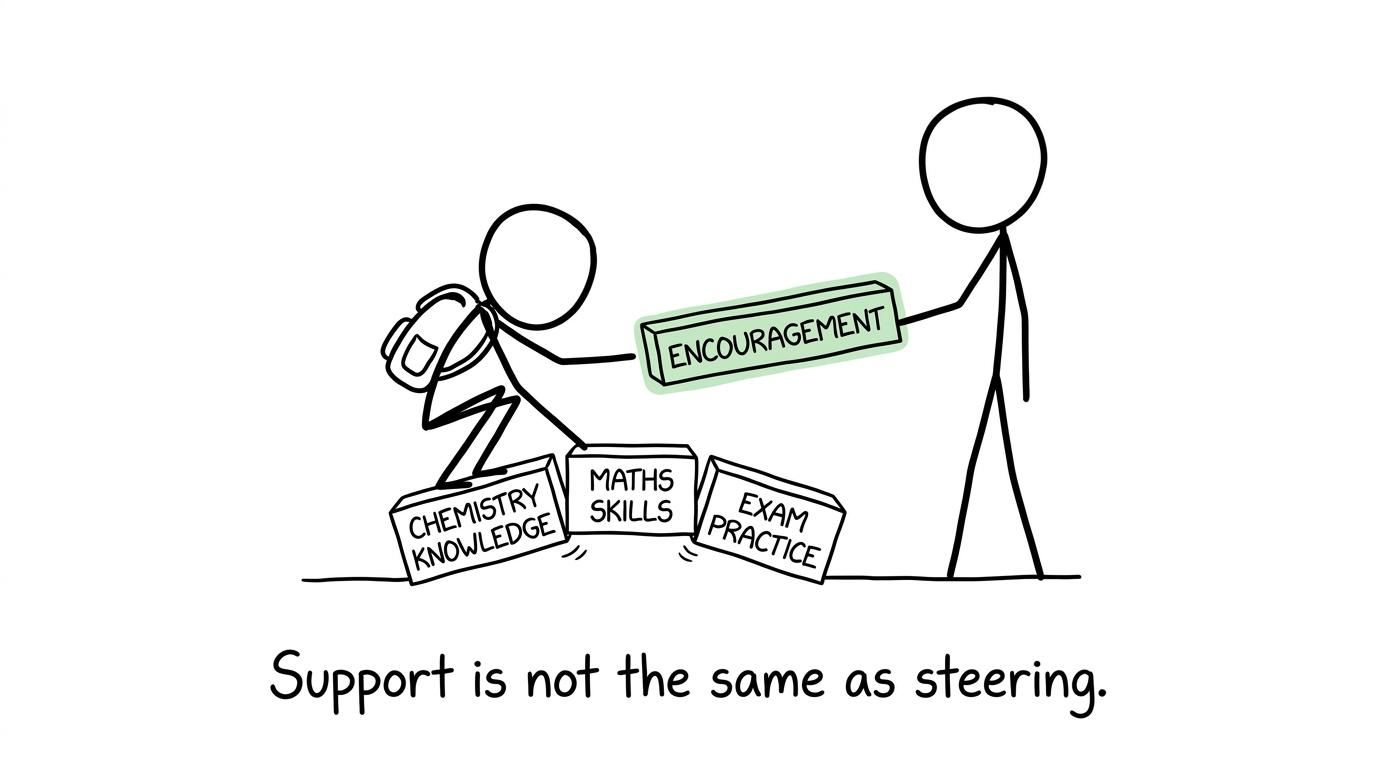 A parent hands over one revision block while the student builds the bridge
Common mistakes when parents help with GCSE revision
Correcting too quickly
Silence can feel uncomfortable, but recall takes time. Wait before offering a prompt. If help is needed, give the smallest useful clue rather than the answer.
Marking generously
Kind marking creates false confidence. Use the supplied mark scheme and apply it consistently. A missed unit, unsupported conclusion or incorrect key term should become a revision target.
Revising the parent’s favourite topics
Adults naturally return to content they recognise. Revision should follow the student’s specification, assessment evidence and teacher guidance instead.
Fixing every problem at once
A long mistake list can feel like failure. Choose one or two high-value weaknesses, repair them and retest. Progress becomes visible when the list gets shorter.
Ignoring the student’s boundaries
Some students welcome quizzing but dislike timetable checks. Others want help beginning a task but prefer to mark it alone. Ask what support is useful, review the arrangement and change it if it is creating more tension than learning.
Support the process, then let the student own it
The best parental involvement is often quiet. It creates time, reduces confusion and helps the student respond intelligently to mistakes. Then it steps aside.
For students balancing Chemistry with GCSE maths, MathsGenie offers free revision lessons, practice questions, mini tests, video solutions, past papers, mark schemes and predicted papers. Start at the GCSE Maths revision hub, identify the mathematical skill behind any lost Chemistry marks, practise it directly and return to the science question with greater confidence.
Parents can build the conditions. Teachers can clarify the course. MathsGenie can provide the practice. But the student still has to do the thinking, and that is exactly where lasting progress begins.