Online GCSE Arabic Revision Course: Is It Worth It?
Online GCSE Arabic revision course guide: compare paid teaching with free resources, protect maths time, and decide what support is genuinely worth it.
Revision creates an awkward kind of pressure. Every subject asks for more time, while every advert promises that one more course will make the difference. If you are considering an online GCSE Arabic revision course while preparing for GCSE maths, the short answer is simple: it can be worth paying for if you need regular speaking feedback, specialist teaching or firm accountability. It is probably not worth it if free resources already meet those needs or the course would take time away from a weaker, more important subject.
The real question is not whether paid teaching is good. It is whether this particular course solves a problem you genuinely have.
A quick decision checklist
Before joining, ask:
- Does the course match your exact GCSE Arabic specification and tier?
- Will a qualified teacher assess your speaking and writing?
- Are lessons live, recorded or both?
- Will you receive individual feedback rather than general model answers?
- Can you attend without weakening your GCSE maths revision?
- Have you tried the available free resources first?
- Is there a trial lesson, cancellation policy or sample timetable?
- Does the course provide something your school cannot already offer?
If you cannot explain the course's value in one sentence, do not buy it yet.
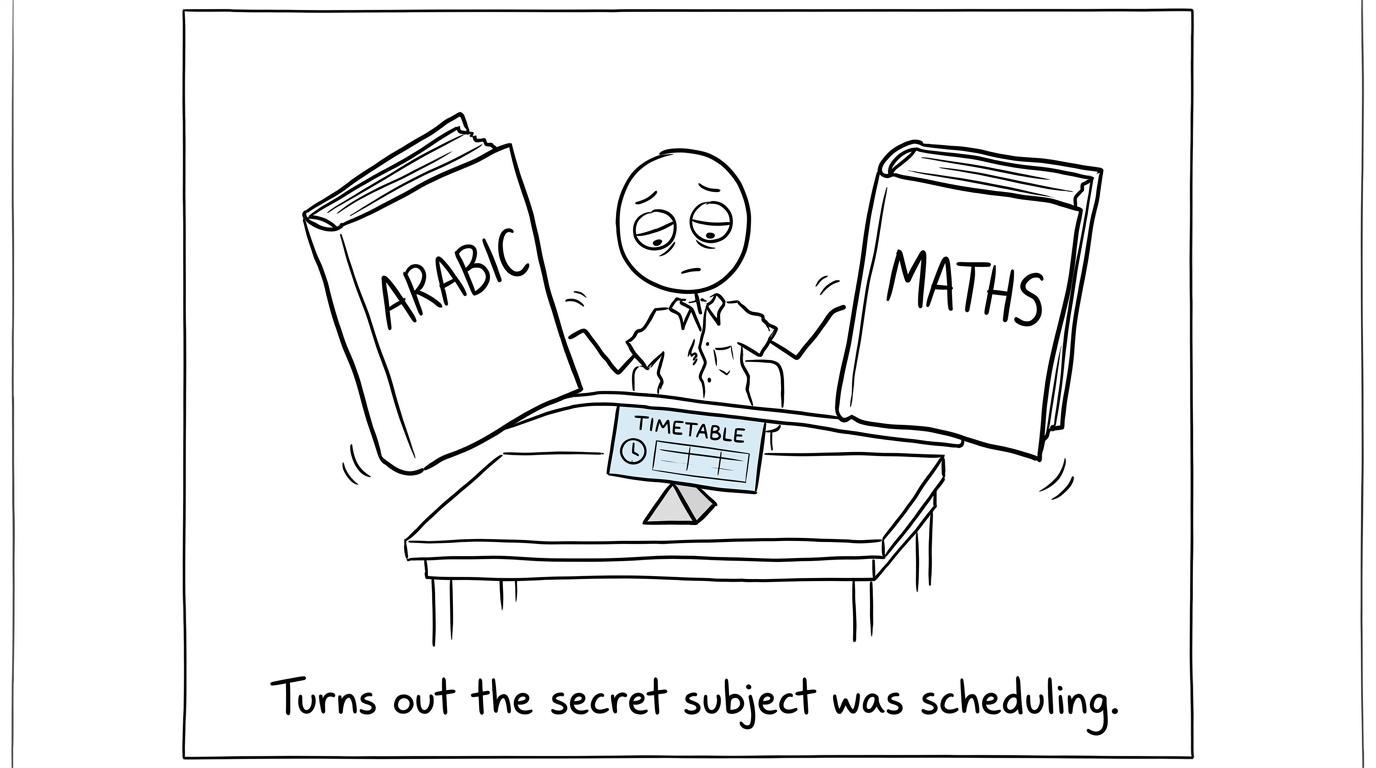 A student balancing Arabic and maths revision with a sensible timetable
What GCSE Arabic revision actually needs to cover
Start with the specification, not the sales page. Students sometimes buy a broad Arabic language course and discover that it does not teach the tasks, timings or vocabulary expected in their examination.
For the current Pearson Edexcel GCSE Arabic qualification, students are assessed through four papers covering listening, speaking, reading and writing. Each area contributes 25%25\%25% of the qualification. Foundation and higher tiers are available, but a student must be entered for the same tier across all four papers. Dictionaries are not permitted in the assessments, including the preparation period for speaking.
The speaking assessment includes structured tasks, while reading includes translation from Arabic into English and writing includes translation into Arabic. Exact task demands and timings differ by tier, so your school entry and the current specification matter.
That creates four distinct revision needs:
- Listening: understanding standard spoken Arabic at examination speed
- Speaking: responding spontaneously, developing answers and communicating clearly
- Reading: identifying meaning, inference and detail across different texts
- Writing: producing accurate, relevant Arabic and handling translation
A course that spends most of its time teaching isolated vocabulary may feel productive without preparing you for all four skills. Likewise, conversational fluency does not automatically produce strong examination technique. Always confirm your exam board with your school rather than assuming it is the same board you take for maths.
When a paid online GCSE Arabic revision course is worth it
You need speaking feedback
Speaking is the strongest reason to consider live teaching. A worksheet can show vocabulary, but it cannot reliably tell you whether your response is clear, relevant and sufficiently developed. Nor can it recreate the pressure of hearing an unexpected question and answering without a script.
A useful course should give you repeated opportunities to speak, followed by specific corrections. Ask how often each student speaks during a lesson. A large online class in which the teacher does most of the talking may offer less individual practice than the timetable suggests.
Your writing errors are difficult to diagnose
Model answers help you see what good writing looks like, but they do not necessarily reveal why your own sentence is inaccurate. Individual marking can identify recurring issues in grammar, spelling, agreement, vocabulary choice and sentence construction.
The valuable part is not simply receiving a corrected answer. It is learning what to change next time. Look for feedback that identifies patterns and sets a clear revision action.
You need external structure
Some students can build a plan and follow it. Others repeatedly postpone the subject that feels hardest. Neither is a character judgement. It is simply a difference in how people respond to unstructured time.
A fixed weekly lesson may be worthwhile if it turns good intentions into regular listening, speaking and writing practice. In that case, you are partly paying for accountability. That can be sensible, provided the workload remains realistic.
Your school has limited specialist support
A course may fill a genuine gap if your school cannot provide frequent Arabic teaching, speaking practice or detailed marking. It may also help a private candidate who needs guidance on the specification and examination tasks.
However, an online course cannot make formal examination arrangements for you unless it explicitly operates through an appropriate centre. Private candidates should confirm speaking and entry arrangements directly with an examination centre rather than relying on assumptions made in a course advert.
When free GCSE Arabic resources may be enough
Paid support is not automatically better support. Free materials can be sufficient when you already have access to a teacher, understand the specification and can practise consistently.
A strong free-resource plan can include:
- the current specification and vocabulary guidance from your exam board
- official past papers, audio and mark schemes
- teacher feedback available through your school
- regular speaking practice with an appropriate partner
- vocabulary retrieval rather than passive rereading
- timed reading, translation and writing tasks
- an error log showing weaknesses to revisit
The limitation is usually not the amount of available information. It is feedback. Listening and reading can often be checked against answers, but speaking quality and extended writing are harder to judge alone. Before paying for a complete course, ask whether a smaller amount of targeted tutoring or school feedback would solve that narrower problem.
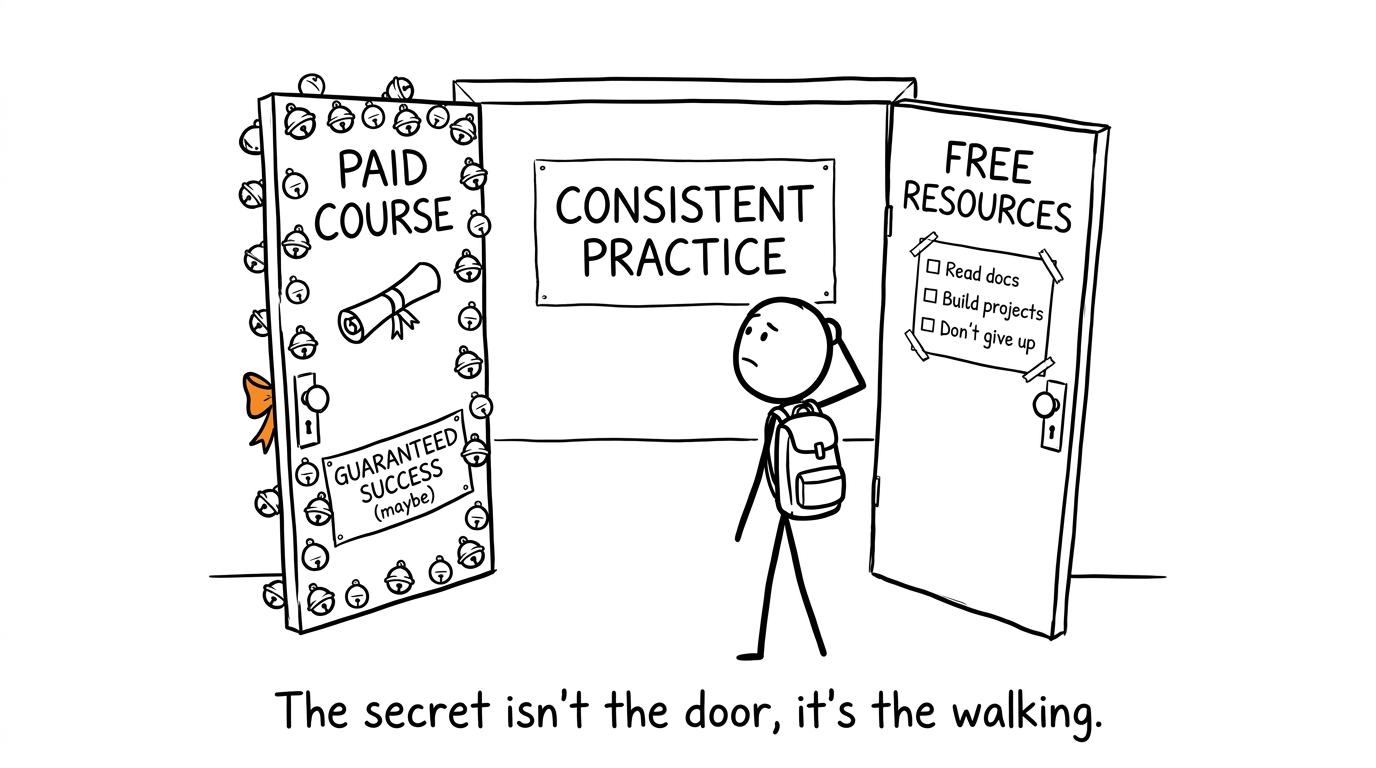 Two revision routes leading towards consistent practice
Compare the course with free resources properly
Do not compare a polished course website with a random collection of free videos. Compare complete revision systems.
| What you need | Free resources may be enough when... | Paid teaching may help when... |
|---|---|---|
| Specification coverage | You can organise official materials yourself | You need a teacher-led sequence |
| Speaking practice | Your school or a suitable partner gives feedback | You lack regular, informed feedback |
| Writing improvement | A teacher already marks your work | The same errors keep recurring unnoticed |
| Accountability | You follow a timetable independently | Revision is repeatedly postponed |
| Exam technique | You understand papers and mark schemes | You need tasks explained and reviewed |
| Flexibility | You prefer working at your own pace | Fixed lesson times help you begin |
Paid courses should be judged by teaching quality and feedback, not by the number of downloadable files. A large resource library has little value if you never use it.
Before enrolling, request or inspect:
- a scheme of work linked to the current specification
- the teacher's experience with GCSE Arabic
- class size and individual speaking time
- how frequently writing is marked
- examples of feedback, without personal student information
- recording availability and access duration
- total fees, additional charges and cancellation terms
Avoid relying on guaranteed-grade claims. No responsible provider can control your examination performance, and impressive testimonials do not tell you whether the course fits your needs.
Protecting your GCSE maths revision time
For a student preparing for maths exams, the hidden cost of an Arabic course is not only money. It is time, energy and attention.
Suppose a weekly lesson also brings homework, vocabulary practice and travel-free but screen-heavy preparation. That commitment has to fit alongside maths, English, science and your other subjects. If maths is currently below your target grade, sacrificing its most productive revision sessions may be a poor exchange.
Use a timetable built around evidence. Begin with the GCSE maths revision hub, select your exam board and identify the topics costing you marks. The GCSE one-month revision plan can help you give each subject a defined place rather than revising whichever one feels urgent that evening.
A balanced week might contain separate blocks for Arabic listening, speaking and writing, alongside maths topic practice and one timed assessment. The precise balance depends on your current grades, targets and examination dates. Your lowest-performing subjects usually need more time, but teacher advice should shape that decision.
For maths, shorter assessments can keep progress visible without consuming an entire evening. Use the GCSE mini tests or, if appropriate, the Edexcel GCSE maths mini tests. Mark them immediately and let the mistakes choose the next topic.
A sensible trial before paying
Give free revision a fair test first. For two weeks, follow a small but complete Arabic routine:
- complete one listening activity and review every missed answer
- practise speaking aloud several times
- complete one timed reading or translation task
- write one response and obtain feedback where possible
- review vocabulary through self-testing
- record what you completed and where you became stuck
At the end, inspect the evidence. If you worked consistently but could not evaluate your speaking or writing, paid feedback may be useful. If you did not begin the planned sessions, a structured course could provide accountability, although a simpler timetable may solve the same issue for free.
Apply the same approach to maths. Complete a short assessment, mark it and repair the weakest topic. Students taking Edexcel can use Edexcel GCSE maths past papers, while AQA students can choose from AQA GCSE maths past papers. Past papers should diagnose your next action, not merely produce a score.
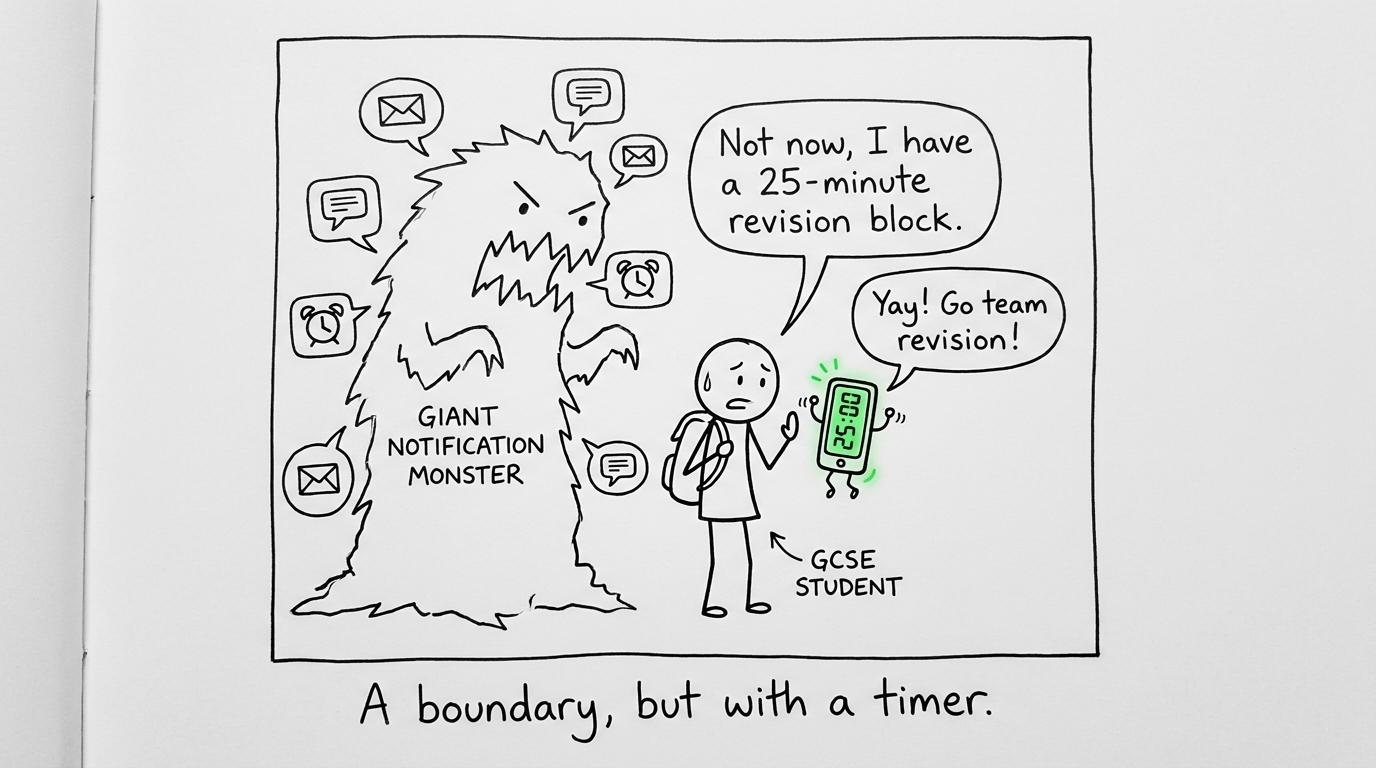 A student setting a boundary with a revision timer
Common mistakes when choosing an Arabic revision course
Buying before identifying the problem
Do not purchase a full course when the actual gap is one marked writing task each week. Diagnose first, then buy the smallest intervention that solves the problem.
Ignoring the specification and tier
A general Arabic course may improve language knowledge without matching GCSE assessment. Confirm the qualification, paper structure, tier and current specification before joining.
Mistaking attendance for progress
Watching a live lesson is still passive if you rarely retrieve vocabulary, speak or write. Progress requires activity between lessons.
Choosing on price alone
The cheapest course is poor value if feedback is vague. The most expensive is poor value if your school already provides the same support. Compare what is taught, how feedback works and how much individual attention you receive.
Letting one subject consume the timetable
A new course can feel unusually important because it has fixed deadlines. Do not let it quietly displace maths revision. Keep maths active through topic questions, mark schemes and regular paper practice. The advice in how to stop forgetting GCSE maths content is useful when several subjects are competing for memory.
Treating predicted materials as promises
Predicted papers can provide fresh practice, but they cannot tell you exactly what will appear. In maths, use them after topic revision and official past papers, not instead of them. The same principle applies to language-course predictions.
The final verdict
An online GCSE Arabic revision course is worth joining when it provides something difficult to reproduce alone: expert speaking practice, detailed writing feedback, specification-led teaching or reliable accountability. It is less likely to be worthwhile when it duplicates school support, offers mostly passive videos or takes scarce time from a weaker subject.
Try free resources first. Identify the precise gap. Inspect the teacher, feedback model and specification coverage. Then consider the full cost in both money and revision hours.
For your maths preparation, keep the system uncomplicated. Use MathsGenie's free revision lessons and practice questions to repair individual topics, mini tests to check recall, and past papers with mark schemes and video solutions to build examination confidence. When the exams are closer, add predicted papers as extra practice. Start with the MathsGenie GCSE maths revision hub and let evidence, rather than pressure, decide what you do next.