Moving Sets GCSE Bengali: Does It Affect Grades?
Moving sets GCSE Bengali: learn if a set change affects your final grade, why tier entry matters, and how to adapt your revision with confidence.
Changing sets can feel like receiving a prediction about your future. Move up and it seems as though success has been confirmed. Move down and it can feel as though a door has closed.
But moving sets GCSE Bengali students does not, by itself, change the grade awarded by the exam board. Your set is an internal school arrangement. Your final result depends on your assessed performance and, where the qualification is tiered, the tier for which your school enters you.
For AQA GCSE Bengali, that distinction matters. Foundation Tier offers grades 111 to 555, while Higher Tier offers grades 444 to 999, with a narrow allowed grade 333 for Higher Tier students who fall just below grade 444. Moving class may influence teaching pace, support and eventually the tier recommended for you, but the set label itself earns or removes no marks.
The short answer and your next-step checklist
If your Bengali set changes, focus on these questions:
- Which qualification are you taking? Confirm the exam board and specification code rather than assuming every Bengali or Bangla course has the same structure.
- Has your exam tier changed? A classroom move and an examination entry are not automatically the same decision.
- Which skills led to the change? Ask about listening, speaking, reading and writing separately.
- What content must you catch up on? A move upwards may mean a faster pace or more demanding language.
- When will the decision be reviewed? One assessment should not become a permanent story about your ability.
- What evidence will be used? Recent assessments, classroom work and performance under timed conditions are more useful than a vague impression.
The calmest response is to replace the question “What does this set say about me?” with “What does my latest evidence tell me to practise?”
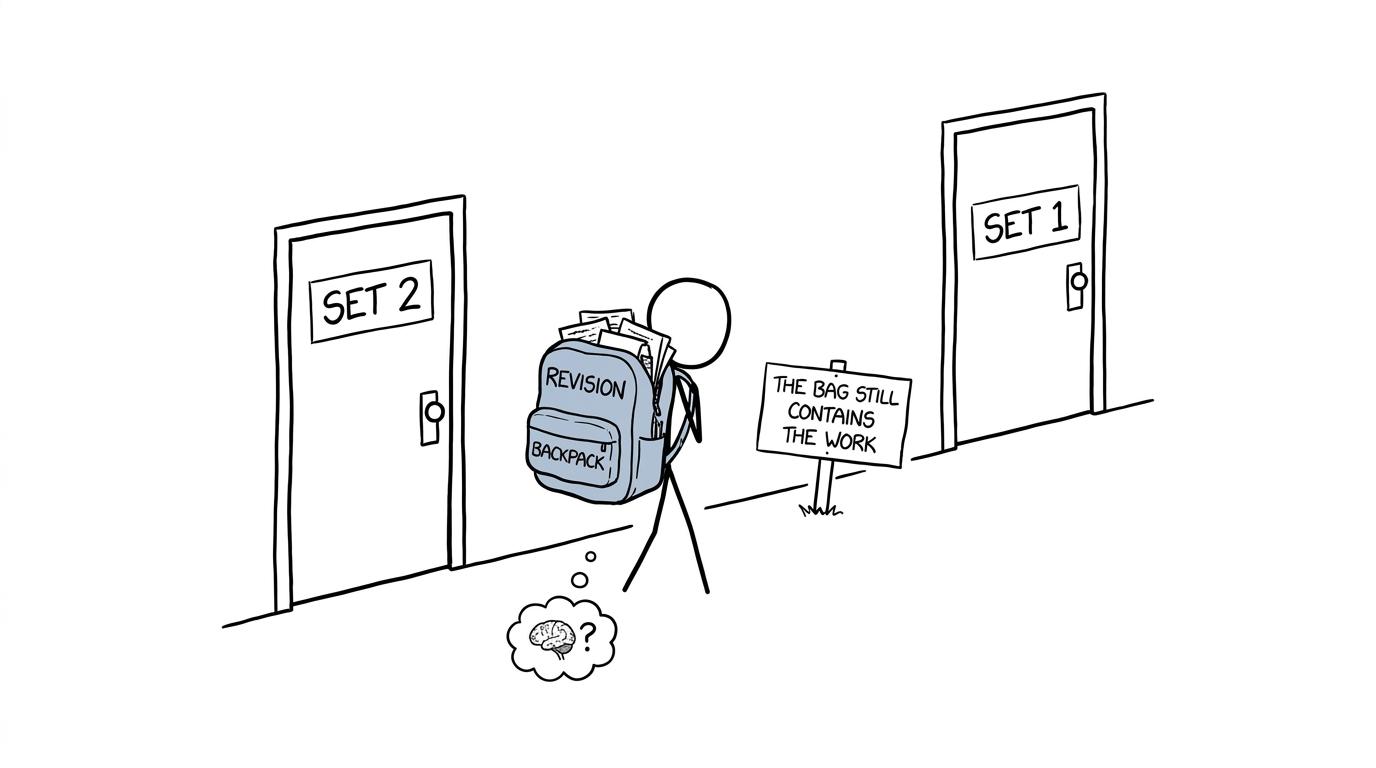 A student discovers that changing sets does not remove the revision work from their bag
What actually determines your GCSE Bengali grade?
For AQA GCSE Bengali 863886388638, the qualification is linear. Students take assessments covering listening, speaking, reading and writing in the same examination series. Each assessment objective contributes approximately $25\% to the overall qualification.
The final result is based on the combined scaled marks from those four components. Grade boundaries are then applied to that overall total. Your timetable group, teacher or school set name does not appear in that calculation.
This creates an important distinction:
| School decision | Examination consequence |
|---|---|
| Moving to a higher or lower teaching set | No direct change to the marks available |
| Receiving a different teacher | No direct change to the grading rules |
| Changing the pace or difficulty of classwork | May affect preparation over time |
| Entering Foundation rather than Higher Tier | Changes the available grade range |
| Improving assessed performance | Can directly improve the final outcome |
A set change can therefore have an indirect effect. A better-matched class may help you receive more suitable explanation, challenge or consolidation. Equally, a poorly managed move could create gaps or reduce confidence. Neither outcome is automatic.
Why tier entry matters more than the set name
AQA GCSE Bengali has two tiers. Students must take all four papers at the same tier; mixed-tier entry is not permitted.
Foundation Tier
Foundation questions target grades 111 to 555. The highest available grade is 555. A grade 444 or 555 achieved through Foundation is a valid GCSE grade; the certificate does not turn it into a lesser version because of the tier.
Foundation may be appropriate when it gives a student the best opportunity to demonstrate secure knowledge without spending too much of each assessment facing inaccessible Higher material.
Higher Tier
Higher questions target grades 444 to 999. A student who narrowly misses grade 444 may receive the allowed grade 333, but a result below that narrow safety net is unclassified.
Higher Tier is necessary if you are realistically aiming above grade 555. However, it should not be chosen simply because “higher” sounds more ambitious. The useful question is whether your current evidence shows that Higher questions allow you to collect enough marks consistently.
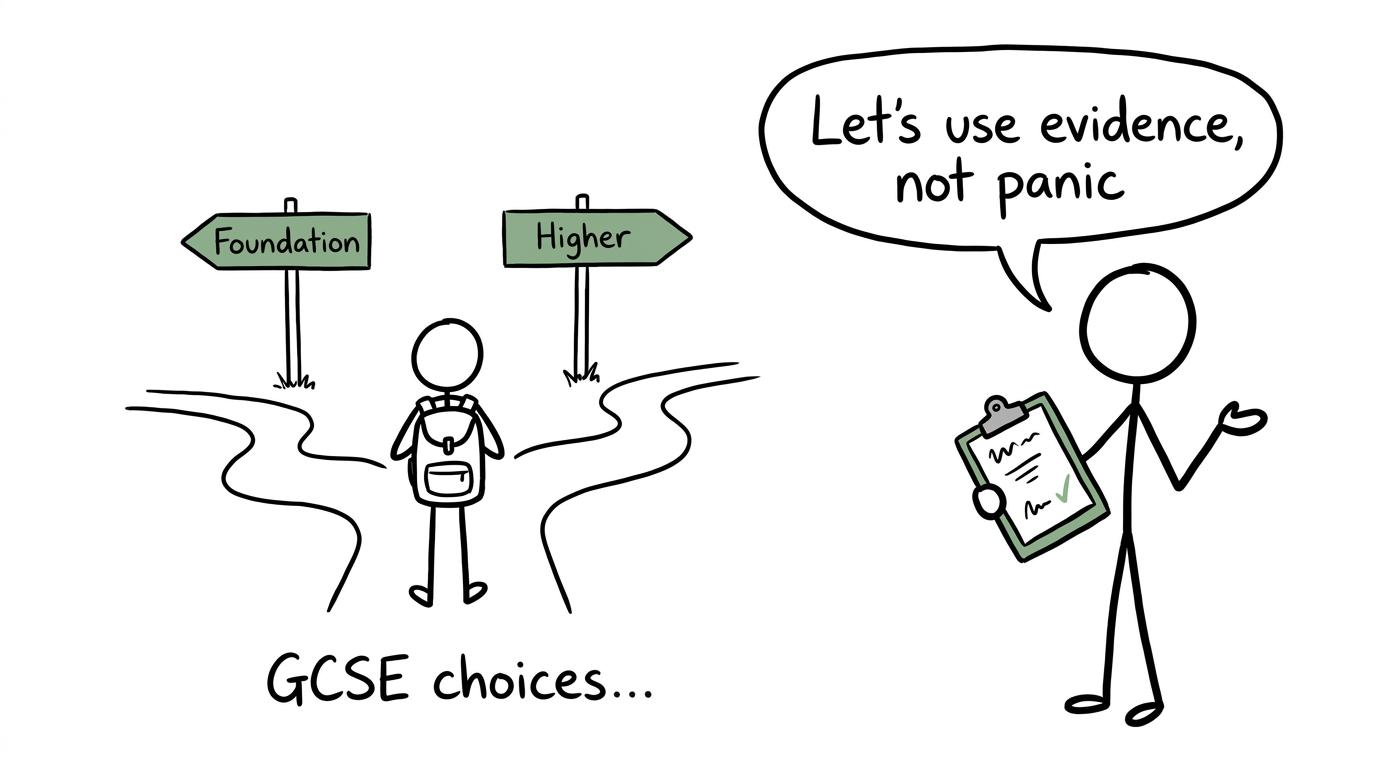 A teacher and student use evidence rather than panic when considering Foundation and Higher paths
A school might place higher-tier candidates in an upper set, but set structures differ. Some schools teach mixed-attainment groups. Others use several sets but enter students from more than one group for the same tier. Ask directly whether your proposed move affects your formal entry.
Does moving down a set reduce your chance of a good grade?
Not necessarily. Moving down can sometimes provide more time for high-value foundations: accurate vocabulary, dependable verb forms, clearer pronunciation, reading comprehension and complete written responses. Secure knowledge is more useful than hurried exposure to difficult material.
The risk is not the move itself. The risk is allowing the move to reduce your expectations without examining the evidence. If you are still performing securely at Higher level and aiming for grade 666 or above, ask how the new class will continue preparing you for Higher tasks.
Use specific questions:
- Will I still cover the Higher vocabulary and grammatical structures?
- Which assessments suggested that this move would help?
- Is the move temporary or permanent?
- What would I need to demonstrate to move back?
- Does it change my intended examination tier?
The answers should lead to an action plan. If they do not, ask your subject teacher or head of department for clarification, ideally with a parent or carer involved where appropriate.
Does moving up a set guarantee a higher grade?
No. Moving up usually means that your school believes greater pace or challenge may suit you, but it is an opportunity rather than a result.
The first danger is hidden missing knowledge. A new group may already know vocabulary, themes or structures that your previous class has not covered. The second is passive optimism: assuming that sitting in a higher set will produce a higher grade without changing your practice.
During your first week, compare exercise books, topic lists and assessment feedback. Ask the teacher to identify the most important gaps, then repair those before trying to catch up with everything at once.
This principle is familiar in maths. Moving to a Higher class does not automatically make algebra secure; deliberate practice does. MathsGenie’s guide to the best order for learning GCSE maths topics shows why foundations should be repaired in a sensible sequence rather than through random revision.
How to adapt after changing Bengali sets
Separate your performance into four skills
A single total can conceal the real issue. You may be a confident speaker but lose marks in reading, or understand listening passages while struggling to produce accurate extended writing.
Create four headings: listening, speaking, reading and writing. Under each, record:
- your latest assessment evidence;
- recurring errors;
- missing vocabulary or structures;
- one specific practice action;
- the date on which you will test the skill again.
This is better than writing “revise Bengali”, which is too broad to guide a useful session.
Build a short catch-up agreement
After moving up, ask for the topic list and identify what the new class has already completed. After moving down, confirm how Higher material will be maintained if Higher entry remains your goal.
A manageable routine might contain three focused language sessions and one timed assessment task each week. The principle matters more than the exact timetable: learn, retrieve, apply, check and revisit.
For organising revision across your GCSEs, MathsGenie’s GCSE maths revision timetable and one-month GCSE revision plan demonstrate how to turn a large specification into repeatable sessions.
Use mark schemes as feedback
Do not look only at the total. Find out why marks were lost. Was the problem knowledge, accuracy, relevance, communication or timing?
A mark scheme is most useful after you have committed to an answer. Compare your response with the criteria, identify the first missing feature and then rewrite or repeat the task. Maths students can apply the same process through MathsGenie’s guide to using GCSE mark schemes to improve.
Retest rather than merely reread
Rereading notes can feel smooth because the material is familiar. Retrieval is more honest. Test vocabulary without prompts, answer an unfamiliar listening task, speak within a time limit or complete a written response without copying a model.
Then return to the weakness. For maths revision, Edexcel GCSE Maths mini tests provide the same kind of short, focused check. The subject differs, but the feedback cycle remains powerful.
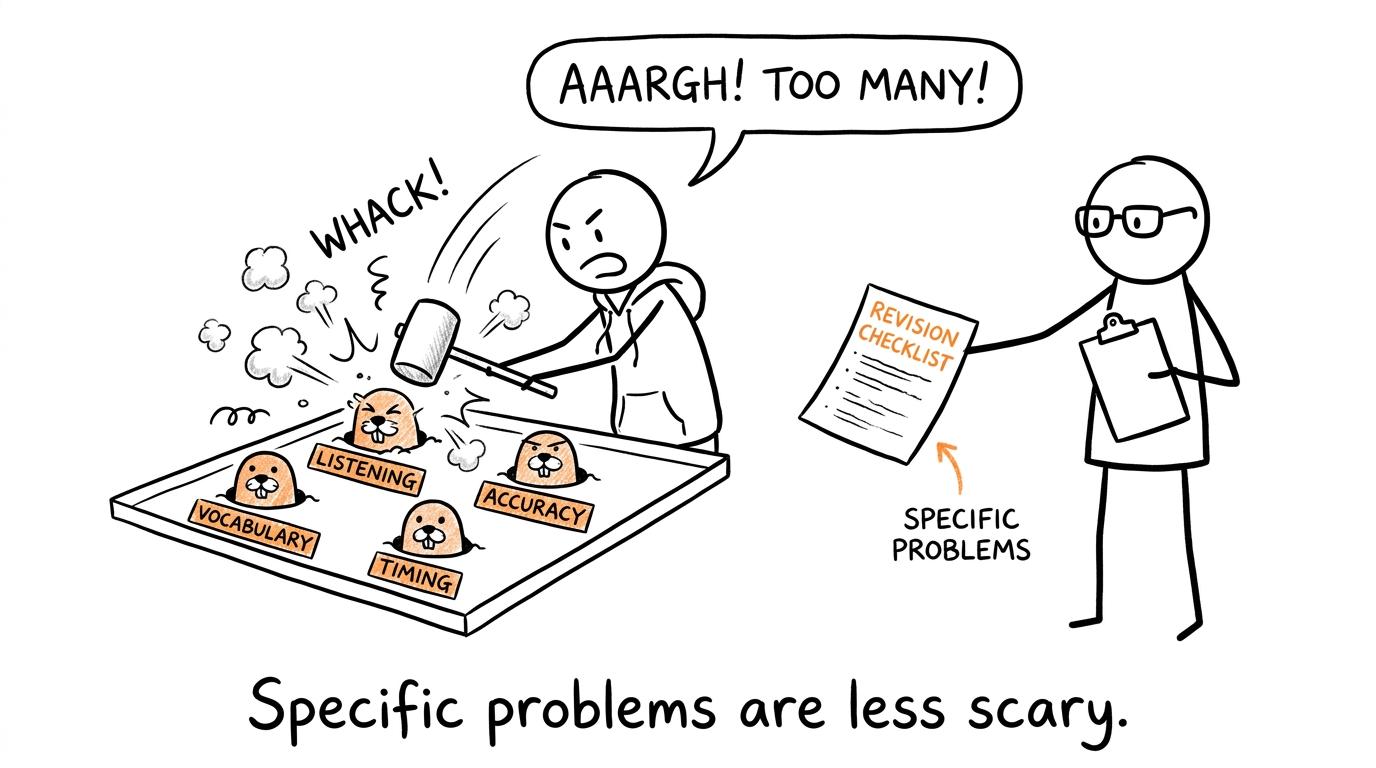 A student turns broad revision worries into specific skills that can be tackled
Keep Bengali and maths tier decisions separate
Students preparing for several GCSEs can easily assume that being in a particular set for one subject predicts the right tier in another. It does not. Bengali and maths test different knowledge, and schools may organise their classes differently.
Check each specification and each entry independently. The GCSE maths revision hub lets you choose resources for your board and tier, while the GCSE maths topics by exam board and tier guide explains how Edexcel, AQA, OCR and Eduqas organise maths assessment.
Also confirm that you are taking AQA GCSE Bengali rather than a differently titled qualification such as an International GCSE in Bangla. Similar subject names do not guarantee identical papers, tier rules or assessment structures. Your teacher, examination officer and statement of entry can confirm the qualification.
Common mistakes after moving sets
Treating a set as a final judgement
Sets are administrative teaching groups, not awarded grades. Respond to the evidence behind the move, not the emotional weight of its label.
Confusing a class move with a tier change
Ask whether your formal examination entry has changed. Never infer it solely from the classroom in which you have been placed.
Revising every weakness at once
Choose one or two high-impact problems first. Specific gaps are repairable; a page headed “everything” is not a plan.
Ignoring one of the four Bengali skills
AQA combines listening, speaking, reading and writing into the overall result. Strong performance in one area does not make the others optional.
Using paper practice without reviewing it
Completing an assessment is only the first half of revision. Mark it, diagnose errors and try the weakest tasks again. Maths students can develop this habit with guidance on using GCSE past papers properly.
Assuming predicted papers can predict a result
A predicted paper is practice, not a promise. Use it to expose weaknesses rather than to guess your grade. For maths, MathsGenie’s Edexcel predicted papers are most valuable when followed by careful marking and targeted repair.
Your set is a starting point, not an outcome
Moving up or down a Bengali set can change your learning environment. It may affect pace, challenge, support and eventually the tier your school recommends. It does not directly award your GCSE grade.
Find out what has actually changed. Confirm your qualification and tier, request evidence, divide improvement across the four assessed skills and agree on a review point. A set label is broad; a revision action is precise.
For your maths exams, make MathsGenie your free revision base. Start with revision lessons and practice questions, check progress through mini tests, and build examination confidence with past papers, predicted papers, mark schemes and video solutions. A class may influence the route, but careful practice is what moves the result.