

Moving Sets GCSE Astronomy: Will Your Grade Change?
Moving sets GCSE Astronomy explained: learn whether a set change affects your final grade and how to protect your progress, observations and exam marks.
A set change can feel like a verdict. Move up and expectations suddenly rise; move down and it may seem as though your final grade has already been decided. If you are searching for moving sets GCSE Astronomy, the direct answer is reassuring: changing set does not formally cap, reduce or increase your GCSE Astronomy grade.
Your final result is determined by your performance in the assessments, not the name or number of your class. However, moving sets can indirectly affect your preparation if the new class is at a different point in the specification, follows a different timetable or has completed observational work that you have not.
The set itself is not the outcome. What matters is what happens next.
The quick checklist after changing sets
If you move up or down a GCSE Astronomy set, check these five things promptly:
- Ask which specification topics the new class has completed.
- Compare that list with what your previous class covered.
- Confirm that your aided and unaided observations are recorded.
- Find out whether any assessments, homework or revision materials differ.
- Create a short catch-up plan for genuine gaps rather than restarting everything.
Your maths skills deserve particular attention. At least 20%20\%20% of GCSE Astronomy marks must reward mathematical skills, so weaknesses in areas such as standard form, ratio, graphs and formulae can affect both astronomy papers. The GCSE Maths revision hub gives you free lessons, question banks and revision tools for rebuilding these skills.
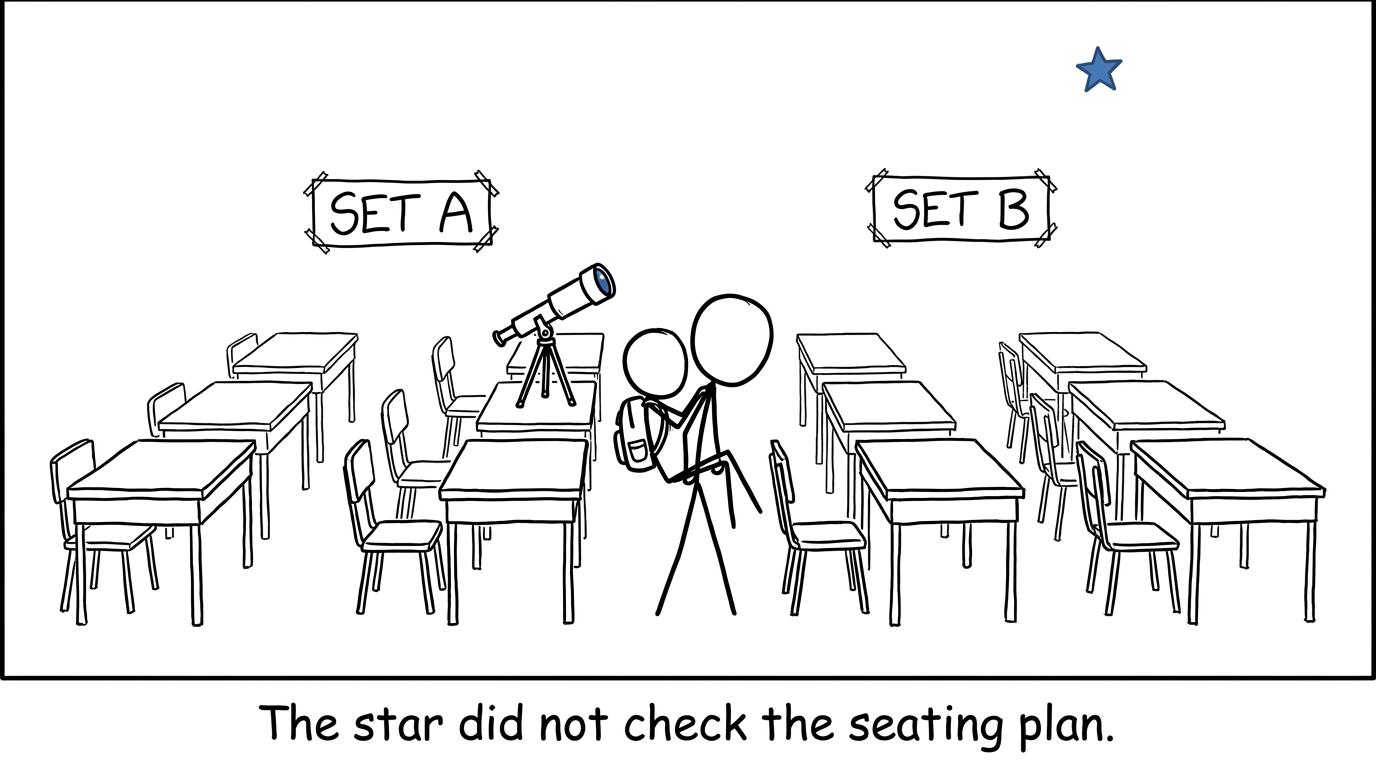 A student changes classroom sets while the star ignores the seating plan
Does moving sets GCSE Astronomy change your grade?
Not directly. In England, the current GCSE Astronomy qualification is provided by Pearson Edexcel. It is a linear qualification graded from 9 to 1 using the total subject mark across two externally examined papers:
- Paper 1: Naked-eye Astronomy, worth 50%50\%50% and 100100100 marks
- Paper 2: Telescopic Astronomy, worth 50%50\%50% and 100100100 marks
Each paper lasts one hour and forty-five minutes. Students answer all questions, and the papers can contain multiple-choice items, short answers, calculations, graphs and extended responses.
The qualification is not divided into foundation and higher tiers. Unlike GCSE Maths with Edexcel, AQA, OCR or Eduqas, there is not a lower Astronomy paper that restricts the highest available grade. Every candidate sits the same Astronomy papers, and individual papers do not receive separate grades.
Your overall mark can therefore be represented as:
Mtotal=MPaper 1+MPaper 2M_{\text{total}}=M_{\text{Paper 1}}+M_{\text{Paper 2}}Mtotal=MPaper 1+MPaper 2The grade boundary is then applied to that total mark. Set membership does not appear in this calculation, and the exam board does not award different grades to students from different classes.
Grade boundaries can change between exam series, so an old boundary should be treated as a guide rather than a guaranteed target. Your safest goal is to collect as many secure marks as possible across the whole specification.
Why a set move can still affect your preparation
A change that has no formal effect can still have a practical effect. This is where students need to be alert without becoming alarmed.
The new class may be covering topics in a different order
One teacher might complete the Earth-Moon-Sun system before celestial observation. Another might organise lessons around Paper 1 and Paper 2 or place observational skills alongside related theory.
After moving, you may discover that the new class has already covered one topic you have not seen, while you have studied something they will meet later. That does not necessarily mean you are behind overall. It means your coverage is uneven.
Ask both teachers for topic lists and divide the specification into three categories:
- secure and already practised
- covered but needing revision
- not yet taught or genuinely missed
This produces a useful map. Revising everything from the beginning usually wastes time and makes the course feel larger than it is.
The pace and level of support may change
A higher set may move quickly, expect more independent reading or spend longer on demanding application questions. A lower set may revisit foundations more carefully and provide additional scaffolding.
Neither approach automatically determines your grade. A slower explanation can strengthen understanding; a quicker class can expose you to more challenging questions. The important question is whether you are learning, practising and receiving feedback at the level you need.
If the pace is too quick, ask for the lesson material in advance. If it feels too slow, request extension questions, past-paper tasks or independent specification sections. Moving sets should change your plan, not your ambition.
Your confidence may move before your knowledge does
Moving down can be interpreted as proof that you are not capable of a strong grade. Moving up can create the opposite fear: that everyone else knows more than you.
Both reactions confuse placement with performance. A set decision may reflect a mock result, class size, timetable arrangements, attendance, working pace or the support a teacher believes will help. It is information about the present learning environment, not a certificate issued early.
Treat the move as a diagnostic event. Ask, “Which marks am I currently losing, and what practice would recover them?” That question is more useful than trying to decode what the set label says about you.
Protect your observational work
GCSE Astronomy students must undertake at least one unaided observation and one aided observation. Schools must confirm completion to Pearson, while knowledge and understanding of observational work are tested in the written examinations.
The observations are not a separate piece of coursework carrying their own bank of marks. Nevertheless, completing and understanding them is compulsory. Current Pearson arrangements require centres to submit the relevant statement by the published deadline in the certification year.
A mid-course set move can create an administrative gap if records do not travel with you. Ask your teacher to confirm:
- which observation or observations you have completed
- whether they were aided or unaided
- where your observation records are stored
- whether the new teacher has access to those records
- what you must complete if one category is still missing
Do this especially quickly if you have also changed school. Do not assume the transfer has happened automatically.
You should also understand the observation cycle: designing an observation, making and recording it, analysing the results and evaluating the method. Across the qualification, observational knowledge and skills account for at least 15%15\%15% of the available marks in the written assessments.
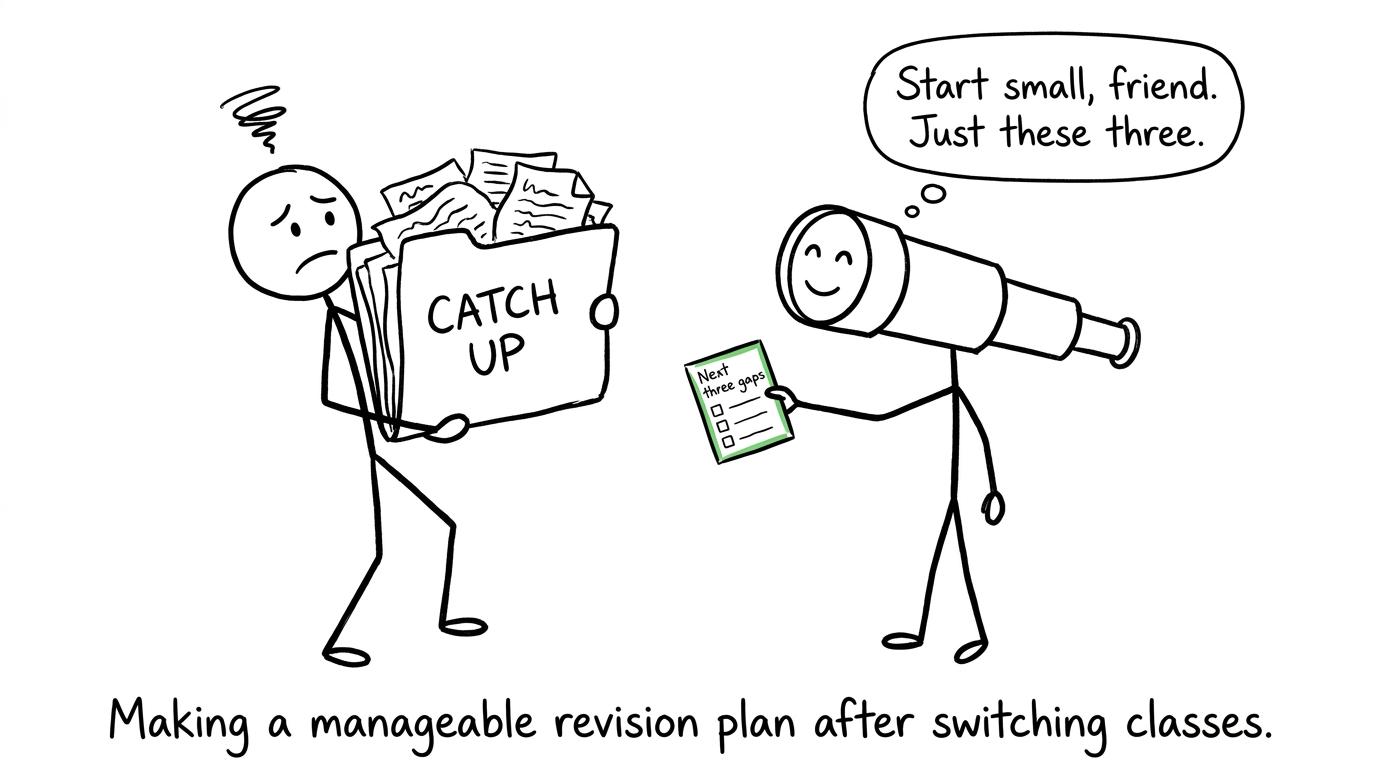 A telescope turns an enormous catch-up folder into three manageable gaps
Build a catch-up plan that protects your final grade
The best response to moving sets is a small, evidence-led plan. You do not need a dramatic revision reset.
Start with a specification audit
Compare your old and new topic coverage. Then use a recent assessment to identify whether each problem came from missing knowledge, weak maths, inaccurate recall, poor interpretation or time pressure.
Keep the initial priority list short. Three specific gaps are more actionable than a page headed “Astronomy”. Review the list weekly and remove topics once you can answer unfamiliar questions without notes.
Strengthen the maths that transfers into Astronomy
Astronomy calculations can require arithmetic, significant figures, unit conversions, standard form, ratios, inverse-square relationships, graphs, formula substitution and basic geometry. Formulae and data needed for the examination are provided, but you still need to select information and use it accurately.
For large and small astronomical quantities, practise standard form for GCSE Maths. For scales and comparisons, use the ratio revision resources. If plotting or interpreting data is a weakness, revisit drawing linear graphs and scatter graphs.
The Astronomy specification only requires mathematical skills within astronomical contexts. MathsGenie topic practice helps make the underlying technique automatic, leaving more attention available for the science in the question.
Use short tests before full papers
A full paper can reveal weaknesses, but it is an expensive way to discover that one skill needs work. Begin with focused questions and mini tests. Mark them carefully, record the precise cause of each lost mark and return to the same skill after a short gap.
Once your coverage is reasonably secure, use timed papers. The method described in how to use GCSE past papers properly transfers well to Astronomy: sit the paper honestly, mark it, classify mistakes, repair a small number of gaps and reattempt difficult questions.
Maths past papers will not replace Astronomy papers, but Edexcel GCSE Maths past papers can sharpen calculation accuracy, graph reading and time management. If you are unsure when to move from topic work to full papers, use the GCSE past-paper revision guide.
Moving up a set: how to adapt
Moving up is an opportunity, not a requirement to understand everything instantly.
Before your first few lessons, ask what the class recently studied and preview unfamiliar vocabulary. During lessons, mark gaps rather than silently copying around them. Afterwards, choose one missing idea and one related question set. This prevents small gaps from joining together.
Do not abandon foundational practice because the class seems more advanced. Accuracy with units, graphs and formula substitution remains valuable in challenging questions. If algebraic manipulation is slowing you down, the rearranging formulae revision resources provide structured practice.
Moving down a set: how to keep aiming high
A move down does not place a ceiling on your Astronomy grade because there is no foundation-tier Astronomy paper. Keep your personal target and ask what evidence would support a future move or show that your progress is improving.
Use the additional explanation time well. Answer questions fully, request more demanding tasks when ready and continue revising topics beyond the immediate class lesson. Your responsibility is not to prove that the set decision was wrong. It is to make the new environment useful.
Common mistakes after changing Astronomy sets
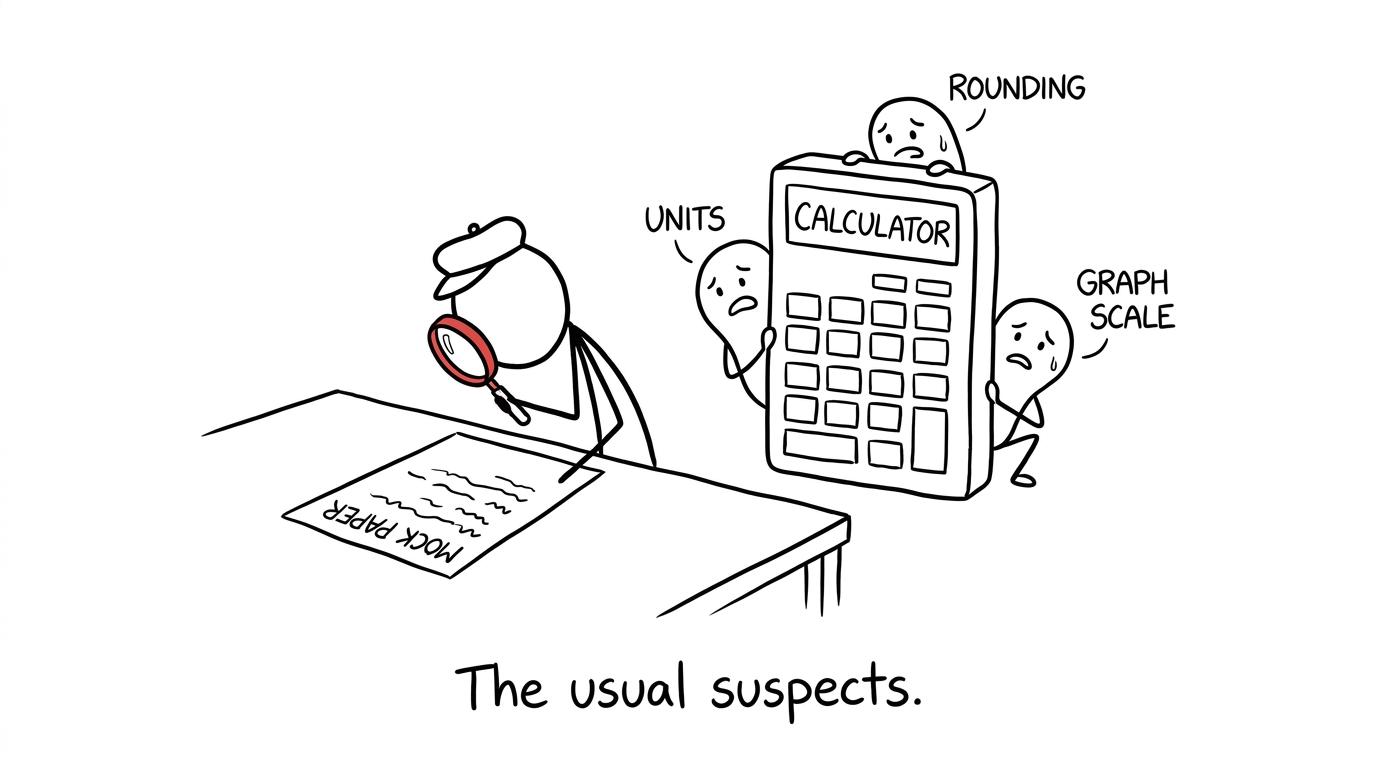 A student detective finds units, rounding and graph scale hiding near a calculator
Assuming a lower set means a lower maximum grade. GCSE Astronomy is not tiered, so the same grade range remains available.
Trying to catch up on the entire course. First identify the exact differences between the two classes. Much of your learning may already overlap.
Forgetting observational records. Confirm that aided and unaided observation evidence has transferred, particularly after changing school.
Focusing only on factual recall. The assessments weight knowledge and understanding at 40%40\%40%, application at 40%40\%40%, and analysis and evaluation at 20%20\%20%. Knowing facts is necessary, but questions also require you to apply and interpret them.
Ignoring maths because formulae are supplied. A formula sheet removes the need to recall specified equations; it does not perform substitutions, conversions, graph interpretation or significant-figure decisions for you.
Treating one mock as a final forecast. A mock is most valuable when it identifies recoverable marks. Record the type of mistake and choose the next revision action.
Your set is a location, not a destination
Moving sets partway through GCSE Astronomy can alter the pace, sequence and support around your learning. It does not formally alter how Pearson calculates your grade, cap the result available or change the examination papers you sit.
Respond by checking topic coverage, protecting your observation records and turning recent mistakes into a short catch-up list. Then strengthen the maths beneath the astronomy through deliberate practice.
Start with MathsGenie’s free GCSE Maths revision resources. Use revision lessons to rebuild methods, practice questions and mini tests to expose gaps, mark schemes and video solutions to correct them, and past papers or predicted papers to test whether those improvements survive under pressure. A class can change in a day. Progress is built in the calm, repeatable decisions that follow.










