

Moving Sets GCSE Arabic: Does It Affect Your Grade?
Moving sets GCSE Arabic explained: learn how class changes, tier entry and focused revision can affect your final grade, confidence and exam preparation.
A set change can feel like a verdict. Moving up may create pressure to prove that you belong; moving down can make it seem as though your final grade has already been decided. But the direct answer to moving sets GCSE Arabic is reassuring: your set does not determine your GCSE grade. Your assessed performance does.
What can matter is whether the change affects your teaching pace, access to Higher-tier content or eventual tier of entry. Under the current Pearson Edexcel GCSE Arabic specification, Foundation tier offers grades 111 to 555, while Higher tier offers grades 444 to 999, with a narrow grade 333 safety net for Higher-tier candidates who fall just below grade 444. Students must be entered for the same tier across all four papers.
So the important question is not simply, "Which set am I in?" It is, "What will I now be taught, which tier am I likely to sit, and what evidence would justify changing that decision?"
The short answer and your immediate checklist
Moving sets can influence your learning environment, but it does not directly add or remove marks. After a change, establish the facts quickly:
- Ask whether your intended exam tier has changed.
- Confirm that you are taking Pearson Edexcel GCSE Arabic rather than an International GCSE qualification.
- Find out which topics, vocabulary and grammar your new class has already covered.
- Compare recent evidence from listening, speaking, reading and writing.
- Ask when your school will review the placement or tier decision.
- Create a short plan for any missing content.
- Keep your maths revision stable while you adapt.
That last point matters. A timetable change in one subject can quietly disrupt everything else. The MathsGenie GCSE maths revision hub gives you one reliable place for lessons, questions, papers and solutions while your Arabic routine settles.
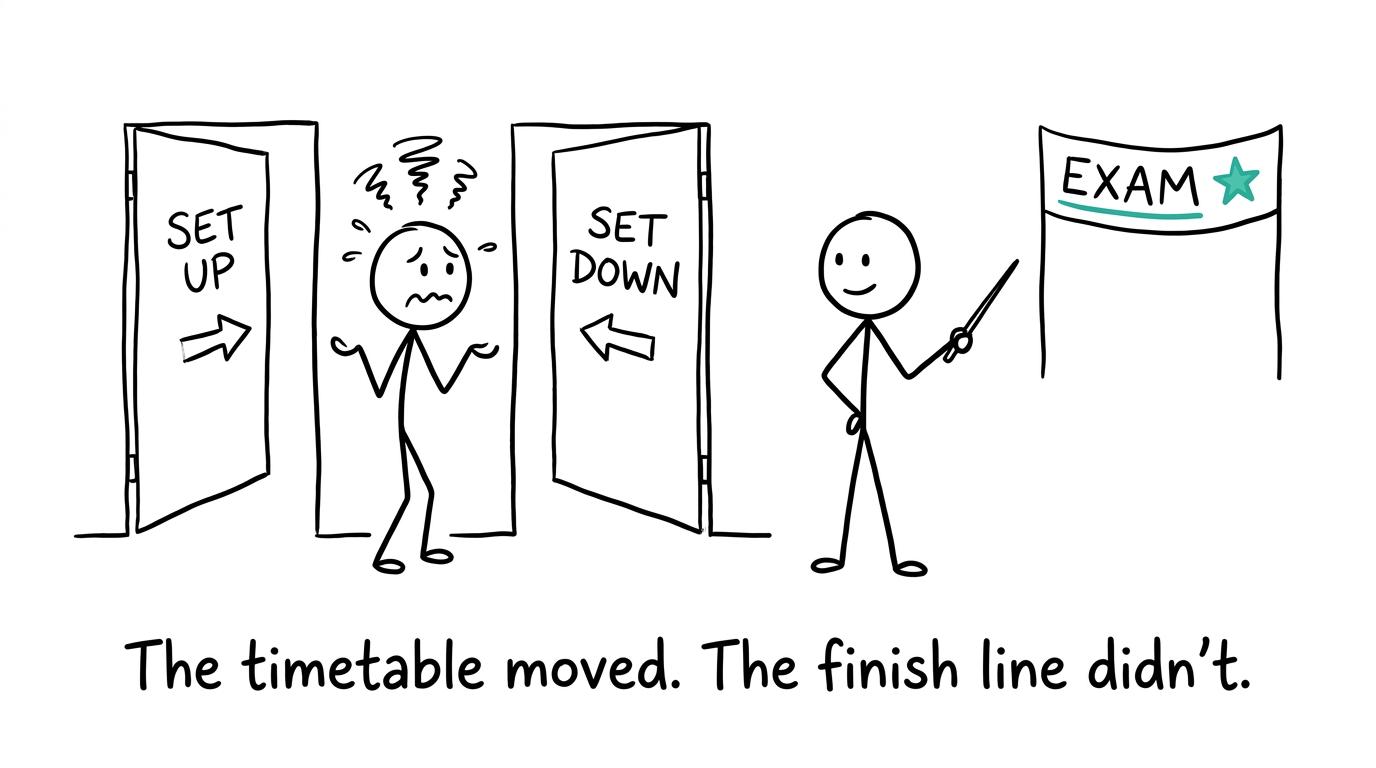 A student realises that changing classroom does not move the exam finish line
Set placement and exam tier are different decisions
A school set is an internal teaching arrangement. Schools may use sets to group students by current attainment, working pace, support needs or likely tier, but the set name itself is not sent to the examiner and does not appear as part of your result.
Tier entry is different because it determines which examination papers you take and which grades are available.
| Decision | What it changes | What it does not decide |
|---|---|---|
| Moving class set | Teaching pace, classmates, support and possibly content | Your final mark or grade automatically |
| Foundation-tier entry | The papers taken and an available range of grades 111 to 555 | Whether you can achieve a secure grade 444 or 555 |
| Higher-tier entry | The papers taken and an available range of grades 444 to 999, plus the narrow grade 333 safety net | A guaranteed high grade |
Ofqual requires grades 444 and 555 to be comparable across Foundation and Higher tiers. A grade 555 earned on Foundation is the same qualification grade as a grade 555 earned on Higher, and the certificate does not identify the tier.
The trade-off is the ceiling and the risk. Foundation cannot award above grade 555. Higher provides access to grades 666 to 999, but a candidate scoring below the limited grade 333 safety net receives an unclassified result.
You can examine how marks have related to grades in completed exam series through the Edexcel GCSE Arabic grade boundaries. Boundaries change between series, so use them as historical context rather than a promise about your paper.
When moving up may improve your eventual outcome
Moving up can help when the new class gives you more sustained access to Higher-tier grammar, longer texts, less familiar vocabulary and more demanding speaking or writing tasks. It may also place you among students working towards grades above 555, making Higher-tier entry a more realistic option.
But the move only becomes valuable when you respond to the increased demand. Merely sitting in a faster class does not create marks. You need to identify the gap between your old class and the new one, then close it deliberately.
Ask your teacher for three precise pieces of information:
- Which Higher-tier structures has the class already studied?
- Which vocabulary themes should already be secure?
- In which skill is your evidence weakest?
Avoid trying to catch up with everything at once. If reading and listening are secure but extended writing is weaker, that is where the greatest immediate return may be. If your speaking lacks fluency, regular short rehearsal is more useful than one long session before a mock.
The same diagnostic habit works in maths. MathsGenie's guide to finding your weakest GCSE topics explains how to turn lost marks into a focused priority list rather than revising whatever feels comfortable.
When moving down does not mean your grade must fall
Moving down may reflect recent assessments, the pace at which you are processing new material or a judgement about the safest tier. It can also happen because schools reorganise classes. None of those explanations is the same as a final GCSE result.
A lower set can sometimes provide something valuable: more time to secure grammar, vocabulary and exam routines. If it leads to more accurate responses and a confident Foundation-tier performance, it may protect a grade 444 or 555 more effectively than struggling through a Higher paper.
However, moving down deserves a clear conversation if you are aiming above grade 555. Ask whether Higher-tier entry remains possible and what evidence your teacher would need to reconsider. Useful evidence might include consistent mock performance, improved class assessments or secure work across all four language skills. Your school makes the entry decision, so approach the discussion calmly and with completed work rather than relying only on ambition.
This resembles the choice between tiers in maths: a higher ceiling is useful only when your performance supports the risk. The GCSE Foundation versus Higher maths guide explores that principle in a subject where the same grade ranges apply.
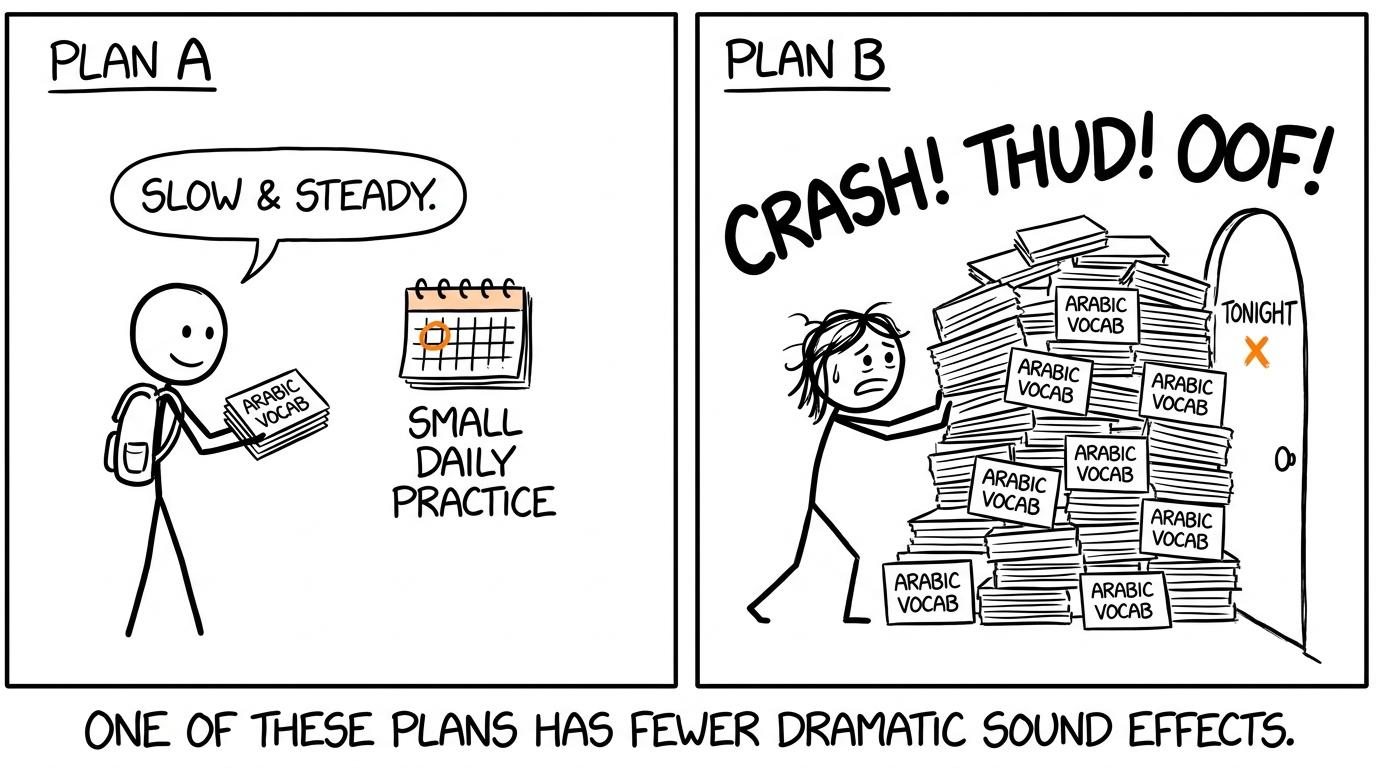 A student chooses steady vocabulary practice over dramatic last-minute cramming
How to adapt after changing sets
The first week after moving is not the time to make a judgement about your ability. It is the time to collect information.
Compare coverage, not labels
Obtain the course checklist or specification used by your department. Mark each area as secure, partly secure or not yet covered. Compare this with the work completed by your new class.
Pay particular attention to Higher-only demands if you have moved up. Higher-tier students are expected to use Foundation grammar and structures as well as the additional Higher content. A missing Foundation skill does not disappear because the class has moved ahead.
Audit all four skills separately
Pearson Edexcel GCSE Arabic assesses listening, speaking, reading and writing through four papers. A single overall mock mark can conceal an important imbalance. Record your performance and teacher feedback separately for each skill.
A simple audit could include:
- Listening: identifying details, coping with unfamiliar words and following longer passages.
- Speaking: responding spontaneously, developing answers and communicating clearly.
- Reading: understanding gist and detail, handling different text types and translating meaning accurately.
- Writing: selecting appropriate language, developing ideas and controlling grammar.
This makes revision specific. "Improve Arabic" is too vague to schedule. "Practise listening for dates and opinions three times this week" is actionable.
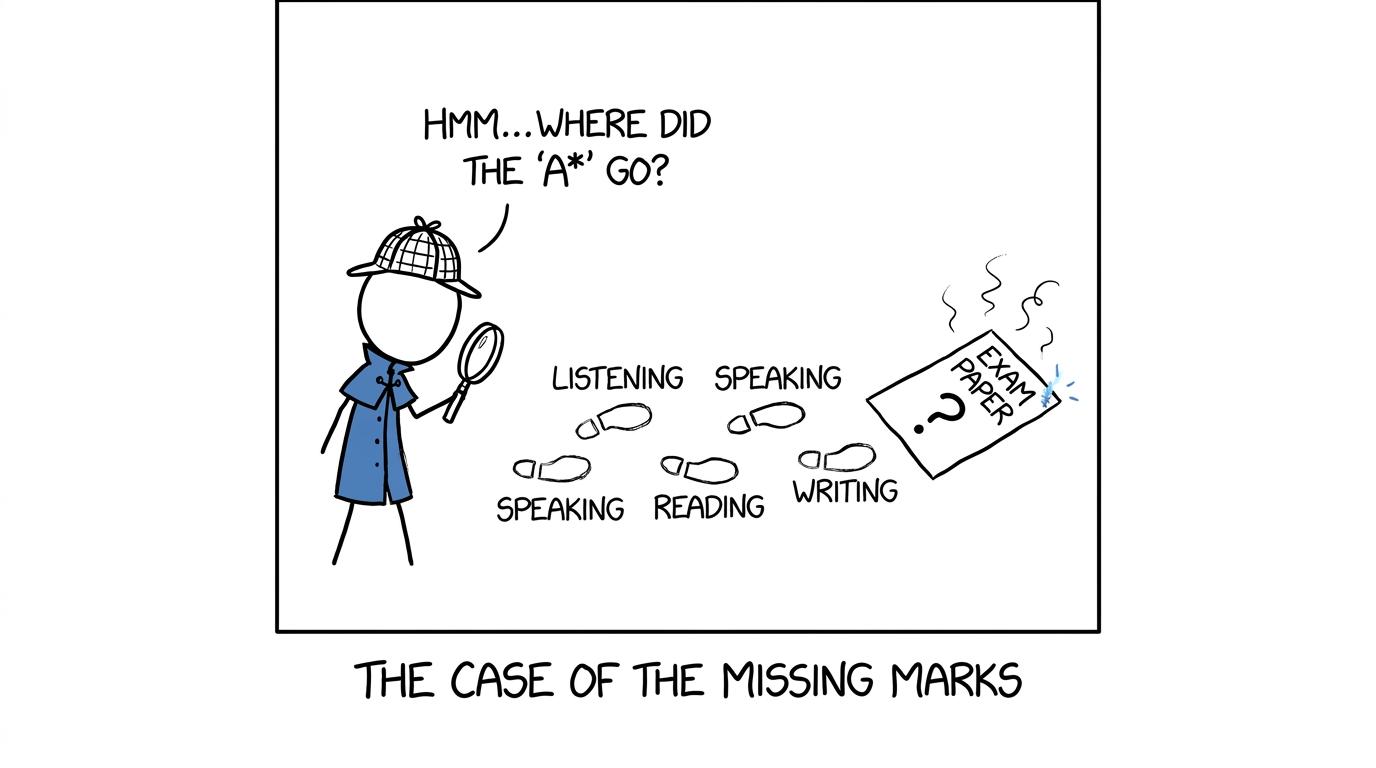 A student detective follows the trail of missing marks across four Arabic skills
Build a routine that survives the change
Use short, repeatable sessions. Vocabulary retrieval, listening practice and spoken rehearsal benefit from regular contact. Schedule catch-up work separately from current classwork so that yesterday's gaps do not cause you to miss today's lesson.
A realistic weekly structure might include:
- two short vocabulary and grammar retrieval sessions;
- one listening or reading session;
- one speaking or writing session;
- one review of corrections and teacher feedback.
Do not allow an Arabic set move to consume every revision evening. Build both subjects into a manageable plan using the GCSE maths revision timetable guide. Regularity is usually more sustainable than a burst of anxious catch-up followed by exhaustion.
Use assessment evidence properly
After a mock or class test, do more than record the total. For every lost mark, identify whether the cause was missing knowledge, weak recall, misunderstanding the task, insufficient detail or time pressure. Then choose one action.
This is the same feedback loop that makes maths papers useful. The MathsGenie guide to using GCSE past papers properly follows a clear pattern: complete, mark, diagnose, repair and retest. You can apply that thinking to Arabic even though the subject skills are different.
What to discuss with your teacher
A useful conversation is specific and forward-looking. Consider asking:
- Is this move temporary, permanent or subject to review?
- Am I currently expected to sit Foundation or Higher tier?
- Which assessment evidence influenced the decision?
- What are my strongest and weakest language skills?
- Which content do I need to catch up on?
- What would demonstrate readiness for Higher tier or a higher set?
Listen carefully to the answer. A teacher may see patterns that are difficult to notice from one result. At the same time, you are entitled to understand the practical consequences of the change and the route available for improvement.
Common mistakes after moving sets
Treating the set as a predicted grade
A set is a teaching group, not a grade boundary. Use it as information about your current learning needs, not as a permanent label.
Assuming moving up guarantees Higher entry
The two decisions may be connected, but they are not identical. Confirm the intended tier directly with your school.
Assuming moving down removes every route above grade 555
It may affect the likelihood of Higher entry, but school decisions can be reviewed. Ask what evidence is required and when the next review will occur.
Revising only the most comfortable skill
Reading notes or memorising familiar vocabulary can feel productive while speaking or listening remains weak. Audit all four skills and prioritise the area costing the most marks.
Cramming missed content
Trying to copy months of classwork in a weekend creates activity without dependable recall. Use small catch-up blocks and revisit material later.
Neglecting maths because Arabic feels urgent
Your GCSE subjects share the same limited revision time. Keep maths moving with short lessons, questions and GCSE maths mini tests, then expand into full papers when your timetable allows.
Your set can change without defining your destination
Moving up or down a set may alter the pace, support and content around you. It may also influence your school's tier recommendation. But it does not directly award your GCSE Arabic grade. The decisive factors are your tier of entry and the marks earned across listening, speaking, reading and writing.
Find out what has actually changed. Diagnose the gaps. Ask what evidence would move the decision. Then build a routine small enough to repeat.
And while you adapt, keep your maths revision organised with MathsGenie. Start in the free GCSE maths revision area, strengthen individual topics through revision lessons and practice questions, check progress with mini tests, and finish with past papers, mark schemes, video solutions and Edexcel predicted papers. A class label is temporary. A clear revision process travels with you.










