

Morning vs Evening Revision: Which Is Better?
Morning vs evening revision: find your best study time, protect sleep and build a practical GCSE or A Level schedule you can follow each week.

At nearly nine in the evening, a student finally opens a revision book. Their parent worries they have started too late. The student remembers struggling to concentrate before school and feels ready now.
The practical answer to morning vs evening revision is that neither is automatically better. Choose the period when you can focus, remember what you learn and protect your sleep. Your plan may use mornings for recall and early evenings for demanding questions, or reverse that balance.
The quick answer
Choose morning revision if you wake alert, have a quiet space and can maintain an early enough bedtime. Choose evening revision if you concentrate better later and can finish without delaying sleep.
Whichever you prefer, check it against completed work. Feeling productive and learning effectively do not always happen together.
Start with this checklist:
- Choose a specific task before each session.
- Compare similar work at different times.
- Record accuracy, distractions and next-day recall.
- Protect sleep when adjusting your timetable.
The GCSE revision timetable guide can help you fit those sessions around school and other commitments.
Why your best revision time is personal
Imagine a student who agrees to revise before school because the house is quiet, then spends the session rereading questions. In the evening, concentration improves, but starting late sometimes pushes bedtime back. This hypothetical situation contains two useful observations: the morning environment helps, while evening alertness helps too.
Teenagers commonly experience later sleep and waking preferences during adolescence. General health guidance recommends roughly 8-10 hours of sleep for teenagers, although individual needs vary. An early session is only useful if the student has had sufficient rest.
The aim is to find a sustainable working period. A tired hour at a desk can look disciplined while producing little learning.
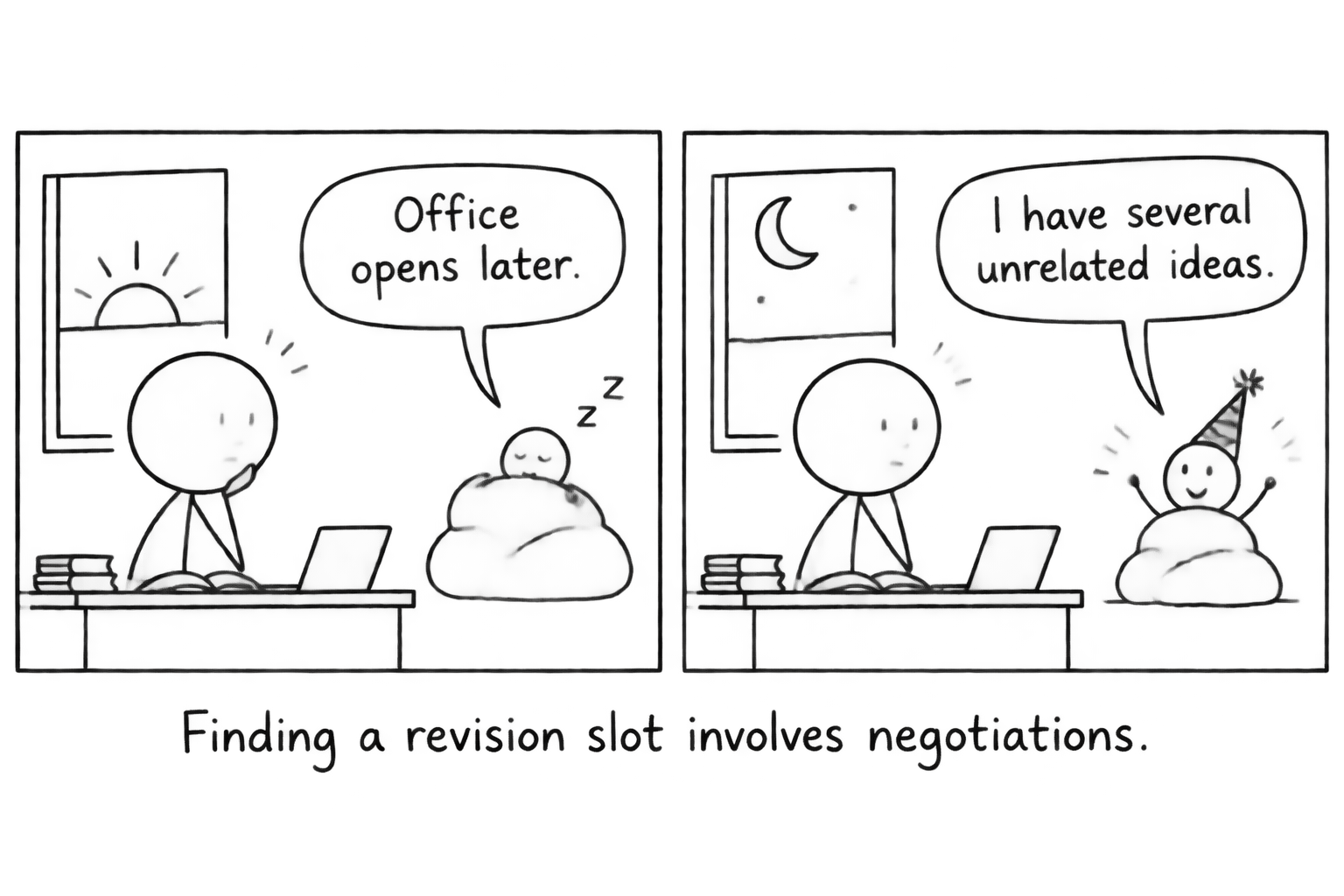 A student negotiating with a sleepy morning brain and an energetic but distracted evening brain
Test morning vs evening revision for one week
Choose comparable tasks
Use practice sets from the same maths topic, with similar difficulty. Comparing an easy morning worksheet with a challenging evening paper tells you more about the questions than your concentration.
Try two or three sessions in each time slot. Keep the duration manageable, perhaps 25-40 minutes, and keep conditions broadly similar. Avoid testing mornings only at weekends and evenings only after exhausting school days.
Record what actually happens
After each session, note how quickly you settled, how often you became distracted and which errors appeared when marking. The following day, check whether you can recall the method without looking at your notes.
Look for patterns across the week. One difficult session proves little. If evenings consistently produce more accurate work, use them for your main revision. If mornings improve recall and concentration, give them priority.
Build the results into the MathsGenie Revision Planner, leaving space to adjust when homework or commitments change.
Match the task to your energy
Reserve your strongest period for demanding work
Use your clearest period for unfamiliar topics, timed exam questions and problems requiring several steps. These tasks need sustained attention and reveal where your understanding breaks down.
MathsGenie GCSE maths revision provides topic resources and exam-board materials. For students taking that qualification, the Edexcel A Level maths revision area supports more advanced practice.
Make quieter sessions active
Lower-energy periods can support consolidation. Review marked mistakes, complete a mini test or watch a video solution before retrying the question independently.
Retrieval matters here. Close your notes and explain the method, then attempt a question. Reading a solution may feel familiar without showing whether you can reproduce it.
Prepare for the time of your exam
As exams approach, include some timed practice at the scheduled exam time, even if another period remains your favourite revision slot. Check your timetable rather than assuming every paper takes place in the morning.
Use GCSE maths past papers and mark schemes to practise selecting methods and managing time. Predicted papers can provide additional practice, but they cannot guarantee which questions will appear.
Combine morning and evening sessions
An evening-focused routine might include brief morning recall, rest after school and the main question session in the early evening. Leave time afterwards to wind down before bed.
A morning-focused routine could involve choosing questions and preparing materials the previous evening, completing the main session before school, then marking it later.
Both approaches remove a common barrier: deciding what to do after sitting down. Write a clear task such as completing simultaneous equations questions, marking them and retrying mistakes.
Keep the overall workload realistic. The guide to how many hours to revise each day helps you consider volume, while the GCSE maths revision timetable guide helps distribute maths across the week.
Common mistakes with revision timing
Copying someone else's routine. A classmate's early start may suit their sleep, travel and household. Test your own circumstances.
Borrowing time from sleep. If late revision leaves you exhausted the next day, move the start earlier or shorten the session.
Using your best hour for organisation. Prepare folders and materials elsewhere in the timetable. Reserve focused periods for questions, retrieval and difficult topics.
Changing everything after one bad day. Review several sessions before adjusting. Use marked work and recall as evidence.
Parents can support this process by asking what was completed and what needs another attempt. Agreeing on a practical start and finish time is more useful than repeatedly checking the clock.
Turn your best time into a routine
The useful outcome is a repeatable schedule that supports learning and sleep. Choose tomorrow's task today, test your timing and review the evidence after a week.
Use MathsGenie's free revision lessons, practice questions, mini tests and video solutions to make each session purposeful. Then put your chosen slots into the MathsGenie Revision Planner and begin with one manageable task.















