

How Many Hours Should You Revise a Day for GCSEs?
GCSE revision hours explained: how long to revise daily for maths, what to do in each session, and how YesGenie past papers improve grades.
A strange thing happens every spring: a perfectly sensible GCSE student sits down to revise maths and immediately asks the question that feels safest to ask. Not “what do I not understand yet?” but “how many hours should I do?” It’s understandable. Hours are measurable. Confidence isn’t. But in GCSE maths, time is only useful when it buys you something real: clearer methods, fewer mistakes, and better exam decisions under pressure.
This post will help you choose a realistic number of revision hours per day for GCSE maths, and (more importantly) what those hours should contain. Whether you’re on foundation tier or higher tier, and whether you sit Edexcel, AQA, OCR or Eduqas, the same truth keeps showing up: consistent, high-quality practice beats heroic late-night cramming.
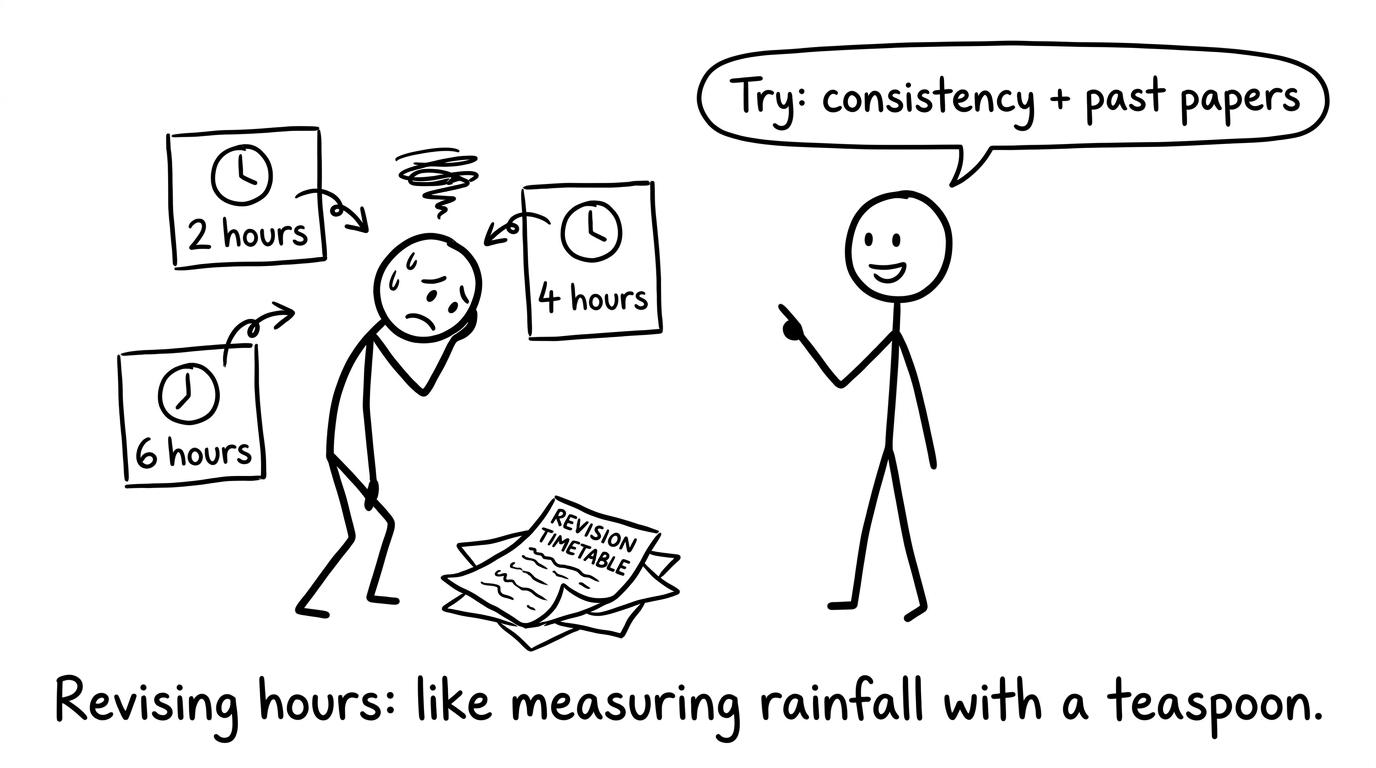 A student surrounded by revision timetables
The short answer: how many hours for GCSE revision per day?
Most students do best with 111 to 333 hours per day of focused GCSE revision in the weeks leading up to exams, per school night, plus a little more at weekends.
But the better answer is: enough time to complete one full cycle of maths improvement.
That cycle is:
- Learn or re-learn the method (short lesson)
- Do exam-style practice (questions)
- Mark it honestly (mark scheme)
- Fix the one thing that keeps costing you marks (targeted retry)
YesGenie is built around this loop: revision lessons, topic practice, mark schemes, video solutions, mini tests, and full past papers. If you can complete the loop once per day, you are doing the kind of GCSE revision that moves grades.
Helpful starting points on YesGenie:
- Edexcel GCSE Maths Revision
- Edexcel GCSE Maths Revision Guides
- GCSE Past Papers
- Edexcel GCSE Maths Predicted Papers
- Edexcel GCSE Maths 45 Min Tests
- Resources (Mini Tests, Predicted Papers, and more)
A quick checklist for setting your daily GCSE hours
Before you set a number, answer these honestly:
- How many weeks until your GCSE maths paper?
- Are you foundation tier or higher tier?
- Are you mainly missing marks from gaps in knowledge, or from exam technique?
- Can you focus well for 252525 minutes at a time, or do you fade after 101010?
- Are you revising multiple subjects, or mainly maths?
A practical rule:
- If you’re far out (8-12 weeks): aim for 454545 to 909090 minutes of GCSE maths revision most days.
- If you’re mid-range (4-7 weeks): aim for 606060 to 120120120 minutes most days.
- If you’re close (0-3 weeks): aim for 909090 to 180180180 minutes most days, split into smaller sessions.
The point is not to “do more”. The point is to do enough good reps that your brain stops treating topics like strangers.
Why “hours per day” is the wrong unit (and what to measure instead)
Hours are blunt. Maths improvement is specific.
A more useful unit is: How many marks did you learn to collect today?
In a GCSE maths paper, lots of marks come from method and accuracy, not genius. The student who gets a grade 7 often isn’t “smarter” than the student who gets a grade 5. They just leak fewer marks.
So measure your revision by outputs like:
- One topic completed with questions and corrections
- One mini test marked and fixed
- One half-paper done under time
- One error pattern removed (for example, sign mistakes in rearranging)
That’s why doing a 45 Minute Edexcel GCSE Test can be more valuable than three hours of “reading notes”. It forces you into the exam world, where marks actually live.
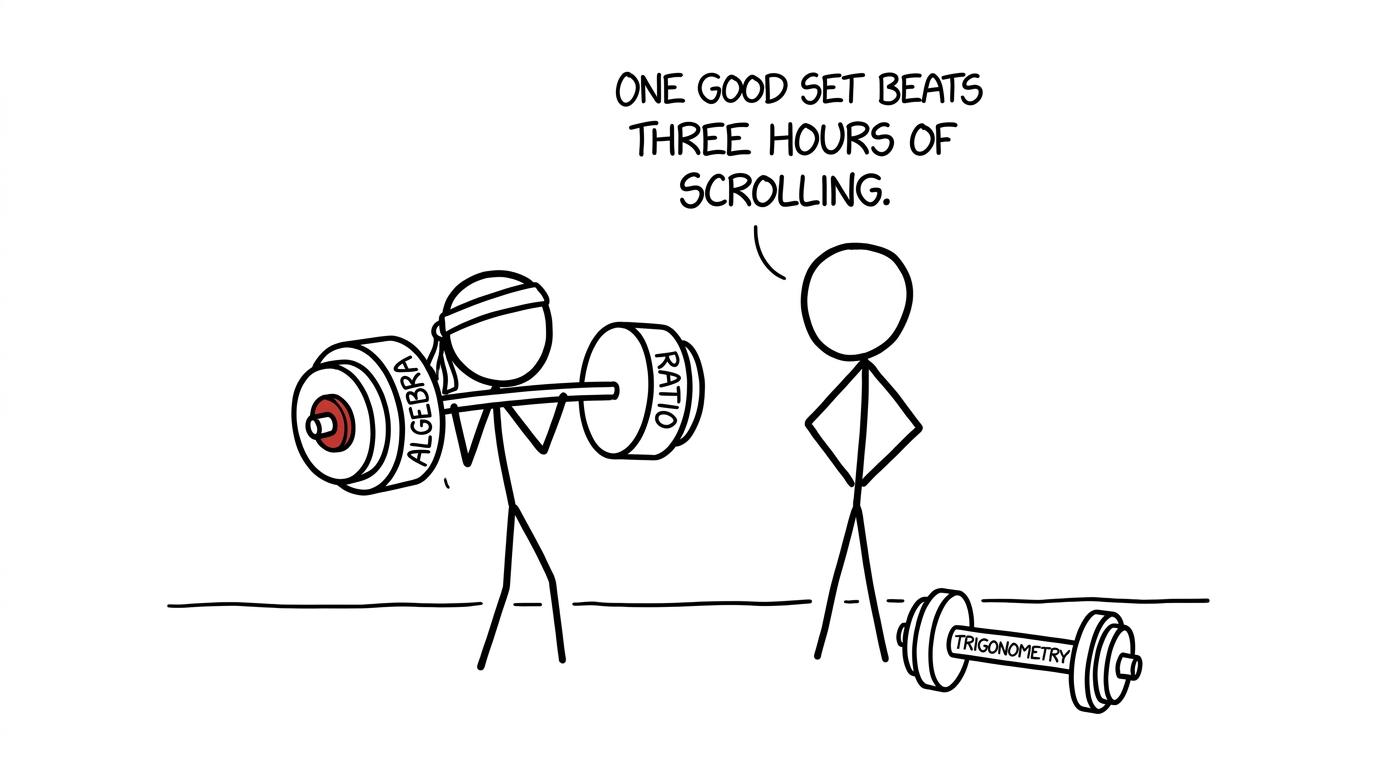 Maths practice like lifting weights
A GCSE maths daily plan that actually works
Here’s a simple structure for GCSE maths revision that fits into 606060 to 120120120 minutes.
Warm-up (10 minutes)
Pick something you can do, quickly, to wake up the part of your brain that calculates.
Examples:
- Simplifying algebra
- Fractions, decimals, percentages
- A short set of arithmetic with negatives
Use a short topic section from Edexcel GCSE Maths Revision Guides or a mini test from Resources.
Main block (35-60 minutes)
Choose one topic you want to improve.
- Read the method (or watch a video solution)
- Do exam-style questions
- Mark them
- Write one sentence: “The mistake I made was…”
Try mixing foundation and higher demands depending on tier. Foundation students should obsess over clean method marks. Higher students should practise the awkward edges of topics (algebraic fractions, proof, harder problem-solving).
Example higher-style link you can use when you’re ready:
Exam block (15-45 minutes)
Do something timed.
- Half a paper (45 minutes)
- A mini test
- A set of past-paper questions from a topic
Use:
Feedback (10 minutes)
This is where GCSE grades are quietly made.
- Mark carefully
- Identify the type of error
- Redo just those questions two days later
A decent revision session ends with fewer unknowns than it started with.
Worked example: planning revision time using a simple model
Students often plan revision like this: “I’ll do as much as I can.” It’s noble, but it’s not a plan.
Instead, use a basic calculation.
Suppose:
- You have 212121 days until your first GCSE maths paper.
- You decide you can manage 909090 minutes per day for maths.
Total revision minutes:
21×90=1890 21 \times 90 = 1890 21×90=1890Convert to hours:
1890÷60=31.5 1890 \div 60 = 31.5 1890÷60=31.5So you have 31.531.531.5 hours of GCSE maths revision time.
Now make it meaningful. If you split each day into:
- 101010 minutes warm-up
- 505050 minutes topic practice
- 303030 minutes timed exam practice
Then over 212121 days you get:
- Warm-up: 21×10=21021 \times 10 = 21021×10=210 minutes =3.5= 3.5=3.5 hours
- Topic practice: 21×50=105021 \times 50 = 105021×50=1050 minutes =17.5= 17.5=17.5 hours
- Exam practice: 21×30=63021 \times 30 = 63021×30=630 minutes =10.5= 10.5=10.5 hours
That is enough time to complete multiple full papers, plus targeted topic fixes. It’s also realistic. And because it’s realistic, you’ll actually do it.
Worked example: a marks-first method using unit cost (GCSE maths skill)
A lot of GCSE maths improvement comes from becoming fluent with standard methods that appear across papers.
Here’s a classic: best buy (unit cost). See the full guide here: Best Buy Questions.
Question (exam style): A pack of 121212 drinks costs £4.204.204.20. A pack of 555 costs £1.851.851.85. Which is better value per drink?
Method: compare cost per drink.
Convert to pence:
- £4.20=420p4.20 = 420\text{p}4.20=420p
- £1.85=185p1.85 = 185\text{p}1.85=185p
Unit costs:
Pack of 12: 42012=35p per drink \text{Pack of 12: } \frac{420}{12} = 35\text{p per drink} Pack of 12: 12420=35p per drink Pack of 5: 1855=37p per drink \text{Pack of 5: } \frac{185}{5} = 37\text{p per drink} Pack of 5: 5185=37p per drinkSo the pack of 121212 is better value.
Why include this in a post about hours? Because this is what “good revision” looks like: learn a method, practise it, and make it automatic. An hour spent getting 101010 methods to this level is worth far more than an hour spent vaguely “going over” everything.
How revision hours should change by tier and target grade
Foundation tier
Foundation GCSE maths rewards reliable accuracy.
- Aim for 454545 to 909090 minutes most days early on.
- As exams approach, move towards 909090 to 150150150 minutes.
- Spend more time on core topics: number, percentages, ratio, algebra basics, angles, and graphs.
Foundation students also gain a lot from shorter timed practice like Edexcel GCSE Maths 45 Min Tests because it builds confidence without the overwhelm of a full paper.
Higher tier
Higher GCSE maths needs fluency and problem-solving.
- Aim for 606060 to 120120120 minutes most days early on.
- Near exams, 120120120 to 180180180 minutes can be appropriate if you can still sleep well.
- Prioritise topics that join ideas together: proof, vectors, trig in 3D, algebraic manipulation.
Useful higher-style reading:
Common mistakes when deciding GCSE revision hours
- Equating long hours with high quality. If you are tired, you will practise mistakes.
- Doing only passive revision. Reading solutions is comforting, but GCSE maths marks come from writing your own solutions under time.
- Ignoring mark schemes. The mark scheme is basically a map of where the marks are buried.
- Revising what you like. Everyone likes the topics they’re already good at. Your grade changes when you practise the awkward ones.
- Never timing anything. If timing makes you anxious, that’s exactly why you need gentle timed practice.
- Going too hard too late. Pulling repeated late nights hurts memory and accuracy, especially on calculator papers.
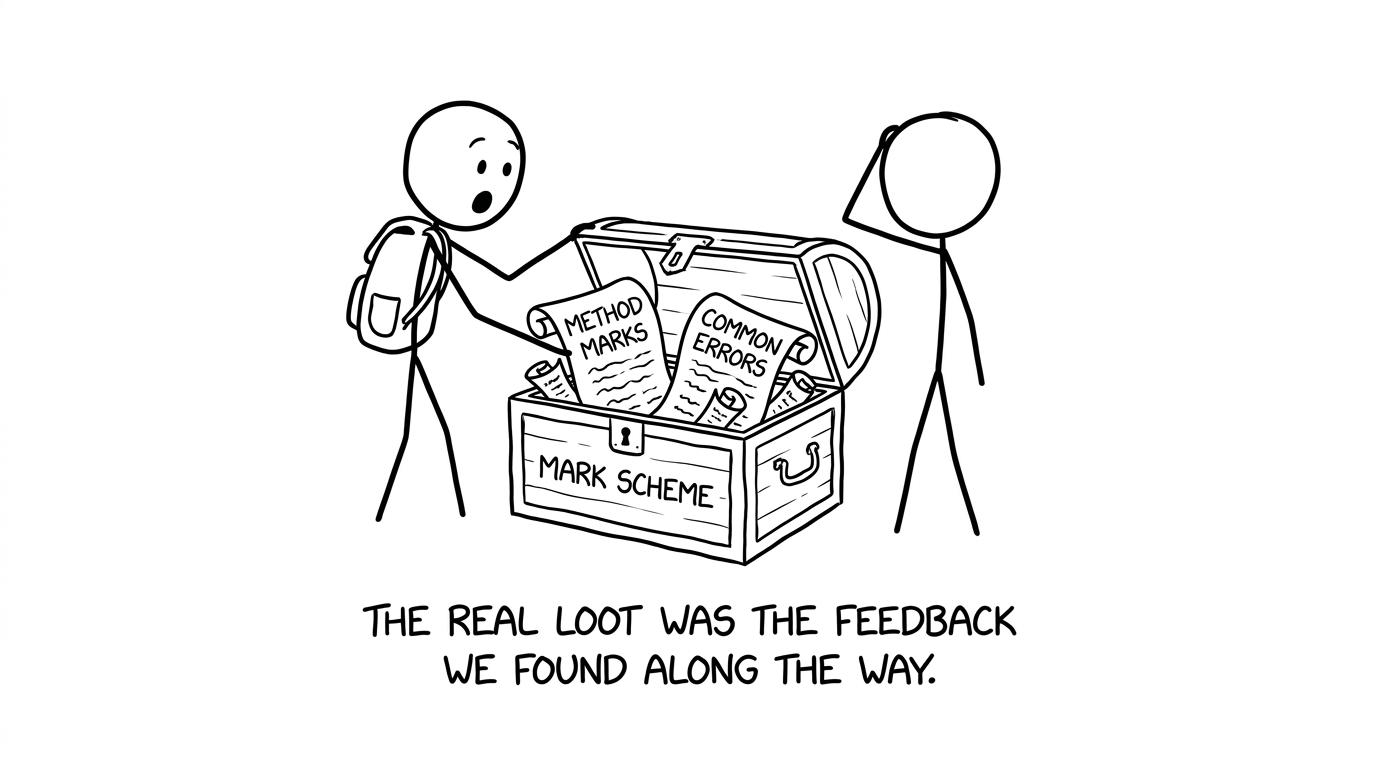 Mark scheme treasure chest
The best GCSE revision hours are the ones you can repeat
A good GCSE revision plan doesn’t impress anyone on day one. It’s slightly boring. It fits around your life. It survives a bad day at school. And it still moves you forward.
If you want a simple next step, use YesGenie as your daily structure:
- Pick a topic from Edexcel GCSE Maths Revision Guides
- Practise with exam-style questions and corrections
- Build exam confidence with GCSE Past Papers
- Sharpen your focus with Edexcel GCSE Maths Predicted Papers
- Keep it manageable with 45 Minute GCSE Tests
Decide your hours, yes. But then decide your loop: learn, practise, mark, fix. Do that, and your GCSE maths grade won’t just improve; it will feel earned, because it will be.










