Miss GCSE Biblical Hebrew Exam Through Illness?
Miss GCSE Biblical Hebrew exam through illness? Learn what to do, how special consideration works and how Pearson may determine your final grade.

An empty chair in an exam hall can feel like a disaster. Yet if you miss GCSE Biblical Hebrew exam illness may be a valid reason for special consideration. The short answer is: tell your school or exam centre immediately. If you miss one paper because of a temporary illness, your centre can apply to Pearson Edexcel on your behalf, and Pearson may determine a final grade using your performance in the paper you completed.
You do not normally sit the missed paper a few days later, and the process is not automatic. Your centre must support the application, provide appropriate evidence and submit it promptly. Here is what matters most.
- Contact your exams officer as soon as you know you cannot attend.
- Follow the centre's procedure for reporting sickness.
- Keep any evidence the centre requests.
- Confirm which Biblical Hebrew component you have missed.
- Ask whether a special consideration application will be submitted.
- Continue preparing for every remaining exam if you are well enough.
What happens if you miss GCSE Biblical Hebrew through illness?
GCSE Biblical Hebrew is currently offered by Pearson Edexcel. The qualification has two written components:
- Component 1: Language, worth 50%50\%50% of the qualification
- Component 2: Literature, worth 50%50\%50% of the qualification
Each examination lasts 222 hours and carries 100100100 raw marks. This structure matters because current Joint Council for Qualifications rules normally require a GCSE candidate to have completed one whole component worth at least 15%15\%15% of the qualification before enhanced grading can be considered for an acceptable absence.
If you sit one Biblical Hebrew component and miss the other through an illness accepted under the rules, the completed component is worth 50%50\%50%. It therefore exceeds that minimum requirement. Pearson may then use enhanced grading to determine the qualification result.
That does not mean your mark from the completed paper is simply doubled. Awarding organisations use a statistical process based on your performance in the completed assessment and how that performance compares with the wider cohort. The aim is to determine a defensible qualification result, not to guess what you might have written.
If you miss both components, you will not normally have completed the minimum assessment needed for an award through acceptable-absence special consideration. Your exams officer can explain the available options, which may include entering for a future examination series.
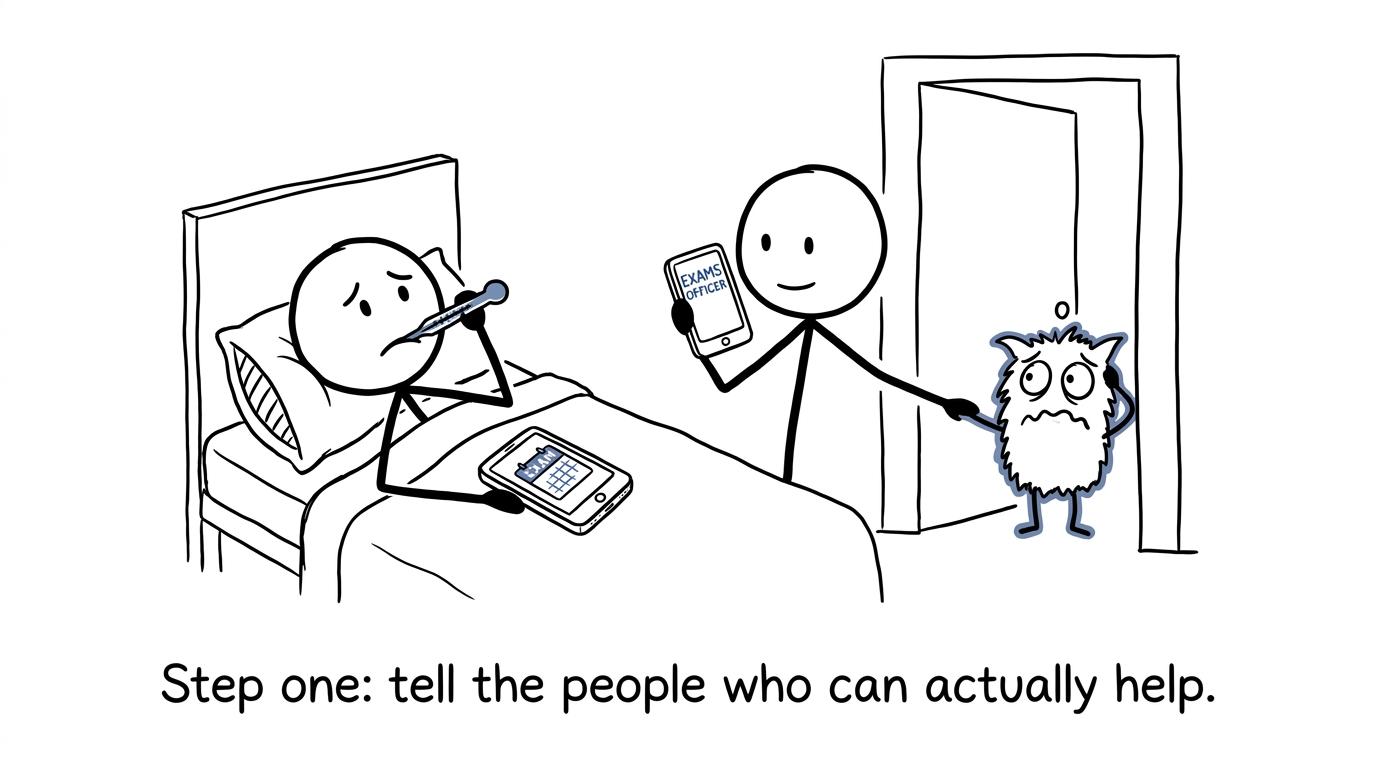 An ill student contacts the exams officer while the panic monster leaves
The first actions to take on the day
When illness arrives on an exam morning, the tempting response is to wait and see. That can turn one problem into two: the illness itself and a centre that does not know why you are absent.
Contact your school or exam centre immediately
Telephone the school using its published absence or examinations procedure. If a parent or carer calls for you, they should make clear that you are entered for a public examination that day. Ask for the exams officer to be informed.
Give concise, accurate information:
- your full name and candidate details, if known
- the examination and component you will miss
- when the illness began
- how it prevents you from attending or completing the examination
- how the centre can contact you or your parent or carer
Private candidates should contact the centre that made their entry. Students and parents cannot normally submit the awarding-body application themselves.
Ask what evidence is needed
JCQ rules require the centre to support an application with appropriate evidence authorised by a member of its senior leadership team. The exact evidence needed depends on the circumstances and the centre's procedures. It might include a centre record, a statement explaining the illness or relevant medical information.
Do not assume that every illness automatically requires a GP appointment, but do not assume that a verbal message will always be sufficient either. Ask the exams officer what they need and provide it promptly. Evidence should describe the genuine situation; it should never exaggerate symptoms.
Do not attend when it is medically unsafe
Special consideration is not a reason to force yourself into an exam hall while seriously unwell. In cases of serious illness, centres are expected to seek appropriate medical advice about whether a candidate is fit to sit the examination.
Equally, feeling understandably nervous is not the same as being medically unable to attend. If you are uncertain, speak to a parent or carer and contact the centre rather than making the decision alone.
How special consideration works
Special consideration is a post-assessment process. It is intended for students who were fully prepared, had covered the course, but were prevented from taking an assessment or showing their normal attainment because of a temporary event outside their control.
Temporary illness at the time of an examination can qualify. Missing revision because of an earlier illness does not automatically qualify unless there is a relevant worsening or additional effect at the time of assessment.
If you miss the whole paper
Your centre records you as absent and applies under the acceptable-absence route. Pearson considers whether:
- the reason for absence meets the JCQ criteria
- you were fully prepared and had covered the course
- the centre supports the application
- you completed the required minimum assessment
- the missed component belongs to the series in which you are receiving the qualification
For Biblical Hebrew, completing either the Language or Literature component means completing 50%50\%50% of the qualification. If the application is accepted, Pearson may calculate the result through enhanced grading.
If you attend but become ill
A different category applies when you are present but disadvantaged. For example, you might become unwell during the paper and be unable to perform normally. Tell an invigilator immediately so the incident and its timing can be recorded.
Where this type of application succeeds, the awarding body may apply a percentage allowance to the raw marks available for the affected component. JCQ tariffs range from 0%0\%0% to a maximum of 5%5\%5%, with the maximum reserved for the most exceptional circumstances. The allowance is not chosen by your teacher, and it is not automatically 5%5\%5% because an illness felt severe to you.
If you leave early, the awarding body decides which special consideration category is appropriate after considering the information provided by the centre.
What special consideration cannot do
The phrase can sound more generous than the process really is. Special consideration protects fairness, but it cannot recreate an examination you did not take.
It cannot:
- guarantee your predicted grade
- use a mock grade as an automatic replacement
- give unlimited additional marks
- compensate for not learning the course
- excuse a holiday or avoidable timetable conflict
- arrange an individual sitting after the national examination
- guarantee that an application will be accepted
Your teacher's prediction may help the school understand your general position, but enhanced grading is based on awarding-body procedures rather than simply choosing the grade predicted by a teacher.
How to protect your other GCSE exams
Illness can occupy every thought. Once the administrative steps are complete, however, repeatedly checking what might happen will not improve the decision. Recovery and the next manageable action will.
If you have maths coming up, first confirm whether you are fit to revise. Then use a reduced plan rather than attempting to recover every lost hour. The GCSE Maths revision hub brings together free lessons, worksheets, exam questions and resources for Edexcel, AQA, OCR, Eduqas, WJEC and CCEA.
A short session can be enough while your energy returns. The 20-minute GCSE maths revision routine shows how to combine recall, questions and marking without turning recovery into an endurance test.
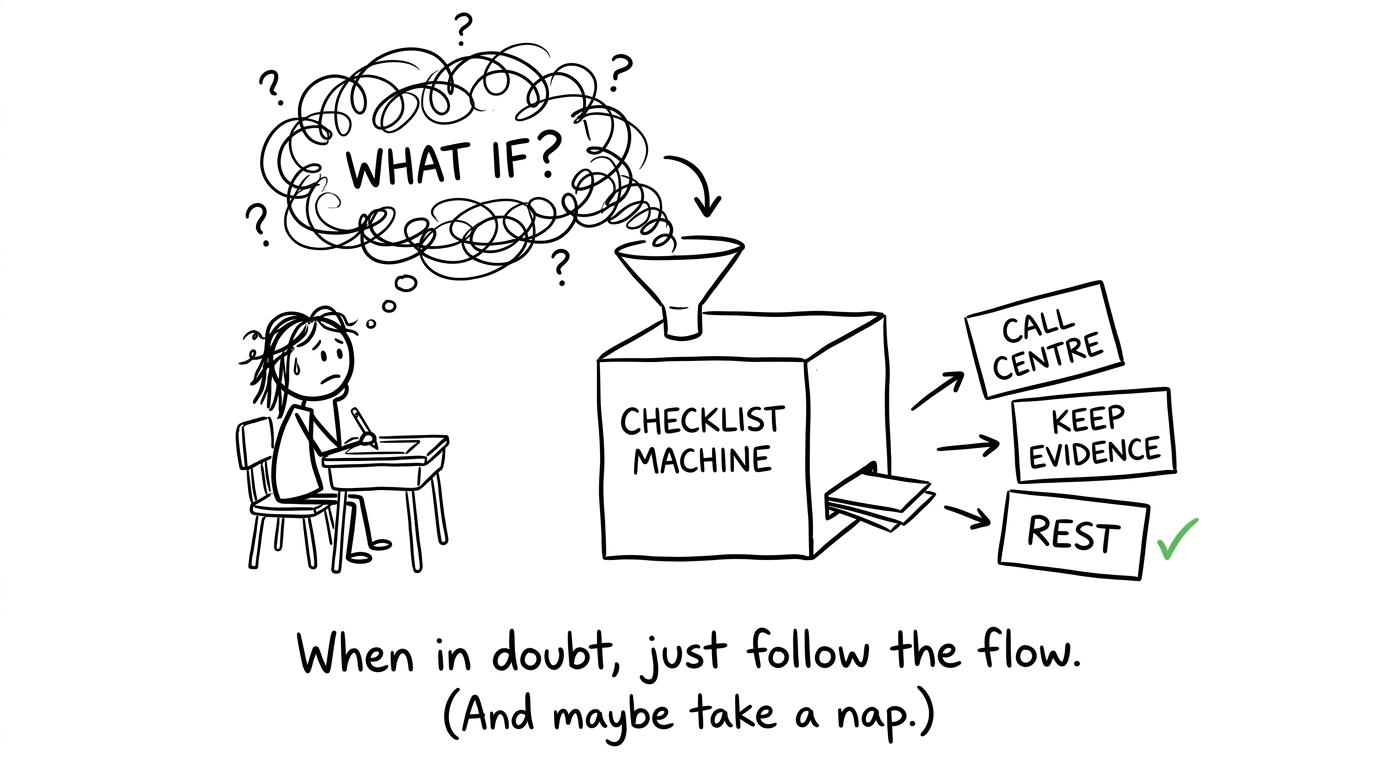 A what-if cloud becomes a short practical checklist
Return to revision in stages
Start with one familiar topic and a few practice questions. When your concentration improves, use mini tests and timed sections before returning to complete papers. A sensible GCSE maths revision timetable can help you redistribute work without creating an impossible catch-up plan.
If exams are close, follow the GCSE maths night-before plan. It prioritises exam-board accuracy, a small amount of focused practice, equipment and sleep. Those basics are more valuable than late-night panic revision.
When you are fully recovered, use GCSE past papers at the right stage, mark them carefully and turn each lost mark into a topic to revisit. Edexcel maths students can follow the detailed guide to using Edexcel GCSE Maths past papers properly. Close to the examination, Edexcel GCSE Maths predicted papers can provide fresh timed practice alongside official past papers.
Common mistakes after missing an exam
Waiting until the next school day
Report the absence immediately using the centre's procedure. Applications have deadlines, and the exams officer needs an accurate record of what happened.
Assuming the exam will be rearranged
Public examinations run to a national timetable. An individual make-up paper is not normally available. Ask about special consideration rather than waiting for a new date.
Believing a predicted grade will simply be awarded
Enhanced grading is an awarding-body calculation. It is not an automatic conversion of a mock result, target grade or teacher prediction.
Confusing absence with being disadvantaged
Missing the complete paper and sitting it while ill are different situations. If you become unwell in the examination, tell an invigilator immediately. A record made at the time can be important.
Abandoning revision for every remaining subject
One missed paper does not decide your whole GCSE series. Deal with the application, recover properly and restart with a realistic plan. MathsGenie's revision lessons, practice questions, mini tests, mark schemes and video solutions let you resume at the right level rather than starting again from nowhere.
A calm next step
If illness makes you miss GCSE Biblical Hebrew, act quickly but do not assume the qualification is lost. Contact the exams officer, provide the evidence requested and ask the centre to confirm whether it will submit a special consideration application. If you completed the other Biblical Hebrew component, its 50%50\%50% weighting means you normally meet the current minimum-assessment threshold, although Pearson must still decide whether the application and final award are valid.
Then bring your attention back to what remains within your control. Rest, follow medical advice and rebuild revision gradually. Open the MathsGenie GCSE maths revision hub, choose your exam board and tier, and use free revision lessons, practice questions, past papers, predicted papers, mini tests, mark schemes and video solutions to prepare for the papers still ahead.