Making a Revision Plan You'll Actually Follow
Making a revision plan you'll actually follow starts with realistic sessions, clear tasks and weekly resets. Build a GCSE or A Level routine that lasts.

Making a revision plan you'll actually follow starts with choosing realistic sessions, giving each one a specific task and reviewing the plan weekly. If your timetable looks impressive but falls apart by Tuesday, it probably needs fewer commitments and clearer instructions.
Imagine a student planning two hours of revision after school, dinner and football training. The intention is reasonable. The available time is not. A useful timetable begins with the week you actually have, including tired evenings and unexpected homework.
Your revision planning checklist
Every session should tell you:
- When you will revise.
- Which topic you will cover.
- What task you will complete.
- Which resource you need.
- How you will check your understanding.
- When you will revisit the topic.
For help dividing time between subjects, read the GCSE revision timetable guide. If your main uncertainty is workload, see how many hours you should revise each day.
Begin with the week you really have
Add fixed commitments first: school, work, clubs, travel, meals and sleep. Then identify dependable revision windows. Tuesday after dinner might suit a short task; Saturday morning might allow something longer. Some evenings may have no sensible space for revision.
Start below your maximum capacity. Leave room for homework, illness and ordinary family life. A plan that survives a busy week gives you a reliable starting point. You can increase the workload once you know it fits.
Parents can help identify overlooked commitments without filling every remaining gap. Rest belongs in the timetable too.
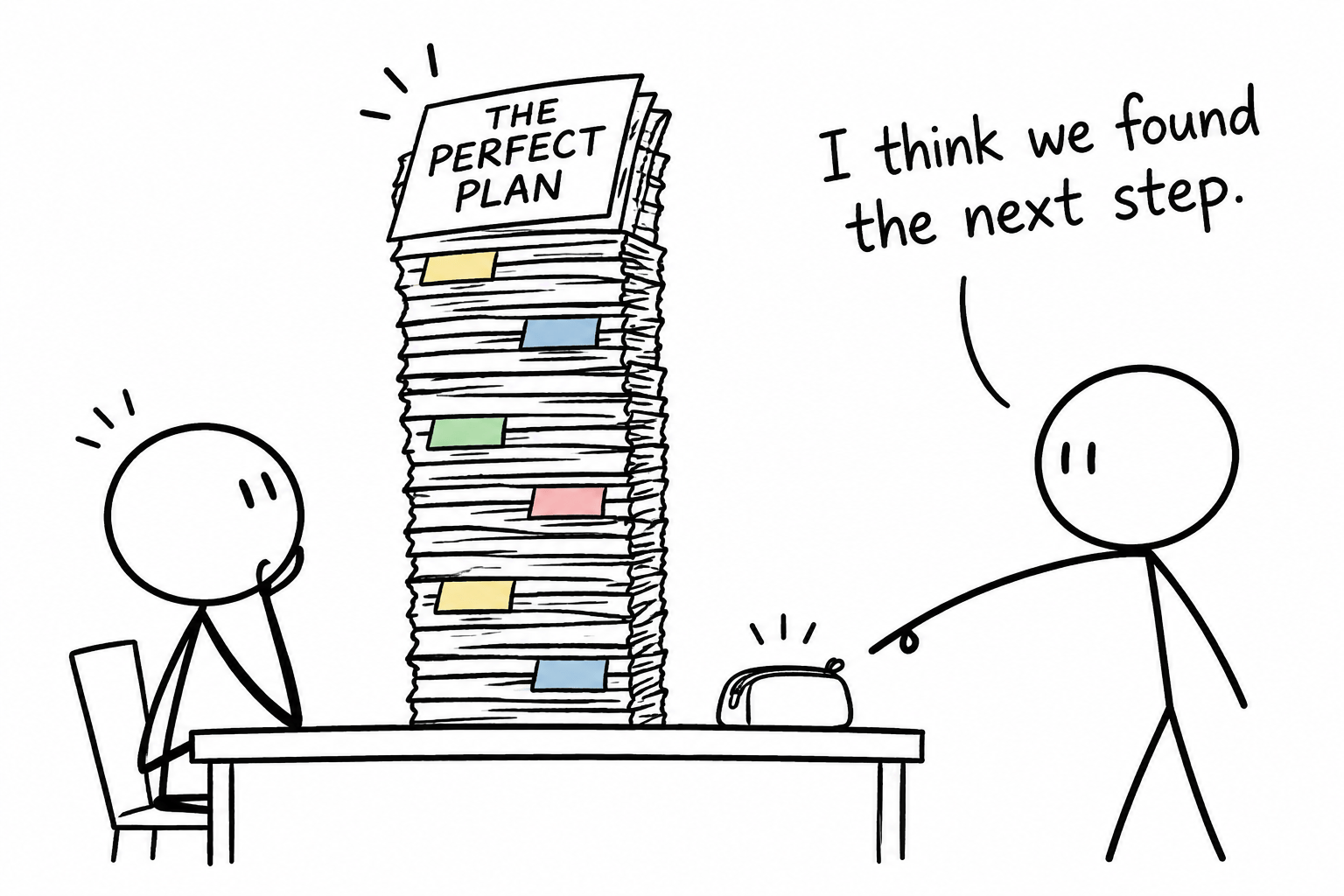 A student discovers that using the revision plan requires opening the pencil case
Turn subjects into visible tasks
“Revise maths” leaves several decisions unfinished. Which topic? Which questions? How will you know you have finished?
Give each task three parts: a topic, an action and a check. For GCSE maths, that could mean completing circle theorem questions, marking them and retrying incorrect answers without the solution. For A Level, it could mean attempting differentiation questions and recording which methods need further practice.
Choose materials before the session starts. MathsGenie's GCSE maths revision resources and A Level maths revision resources help you connect a topic with revision materials, practice questions and past papers.
A clear finish line makes progress visible. “Questions completed and corrected” tells you more than “time spent at my desk”.
Build a simple weekly routine
Choose priorities from evidence
Use recent assessments, marked homework, teacher feedback and practice questions to identify weaknesses. Confidence alone can be misleading: a familiar topic may still produce repeated mistakes.
Allocate time accordingly. Secure topics need occasional checking; recurring weaknesses need explanation, practice and another attempt later. Keep favourite subjects in the plan, but check that they are not taking all the available time.
Match demanding work to your energy
Put difficult tasks where you are usually most alert. Shorter correction or recall tasks may fit evenings when concentration is lower. Avoid scheduling several demanding subjects consecutively simply because there is space.
Estimate time for marking as well as answering. Otherwise, unfinished corrections can accumulate while the timetable suggests you are ready to move on.
Schedule repeat visits and recovery
Spaced practice means returning to learning over time. Retrieval practice means recalling information or methods without immediately consulting your notes.
Plan an initial session to review a method and answer focused questions. Return later to attempt questions without notes, then include the topic in mixed practice or an exam paper.
Keep one weekly recovery slot for missed work. If nothing needs moving, use it for corrections or rest. You can organise these sessions with the MathsGenie Revision Planner.
Match the technique to the task
For maths, most revision sessions should involve answering questions. If a method is unclear, use a revision lesson or video solution, then close the explanation and attempt it independently. Mark your work, identify the error and try again.
Use past papers when you can attempt substantial sections. Check that resources suit your qualification, tier and specification. Predicted papers can provide additional practice, but they cannot guarantee what will appear in an exam.
Across other subjects, choose methods that match the demand: flashcards for vocabulary, closed-book recall for key ideas, and exam questions for application or extended responses. Remembering information and using it effectively both need practice.
Make starting easier
Before finishing a session, prepare the next one. Bookmark the resource, write down the first question or leave the required paper ready. This removes a decision from the moment when you need to begin.
Choose a consistent start cue, such as finishing dinner. Begin with a manageable task rather than waiting to feel motivated. The GCSE revision guide for reluctant starters offers further ways to reduce the effort of getting started.
Review without rebuilding
At the end of the week, ask what you completed, what improved your understanding and why sessions were missed.
Make targeted adjustments. Move a session that clashes with a regular commitment. Reduce tasks that consistently overrun. Add work only when the current plan feels manageable.
Parents can support this conversation by asking what needs changing next week, while leaving the student responsible for choosing and completing tasks.
Common revision plan mistakes
- Filling every hour: Leave space for unexpected demands and rest.
- Using broad labels: Replace subject names with specific tasks and checks.
- Avoiding weak topics: Use marked work to decide priorities.
- Counting only time: Track questions answered, errors corrected and ideas recalled.
- Giving up after one missed session: Use the recovery slot and continue.
- Constantly redesigning the timetable: Adjust a useful structure instead of making planning another task.
Build the plan you can keep
Your timetable should make the next useful action clear. Choose realistic windows, prepare specific tasks and let each week's experience improve the next.
Start with one manageable week in the MathsGenie Revision Planner, then use free revision lessons, practice questions and mark schemes to turn scheduled time into checked understanding.