

Make Own GCSE Biblical Hebrew Practice Questions?
Make own GCSE Biblical Hebrew practice questions from notes, match Edexcel exam styles, build fair mark schemes and strengthen recall through careful self-testing.
Revision notes can create a comforting illusion. The page looks familiar, the vocabulary has been highlighted, and the grammar rules seem obvious while they are sitting in front of you. Then the notes close, and certainty disappears.
That is why it can be worth learning how to make own GCSE Biblical Hebrew practice questions from your notes. Writing a good question forces you to decide what matters, how knowledge might be assessed and what a complete answer should contain. Answering it later turns that preparation into retrieval practice.
The important qualification is this: self-written questions should supplement official past papers and sample assessment materials, not replace them. Your questions are best for targeting weak areas. Official material remains the clearest guide to the real wording, difficulty and marking standard of the qualification.
The short answer
Making your own Biblical Hebrew questions is worthwhile when you:
- base them on the current Pearson Edexcel specification and your prescribed texts
- imitate genuine question types rather than inventing puzzles
- write a mark scheme at the same time
- answer the questions later, without notes
- check uncertain language or interpretation with a teacher
- continue using official papers for realistic exam practice
This is the same principle that makes short, focused GCSE revision sessions useful in maths: practise one clearly defined skill, check the result and decide what needs attention next.
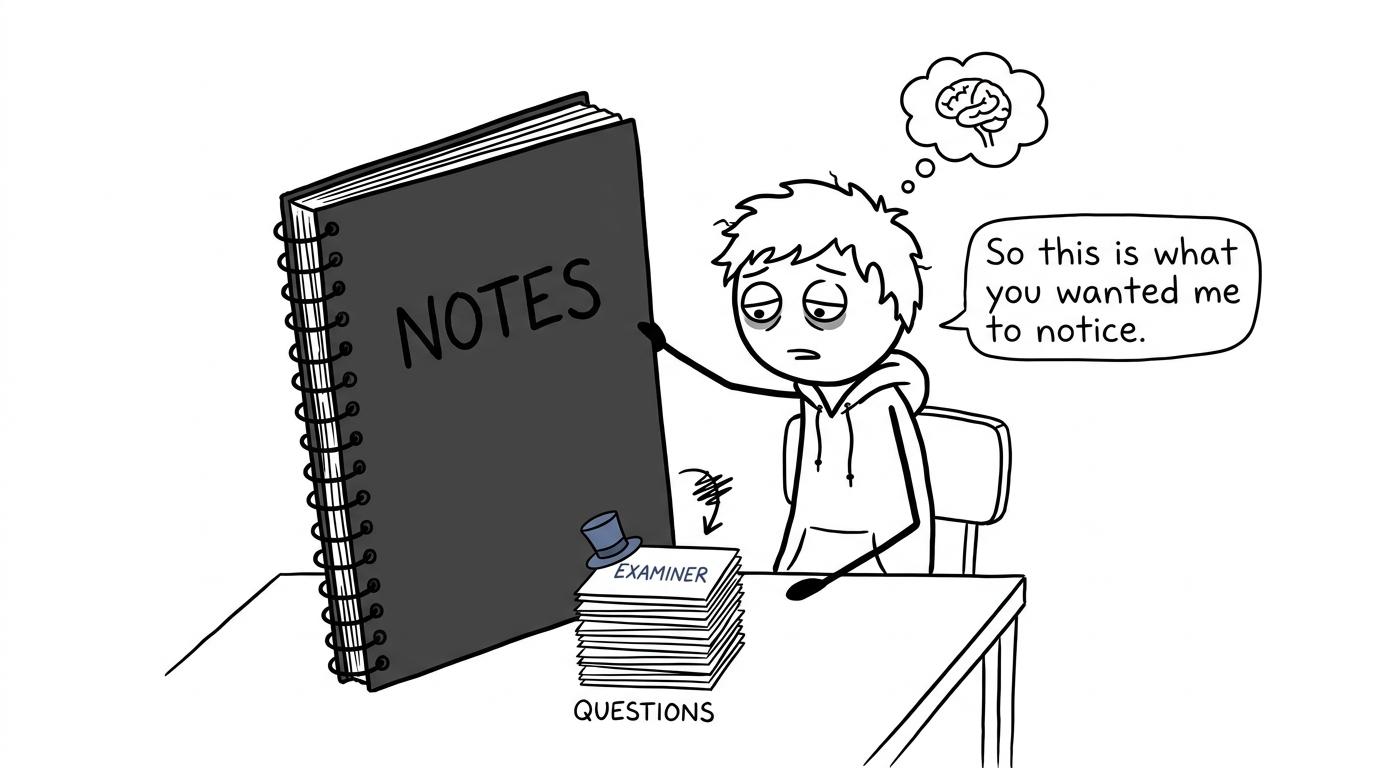 A student turns an intimidating notebook into a manageable stack of revision questions
Why writing questions can deepen your learning
A question is a decision about importance. To write one, you must separate central knowledge from background detail. That act of selection can reveal whether you genuinely understand your notes or have merely become used to seeing them.
It makes you process the material
Copying a grammar rule produces another copy. Turning that rule into a question requires more thought. You must identify what a candidate should recognise, which clues make the answer possible and what would distinguish a precise response from a vague one.
For a prescribed passage, you might need to distinguish between questions about translation, grammatical form, context, character, theme and literary effect. Those distinctions make the structure of the course more visible.
It exposes gaps early
You may begin writing a mark scheme and discover that you cannot explain why an answer is correct. That is not a failed revision session. It is useful evidence.
The gap might concern vocabulary, parsing, syntax, textual detail or the difference between description and analysis. Once named, it becomes fixable. Maths students can use the same diagnostic idea through MathsGenie's guide to finding weak GCSE topics quickly.
It prepares you to retrieve knowledge
Research on retrieval practice generally supports attempting to recall information rather than relying entirely on rereading. However, research specifically examining student-generated questions is more mixed. Writing and answering your own questions is not automatically better than answering well-designed questions supplied by an expert.
The practical lesson is simple: use both. Create targeted questions for your personal gaps, but keep official questions in the revision cycle so that your practice remains accurate and appropriately demanding.
Start with the GCSE Biblical Hebrew assessment
At the time of writing, the approved GCSE in Biblical Hebrew is Pearson Edexcel's GCSE graded 999 to 111. Its specification contains two externally examined components: language and literature.
The regulated assessment objectives place 50%50\%50% of the weighting on demonstrating knowledge and understanding of the language, 25%25\%25% on knowledge and understanding of literature or other ancient sources, and 25%25\%25% on analysing, evaluating and responding to those sources.
That balance matters. If every question you create is a vocabulary flashcard, you are revising only one part of what the examination requires.
Before making a question bank, check the current specification, prescribed vocabulary requirements, set texts, official sample assessment materials and any updates supplied by your school. Set-text details can change between specification arrangements, so use your teacher's current course information rather than an old online checklist.
Divide your bank into broad areas:
- vocabulary and word recognition
- morphology and grammatical identification
- syntax and meaning in context
- translation and comprehension
- knowledge of prescribed literature
- analysis of language, character, themes and ideas
- longer responses requiring supported judgement
This is similar to selecting the correct exam board and tier in maths. A useful resource can still be the wrong resource if it does not match the paper you will sit. MathsGenie's GCSE maths revision hub organises free materials by board and provides practice for Edexcel, AQA, OCR, Eduqas and other specifications.
How to turn notes into strong practice questions
Give each question one clear purpose
Begin with a small section of notes. Decide what the question is testing before deciding how it will sound.
Possible purposes include recalling a meaning, identifying a form, explaining how grammar affects translation, retrieving a detail from a prescribed passage or analysing how a feature contributes to the text.
Write that purpose privately beside the question. If you cannot describe the purpose in one sentence, the question may be too broad.
Match a genuine exam format
Study official papers and sample materials. Notice the command words, the quantity of source material provided, the expected response length and how marks are allocated.
Do not merely copy an official question and change one word. Reuse the structure while changing the content being tested. Your aim is to reproduce the intellectual demand, not the surface wording.
Short recall prompts are suitable for knowledge checks, but they cannot prepare you fully for translation, grammatical explanation or literary analysis. A balanced bank needs questions of different lengths and demands.
Build from notes, then put the notes away
Your notes can remain open while you construct the question and mark scheme. This helps you check accuracy. But do not answer the question immediately while the source is still visible.
Leave it until a later session, shuffle it among other questions and answer from memory. Otherwise, you may be measuring recognition rather than retrieval. The principle also appears in MathsGenie's advice on when to begin using GCSE past papers: practice is most useful when there is still time to respond to what it reveals.
Write the mark scheme immediately
A question without a mark scheme is unfinished. Record:
- the essential answer or acceptable meanings
- the grammatical evidence required
- relevant textual references
- the number of distinct points expected
- what a stronger analytical response would add
- any alternative answer that may be valid
Keep the scheme concise enough to use. For translation or interpretation, ask a teacher to check uncertain judgements. You are creating revision material, not declaring yourself the awarding body.
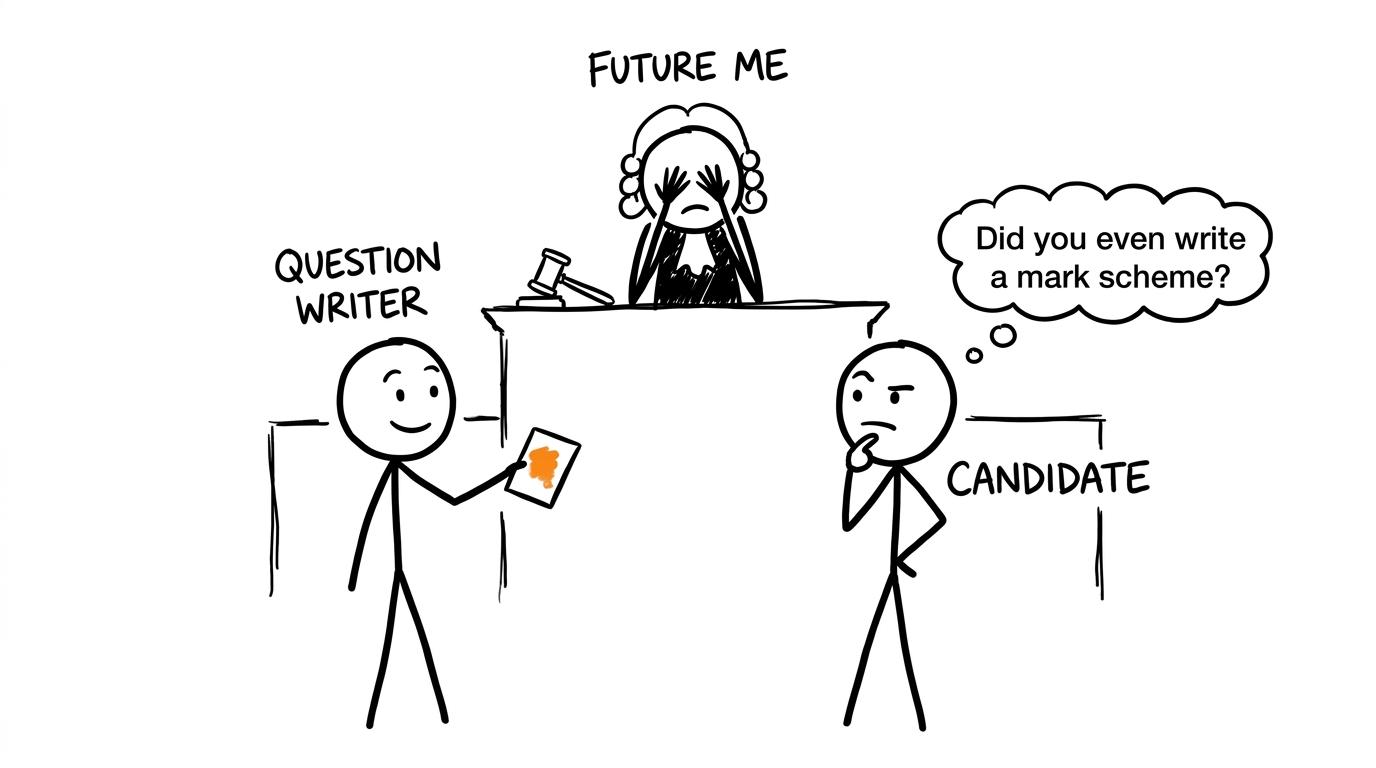 A candidate challenges the question writer to produce a mark scheme
Make wrong answers plausible when using choices
Multiple-choice questions can be useful for quick checks, but weak distractors make the answer obvious. A plausible wrong option should reflect a real confusion, such as a similar form, an imprecise meaning or a familiar mistranslation.
Do not make every correct option the longest or most detailed. Patterns allow recognition to replace knowledge.
Label questions by confidence and skill
Add a simple label such as secure, uncertain or teacher-check. Also identify the skill: vocabulary, grammar, translation, comprehension or literature.
After answering, record why marks were lost. “Wrong” is not a diagnosis. “Confused two similar forms” or “gave narrative detail without analysis” points towards a useful next action.
This mirrors the review process recommended when students use Edexcel GCSE maths past papers properly: mark, diagnose, repair and reattempt.
A practical revision cycle
Question writing can consume all the time available if it becomes a craft project. Set a limit and protect time for answering.
A productive cycle is:
- choose one narrow section of notes
- create a small mixture of recall and application questions
- draft concise mark schemes
- ask for a check where accuracy is uncertain
- answer the set in a later session without notes
- mark strictly and record the cause of each error
- revise the gap, then answer a different question testing the same skill
- use an official paper regularly to check realism
You could place this inside a broader timetable such as MathsGenie's one-month GCSE revision plan. The subjects differ, but the rhythm transfers: retrieve, practise, mark and revisit.
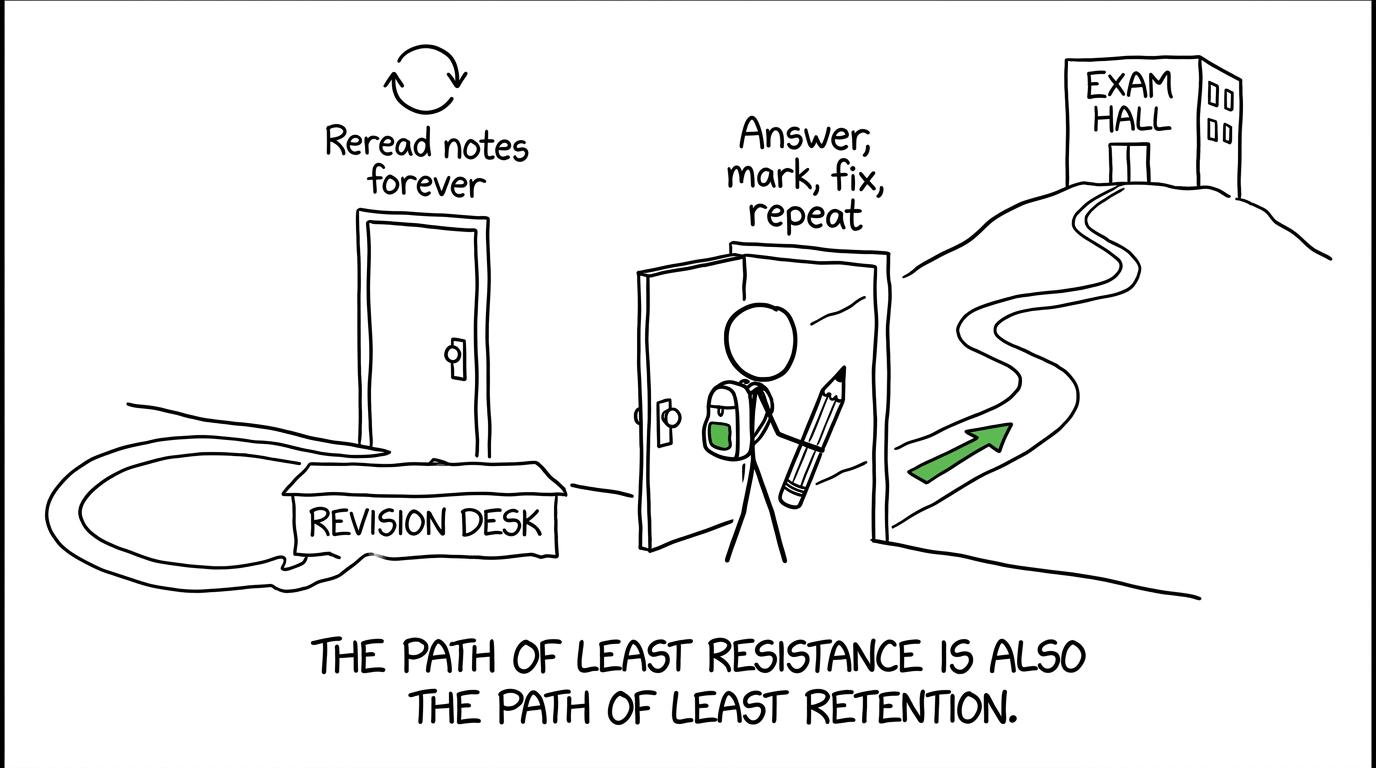 A student chooses the revision path of answering, marking, fixing and repeating
When making your own questions is not the best use of time
Do not create everything yourself. It may be inefficient when the examination is very close, when you are unsure about the content or when suitable official questions already test the precise skill you need.
Near the exam, prioritise timed work, accurate marking and correction. If question writing becomes an elaborate way to avoid discovering what you cannot answer, switch to a past paper.
The best revision resources form a ladder. Notes establish understanding. Self-written questions target individual gaps. Teacher-checked material improves accuracy. Official papers provide the closest available exam standard.
Common mistakes when creating Biblical Hebrew questions
Testing only easy facts
Vocabulary and factual recall feel productive because they are quick to mark. They should not crowd out translation, grammatical reasoning and literary analysis.
Writing questions that are too vague
A prompt such as “What happens in this passage?” gives little guidance about depth or focus. Use a precise command word and make the required evidence clear.
Copying notes into the answer
A long paragraph is not automatically a useful mark scheme. Identify the minimum elements needed for credit and separate required content from helpful development.
Trusting your own answer without checking it
Errors in parsing, translation or textual interpretation can become more familiar each time they are repeated. Flag uncertainty and seek authoritative feedback.
Answering immediately after writing
You still remember the sentence you converted into a question. Delay the attempt and mix it with older material.
Replacing official papers entirely
Home-made questions are personal diagnostic tools, not perfect simulations. Official material is essential for learning the real style, balance and standard of the assessment.
Turn question writing into a wider revision habit
Writing questions is worthwhile because it changes your relationship with notes. Instead of asking, “Have I read this?”, you begin asking, “Could I retrieve, use and explain this under pressure?” That is a much more honest question.
Use the method selectively for GCSE Biblical Hebrew, then bring the same discipline to maths. On MathsGenie, begin with the free GCSE maths revision hub, use revision lessons and practice questions to repair weak skills, and move towards mini tests, past papers and predicted papers. Mark schemes and video solutions then show not only whether an answer is wrong, but how to improve it.
If you are balancing several GCSEs, efficiency matters. Create questions where personalisation adds value. Use expert resources where accuracy and exam realism matter more. For maths, MathsGenie already provides that complete route: learn, practise, mark, fix and return stronger.











