

Is GCSE Spanish Hard? What Students Really Say
Is GCSE Spanish hard? See what students find toughest, how the 2026 course works, and how to revise it without sacrificing valuable GCSE maths revision time.
A Spanish listening recording begins. You recognise the first phrase, miss the next one, then spend ten seconds wondering whether the speaker mentioned a train station or a birthday. Meanwhile, the recording continues without you.
That feeling explains why so many students ask: is GCSE Spanish hard? The straight answer is yes, it can be challenging, especially listening and spontaneous speaking, but it is not unmanageably hard. Students who have taken the subject repeatedly describe it as difficult when revision is left late, yet much more predictable once vocabulary, grammar and listening become regular habits.
The difficulty is different from GCSE maths. In maths, one missing method may affect a particular topic. In Spanish, forgotten vocabulary can appear in listening, reading, speaking and writing. The upside is that one well-learned phrase or verb can also help across several assessments.
GCSE Spanish difficulty at a glance
Here is the honest overview:
- Listening is the skill students most consistently describe as difficult. Spoken words can seem fast, connected and easy to confuse.
- Speaking often feels hardest emotionally. You must respond aloud while managing pronunciation, grammar and nerves.
- Reading is usually more controllable. The text stays on the page, giving you time to use context.
- Writing rewards preparation. Secure verbs, opinions, reasons and time frames can be reused across topics.
- Vocabulary cannot be crammed comfortably. Short, repeated recall is more reliable than one enormous revision session.
- Your exam board and tier matter. Foundation and higher tier target different grade ranges, and exact task formats must be checked against your specification.
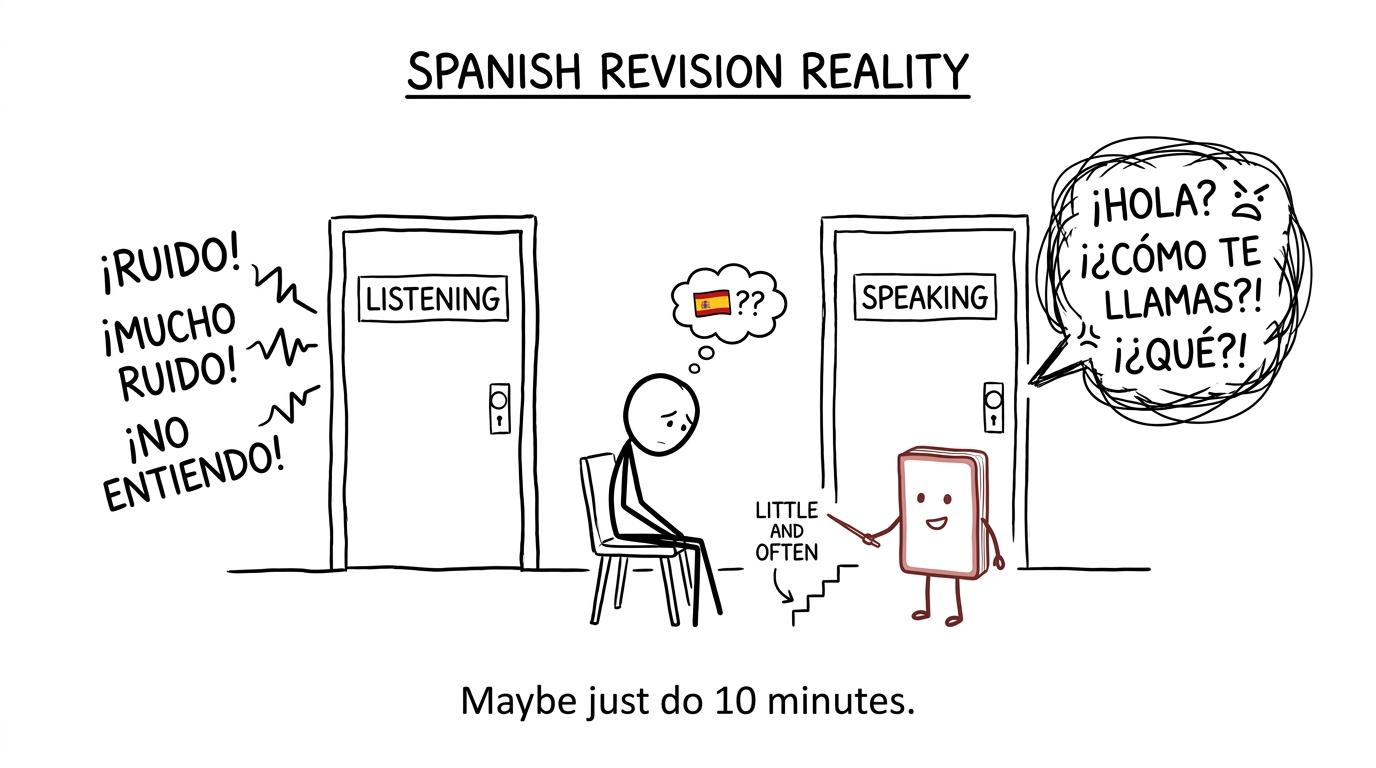 A student chooses between intimidating Spanish skills while a flashcard points towards steady progress
What students really say about GCSE Spanish
There is no single, representative survey that tells us exactly how every student experiences the course. Public student discussions are anecdotal, so they should not be treated like controlled research. Yet the same themes appear often enough to be useful.
Students frequently say that classroom Spanish feels understandable until they hear an unfamiliar recording. Others report that speaking becomes easier when they practise answers aloud rather than merely reading them. Many also say that writing and speaking can raise their overall performance when prepared structures are secure, even if listening remains weaker.
Another recurring observation is that you do not need to understand every word. Stronger candidates learn to identify the speaker, tense, opinion, negative expression and key detail. Students who chase every unknown word are more likely to lose the thread of the passage.
Perhaps the most important theme is less dramatic: regular exposure works. Students commonly recommend past-paper recordings, vocabulary recall, speaking aloud and Spanish media pitched at an appropriate level. These suggestions match the structure of the qualification because they practise retrieval rather than recognition alone.
Why GCSE Spanish can feel hard
Four skills must develop together
Current GCSE Spanish qualifications assess listening, speaking, reading and writing. On specifications such as the reformed AQA course first assessed in summer 2026, each component contributes approximately 25%25\%25% of the qualification. Pearson Edexcel also assesses these four areas, although students should check their own board for precise tasks, timings and marks.
This breadth is what makes Spanish unusual. Knowing a word when you see it does not guarantee that you can recognise it in speech, pronounce it accurately or produce it from memory.
A useful comparison is GCSE maths. Watching someone solve an equation can create a sense of familiarity, but independent questions reveal whether the method is genuinely secure. Spanish has the same gap between recognising and producing. That is why active recall matters in both subjects.
Listening happens in real time
Listening gives you less control than reading. Spanish sounds link together, familiar words may be pronounced differently from how you imagined, and distractors can appear before the correct detail.
Students often describe the audio as extremely fast. That reaction is understandable, although the deeper issue is usually automatic recognition. If translating every word requires conscious effort, the recording will move ahead before the translation is complete.
The solution is not simply to “listen more”. Use short exam-style clips with a deliberate routine:
- read the question before the audio begins;
- predict the type of information required;
- listen for negatives, opinions, time references and changes of mind;
- check the transcript afterwards where one is available;
- replay the difficult sentence and identify the exact sound you missed.
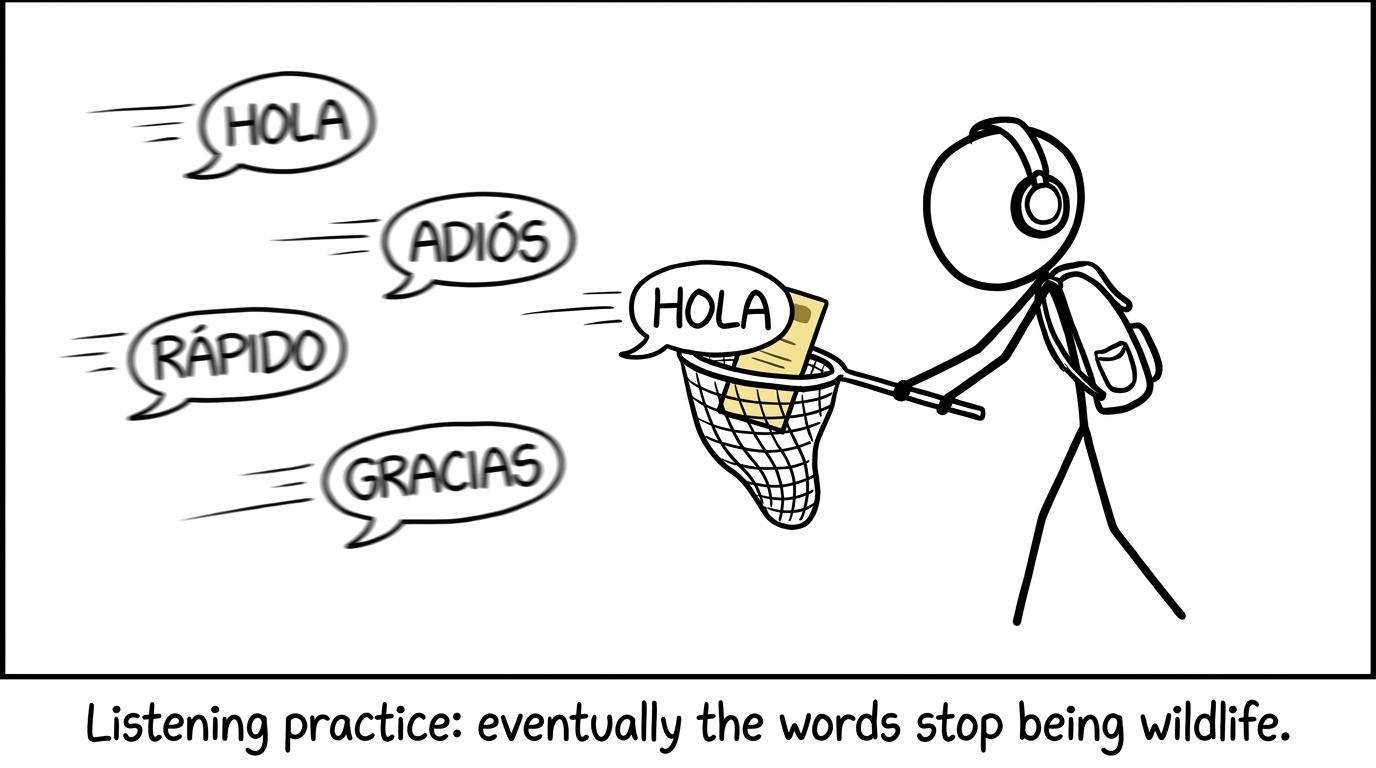 A student catches fast Spanish words with a butterfly net during listening practice
Speaking combines knowledge with pressure
Speaking can feel personal in a way that a written paper does not. A pause seems longer when another person is waiting. One forgotten word can make a prepared student believe the whole response has collapsed.
But speaking is trainable. Practising silently is not enough because your mouth also needs to learn the movement and rhythm of the language. Say answers aloud, record them, listen back and repeat awkward phrases. Practise recovering with simpler language instead of stopping whenever the perfect word disappears.
Students sitting reformed qualifications may encounter tasks such as role-play, reading aloud and discussion based on visual material, depending on their board. Learn the format actually used by your specification rather than relying on advice from someone who sat an older course.
Vocabulary grows quietly, then becomes urgent
Vocabulary rarely feels disastrous in one lesson. The problem appears gradually. A few missed words become several topics, then Year 11 arrives and the total feels impossible.
The new AQA specification, for example, defines 1,2001{,}2001,200 lexical items at foundation tier and a further 500500500 at higher tier, alongside specified phrases and cultural or geographical items. That does not mean every board uses an identical list, but it shows why last-minute memorisation is fragile.
Learn vocabulary in both directions. Seeing a Spanish word and recognising its English meaning supports reading, but producing Spanish from an English prompt is essential for writing and speaking. Add audio where possible so that spelling, meaning and sound become connected.
Is GCSE Spanish harder than GCSE maths?
There is no objective answer for an individual student. Spanish and maths reward different kinds of thinking.
Maths is often cumulative: fractions support ratio, algebra supports graphs, and weak foundations can affect later topics. Spanish is cumulative too, but progress depends heavily on memory, listening familiarity and willingness to communicate despite imperfections.
If you enjoy rules and definite answers, maths may feel safer. If you remember phrases easily and enjoy communication, Spanish may feel more natural. Neither reaction predicts your final grade. It mainly tells you what kind of practice you need.
For students preparing for both subjects, the real danger is allowing the more uncomfortable one to consume the timetable. Use a balanced plan. MathsGenie’s GCSE maths revision timetable offers a structure you can adapt across subjects: short topic sessions, timed practice and a specific review of mistakes.
A revision approach that makes Spanish manageable
Use short daily contact
Spanish responds well to frequency. A focused session might include vocabulary retrieval, a short listening extract and two minutes of speaking aloud. The aim is not to exhaust yourself. It is to stop the language becoming unfamiliar between lessons.
This leaves room for maths. Use the GCSE maths revision hub to choose your board and tier, then alternate language recall with one targeted maths topic rather than vaguely “doing revision”.
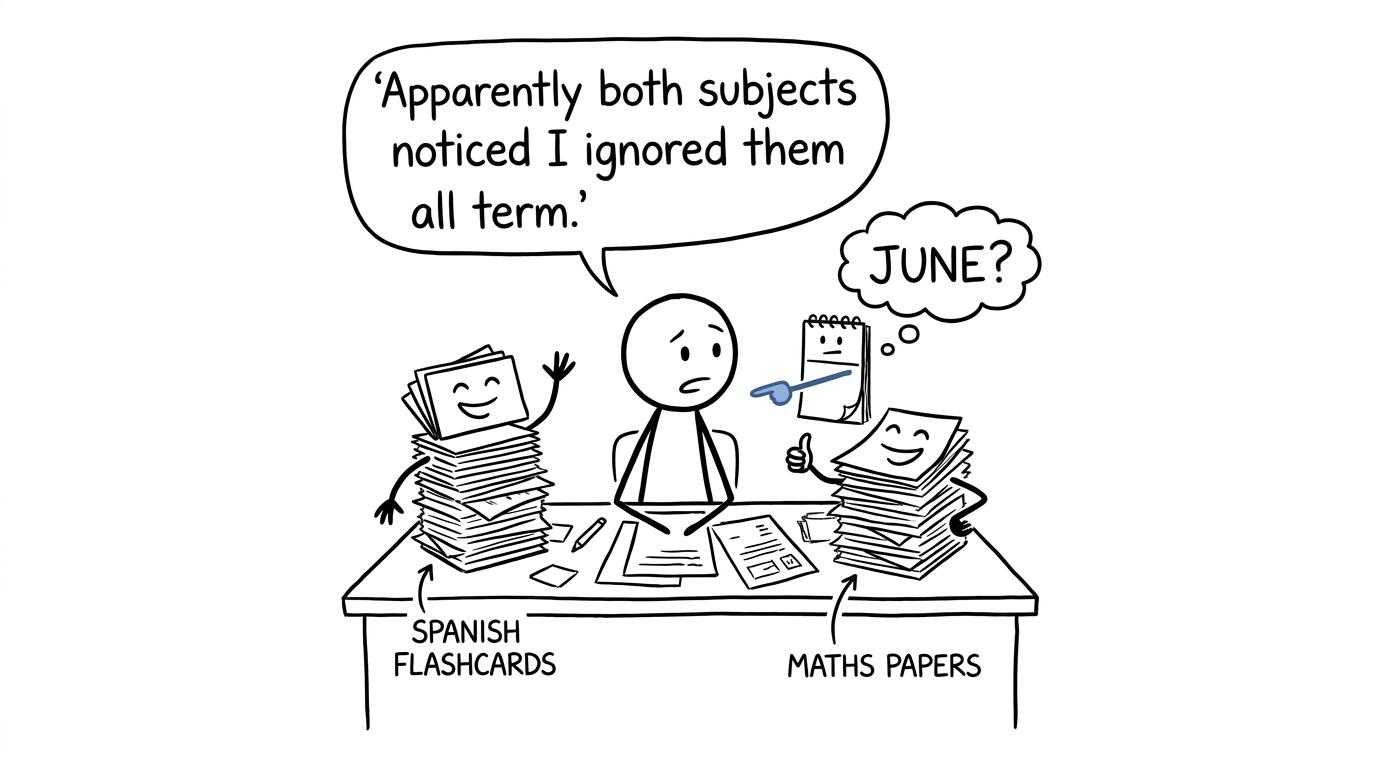 Spanish flashcards and maths papers remind a student that both subjects noticed being ignored
Revise weaknesses, not favourite activities
Students naturally repeat what feels comfortable. A strong reader may spend another hour highlighting vocabulary while avoiding speaking. A confident writer may prepare longer answers but never train their ear.
Track the marks or errors from each skill separately. After a listening task, record whether the problem was vocabulary, sound recognition, a negative, a distractor or lost concentration. This is the language equivalent of turning a maths paper into a topic list.
For maths, GCSE mini tests provide the same diagnostic benefit in manageable sections. The principle is simple: test first, identify the gap, then revise precisely.
Treat past papers as feedback
Past papers are not merely final rehearsals. They show how familiar knowledge changes under exam conditions. Begin with sections, mark them carefully and return to the exact skill that cost you marks.
The same timing applies to maths. MathsGenie explains when to start GCSE past papers and why topic repair should sit between attempts. Nearer the exams, Edexcel GCSE maths predicted papers can provide fresh practice, but they should supplement rather than replace official past papers.
Foundation or higher tier: does it change the difficulty?
GCSE Spanish uses foundation and higher tiers. Foundation normally makes grades 111 to 555 available, while higher targets grades 444 to 999, with a narrow grade 333 safety net for students who just miss the higher-tier grade 444 boundary. Students take the same tier across the qualification rather than mixing tiers by skill.
Higher tier contains greater linguistic demand, but foundation is not automatically “easy”. You still need to prepare all four skills carefully. Ofqual’s guidance also makes clear that a grade 444 or 555 has the same value whichever tier produced it.
Talk to your teacher about entry decisions. They can use your full pattern of performance rather than one unusually good or bad mock. This mirrors maths, where board and tier affect the content and question demand. The GCSE maths topics by exam board and tier guide can help you organise the maths side accurately.
Common mistakes that make GCSE Spanish harder
Memorising one perfect paragraph
A memorised answer may not match the question. Learn flexible sentence structures and vocabulary that can be adapted, then practise responding to unfamiliar prompts.
Revising vocabulary only from Spanish to English
Recognition supports reading, but speaking and writing require recall in the opposite direction. Test English to Spanish and include pronunciation.
Avoiding listening because it feels uncomfortable
The weakest skill often creates the strongest urge to postpone it. Start with short clips and review exactly what you missed. Repeated, tolerable difficulty is more useful than occasional panic.
Ignoring the exam board specification
Advice from former students may describe an older assessment. Reformed GCSE French, German and Spanish qualifications were first awarded in summer 2026. Check your board’s current specification, sample materials and teacher guidance before learning task formats.
Letting Spanish revision replace maths revision
Urgency is not the same as priority. Keep both subjects visible in your week. If time is short, the GCSE one-week maths revision plan provides a calm structure built around diagnosis, practice and correction.
The honest verdict
So, is GCSE Spanish hard? It is demanding because you must understand and produce another language across four different skills. Students most often identify listening speed, vocabulary volume and speaking pressure as the toughest parts. Yet they also describe improvement when they practise little and often, use exam recordings, speak aloud and learn reusable language.
Spanish becomes hardest when it is treated as something to rescue in one weekend. It becomes more manageable when unfamiliar sounds and phrases are encountered regularly.
Keep your wider revision balanced. Use MathsGenie as your free maths home base: begin with revision lessons and practice questions, check progress through mini tests, then build exam technique with past papers, predicted papers, mark schemes and video solutions. If the night before an exam starts to feel chaotic, follow the GCSE maths night-before plan rather than trying to relearn everything.
You do not need every subject to feel easy. You need a routine that makes the next task clear, and enough repetition for difficult things to become familiar.










