

Is GCSE History Hard? What Students Really Say
Is GCSE History hard? Get an evidence-based answer on workload, memory, essays and timing, plus practical revision advice for busy GCSE students.

The unsettling thing about GCSE History is not any single date, source or essay. It is the moment when several topics begin competing for space in your memory while maths, science and English demand attention too.
So, is GCSE History hard? The straight answer is yes: many students find it demanding because it combines a large volume of content with timed writing, source evaluation and historical argument. But student feedback also shows that difficulty is personal. If you enjoy explaining causes, weighing evidence and building arguments, History can feel far more manageable than its reputation suggests.
Official student research supports both sides of that answer. Students have identified essay writing and remembering key dates as difficulties, yet broader research into subject choices found that perceived difficulty depends heavily on the individual. More recent feedback collected by Pearson also suggests that students enjoy History while feeling less positive about the amount of content and assessment.
In other words, the challenge is real. The horror stories are not the whole story.
The short answer: how hard is GCSE History?
GCSE History is usually hard in four specific ways:
- There is substantial content to retain, often across contrasting periods and places.
- Knowing facts is not enough because questions also test explanation, analysis and judgement.
- Several question styles must be mastered, including source and interpretation questions.
- Time pressure matters, especially when extended answers compete for limited exam time.
It is not necessarily hard because every fact is complicated. It is hard because you must select the right knowledge, match it to the right question and communicate it quickly.
That distinction is encouraging. Memory, question recognition and timed writing are skills. Skills improve through deliberate practice.
What students really say about GCSE History
It is tempting to look for one verdict from former students. There is not one.
Online student discussions contain sharply different views. Some describe History as their heaviest subject because of the volume of facts and the speed of the exams. Others say the content is manageable and that essay technique is the real obstacle. These comments are useful as lived experiences, but anonymous forum posts are anecdotal rather than representative evidence.
More systematic research offers a steadier conclusion. In government-published research into perceptions of subject difficulty, students associated History with essay writing and remembering dates. The same research found that students generally saw difficulty as person-specific: a subject one student finds punishing may suit another student’s strengths.
Pearson has also reported positive student attitudes towards studying History alongside concerns about content and assessment. The exam board subsequently increased the time available for its GCSE History papers from summer 2025, taking the total examination time to four hours and forty minutes. That does not prove that every student struggles with timing, but it confirms that assessment pressure has been taken seriously.
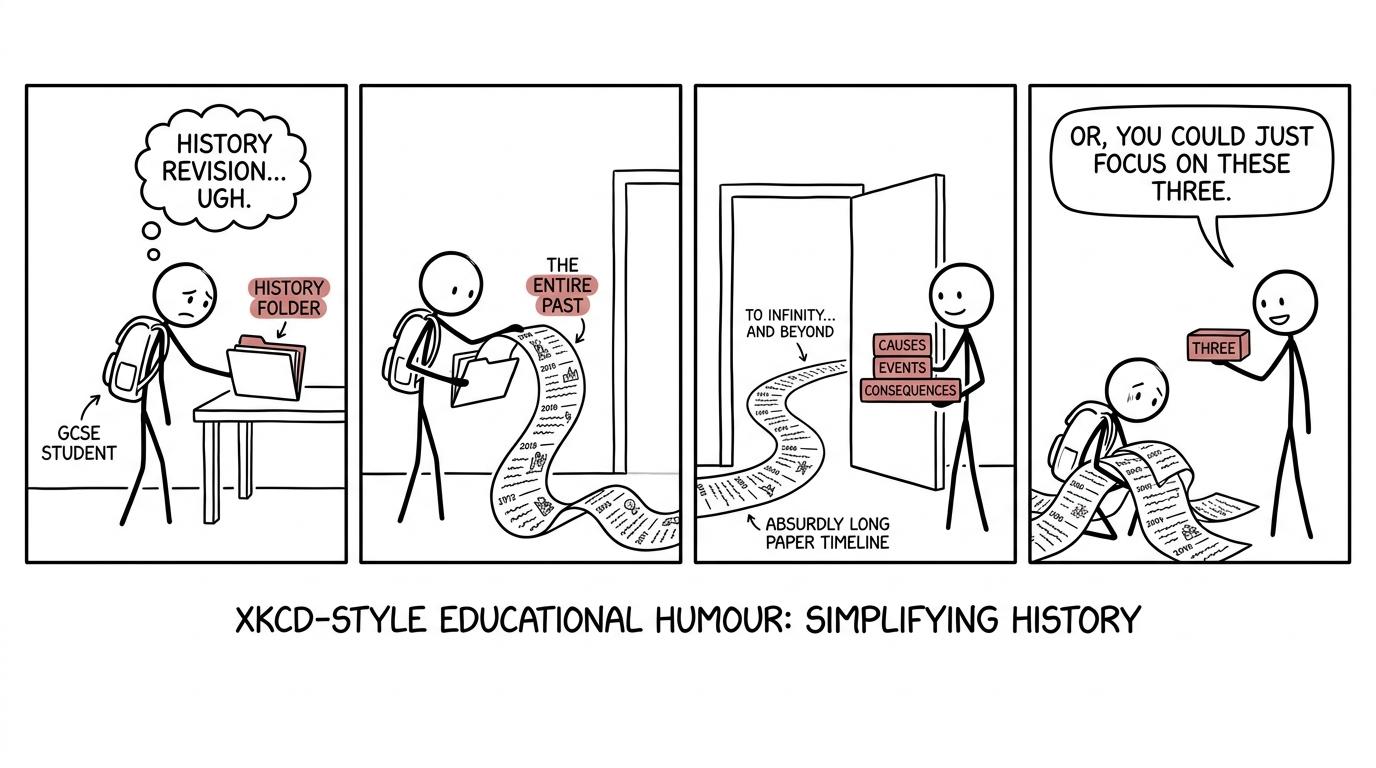 A GCSE student discovers that organising History is easier than wrestling one enormous timeline
Why GCSE History feels difficult
The course asks for breadth and depth
Across the main English exam boards, students encounter several kinds of historical study rather than one continuous story. These commonly include depth, period and thematic studies, together with British and wider-world history and a historic environment.
The exact arrangement varies. AQA currently assesses GCSE History through two written papers, while Pearson Edexcel uses three externally examined papers. OCR offers History A and History B routes with three assessed components, and Eduqas organises its content into studies in depth and breadth. Always check your school’s current specification rather than borrowing another student’s revision list.
This variety creates an unusual memory problem. You may understand each topic in lessons but struggle to retrieve precise evidence once the topics become mixed together.
The marks reward thinking, not fact dumping
The assessment objectives used by GCSE History specifications distinguish between several abilities:
- knowledge and understanding;
- explanation using concepts such as cause, consequence, change and significance;
- analysing and evaluating contemporary sources;
- evaluating historical interpretations.
That is why memorising a textbook is not a complete strategy. A student can know many details and still lose marks by failing to answer the exact question. Conversely, a clear argument supported by carefully selected evidence is usually more valuable than a page of disconnected facts.
Question types change the job
A question about causation does not require the same structure as one about usefulness, interpretations or change over time. Students often experience this as uncertainty: they know the topic but cannot decide what the examiner wants.
The solution is to learn the purpose of each question type. Before writing, identify the command word, historical concept, evidence required and whether a supported judgement is needed. This reduces the amount of improvisation required under pressure.
The clock exposes weak technique
Time pressure is partly a knowledge issue and partly a decision-making issue. If recall is slow, planning takes longer. If you include everything you know, one answer expands and steals time from the next.
Timed practice therefore needs to begin before the final week. The principle is familiar from when to start GCSE past papers: short, reviewed sections can build technique before full papers become useful.
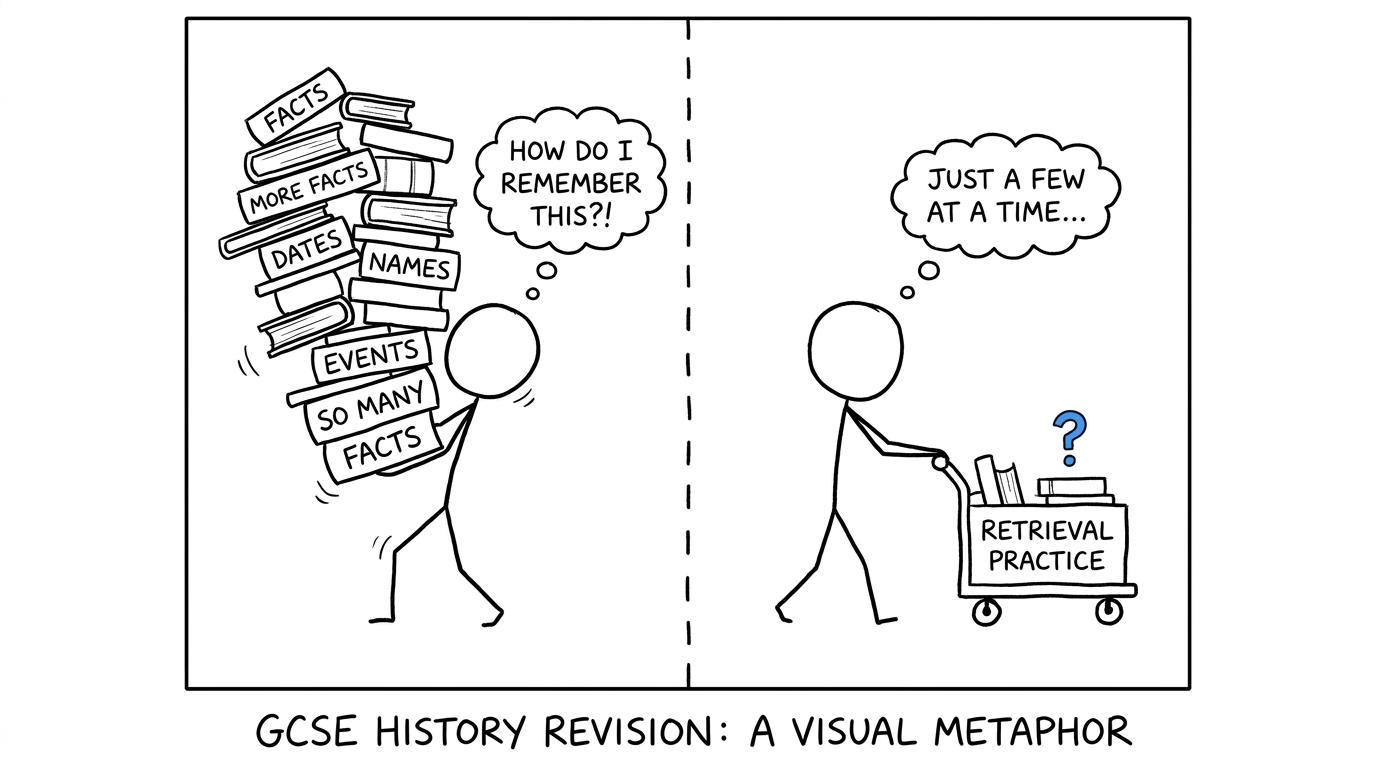 One student carries every fact while another lets retrieval practice do the heavy lifting
Who is likely to find History manageable?
History may suit you if you enjoy asking why events happened, comparing explanations and expressing ideas in writing. You do not need a naturally perfect memory. You do need to revisit material regularly and accept that good answers are constructed, not simply recalled.
The subject may feel harder if you dislike extended writing, leave revision until the end or treat every detail as equally important. None of those difficulties makes success impossible. They simply tell you where your preparation must be more deliberate.
There is also no foundation or higher tier in GCSE History. Students following the same specification sit the relevant common assessments, unlike GCSE Maths, where tier and exam-board choices shape the paper. Make sure your revision reflects this difference when planning across subjects.
How to make GCSE History easier
Organise knowledge around questions
Do not make one enormous collection of notes. Divide each topic into useful categories such as causes, consequences, turning points, changes, similarities and evidence for competing judgements.
A date becomes memorable when it has a job. Connect it to what happened, why it mattered and which argument it could support.
Use retrieval rather than repeated reading
Close the book and reconstruct a timeline, explain a cause aloud or list evidence for and against a judgement. Then check what was missing. This feels harder than rereading because it reveals gaps, which is precisely why it is productive.
Keep the cycle simple: retrieve, check, correct and revisit. A sustainable routine matters more than one heroic weekend.
Practise complete exam decisions
Essay practice does not always mean writing a full essay. You can identify the question type, choose evidence, create a brief plan or write one paragraph under time. Full answers still matter, but smaller drills let you practise more decisions in less time.
Mark schemes and examiner guidance should be used to discover what earns credit, not merely to produce a score. Ask whether your evidence was specific, your explanation developed and your judgement supported.
Protect time for maths as well
History and maths reward different forms of practice, so switching intelligently between them can prevent revision from becoming monotonous. History may use retrieval and essay planning; maths needs active problem-solving and correction.
Start from the free GCSE Maths revision hub, where resources are organised by exam board. A repeatable GCSE revision timetable can stop one content-heavy subject from consuming every evening.
If exams are close, the one-month GCSE revision plan provides a practical structure for diagnosis, topic work and timed practice. The broader lesson applies across both subjects: find the gap, practise it, check the result and return to it later.
Common mistakes that make History feel harder
Trying to memorise everything equally
Not every detail deserves the same revision time. Secure the chronology, central developments, major individuals and versatile evidence before chasing minor details.
Writing everything you know
A long answer is not automatically a focused answer. Select material that addresses the wording of the question and explain how it supports your argument.
Treating sources as either reliable or unreliable
Source evaluation is more precise than assigning a simple label. Consider what the source reveals, its context, its purpose and how your own knowledge affects its usefulness for the stated enquiry.
Ignoring the exact exam board
AQA, Edexcel, OCR and Eduqas do not use identical papers or question structures. Revising from mismatched guidance can create avoidable confusion. Confirm your board, specification and topics with your teacher.
Saving timed work until the end
Knowing the content in a quiet bedroom is different from retrieving it against a clock. Build timing gradually, then review why time was lost.
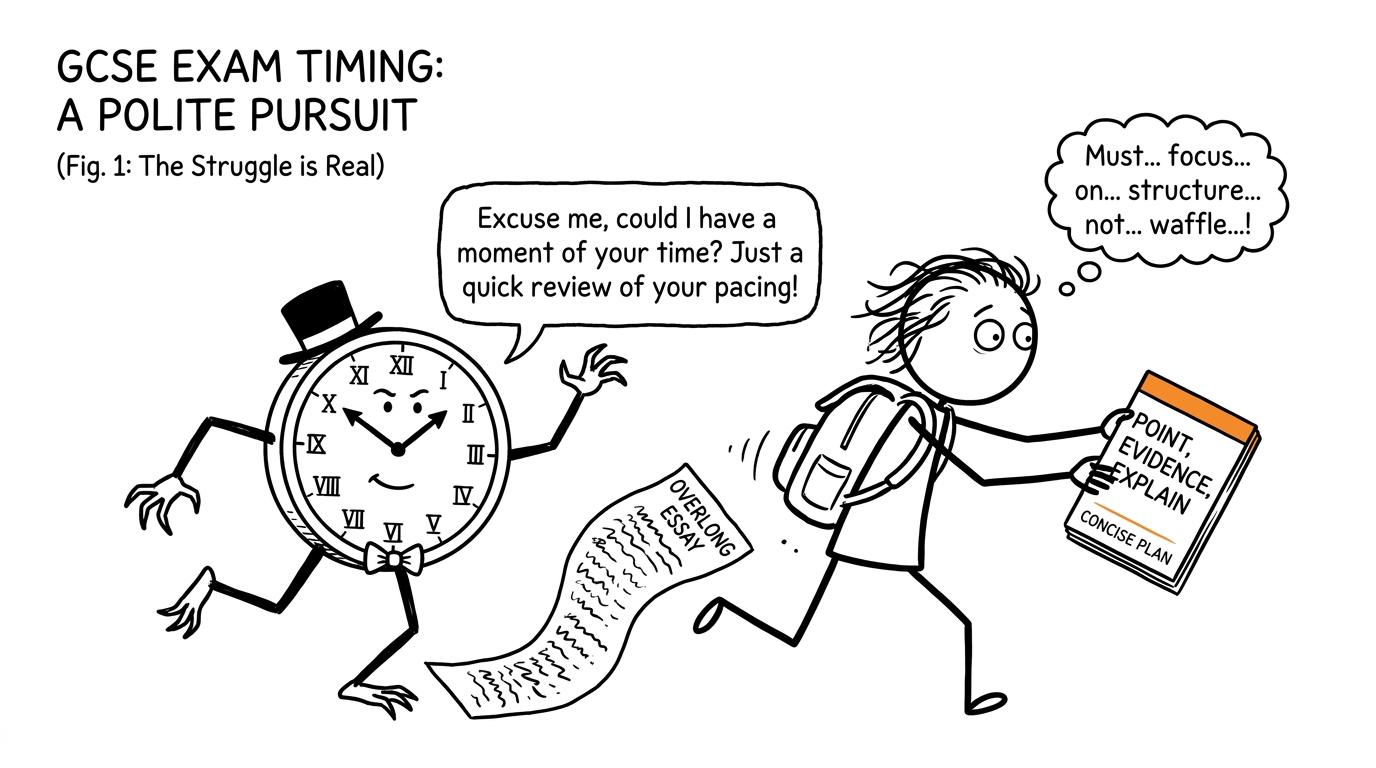 A determined student escapes the exam clock by choosing a concise plan instead of an endless essay
Balancing History with GCSE Maths revision
The real difficulty for many students is not History in isolation. It is History alongside several other exams.
Give each revision session one visible outcome. For History, that might be recalling one topic or planning two answers. For maths, it might be repairing one weak skill and completing related questions. Avoid vague tasks such as “revise History” or “do maths”. They offer no clear finishing point.
MathsGenie can make the maths side of that plan more efficient. Use GCSE predicted papers after building your underlying skills, not as a replacement for the specification. The guide to predicted GCSE topics explains how to combine likely areas with full-course revision.
Near an exam, resist the urge to solve panic with volume. A calm GCSE maths night-before plan is more useful than an exhausting final cram. History benefits from the same restraint: refresh structures and high-value evidence, then protect your sleep.
The honest verdict
GCSE History is challenging, especially if you underestimate the content, delay retrieval practice or enter the exam without rehearsing its question types. Student feedback consistently makes those pressures visible.
But “hard” does not mean unpredictable or unmanageable. The course asks for a recognisable combination of knowledge, selection, explanation and judgement. Once those demands are separated, you can train them one at a time.
Let MathsGenie remove uncertainty from the maths part of your GCSE workload. Begin with the free MathsGenie revision resources, use revision lessons and practice questions to close topic gaps, then test your progress with mini tests, past papers, predicted papers, mark schemes and video solutions. The more organised your maths revision becomes, the more attention you can give History without feeling that every subject is competing at once.










