

Is GCSE German Hard? What Students Really Say
Is GCSE German hard? Read an honest student-led view of grammar, listening and speaking, plus a practical plan for balancing German with GCSE maths.
The first German listening practice can feel unfair. You know the vocabulary on the page, the recording begins, and suddenly every familiar word seems to disappear. At the same time, your maths revision list is growing. It is natural to ask: is GCSE German hard, or does it simply feel hard at the beginning?
The straight answer is that GCSE German is challenging but manageable. Recurring themes in published student accounts suggest that listening, speaking under pressure and German grammar cause the most difficulty. Yet students also describe German as logical, structured and increasingly predictable once its patterns become familiar. You do not need to be fluent. You need regular vocabulary practice, control of essential grammar and experience of the exam tasks.
Online student comments are not a scientific survey, and people are more likely to post when they are struggling. Still, the same practical themes appear often enough to be useful.
GCSE German difficulty at a glance
Use this checklist as an honest summary:
- Grammar takes time: cases, noun gender and word order can initially feel less forgiving than English.
- Listening often feels hardest: you must recognise language immediately rather than pausing to inspect it.
- Speaking creates pressure: even well-prepared students can become nervous when answering aloud.
- Reading is often more controllable: you can reread, identify context and look for familiar word families.
- Writing rewards preparation: reliable structures and accurate common vocabulary can carry substantial value.
- Regular practice matters more than occasional long sessions: language knowledge fades when it is not retrieved.
- The course is not a fluency test: it assesses communication using vocabulary and grammar defined by your specification.
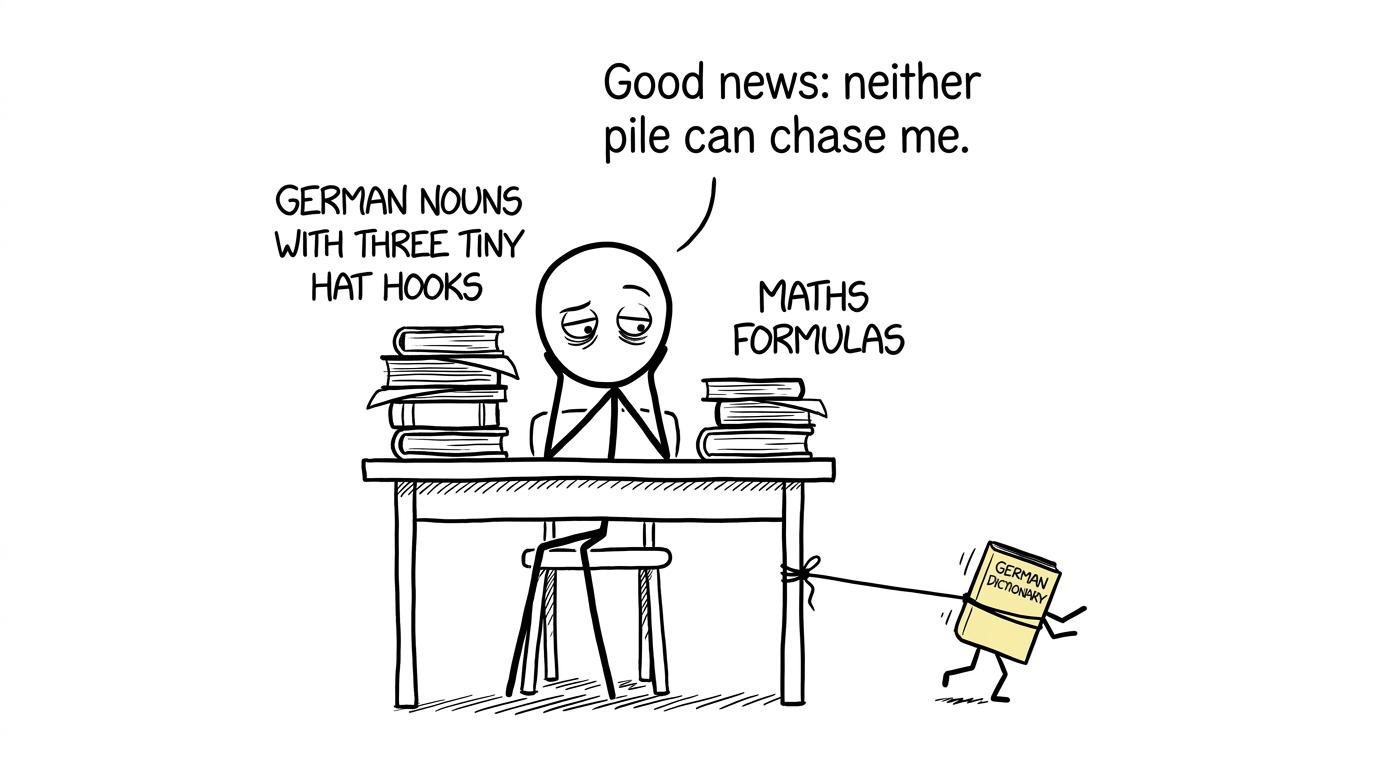 A student discovers that revision piles cannot chase them
What students really find difficult about GCSE German
When students call German hard, they rarely mean every part of the course. Usually, one particular skill is shaping their opinion of the whole subject.
German grammar has several moving parts
German nouns have grammatical gender, and articles can change according to a noun's role in a sentence. Word order can also change when certain conjunctions, time phrases or subordinate clauses are used.
This creates a distinctive type of difficulty. Learning a word is not always enough; you may also need to remember its gender and how it behaves in a sentence. Students who try to absorb every rule at once can feel overwhelmed.
However, German grammar is often rule-based. Once a pattern is secure, it can be applied repeatedly. That is one reason some maths students enjoy German more over time: both subjects reward attention to structure. In maths, an algebraic method reduces uncertainty. In German, a dependable sentence pattern does something similar.
Listening does not give you much thinking time
Reading allows you to stop. Listening keeps moving.
Student discussions commonly describe listening as one of the least comfortable parts of GCSE German. A missed word can create panic, and that panic then causes the next sentence to be missed as well. Numbers, negatives and small changes of tense can alter the meaning even when most of the passage is understood.
The important correction is this: you usually do not need to understand every word. Listen for the information demanded by the question, including opinions, reasons, times, places and whether an idea is positive or negative.
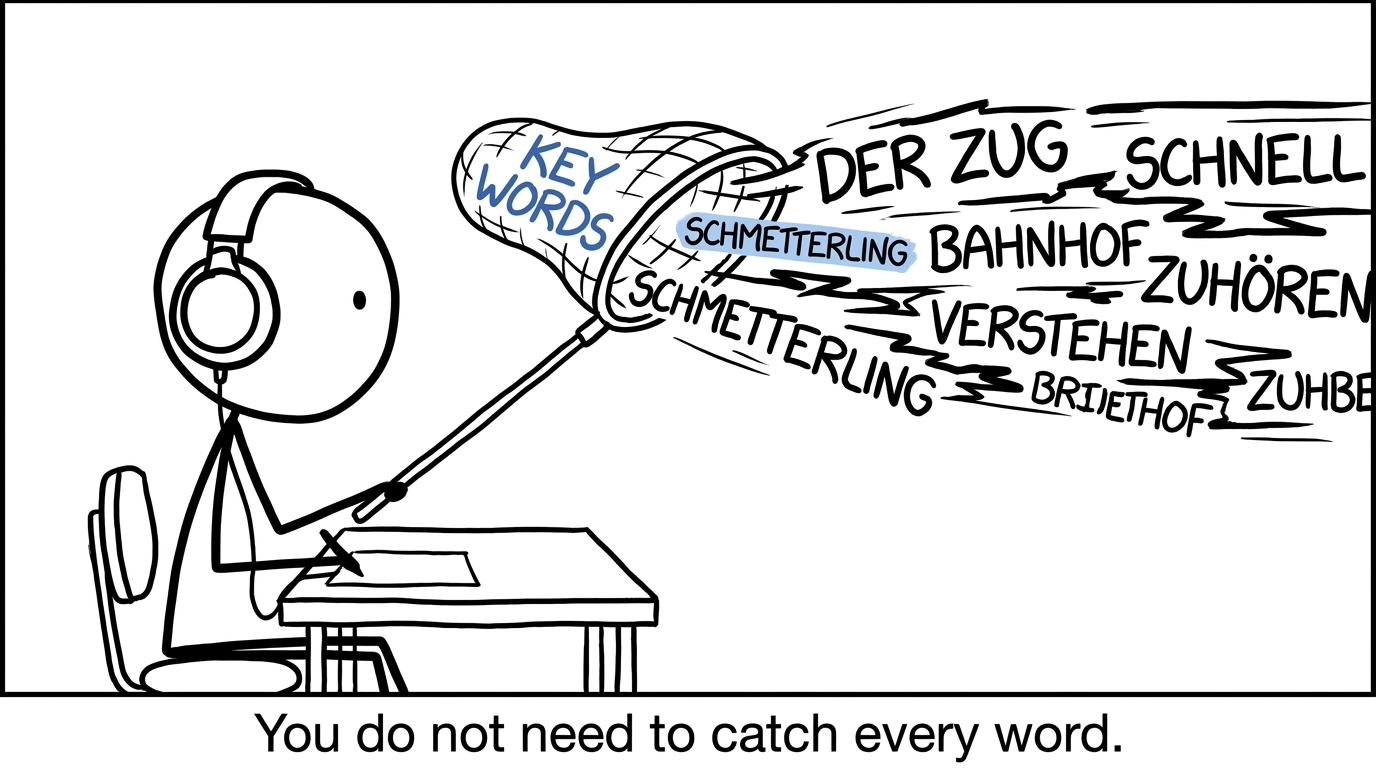 A student catches key words instead of every passing word
Speaking feels more personal than a written paper
A blank on a written paper is private. A pause in a speaking assessment feels visible, even when it is brief and completely recoverable.
That emotional difference explains why speaking can feel harder than its content. Students may know what they want to communicate but struggle to retrieve it quickly. Practising silently does not fully prepare you for this. Speaking is a physical skill involving recall, pronunciation and recovery when a sentence does not go to plan.
Short, frequent practice is more useful than repeatedly memorising one perfect paragraph. Say answers aloud, record them and practise responding in a slightly different way each time. The aim is flexible communication, not a performance that collapses if one word is forgotten.
What the current GCSE German course actually requires
For reformed GCSE German specifications taught from 2024 and first awarded in 2026, the official AQA, Pearson Edexcel and Eduqas documents divide assessment across speaking, listening, reading and writing. Each component contributes 25%25\%25% of the qualification on these specifications.
Foundation tier offers grades 111 to 555, while Higher tier offers grades 444 to 999. Students are entered for the same tier across the components. Exact task formats and timings vary by exam board, so your own specification and teacher's guidance should decide how you practise.
The newer specifications use defined vocabulary and grammar content. They also include tasks such as reading aloud and dictation, although the precise structure varies between boards. This makes accurate sound-to-spelling knowledge more important, but it also gives revision clearer boundaries.
The key point is reassuring: the examination is not asking whether you could move to Berlin tomorrow and handle every conversation. It is asking whether you can understand and communicate within GCSE-level contexts using the prescribed language.
Is German harder than GCSE maths?
There is no universal ranking because the subjects demand different kinds of thinking.
Maths is cumulative. If fractions or algebra remain insecure, later topics can become harder. German is also cumulative, but its pressure comes from maintaining vocabulary while developing four skills at once. A student who likes fixed procedures may find maths more comfortable; someone who enjoys communication and remembers language easily may prefer German.
The fairest comparison is not which subject is objectively harder. Ask where your marks currently leak.
- In German, is it vocabulary recall, listening, grammar, speaking confidence or task technique?
- In maths, is it missing knowledge, inaccurate execution or misreading questions?
For maths, the GCSE Maths revision hub helps you diagnose topics using revision lessons, exam-style questions, worksheets and papers. If you are taking AQA, the AQA GCSE Maths revision page keeps board-specific materials together.
Once each subject has a precise problem, neither feels like one enormous judgement of your ability.
How to balance German with GCSE maths revision
The risk is not that German consumes all your time. It is that switching between subjects becomes unplanned, so you repeatedly revise whichever feels easiest.
Give each session one clear purpose
A German session might focus only on listening discrimination, vocabulary retrieval or speaking aloud. A maths session might focus on equations, ratio or one timed paper section.
MathsGenie's guide to the best order for learning GCSE maths topics can help you identify dependencies instead of jumping randomly between chapters.
Use short retrieval alongside deeper practice
Vocabulary benefits from brief, repeated recall. Maths needs repeated retrieval too, but you must also spend enough time completing full solutions and checking methods.
A realistic week could contain short German recall on several days, focused German skill practice, targeted maths lessons and one timed maths section. The GCSE maths revision timetable guide shows how to organise focused sessions without turning every evening into a revision marathon.
Mark, diagnose and return
Completing a task is only the beginning. For German, note whether an error came from unknown vocabulary, misheard sounds, grammar or misunderstanding the instruction. For maths, classify lost marks by topic, method, accuracy or exam technique.
The same feedback loop works in both subjects:
- attempt;
- check;
- name the error;
- correct it;
- revisit it later.
MathsGenie's guide to using GCSE past papers properly explains how mark schemes, error logs, revision lessons and retesting turn a paper into improvement rather than merely a score.
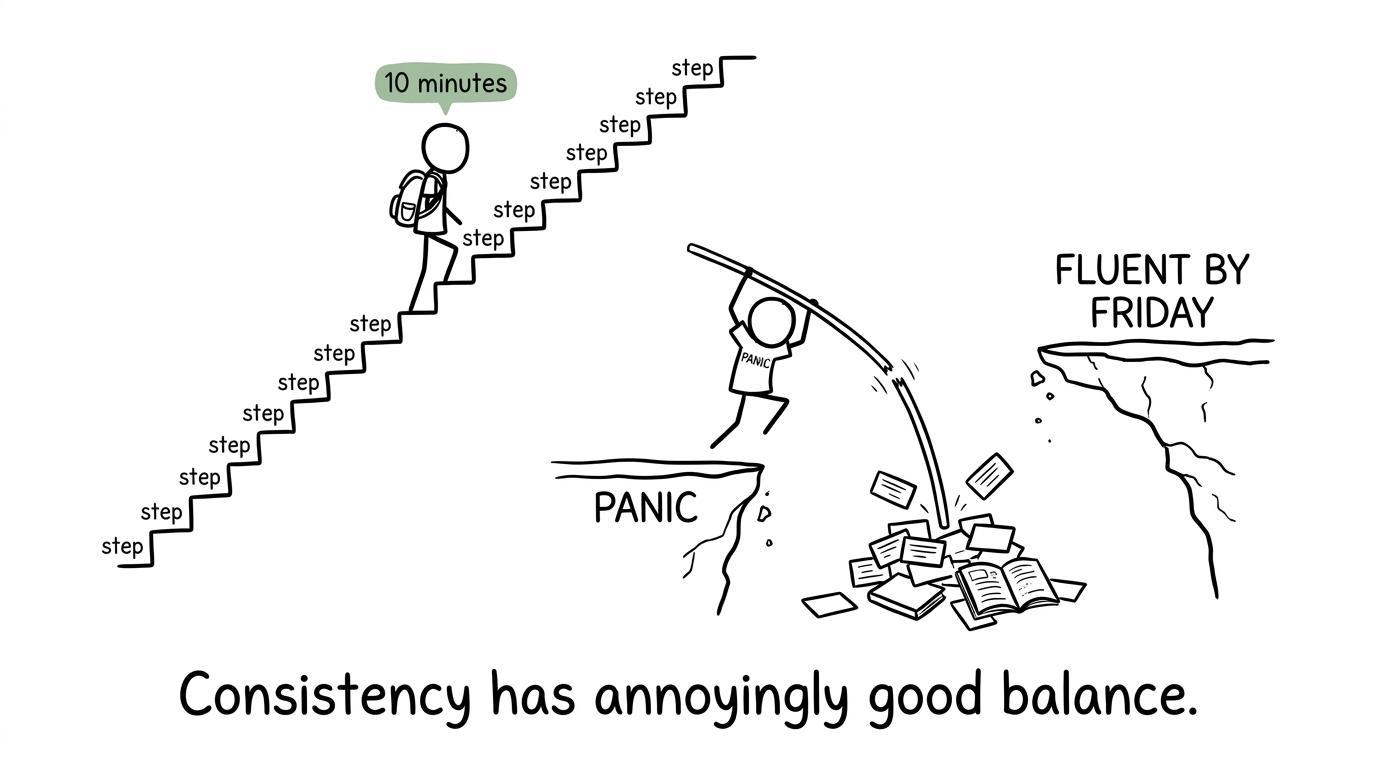 Small daily revision steps beat a last-minute leap
A realistic revision approach for GCSE German
The students who feel most secure are not necessarily those who began with the best accent or the largest vocabulary. They are often those who stopped treating German as something that could be crammed.
Build revision around four habits:
- retrieve vocabulary without looking at the answer first;
- listen to short exam-style extracts and check exactly what was missed;
- speak aloud regularly rather than rehearsing only in your head;
- write brief responses accurately before trying to make them more complex.
Do not neglect the skill you dislike. If listening makes you anxious, avoiding it protects the anxiety. Small, controlled exposure makes the format more familiar.
The timing of full papers matters too. Early revision should diagnose gaps; later revision should increasingly reproduce exam conditions. The MathsGenie guide on when to start GCSE past papers provides a useful framework for sequencing topic work, timed sections and complete papers. Its principles transfer well to language revision, even though you should obtain German materials from your school or official exam board.
Common mistakes that make GCSE German feel harder
Memorising answers without understanding them
A memorised response can sound secure until the task changes. Learn reusable structures and vocabulary, but understand how to adapt them.
Learning nouns without their gender
Treating a noun and its article as one unit reduces uncertainty later when cases and adjective endings matter.
Practising listening passively
Simply replaying audio can create familiarity without understanding. Predict the topic, answer specific questions, check the transcript when available and identify exactly what prevented recognition.
Waiting to feel confident before speaking
Confidence usually follows practice. It rarely arrives beforehand. Brief, imperfect speaking is more useful than silent preparation for an imaginary perfect attempt.
Letting one weak paper define the entire subject
A difficult listening result does not prove that you are bad at German. It identifies a skill that needs a different practice method.
The same applies to maths. A low paper mark should become a list of topics, not an identity. If exams are approaching, the one-month GCSE maths revision plan can help turn that list into manageable weekly action.
The honest verdict
So, is GCSE German hard? Yes, in the sense that it asks you to remember vocabulary, apply unfamiliar grammar and communicate under time pressure. Listening and speaking can feel especially exposed. But it is not unreasonably difficult, and it does not require perfect German.
The subject becomes manageable when its four skills are practised separately and regularly. Grammar becomes a collection of patterns. Listening becomes a search for meaning rather than every word. Speaking becomes something you have done many times before the assessment begins.
Protect time for your other GCSEs as well. Open the MathsGenie GCSE Maths hub, choose your board and tier, then use free revision lessons, practice questions, mini tests, past papers, predicted papers, mark schemes and video solutions. Add each task to your revision planner and keep the loop simple: learn, practise, check, fix and return.










