Is GCSE Geography Worth It? Honest Pros and Cons
Is GCSE Geography worth it? Explore the honest pros, cons, workload, maths links and future pathways before deciding whether the subject is right for you.
Choosing GCSE options can feel strangely permanent. A subject that currently occupies three lessons a week suddenly looks as though it might shape your sixth-form choices, university course and entire career. It probably will not. But it can influence what you enjoy learning over the next two years.
So, is GCSE Geography worth it? For many students, yes. It is a broad, respected subject combining physical processes, human issues, fieldwork, data interpretation and extended writing. It is especially suitable if you are curious about the world and comfortable learning detailed examples. However, it involves more content and written explanation than some students expect, so it is not automatically the right choice for everyone.
The real question is not whether Geography is universally “good”. It is whether its particular mixture of knowledge, skills and workload fits you.
The quick decision checklist
GCSE Geography may be worth taking if you:
- enjoy learning about hazards, landscapes, cities, development and environmental change;
- like finding connections between people and places;
- are willing to remember case studies and use them as evidence;
- can interpret maps, graphs, photographs and numerical data;
- do not mind extended written answers;
- would value a subject that sits between the sciences and humanities;
- are interested in Geography, environmental science or related routes after GCSE.
Think more carefully if you strongly dislike detailed content, evidence-based writing or fieldwork. You should also ask your school which specification it teaches. AQA, Edexcel, OCR, Eduqas and WJEC organise topics and assessments differently, even where the broad skills overlap.
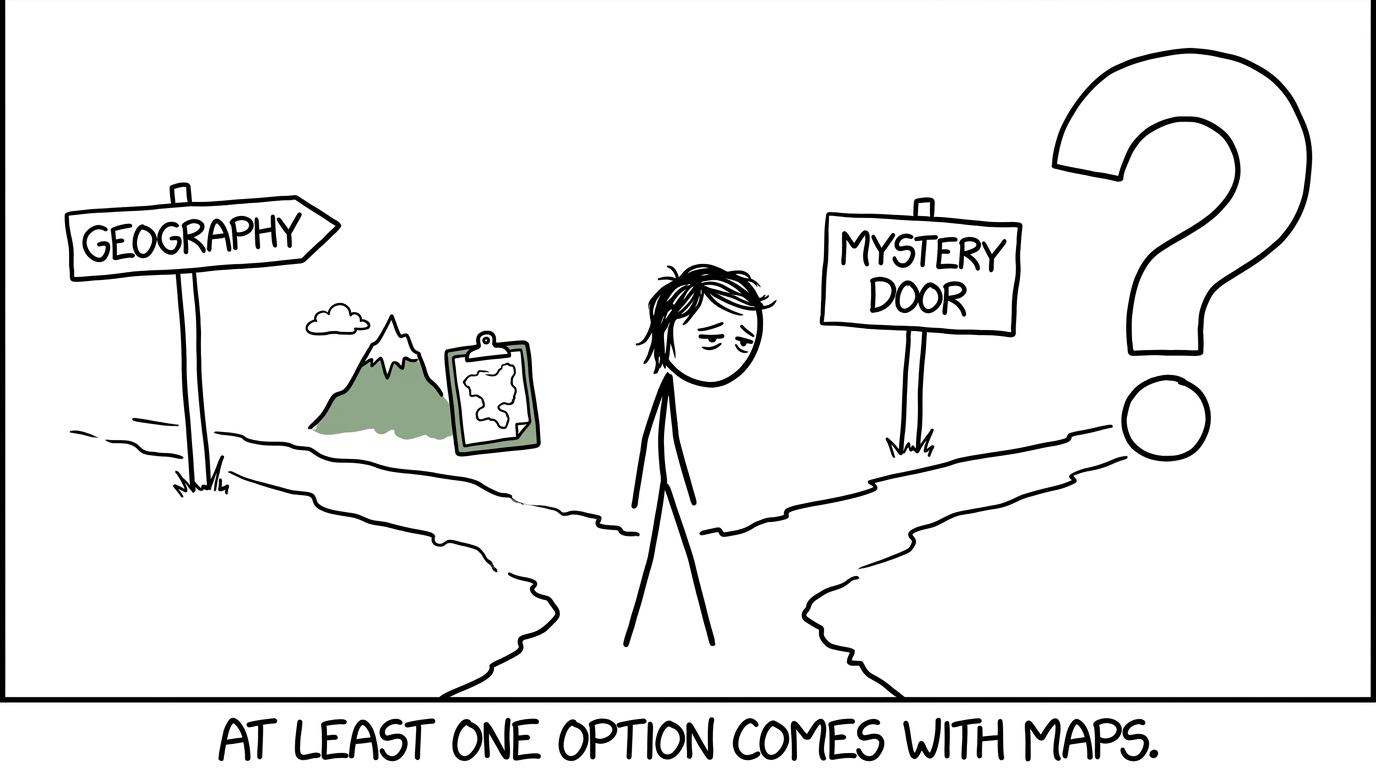 A student choosing between Geography and a mysterious subject door
What do you actually study in GCSE Geography?
The exact course depends on your exam board, but GCSE Geography normally brings together three strands.
Physical geography explores natural processes and environments. Depending on the specification, this may include natural hazards, weather, climate, ecosystems, rivers, coasts and glacial landscapes.
Human geography looks at people, places and economies. Common themes include urban change, development, resource management and the ways societies interact with environments.
Geographical skills involve maps, graphs, statistics, photographs, data sources and fieldwork enquiries. You are expected to interpret evidence, identify patterns, draw conclusions and evaluate how reliable an investigation is.
For GCSE Geography qualifications in England, current subject content requires fieldwork in contrasting environments. Schools must provide opportunities for fieldwork outside the classroom and school grounds on at least two occasions. Fieldwork is assessed through written examinations rather than a separate GCSE coursework project, although the precise question structure varies by board.
AQA, for example, currently uses three written papers. Its assessment includes physical geography, human geography, geographical applications, fieldwork and an issue-evaluation element. That is one example, not a template for every course, so check the specification your school actually follows.
Students taking AQA can explore the free AQA GCSE Geography revision hub to see how the knowledge and skills fit together.
The honest advantages of taking GCSE Geography
It explains things you already see happening
Geography gives structure to questions that appear in everyday life. Why do floods affect some communities more severely than others? Why do cities grow in particular directions? Why can the same environmental policy produce winners and losers?
The subject does not reduce these questions to one-line answers. It asks you to consider scale, evidence, processes and different viewpoints. That makes the course useful even if you never take Geography again.
It develops both numerical and written skills
Geography is neither purely essay-based nor purely numerical. You may interpret population data, compare rainfall figures, calculate percentage change, evaluate sampling methods and then explain what the evidence means geographically.
This creates a useful bridge with GCSE Maths. Topics such as averages, ratios, scales, percentages, correlation and graphs appear in both subjects, although the questions have different purposes. Maths usually focuses on carrying out a method accurately; Geography asks you to use the result as evidence within a wider argument.
You can strengthen that crossover through MathsGenie's GCSE Geography statistical skills guide, graphical skills revision and GCSE Maths scatter graphs resources.
It keeps several future routes open
GCSE Geography can provide a helpful foundation for A Level Geography, although sixth-form entry requirements are set by individual schools and colleges. Always check locally rather than assuming the GCSE is compulsory or that a particular grade guarantees entry.
Further study in geography can connect with environmental science, sustainability, planning, transport, mapping, Geographic Information Systems, international development, tourism and hazard management. Its transferable skills can also support routes involving research, policy, business and data.
That does not mean a single GCSE leads directly to a particular job. It means Geography introduces ways of thinking and handling evidence that remain useful across several pathways.
Fieldwork makes the subject less abstract
Fieldwork asks you to investigate a real environment rather than treating every place as a paragraph in a textbook. You may collect measurements, observations or survey responses before presenting the data and evaluating the method.
Some students find this one of the most memorable parts of the course. Others find the planning and evaluation more demanding than the day itself. Either reaction is reasonable, but it is worth knowing that fieldwork is a genuine assessed part of geographical understanding, not simply a school trip.
The disadvantages and hidden workload
There is a substantial amount to remember
The course covers physical and human processes, geographical terminology, locations, examples and case studies. Knowing that an event happened is rarely enough. Strong answers often need accurate place knowledge, linked causes, consequences, responses and evidence.
The difficulty is not just the quantity. It is retrieving the correct information for the exact question. Memorising a polished paragraph can fail if the examination asks for a different angle.
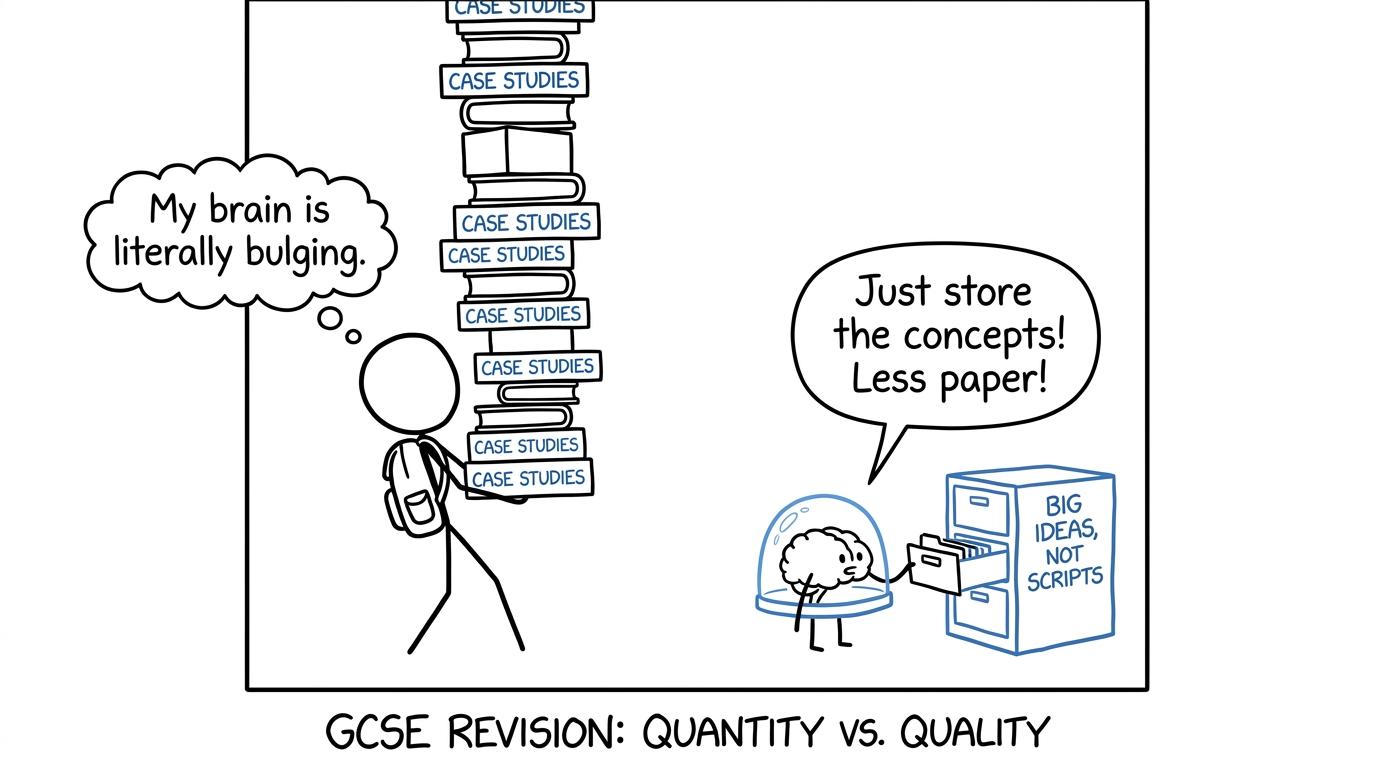 A student carrying too many case studies while a brain suggests filing the big ideas
Extended answers require judgement
Geography contains short questions, calculations and data interpretation, but longer responses matter too. You may need to assess a strategy, compare impacts or reach a justified conclusion.
This can frustrate students who know the content but do not answer the command word. Description, explanation, evaluation and assessment are different jobs. Higher-mark answers generally need a clear argument supported by relevant evidence, not every remembered fact.
Revision competes with your other GCSEs
Geography is usually taught alongside several content-heavy subjects. If you leave case studies and fieldwork until the final weeks, the course can feel much larger than expected.
This matters particularly when maths exams are also approaching. Geography's numerical skills support maths, but Geography revision cannot replace regular mathematical practice. Protect separate time for both. A structured routine such as the GCSE one-month maths revision plan can help prevent one subject from consuming the whole timetable.
Fieldwork may involve practical inconvenience
Fieldwork can mean travel, outdoor conditions and data collection that does not run perfectly. That imperfection is partly the point: you must understand limitations, anomalies, accuracy and reliability. Still, if practical outdoor work strongly puts you off, ask your teacher what the school normally organises before choosing.
How difficult is GCSE Geography?
There is no honest universal ranking of GCSE difficulty. A subject feels manageable when its demands match your strengths and exhausting when they do not.
Geography may feel easier if you can:
- understand connected processes rather than isolated facts;
- retrieve precise examples;
- interpret unfamiliar resources calmly;
- organise extended answers;
- revise steadily across the course.
It may feel harder if you rely on last-minute rereading or struggle to apply familiar knowledge to an unfamiliar place. The good news is that these are trainable skills. Practice questions reveal whether you can use knowledge, while a mark scheme shows what the examiner actually rewarded.
How Geography can support your maths
Geography gives numerical skills a real-world setting. Fieldwork and secondary data may require averages, range, percentages, graph scales, sampling and relationships between variables. The overlap is particularly helpful for students who understand a mathematical idea better when it has a purpose.
If percentages are a weak area, use the GCSE Maths percentages revision resources. If you enjoy the data side of Geography, the broader GCSE Statistics revision hub shows where those skills can develop further.
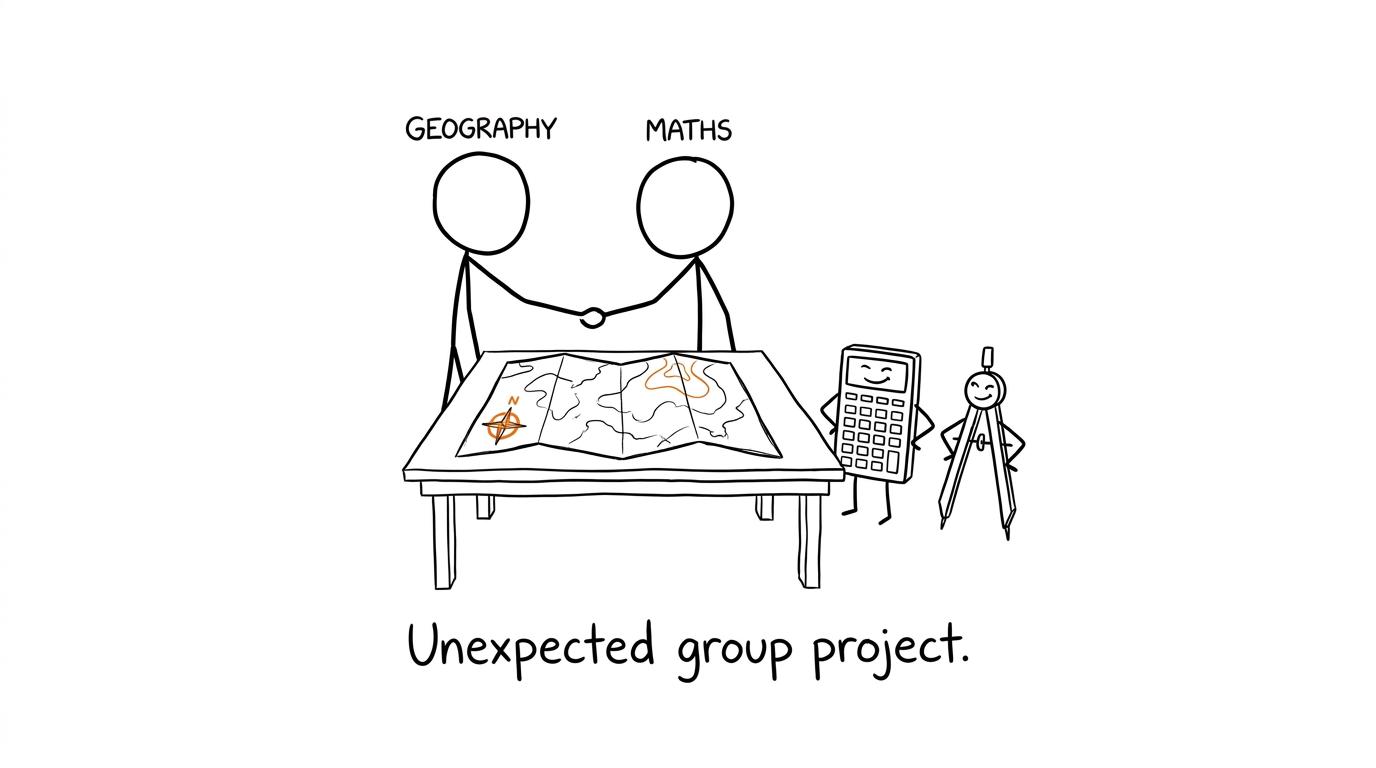 Geography and Maths students discovering their unexpected group project
The overlap has limits. Being strong at maths does not remove the need to explain geographical processes. Equally, being good at essays does not excuse inaccurate calculations or poorly labelled graphs. Geography rewards the combination.
Common mistakes when deciding whether to take Geography
Choosing it because friends are taking it
Friends can make lessons enjoyable, but timetables and classes may change. Choose the subject itself, not the expected seating plan.
Assuming it is only maps and capital cities
Locational knowledge matters, but modern GCSE Geography also includes processes, issues, data, fieldwork and evaluation. Look at your board's actual topics before deciding.
Believing it is an easy option
Geography is accessible, but it is not effortless. The breadth of content and longer answers require regular revision. Treating it as a subject that can be “picked up later” often creates avoidable pressure.
Rejecting it because of one weak topic
Disliking coasts or urban change does not mean you will dislike the whole course. Look at the complete specification and consider the balance of physical geography, human geography and skills.
Ignoring your overall subject combination
Think about your full workload. A broad combination can be valuable, but only if you are willing to revise each subject consistently. Your teachers can help you compare courses, assessment styles and sixth-form requirements.
So, is GCSE Geography worth it?
GCSE Geography is worth taking when its blend of real-world issues, data, fieldwork and explanation interests you enough to justify the workload. It can build versatile skills and support future study without forcing you into one career. Its main costs are the volume of content, case-study recall and the need to write precise, evidence-based answers.
Before deciding, read your school's topic list, ask how fieldwork is organised and look at a recent paper from the relevant exam board. Notice whether the questions make you curious. Curiosity does not make revision effortless, but it makes sustained effort far more likely.
Whatever options you choose, keep your maths preparation deliberate. Use MathsGenie's free revision lessons and practice questions to repair individual skills, then test them with GCSE Maths past papers, mark schemes and video solutions. Nearer the exams, add GCSE Maths predicted papers and mini tests. A good subject choice gives you a direction. A good revision system helps you make something of it.