Is GCSE Further Maths Harder Than Before?
GCSE further maths harder than before? See what changed, what only feels tougher, and how to revise AQA Level 2 Further Maths confidently for exams.
Some papers feel difficult because you are underprepared. Others feel difficult because they are designed to stretch you. Further Maths often does both at once.
So, is GCSE further maths harder than before? The most accurate answer is: the current AQA Level 2 Certificate is slightly broader and its papers are structured differently from the legacy qualification, but there is no convincing evidence that it becomes steadily harder every year. Much of the increased difficulty students feel comes from the jump beyond ordinary Higher GCSE Maths, the depth of algebra required and the pressure of preparing for an additional qualification.
It is also worth clarifying the name. Students commonly call the course “GCSE Further Maths”, but AQA officially describes it as the Level 2 Certificate in Further Mathematics. This article focuses mainly on the current AQA specification, code 836583658365, because qualifications such as OCR Additional Maths and other Level 2 or Level 3 courses are not directly interchangeable.
The short answer: what has actually changed?
Here is the evidence-led summary.
- AQA redeveloped its Further Mathematics qualification after GCSE reform.
- The current specification was first examined in 202020202020.
- AQA says the content changes from the legacy specification were relatively small.
- Some content was added or extended to create greater coherence, variation and depth.
- The current course has two equally weighted papers, rather than the uneven weighting used by the older specification.
- The qualification remains deliberately demanding because it is intended for students working towards grades 777, 888 or 999 in GCSE Mathematics.
- A higher grade boundary in one year does not prove that the examination was harder or easier.
The fairest conclusion is that Further Maths has changed, but not beyond recognition. It may be somewhat broader than its predecessor. It has not simply transformed into an A Level paper wearing a GCSE badge.
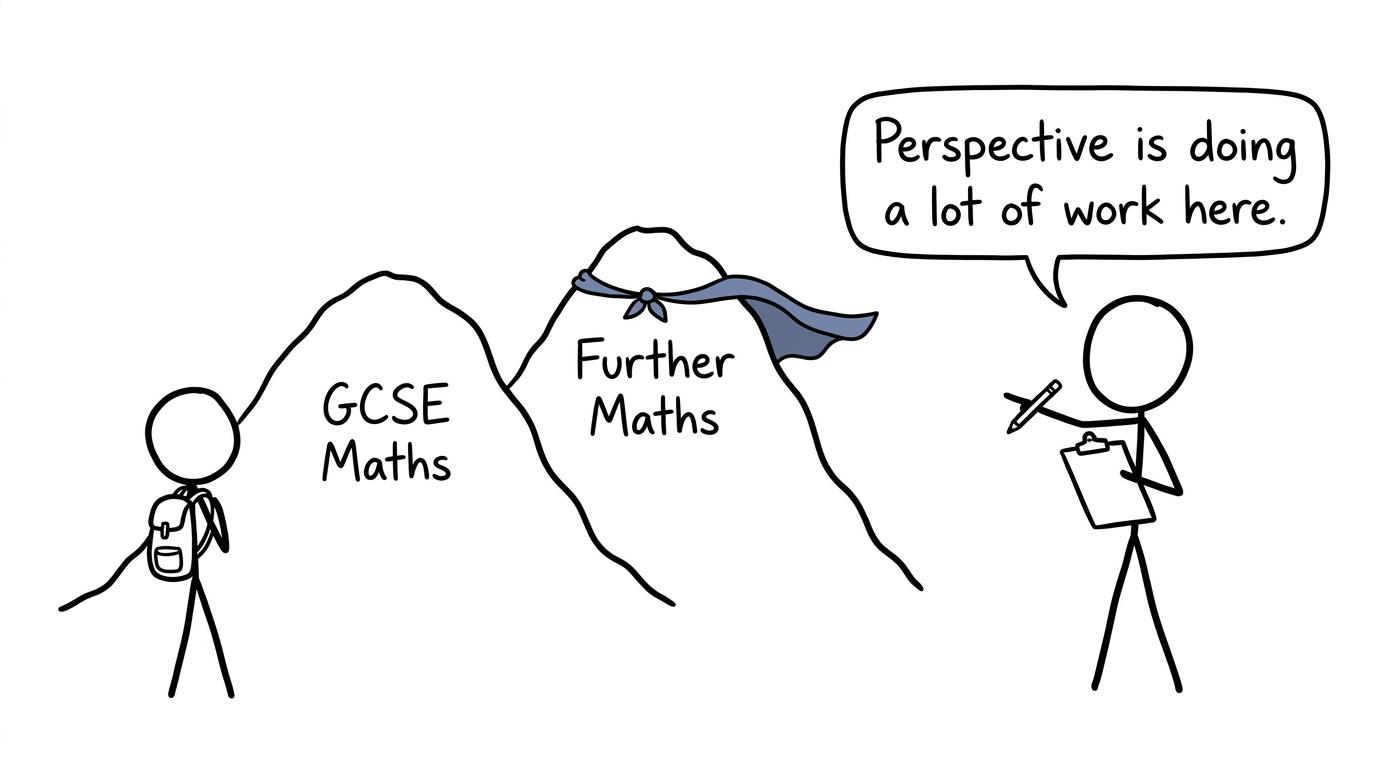 A student comparing the apparently dramatic hills of GCSE Maths and Further Maths
Why today’s Further Maths may genuinely be harder
The current specification allows more depth
AQA states that the changes from its legacy specification were relatively small, while also noting extensions that allow greater variation and depth in questions. Following GCSE reform, it added some content from the reformed GCSE and made smaller additions for coherence and completeness.
That distinction matters. A syllabus does not have to contain dozens of new topics to become more demanding. A modest extension can allow examiners to connect familiar ideas in less predictable ways. The individual algebraic techniques may be recognisable, yet a question can require several of them in one argument.
The course covers six broad areas:
- number;
- algebra;
- coordinate geometry in two dimensions;
- calculus;
- matrix transformations;
- geometry.
Calculus and matrices are usually new to GCSE students. Other areas, including functions, graphs, trigonometry and algebraic reasoning, extend ideas encountered in Higher GCSE Maths. You can compare that foundation with the GCSE Maths topics by exam board and tier.
The assessment structure changed
The current AQA qualification has two papers:
| Paper | Conditions | Time | Marks | Weighting |
|---|---|---|---|---|
| Paper 111 | Non-calculator | 111 hour 454545 minutes | 808080 | 50%50\%50% |
| Paper 222 | Calculator | 111 hour 454545 minutes | 808080 | 50%50\%50% |
Both papers can assess content from anywhere in the specification, and both include question styles ranging from short tasks to multi-step problems. AQA says the mathematical demand increases as students progress through each paper.
The legacy AQA specification used a 707070-mark non-calculator paper worth 40%40\%40% and a 105105105-mark calculator paper worth 60%60\%60%. The current arrangement is more balanced, but Paper 111 now carries half of the qualification. For someone whose algebraic fluency depends heavily on a calculator, that can make the modern course feel less forgiving.
You can become familiar with this structure using the AQA GCSE Further Maths past papers, complete with mark schemes and solutions where available.
Why it can feel harder even when the standard has not risen
You are comparing it with the wrong course
Ordinary GCSE Mathematics is available at Foundation and Higher tier. AQA Level 2 Further Mathematics is untiered: everyone sits the same papers. It is specifically designed to stretch students who already have, or are expected to achieve, the highest GCSE Maths grades.
That means its difficulty is intentional rather than accidental. If Higher GCSE Maths is becoming comfortable, Further Maths is supposed to restore some uncertainty. New notation, longer algebra and unfamiliar ideas such as differentiation can make a capable student feel briefly like a beginner again.
The AQA GCSE Maths revision hub is useful here. If factorising, rearranging, surds, quadratics and coordinate geometry are not secure, Further Maths amplifies those gaps rather than hiding them.
Hard questions are more memorable than routine ones
Students rarely leave an exam discussing the seven questions that went normally. They discuss the one question that appeared impossible.
Online reactions intensify this effect. A particularly unusual final question can circulate widely, creating the impression that an entire examination series was unprecedented. Yet the paper must be judged as a whole, not by its most dramatic few minutes.
The same bias affects past-paper practice. Older questions often seem easier after you have seen their methods in lessons. A new paper feels harder partly because it is genuinely unseen. Familiarity can disguise past difficulty.
The additional workload creates its own difficulty
Further Maths is normally taken alongside GCSE Mathematics, not instead of it. Students are therefore managing another specification while revising their other GCSE subjects.
Difficulty is not only about the hardest equation on the page. It is also about how much fluent knowledge must be available under timed conditions. A technique understood in class may still feel inaccessible if it has not been revisited for several weeks.
A structured rhythm matters more than heroic cramming. The GCSE one-month maths revision plan shows how to combine focused practice, retrieval and timed papers without turning every evening into a full mock exam.
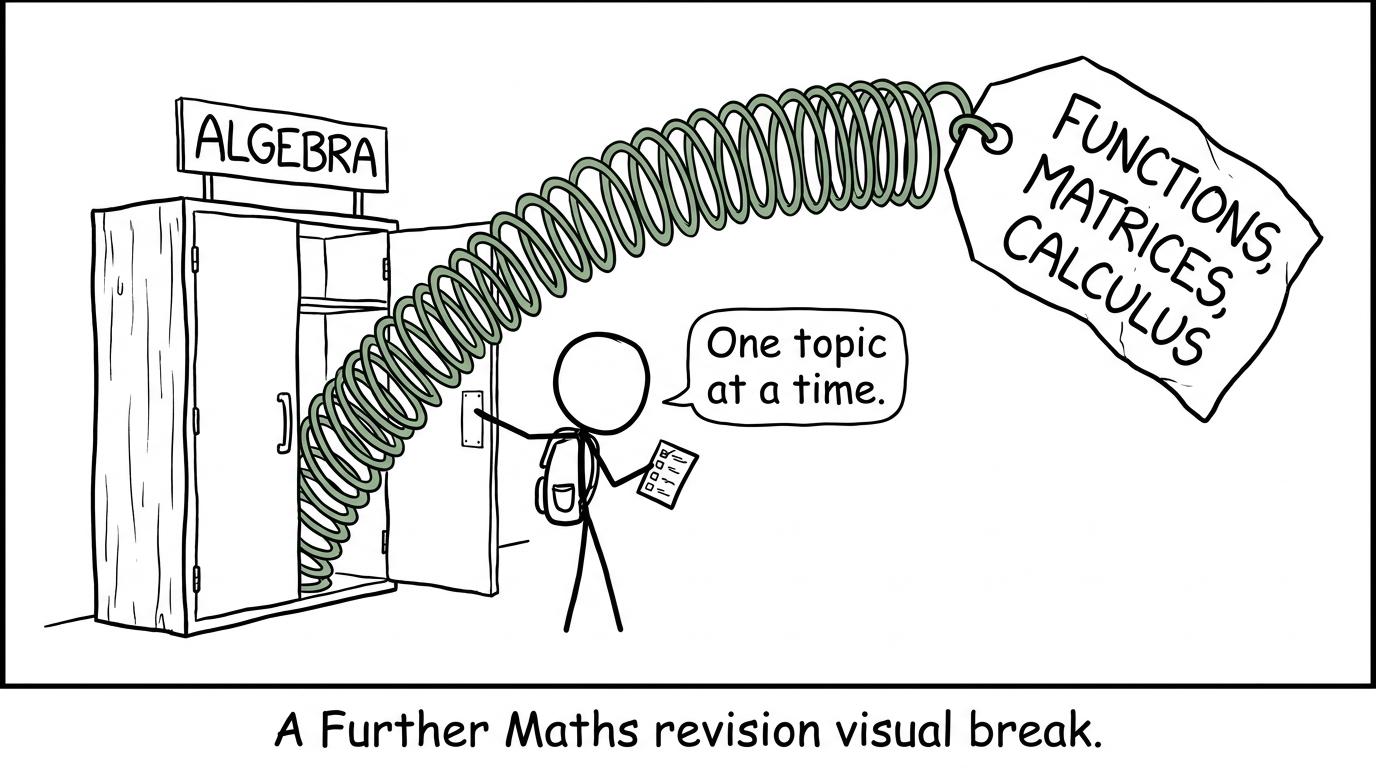 An algebra cupboard releases a spring of new Further Maths topics
Do rising grade boundaries prove the exam is easier?
No. Grade boundaries describe the marks needed for grades in a particular series; they do not provide a simple difficulty scale across years.
For AQA specification 836583658365, the overall grade 999 boundary was 136136136 out of 160160160 in June 202420242024. It was 141141141 out of 160160160 in June 202520252025. That increase does not show that students suddenly became better or that the course was made easier. Boundaries can reflect the demand of the papers and the awarding process for that series.
Nor would a lower boundary automatically prove that the syllabus had become harder. Entry patterns, paper demand and grading judgements all need careful consideration. Raw boundaries are useful when interpreting one result, but weak evidence for sweeping claims about long-term standards.
The more useful question is personal: which topics repeatedly cost you marks? Use the AQA Further Maths revision area to connect those losses to lessons, questions and papers.
How to make Further Maths feel manageable
Secure the GCSE algebra underneath it
Further Maths rewards students who can manipulate expressions without using all their attention on each small step. Prioritise:
- expanding and factorising;
- rearranging formulae;
- solving quadratics and simultaneous equations;
- indices and surds;
- straight-line and quadratic graphs;
- exact trigonometric values;
- algebraic proof.
The aim is not speed for its own sake. Fluency frees working memory for the unfamiliar part of a question.
Revise in layers
A calm revision cycle has four stages:
- learn or revisit one idea through a revision lesson;
- complete focused practice questions;
- check every line against the mark scheme or video solution;
- test the idea later inside a mixed, timed paper.
Topic practice builds technique. Past papers build selection, stamina and timing. Neither replaces the other. If you are unsure when to switch between them, use the guide to starting GCSE past papers at the right time.
Treat errors as data
After marking a paper, label each lost mark:
- knowledge: the fact or method was missing;
- selection: you knew several methods but chose the wrong one;
- execution: a sign, bracket or arithmetic error broke a valid method;
- communication: the reasoning was not shown clearly;
- timing: you did not reach or finish the question.
Then choose the next revision task from the label. “Revise algebra” is vague. “Practise factorising cubic expressions and check signs” is actionable.
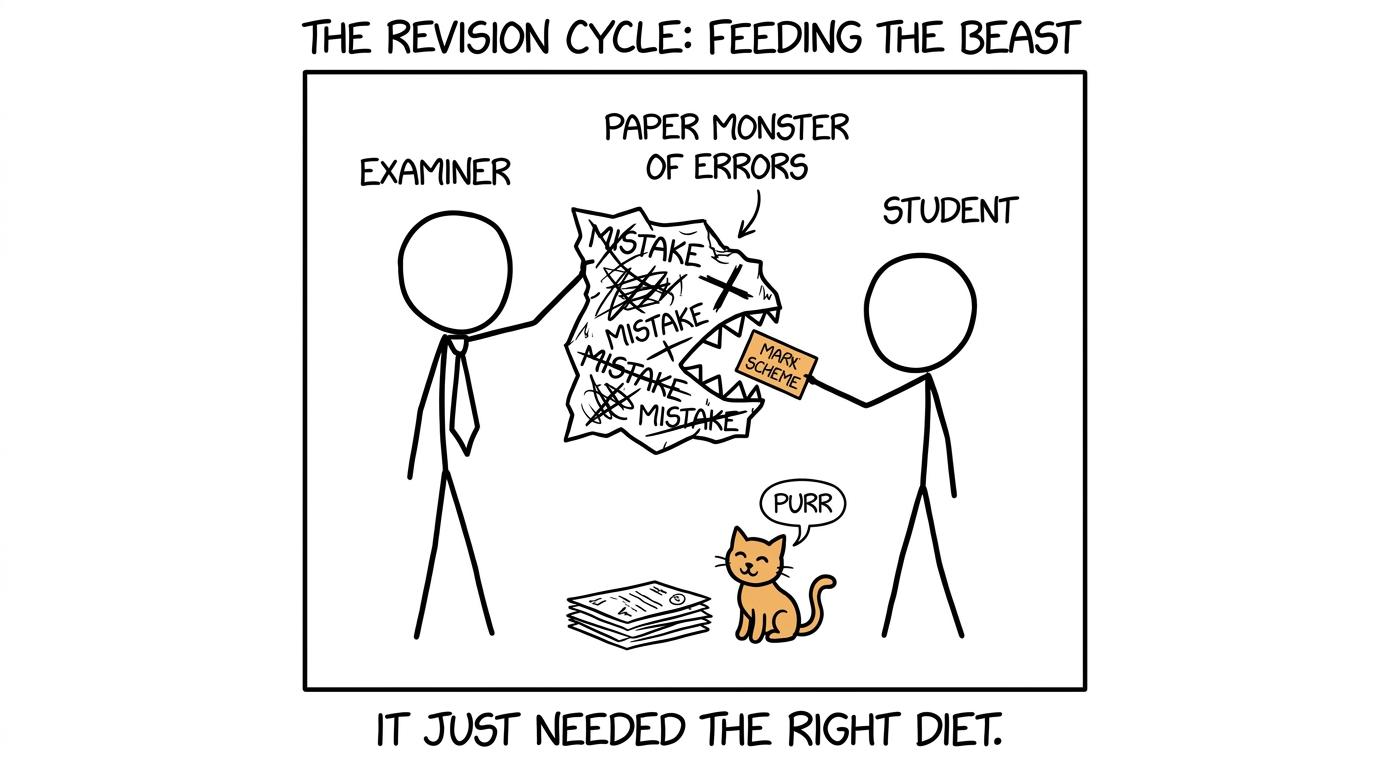 A mark scheme turns an intimidating paper monster into a harmless kitten
Common mistakes when judging or revising Further Maths
Assuming every advanced qualification is the same
AQA Level 2 Further Mathematics, OCR FSMQ Additional Mathematics and Edexcel International GCSE Further Pure Mathematics have different levels, specifications and assessment structures. Check the qualification title and code supplied by your school before downloading papers.
Revising only the newest topics
Calculus and matrices attract attention because they look advanced. However, many difficult questions depend on established algebra, graphs, geometry and trigonometry. New content cannot compensate for weak foundations.
Reading solutions instead of producing solutions
A method can look obvious once it is on the screen. That feeling is recognition, not necessarily recall. Close the solution and reproduce the argument independently.
Treating one difficult paper as a verdict
One score can be distorted by tiredness, unfamiliar wording or a cluster of weak topics. Use several papers and track patterns. MathsGenie’s GCSE predicted papers can provide fresh exam-style practice, but they should supplement official past papers rather than replace them.
Ignoring the bridge to A Level
Further Maths is designed to prepare strong students for greater mathematical rigour at Level 333. Its value is not limited to the certificate. The habits it develops, sustained algebra, clear reasoning and comfort with unfamiliar problems, support A Level Mathematics and, potentially, Further Mathematics. If that is your next step, you can explore the AQA AS Level Further Maths revision resources.
The verdict: harder, or simply different?
Current AQA Further Maths is somewhat broader than the legacy course, and its balanced paper structure gives the non-calculator assessment greater weight. Those are real changes. AQA also explicitly allows greater variation and depth in modern questions.
But the claim that GCSE Further Maths becomes harder every year goes beyond the evidence. Changing grade boundaries, memorable final questions and online reactions cannot establish a steady rise in difficulty. Often, the course feels harder because it is an untiered extension qualification being taken alongside a crowded GCSE timetable.
That should be reassuring. You cannot control the questions selected for this year’s papers, but you can control how familiar the specification becomes.
Start with the free AQA GCSE Further Maths revision hub. Use revision lessons to repair understanding, practice questions and mini tests to build fluency, then complete past papers under timed conditions. Mark them carefully, use video solutions to investigate difficult methods and add predicted papers when you need fresh practice.
A hard course becomes manageable in the same way most hard things do, not all at once, but through fewer unknowns each week.