

Is GCSE English Literature Harder Than Before?
GCSE English Literature harder than before? Learn what changed, what only feels harder, and how maths students can revise both subjects calmly and effectively.
There is a particular kind of panic that arrives when you realise English Literature is asking you to remember quotations, analyse unfamiliar poetry and write several developed essays, while your maths mock is also approaching.
So, is GCSE English Literature harder than before? Compared with the qualifications taken before the reforms first examined in England in 2017, the honest answer is yes in several important ways. The reformed GCSE was deliberately designed to be more demanding, with more challenging texts, closed-book examinations and compulsory unseen material.
But that does not mean it has become progressively harder every year, or that gaining a particular grade is automatically less achievable. Grade boundaries are set after papers have been marked to account for differences in difficulty. The course is demanding; the grading system is intended to keep standards comparable.
For maths students, this distinction matters. You do not need to treat English Literature as an unpredictable threat. You need to understand what makes it demanding, then build a revision plan that leaves enough time for both subjects.
The short answer: what changed?
The current GCSE English Literature qualification in England was first taught from 2015 and first examined in 2017. Its main features include:
- a linear course, with assessment at the end of the qualification;
- closed-book examinations;
- study of complete, substantial texts;
- compulsory Shakespeare and a nineteenth-century novel;
- poetry published since 1789, including Romantic poetry;
- modern fiction or drama from the British Isles;
- unseen literature in the examination;
- greater emphasis on analysis, comparison and a sustained personal response;
- grades 9 to 1 rather than the previous A* to G scale.
English Literature is also untiered. Unlike GCSE maths, there is no separate foundation or higher paper. Students across the grade range take the same qualification, although the exact paper structure and chosen texts depend on the exam board and school.
AQA, Pearson Edexcel, OCR and Eduqas arrange their papers differently, so students should always use their own specification and teacher guidance. However, qualifications offered in England must meet the national subject-content and assessment requirements.
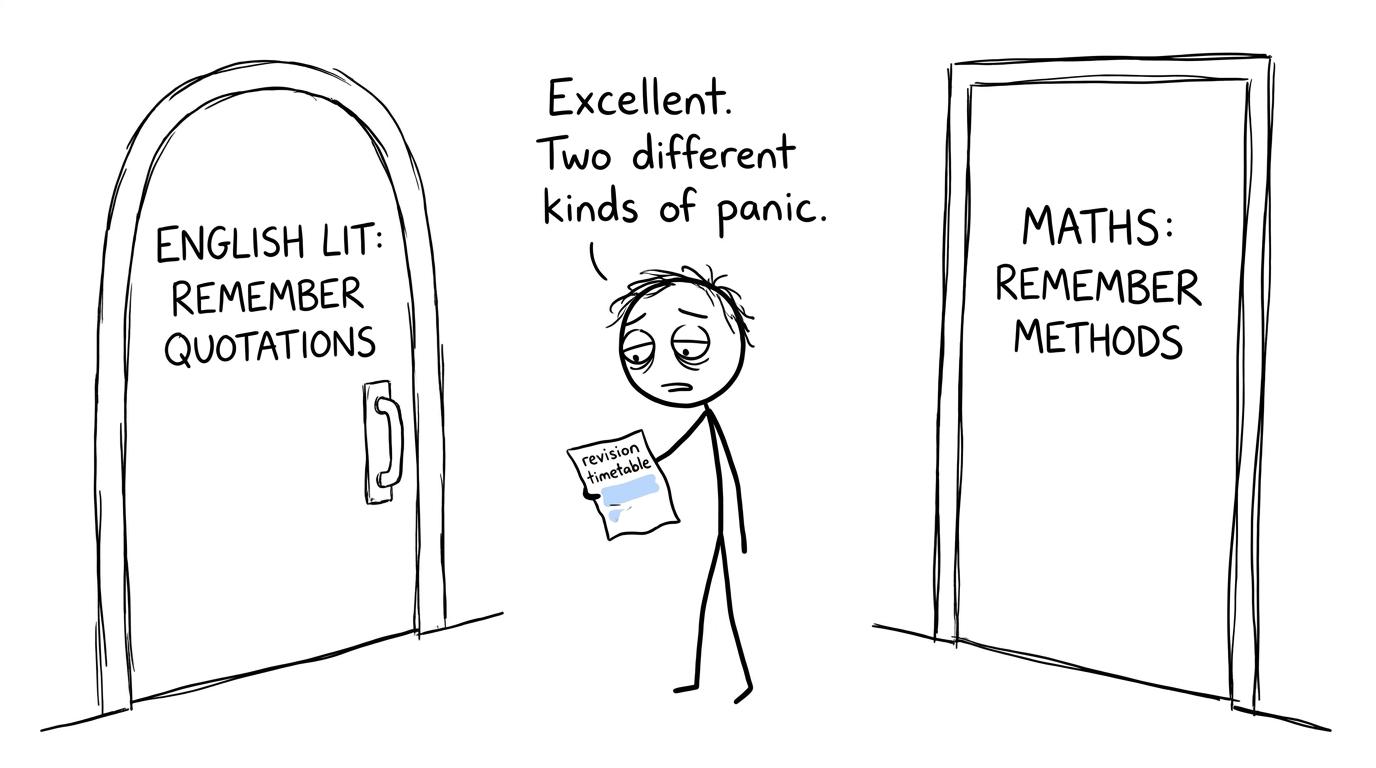 A GCSE student choosing between quotation memory and maths methods
Why GCSE English Literature genuinely became harder
The texts are intended to be challenging
The Department for Education requires students to study a range of high-quality, intellectually challenging and substantial whole texts. This is not simply a larger reading list. Students must understand plot, character and theme while also analysing language, form, structure and context.
A Shakespeare play and a nineteenth-century novel can create difficulties that modern classroom texts do not. Vocabulary may be unfamiliar, sentence structures can be complex and historical assumptions are not always immediately obvious. Poetry adds another layer because meaning is often compressed into a small number of carefully chosen words.
The challenge is breadth and depth at the same time. You must know several works broadly enough to answer an unpredictable question, yet understand key moments deeply enough to analyse them precisely.
Closed-book examinations increase the memory demand
Legacy English Literature examinations were commonly open book. Under the reformed qualification, examinations are closed book, although exam boards provide extracts or stimulus material where their paper design requires it.
That does not mean students are expected to memorise every line. Examiners reward relevant textual references, including quotations, rather than a performance of photographic memory. Nevertheless, a student must enter the examination with secure knowledge of characters, themes, events and a flexible bank of short quotations.
This is one reason the subject can feel harder than maths. In maths, remembering a method is useful because it can often be applied repeatedly. In Literature, a quotation must be recalled, connected to the question and then interpreted convincingly. The memory is only the starting point.
Unseen material prevents complete prediction
Compulsory unseen literature tests whether students can transfer their analytical skills to writing they have not previously studied. This is demanding because revision cannot tell you exactly which poem or extract will appear.
Yet unseen does not mean unpreparable. Students can practise identifying tone, imagery, contrast, structure and shifts in viewpoint. The text changes; the reading process remains recognisable.
This is similar to mathematical problem-solving. You cannot memorise every possible question, but you can become fluent in the underlying decisions. Maths students already understand this more than they may realise.
Everything depends on the final examinations
A linear qualification concentrates assessment at the end of the course. One difficult afternoon can therefore feel as though it carries the weight of two years.
The psychological burden matters. Students are not just recalling content; they are choosing evidence, organising an argument and writing accurately under time pressure. That combination makes the examination feel dense, even when each individual skill has been practised.
Why it may feel harder without becoming harder every year
There are two different questions hiding inside the word “harder”.
The first is whether the reformed course is more demanding than the qualification it replaced. Official reform documents indicate that it was designed to be more stretching. On content and assessment conditions, the answer is broadly yes.
The second is whether it is harder to gain the same grade this year than last year. That does not follow automatically.
Exam boards do not decide grade boundaries before seeing how students perform. Boundaries can move because one paper is more accessible or more demanding than another. A higher raw boundary does not necessarily prove that standards became tougher, just as a lower boundary does not mean the qualification became easier.
The 9 to 1 scale also creates misleading comparisons with older relatives or siblings. The current numbers do not map perfectly onto every old letter grade. Official comparisons identify reference points, for example, the lower edge of grade 7 is comparable with the lower edge of the former grade A, while grade 4 aligns with the former grade C reference point. Grade 9 also provides greater distinction at the top of the scale.
The fairest conclusion is this: the reform raised the academic and examination demands, but annual awarding is designed so that paper difficulty does not arbitrarily determine your grade.
Has it continued getting harder since 2017?
There is no sound basis for saying that GCSE English Literature has simply become harder every year since the first reformed examinations.
Paper questions, set texts and raw grade boundaries can vary. The pandemic also caused temporary changes to assessment and grading, which makes simple year-by-year comparisons unreliable. A boundary from an unusual examination series should not be treated as a prediction for your own paper.
If you want to understand how raw thresholds have moved, MathsGenie’s analysis of GCSE English Literature grade boundary history explains why movements need context. Historical boundaries describe previous papers; they do not reveal the boundary for an examination that has not yet been marked.
Students often experience a different kind of increase in difficulty: the course feels manageable in Year 10, then suddenly several texts, poetry comparisons and timed essays converge in Year 11. The specification has not changed overnight. The number of unfinished revision decisions has.
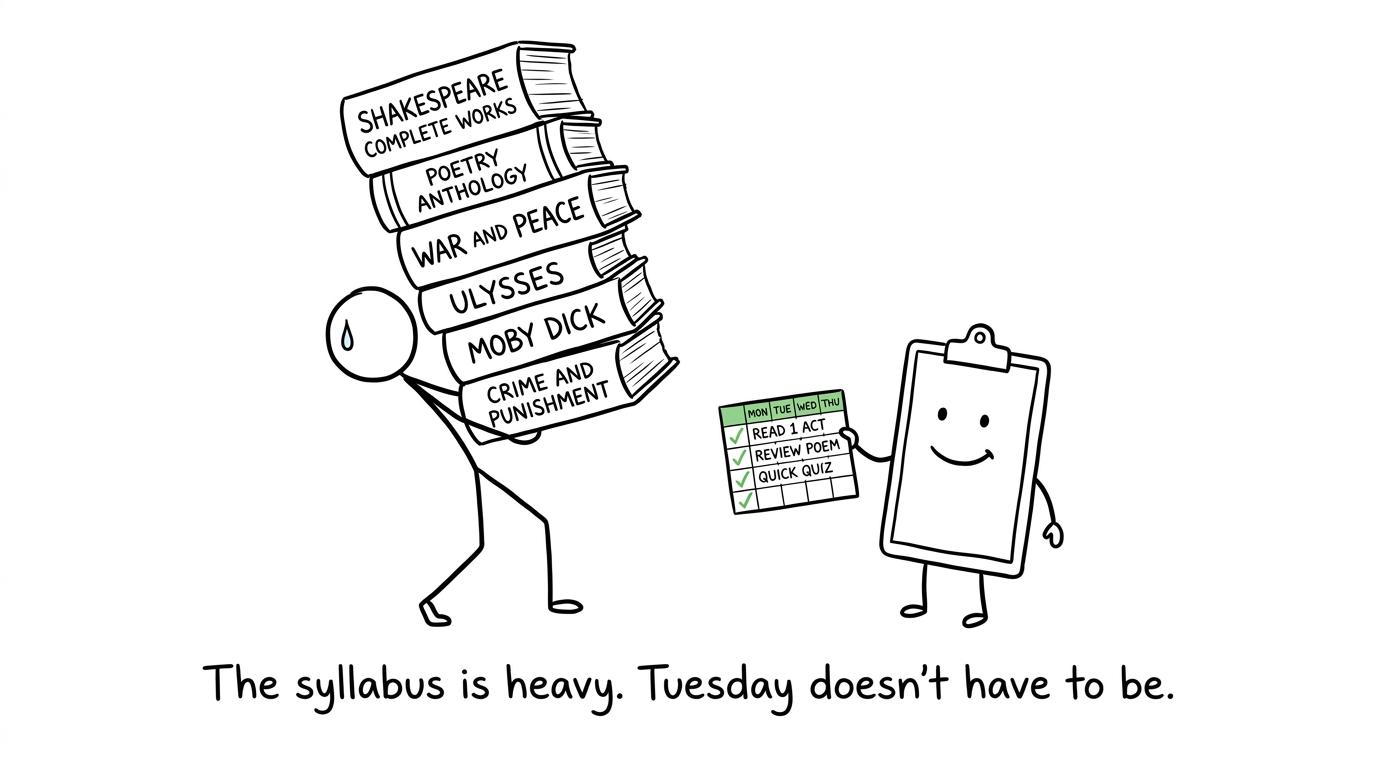 A student carrying a huge Literature syllabus beside a small daily planner
How maths students can balance Literature and maths revision
You do not need identical revision methods for two very different subjects. You need a shared structure.
Separate recall from application
For Literature, recall might mean retrieving quotations, themes or relationships without looking at notes. Application means using that knowledge to plan or write an answer to a particular question.
For maths, recall includes formulae, facts and method steps. Application comes through solving unfamiliar exam questions. The MathsGenie GCSE maths revision hub brings revision lessons, practice questions, papers and solutions together so that you can move quickly from understanding to independent practice.
In both subjects, rereading can create an illusion of fluency. Close the book. Attempt the task. Then check.
Use short, clearly defined sessions
“The evening is for English and maths” is not a plan. It is a hope.
A better session has a visible finish line:
- retrieve quotations connected to one Literature theme;
- plan one response without writing the full essay;
- complete one maths revision lesson and its practice questions;
- sit one short maths test and correct every lost mark.
If the whole examination season feels crowded, use a realistic GCSE maths revision timetable or adapt the one-month GCSE revision plan. The valuable principle is not the exact number of minutes. It is deciding in advance what each session must produce.
Make practice increasingly exam-like
Early revision should rebuild knowledge. Later revision should test whether that knowledge survives time pressure.
For maths, Edexcel GCSE Maths mini tests provide a shorter bridge between topic practice and full papers. Students following other boards can choose appropriate resources through the main GCSE hub.
Once individual skills are secure, move to complete papers. The Edexcel GCSE Maths past papers include mark schemes and worked solutions where available. Nearer the examination, GCSE predicted papers can add fresh practice, but they should be used as diagnostics rather than promises about what will appear.
Use the same progression in Literature: knowledge retrieval, untimed planning, timed paragraphs and finally complete responses.
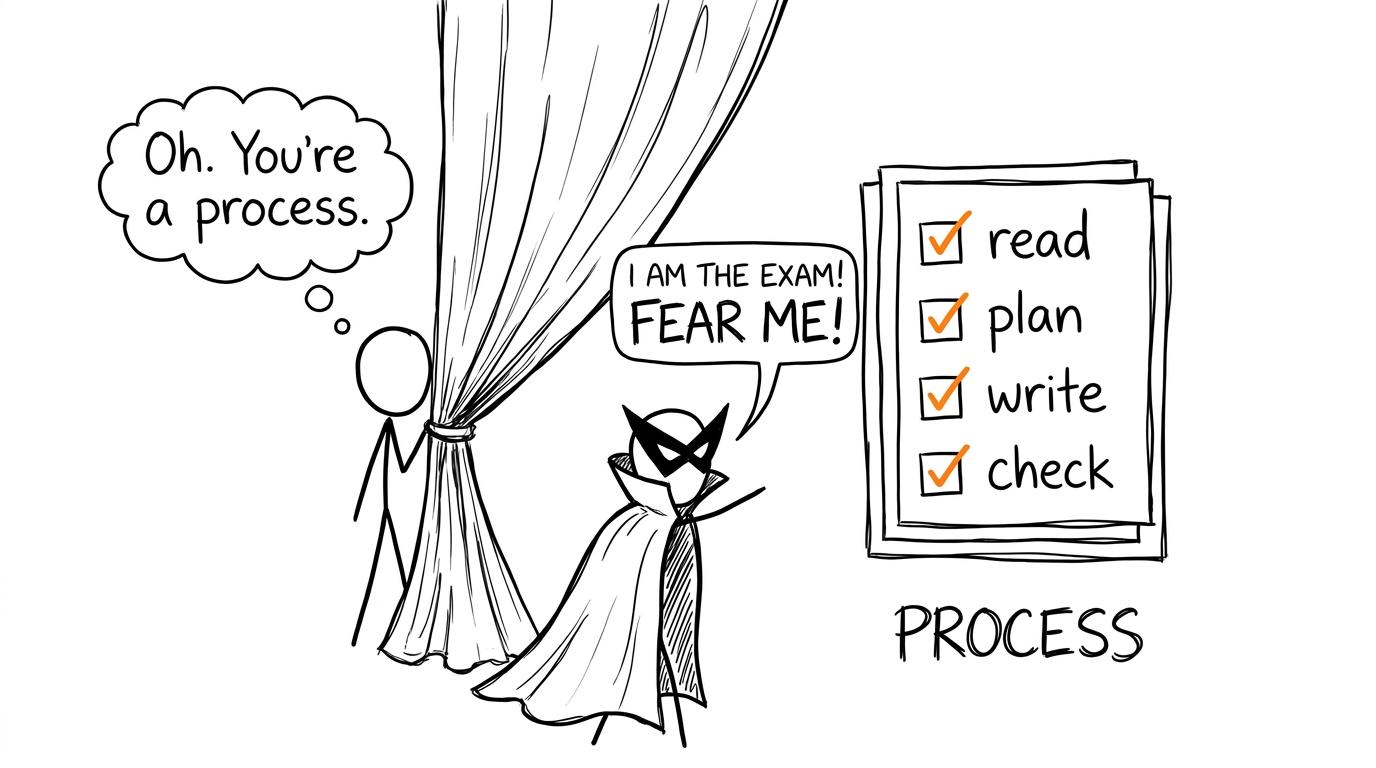 An intimidating exam paper revealed as a simple revision process
Common mistakes when judging GCSE difficulty
Comparing one question with an entire old qualification
An unusually difficult poem or essay title does not prove that the whole GCSE has become harder. Difficulty should be judged across the specification, assessment structure and grading process.
Treating grade boundaries as fixed targets
Boundaries change after performance has been reviewed. Revising towards a rumoured raw mark can encourage false confidence or unnecessary panic. Concentrate on improving the quality of your responses.
Memorising quotations without learning how to use them
A large quotation bank is not automatically useful. A smaller set of flexible, well-understood references is often easier to connect to character, theme, language and context.
Giving Literature all your time because it feels less predictable
Uncertainty attracts attention. That can leave maths revision until the final weeks, when methods have become rusty. Follow the guidance on when to start GCSE past papers and keep maths active through regular, manageable practice.
Assuming all exam boards use identical papers
The national assessment objectives are shared, but paper timings, sections, text choices and question formats vary across AQA, Edexcel, OCR and Eduqas. Check your specification rather than borrowing a revision strategy designed around another board.
The difficulty is real, but it can be organised
GCSE English Literature is more demanding in important respects than the qualifications it replaced. The content was designed to be more stretching, the examinations are closed book and students must respond to unseen material. It is reasonable for the course to feel difficult.
What is less reasonable is the belief that difficulty makes preparation pointless. The exam still rewards identifiable skills: secure knowledge, relevant evidence, thoughtful interpretation, analysis and clear writing.
Your maths revision works in much the same way. Difficult questions become less mysterious when lessons, deliberate practice and honest marking reveal the process underneath. Use MathsGenie to choose the right GCSE topics for your exam board and tier, then combine free revision lessons with practice questions, mini tests, past papers, predicted papers, mark schemes and video solutions.
You cannot make two GCSEs small. But you can make today’s task small enough to begin.










