GCSE English Literature Grade Boundaries History
GCSE English Literature grade boundaries history explained with Edexcel trends from 2017 to 2025, pandemic context and practical revision advice.
A grade boundary can feel like the final twist in a story you have spent two years reading. You finish the papers, remember every uncertain paragraph, then wait to discover how many marks produced each grade. Yet GCSE English Literature grade boundaries history offers reassurance as well as context: boundaries move because papers and student performance vary, not because exam boards casually make a grade harder to achieve.
The short answer is that Edexcel boundaries fell after the first reformed examination in 2017, remained fairly stable before the pandemic, and have risen gradually from 2023 to 2025. That trend does not predict your boundary. It simply records what happened in earlier examination series.
What to know before comparing boundaries
- A grade boundary is the minimum mark required for a grade.
- Boundaries are set after papers have been sat and marking is nearly complete.
- A higher boundary can indicate that students found a paper more accessible.
- English Literature is untiered, unlike foundation and higher tier GCSE Maths.
- Specifications differ across AQA, Edexcel, OCR and Eduqas, so their raw marks should not be compared directly.
- There were no normal summer GCSE examinations in 2020 or 2021.
- The reduced Edexcel assessment in 2022 had a different maximum mark, so percentages provide the fairest comparison.
Before using any figures, confirm your board and specification. The GCSE English Literature revision hub provides separate routes for AQA, Edexcel, Eduqas, OCR and WJEC resources.
Past GCSE English Literature grade boundaries by year
The table tracks Pearson Edexcel GCSE English Literature specification 1ET01ET01ET0. It shows grades 999, 777 and 444, which provide useful reference points across the grade range. Figures have been checked against published Pearson boundaries, with the latest completed summer series being June 2025.
| Summer series | Maximum mark | Grade 999 | Grade 777 | Grade 444 | Commentary |
|---|---|---|---|---|---|
| 201720172017 | 160160160 | 140140140 (87.5%87.5\%87.5%) | 115115115 (71.9%71.9\%71.9%) | 696969 (43.1%43.1\%43.1%) | First award of the reformed specification; the grade 999 threshold was the highest in this period. |
| 201820182018 | 160160160 | 133133133 (83.1%83.1\%83.1%) | 109109109 (68.1%68.1\%68.1%) | 676767 (41.9%41.9\%41.9%) | Boundaries dropped noticeably from the first award. |
| 201920192019 | 160160160 | 132132132 (82.5%82.5\%82.5%) | 109109109 (68.1%68.1\%68.1%) | 696969 (43.1%43.1\%43.1%) | Broadly stable compared with 2018. |
| 202020202020 | Not applicable | Not applicable | Not applicable | Not applicable | Summer examinations were cancelled; no normal summer exam boundaries were produced. |
| 202120212021 | Not applicable | Not applicable | Not applicable | Not applicable | Summer examinations were again cancelled and grades were based on teacher assessment. |
| 202220222022 | 120120120 | 101101101 (84.2%84.2\%84.2%) | 838383 (69.2%69.2\%69.2%) | 515151 (42.5%42.5\%42.5%) | Transitional grading and a reduced assessment mean raw marks are not directly comparable with full 160160160-mark years. |
| 202320232023 | 160160160 | 132132132 (82.5%82.5\%82.5%) | 110110110 (68.8%68.8\%68.8%) | 676767 (41.9%41.9\%41.9%) | Full assessment returned, alongside grading broadly aligned with pre-pandemic standards. |
| 202420242024 | 160160160 | 133133133 (83.1%83.1\%83.1%) | 112112112 (70.0%70.0\%70.0%) | 707070 (43.8%43.8\%43.8%) | A modest rise across the selected grades. |
| 202520252025 | 160160160 | 135135135 (84.4%84.4\%84.4%) | 115115115 (71.9%71.9\%71.9%) | 737373 (45.6%45.6\%45.6%) | Boundaries rose again, but remained below the 2017 grade 999 threshold. |
You can explore every grade in the complete Edexcel GCSE English Literature grade boundaries table.
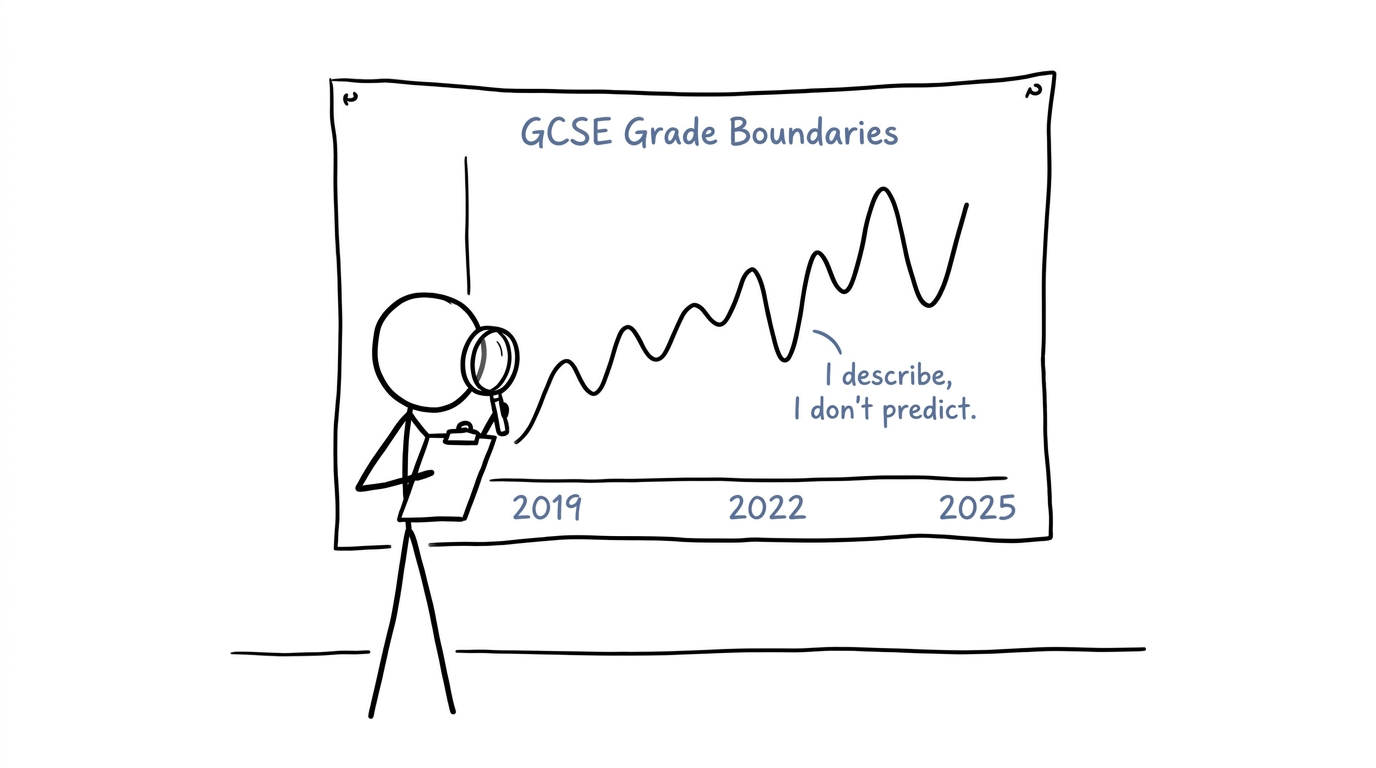 A student detective discovers that a historical grade-boundary chart cannot predict the future
What the GCSE English Literature grade boundary trends show
The first award was unusual
In 2017, grade 999 required 140140140 marks from 160160160, or 87.5%87.5\%87.5%. By 2018, that boundary had fallen by 777 marks to 133133133. New qualifications carry more uncertainty because teachers, students and examiners have less performance evidence from previous live series.
This is why one year should never become your universal target. A student using only the 2017 figures could form a much harsher expectation than a student looking only at 2019.
Pre-pandemic boundaries were relatively steady
From 2018 to 2019, the grade 777 boundary remained at 109109109, while grade 999 moved by just 111 mark. Grade 444 rose by 222 marks. Stability does not mean identical papers; it means the awarding process adjusted the boundaries so that standards remained comparable.
Pandemic years break the sequence
Summer examinations were cancelled in 2020 and 2021, so those years should not be inserted into a graph as ordinary exam boundaries. In 2022, examinations returned with transitional grading intended to be more generous than pre-pandemic grading. Edexcel English Literature was also assessed from 120120120 marks rather than the usual 160160160.
The percentage for a boundary is calculated using:
Boundary percentage=boundary markmaximum mark×100\text{Boundary percentage}=\frac{\text{boundary mark}}{\text{maximum mark}}\times 100Boundary percentage=maximum markboundary mark×100Using percentages makes 2022 easier to view, but it still does not make the assessment structure identical.
Recent boundaries have moved upwards
Between 2023 and 2025, Edexcel grade 999 rose from 132132132 to 135135135, grade 777 from 110110110 to 115115115, and grade 444 from 676767 to 737373. This is a genuine upward movement in the raw thresholds. It is not evidence that examiners decided to make English Literature progressively harder.
Ofqual explains that boundaries are decided after exam boards analyse student performance and senior examiners review work around potential thresholds. If a paper proves more accessible, boundaries may rise; if it proves more demanding, they may fall.
Why boards cannot be compared mark for mark
AQA, Edexcel, OCR and Eduqas use different papers, structures and total marks. A grade 777 boundary of 110110110 on one specification does not automatically represent a higher standard than a smaller raw mark on another.
Use resources built for your specification. Students following Pearson can begin with Edexcel GCSE English Literature revision, while AQA students should use the AQA English Literature revision hub. Eduqas students can consult the separate Eduqas English Literature grade boundaries.
How to use historical boundaries sensibly
Historical figures are useful for interpreting a completed past paper, but they are not a promise about your examination year. A stronger routine is:
- complete the correct paper under timed conditions;
- mark it using the published mark scheme;
- use that paper's own boundary only as a rough historical reference;
- identify whether lost marks came from knowledge, analysis, evidence, structure or timing;
- practise the weakness before attempting another response.
The AQA GCSE English Literature past papers and Eduqas GCSE English Literature past papers make it easier to match each question paper with its mark scheme. Build those attempts into the free MathsGenie revision planner rather than completing several papers without reviewing them.
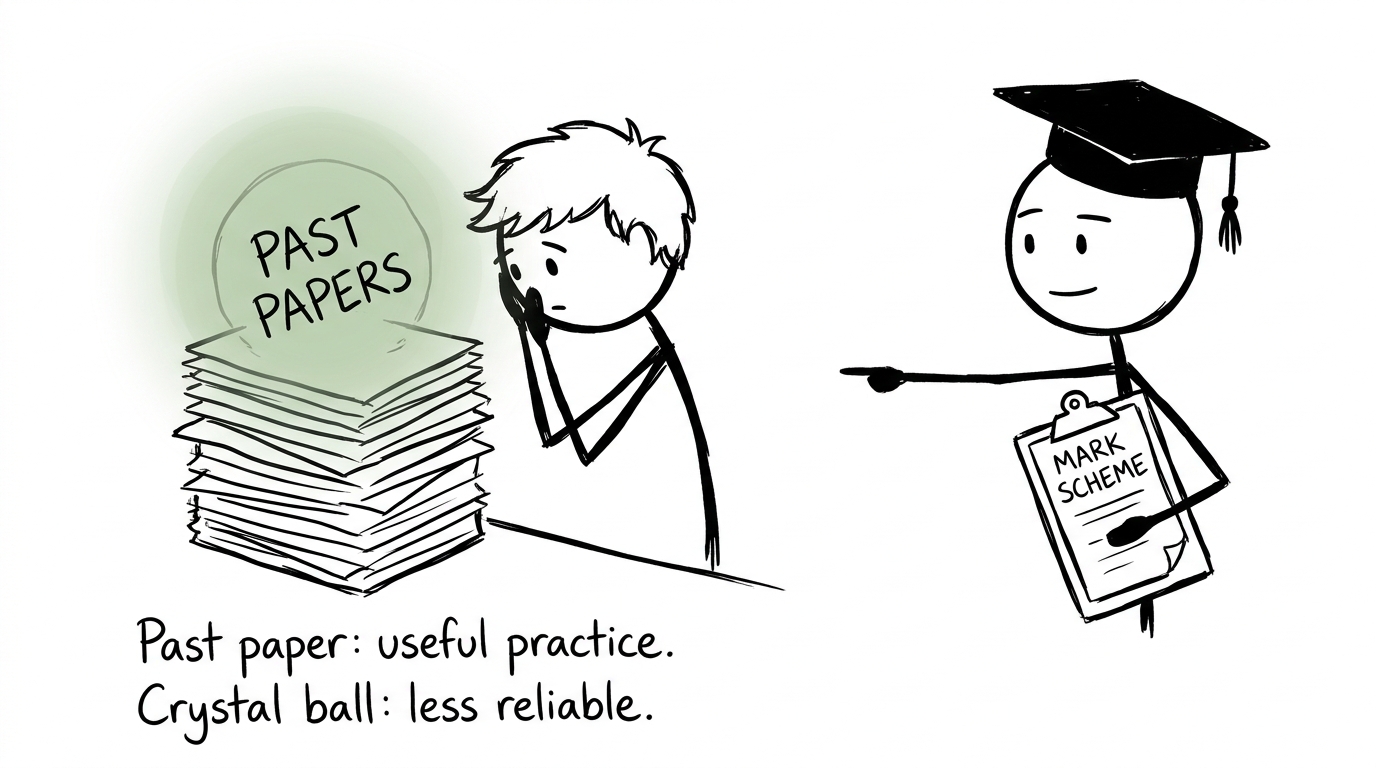 One student tries to use past papers as a crystal ball while another learns from the mark scheme
Common mistakes when reading grade-boundary history
Predicting this year's boundary from last year's figure. The new boundary cannot be confirmed before the papers have been sat and performance evidence has been reviewed.
Comparing raw marks with different totals. The 2022 Edexcel maximum was 120120120, while the standard full assessment totals 160160160 marks.
Treating a higher boundary as a harder grading standard. It may simply reflect a more accessible paper.
Mixing exam boards. Always match the boundary, paper and mark scheme to the same specification.
Revising towards the boundary. Aiming for the exact historical threshold leaves no protection against marking uncertainty, an unusually difficult question or a changed boundary.
Turn the history into better revision
Past GCSE English Literature grade boundaries describe the road behind you. They cannot tell you exactly where the next boundary will sit, but they can help teachers interpret mocks and help students set sensible ranges rather than obsessing over one mark.
The productive next step is evidence: attempt a real question, use the mark scheme and improve the weakest part of your response. Start with MathsGenie's GCSE English Literature past papers and revision resources, then use revision lessons, practice questions, mini tests and predicted papers where available. For maths alongside English, MathsGenie also brings together free past papers, mark schemes and video solutions: everything needed to turn uncertainty into a practical revision plan.