

Is GCSE Economics Hard? What Students Really Say
Is GCSE Economics hard? Get a straight, student-informed answer, discover the main challenges, and see how secure GCSE maths skills make revision easier.
The first few Economics lessons can feel deceptively comfortable. Scarcity makes sense. Supply and demand sound familiar. Then an exam question asks you to apply a concept to an unfamiliar market, analyse its consequences and reach a justified judgement.
So, is GCSE Economics hard? The straight answer is: it is challenging, but not usually because of advanced maths. Students discussing the subject commonly describe the content as understandable and relevant to real life. The difficulty comes from remembering precise terminology, interpreting data, applying ideas to context and writing balanced extended answers under time pressure.
That judgement is not a scientific survey. Online student discussions are self-selecting, and experiences differ by teacher, exam board and individual strengths. Yet the same themes recur often enough to be useful: GCSE Economics can look easy at first, but high marks require more than common sense.
GCSE Economics difficulty at a glance
Here is the short version:
- The mathematical demand is manageable. At least 10%10\%10% of the marks in regulated GCSE Economics assessments must reward quantitative skills at no lower than Key Stage 3 level.
- There is a substantial vocabulary. Accurate use of terms such as opportunity cost, inflation, productivity and market failure matters.
- Application separates recall from strong answers. You must use the information in the question rather than reproduce a memorised paragraph.
- Longer responses require analysis and evaluation. Explaining consequences and weighing competing arguments is harder than listing advantages.
- Graphs must be understood, not merely memorised. Labels, shifts and economic interpretation all matter.
- The subject becomes easier with regular retrieval and exam practice. Leaving the whole course until the final weeks makes its breadth feel much larger.
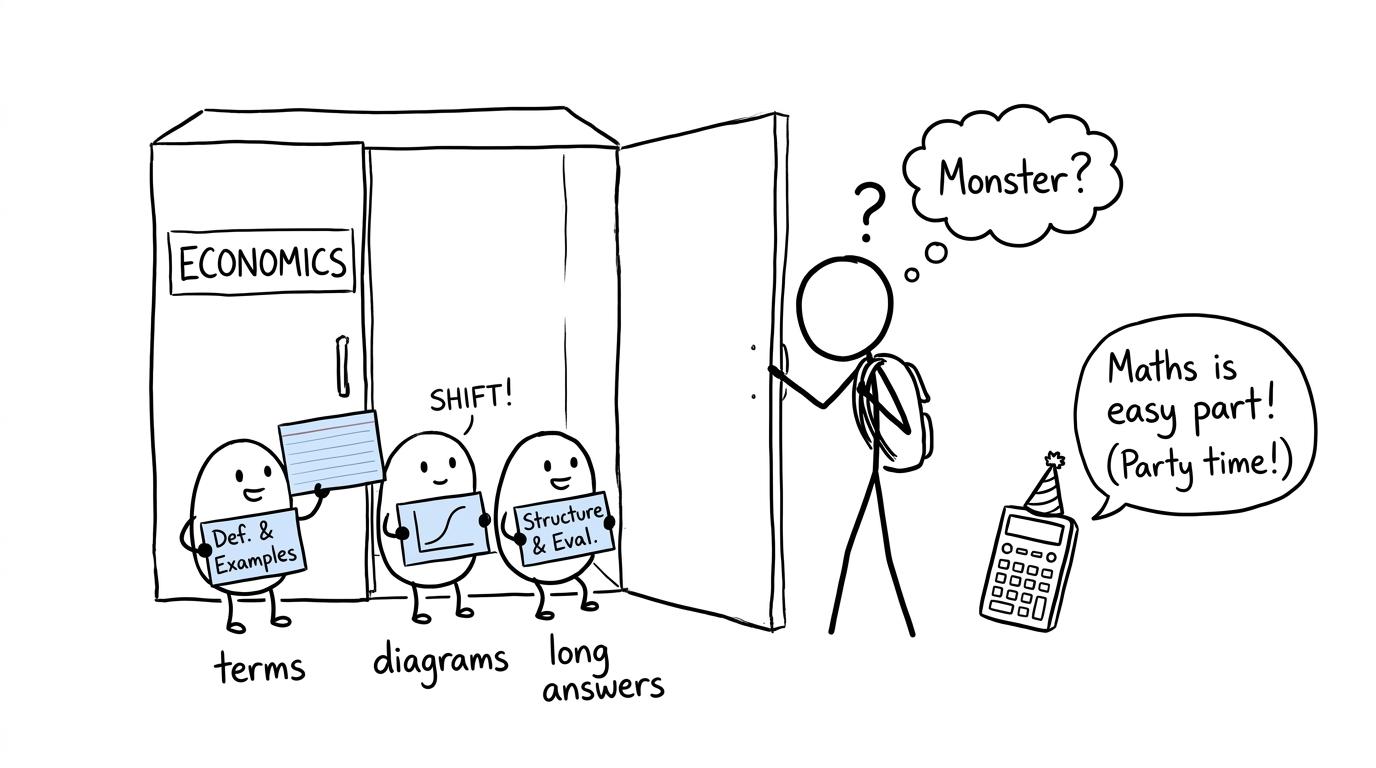 A student discovers that the GCSE Economics monsters are manageable revision tasks
What students tend to find difficult
Public student discussions do not produce one universal verdict. Some students find Economics logical and enjoyable; others are surprised by how much writing and precise application it involves. Their comments tend to cluster around several genuine challenges.
Knowing a definition is only the beginning
Economics contains ideas that sound familiar in everyday conversation but have narrower meanings in an exam. Demand, for example, is not simply wanting something. Economic growth is not the same as every household becoming better off.
This creates a particular trap: a student can understand the general topic without expressing it precisely enough for the mark scheme. Strong revision therefore connects each term to:
- an accurate definition;
- a relevant context;
- a likely consequence;
- a possible limitation or alternative outcome.
The subject rewards connected thinking. One change can affect consumers, firms, workers, government finances and the wider economy differently.
Extended answers are less predictable than calculations
A calculation normally has a destination. An evaluation question asks you to choose the route as well.
For GCSE Economics, the regulated assessment objectives give approximately 35%35\%35% to knowledge and understanding, 35%35\%35% to application, and 30%30\%30% to analysis and evaluation. That helps explain why simple recall is not enough for the highest grades. A polished definition may begin an answer, but it cannot complete the reasoning.
Students who find English or other essay subjects comfortable may adjust quickly. Students who prefer short, closed questions can still succeed, but they need to practise building chains of reasoning. A useful mental sequence is:
- make the economic point;
- explain why it happens;
- trace the consequence;
- apply it to the case;
- consider when the result might differ;
- make a supported judgement.
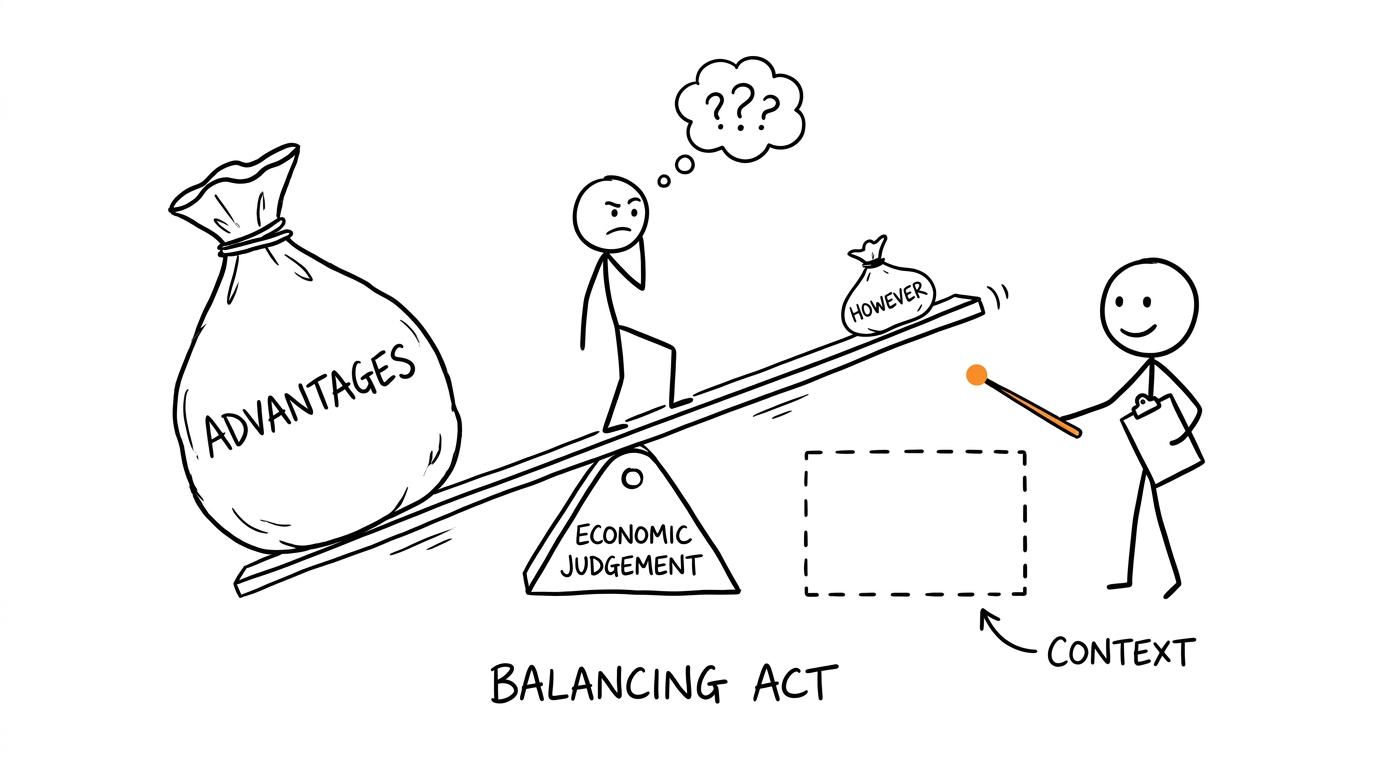 An unbalanced economic judgement waits for context and a proper counterargument
The course has breadth
Economics moves between individual markets and the performance of entire economies. Depending on the specification, students encounter areas such as resource allocation, price determination, costs and revenue, market failure, government objectives, economic policy and international trade.
AQA currently assesses its GCSE through two written papers, each worth half of the qualification. OCR also uses two equally weighted written components. Exact timings and question structures differ, so students should revise from the specification used by their school rather than assuming every board is identical.
It is also worth checking the qualification name carefully. AQA and OCR offer GCSE Economics in England, while Pearson Edexcel offers International GCSE Economics. Economics is not normally divided into foundation and higher tier in the way GCSE Maths is.
How hard is the maths in GCSE Economics?
For most students, the maths is not the hardest part. Official GCSE subject requirements include:
- percentages and percentage change;
- interest on savings;
- averages, including average cost;
- revenue, cost and profit totals;
- gross and net income;
- constructing graphs from data;
- interpreting charts and economic statistics.
The methods are familiar from school maths. The challenge is recognising which method belongs inside an economic context and then explaining what the result means.
Important relationships include:
percentage change=new value−original valueoriginal value×100%\text{percentage change}=\frac{\text{new value}-\text{original value}}{\text{original value}}\times 100\%percentage change=original valuenew value−original value×100% total revenue=price×quantity sold\text{total revenue}=\text{price}\times\text{quantity sold}total revenue=price×quantity sold profit=total revenue−total cost\text{profit}=\text{total revenue}-\text{total cost}profit=total revenue−total costYou can review these demands directly through MathsGenie's AQA quantitative skills in Economics guide. If the arithmetic itself feels uncertain, strengthen the underlying skills with the percentages revision guide and GCSE averages revision resources.
Being confident with the calculation gives you more attention for interpretation. That matters because an answer consisting only of a number may not address the wider economic question. Units, direction of change and context all help turn arithmetic into analysis.
Why Economics can feel easy before it feels hard
The opening ideas are intuitive. People make choices because resources are scarce. A price change can alter behaviour. Governments face trade-offs. This familiarity is encouraging, but it can also hide weak understanding.
Common sense may suggest a plausible answer, while economics demands a disciplined one. A policy might benefit consumers in the short term but reduce incentives for producers. Economic growth may raise average living standards while creating environmental costs. Higher interest rates may help savers but increase borrowing costs.
The difficulty is rarely producing one possible effect. It is recognising that outcomes depend on context, time period, scale and the responses of different economic agents.
This is why some students describe the course as straightforward to learn but harder to score highly in. The content is accessible; the precision is demanding.
What makes GCSE Economics easier
Revise in connected topics
Avoid learning every definition as an isolated flashcard. Group ideas into chains. For example, connect a change in demand to price, output, revenue and possible business decisions. Link inflation to purchasing power, interest rates and different groups within the economy.
The aim is not to memorise one perfect essay. It is to build a network of ideas that can adapt to unfamiliar questions.
Practise short calculations alongside interpretation
If percentages or averages slow you down, use short, frequent sessions rather than one long rescue session. MathsGenie's structured GCSE Maths scheme can help rebuild core number and graph skills in a sensible order.
After every economics calculation, ask three questions:
- What does the answer measure?
- Has it risen or fallen?
- Why might that matter to the group named in the question?
That final sentence is often where mathematical confidence begins to support economic analysis.
Use mark schemes to study decision-making
Completing questions is only half of revision. Mark schemes reveal whether an answer needed knowledge, application, analysis or a justified conclusion.
Keep an error log with categories such as:
- inaccurate definition;
- missing context;
- incomplete reasoning;
- unsupported judgement;
- calculation or graph error;
- poor time management.
This is the same learn, practise, mark and fix cycle that works in maths. The GCSE Maths revision timetable guide provides a practical structure for balancing topic work with timed practice.
Train under time pressure
Economics answers often become vague when students rush. Start with individual questions, move to timed sections, and then complete whole papers from your own exam board.
For maths preparation, MathsGenie's Edexcel GCSE predicted papers can build the same habits of timing, accurate working and honest marking. Predicted papers should complement official past papers rather than replace them.
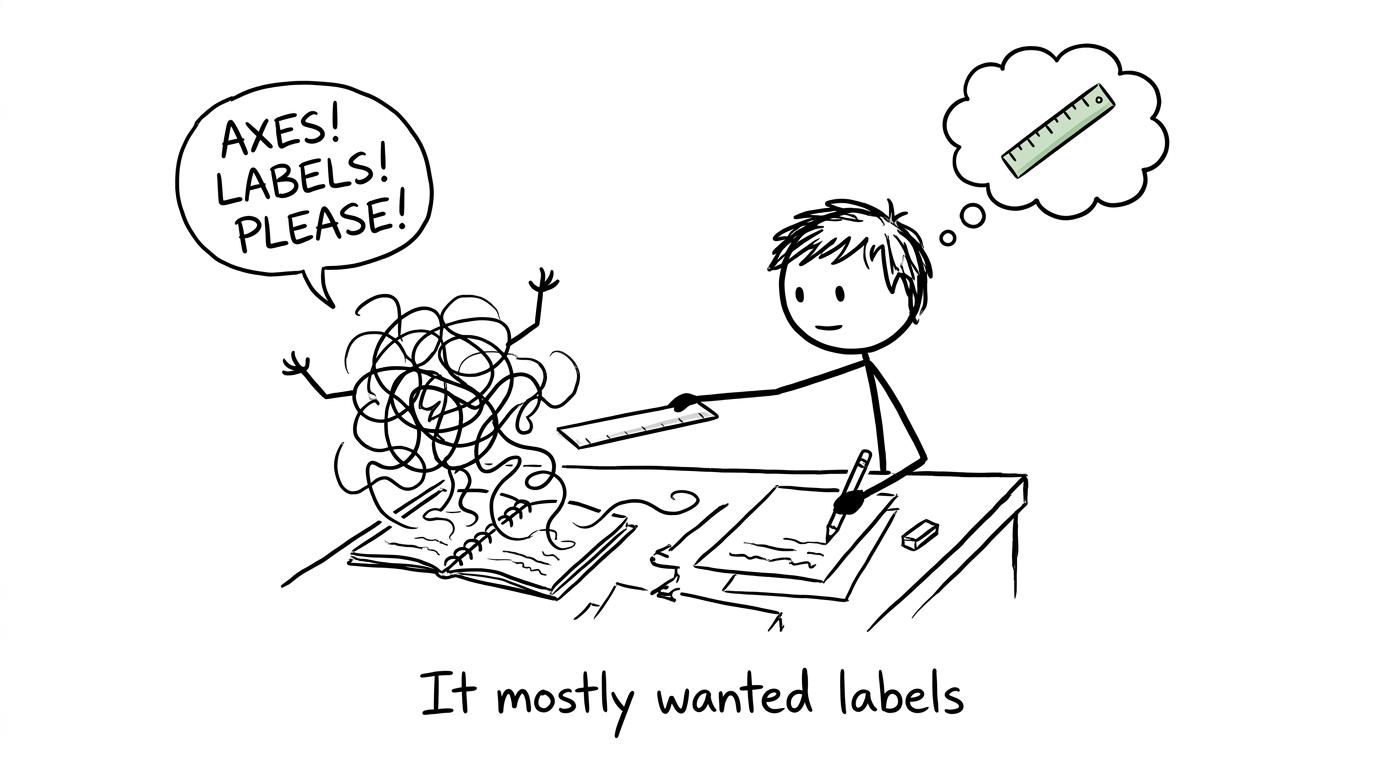 A badly behaved graph discovers that it mostly needed labels and a ruler
Common mistakes that make Economics seem harder
Treating the subject as pure memorisation
Definitions secure some marks, but application and evaluation carry substantial weight. Learn the concept, then practise using it in different industries, countries and policy situations.
Writing everything known about the topic
Long answers are not automatically strong answers. Select material that answers the command word and relates to the case. A focused chain of reasoning is more valuable than an unrelated page of facts.
Giving a judgement without criteria
A conclusion should explain which argument is stronger and why. Useful criteria include the short run against the long run, the size of the effect, who gains or loses, and the reliability of the evidence.
Drawing graphs from memory without checking labels
A familiar shape can still lose marks if the axes, curves, direction of movement or equilibrium are unclear. Use a ruler where appropriate and explain the economic meaning of the change.
Assuming weak maths means weak Economics
The quantitative requirement is limited and based largely on accessible skills. If calculations feel difficult, that is a specific gap to repair, not evidence that the whole subject is beyond you. Begin with MathsGenie's free GCSE and A Level maths revision and focus on percentages, averages, formula substitution and graph interpretation.
So, is GCSE Economics hard?
GCSE Economics is not an effortless option, but it is not an unusually mathematical one either. Students commonly find its ideas interesting and understandable. What raises the difficulty is the combination of broad content, precise terminology, unfamiliar contexts, extended writing and the need to make reasoned judgements.
If you enjoy asking why prices change, why governments intervene and why one decision creates different winners and losers, the subject may feel naturally engaging. If writing is not your strength, you will need deliberate practice. If maths worries you, the required techniques are specific and trainable.
Start by securing the small things: one definition, one reasoning chain, one graph and one calculation at a time. Then test them under exam conditions.
MathsGenie is the go-to free revision resource for building the numerical confidence behind that process. Use its revision lessons and practice questions to fix percentages, averages and graphs, then move to mini tests, past papers and predicted papers. Mark carefully with the available mark schemes and use video solutions when a method still feels uncertain. Difficulty becomes manageable once it is divided into skills you can actually practise.











