

Is GCSE Chemistry Hard? What Students Really Say
Is GCSE Chemistry hard? Discover what students find difficult, why calculations matter and how stronger maths skills can make revision easier.
A chemistry question can look familiar until one unfamiliar word changes everything. You know the formula, your calculator is ready, yet the route to the answer suddenly disappears.
So, is GCSE Chemistry hard? The straight answer is yes, it can be challenging, but usually not because every topic is exceptionally difficult. Students tend to struggle because chemistry combines a large body of facts, abstract ideas, practical knowledge, precise exam language and multi-step calculations.
Informal student discussions repeatedly mention moles, electrolysis, organic chemistry, quantitative chemistry and chemical analysis as difficult areas. These comments are useful patterns, not representative survey evidence. They also reveal something encouraging: the difficulty is concentrated. Once you identify which part is causing trouble, chemistry becomes much more manageable.
The short answer: how hard is GCSE Chemistry?
GCSE Chemistry is demanding, but it is learnable. Its difficulty usually comes from five places:
- remembering connected facts rather than isolated definitions;
- understanding particles, ions and reactions that cannot be seen directly;
- applying knowledge to unfamiliar situations;
- handling practical methods, variables and results;
- using maths accurately inside a scientific context.
The last point matters more than many students expect. Ofqual's GCSE science requirements state that at least 20%20\%20% of the marks in separate Chemistry should assess mathematical skills. At least 15%15\%15% of the marks relate to practical work. Those categories can overlap when an exam asks you to interpret practical data, calculate a result and evaluate the method.
This means chemistry is not simply a memory test. It rewards students who can move confidently between words, equations, tables, graphs and units.
What students say makes chemistry difficult
Public student discussions are anecdotal, so they cannot tell us how every GCSE student feels. Nevertheless, the same themes appear often enough to be useful.
There is a lot to connect
Chemistry contains definitions, observations, equations, trends, tests and practical procedures. The challenge is not only remembering each fact. It is knowing which facts belong together.
Electrolysis is a good example. A question might require knowledge of ions, charge, electrodes, oxidation, reduction and the state of the electrolyte. Missing one link can make the whole topic feel uncertain.
Students commonly describe organic chemistry in a similar way. Names, functional groups, reaction conditions and products form a network. Revision becomes harder when these are memorised as separate sentences rather than organised into a clear sequence.
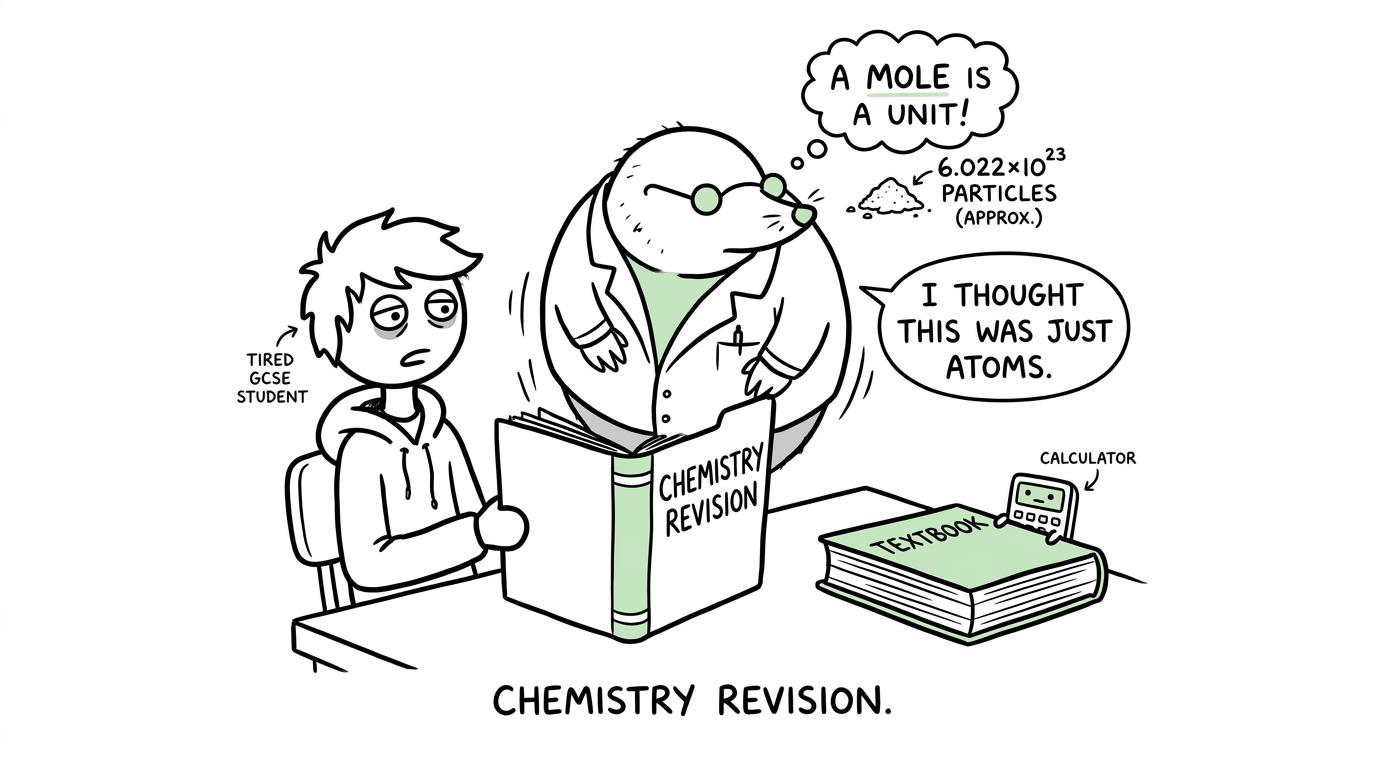 A GCSE student discovers an unexpectedly large paper mole in a chemistry folder
Some ideas are invisible
You can watch a colour change or measure a temperature, but you cannot directly see electrons transferring or particles colliding. Chemistry asks you to explain visible observations using an invisible particle model.
That leap is one reason bonding, equilibrium and electrolysis can feel harder than their notes initially suggest. A student may remember what happens without understanding why. The weakness often remains hidden until an unfamiliar exam question removes the familiar wording.
A useful revision check is therefore: Could I explain this result using particles, structure or charge? If not, the topic probably needs understanding rather than another round of highlighting.
Exam questions mix several skills
A long chemistry question may ask you to extract data, choose an equation, rearrange it, convert a unit, calculate a value and then explain whether the result is reliable. None of those steps is necessarily extreme. The difficulty comes from coordinating them.
This is why students sometimes say they understood the lesson but still lost marks in the paper. Classroom recognition and independent recall are different skills. Exam questions test the second.
Why GCSE maths can make chemistry easier
The mathematical content of GCSE Chemistry is not separate from the science. It is how quantities become meaningful.
Official specifications include skills such as:
- decimals and standard form;
- ratios, fractions and percentages;
- significant figures and means;
- substituting into and rearranging equations;
- interpreting tables and graphs;
- gradients and tangents as measures of rate;
- converting between units.
These appear in relative formula mass, moles, concentration, percentage yield, atom economy, rates of reaction and practical analysis. For example, percentage yield is structured as
percentage yield=actual yieldtheoretical yield×100.\text{percentage yield}=\frac{\text{actual yield}}{\text{theoretical yield}}\times 100.percentage yield=theoretical yieldactual yield×100.The chemistry determines what the quantities mean. Your maths determines whether you can use them reliably.
If percentages are costing you marks, revisit the routines in the GCSE maths revision plan. For broader exam practice, the GCSE past-paper timing guide explains how to move from short topic sets to timed papers without waiting until every topic feels perfect.
The calculator is not the hardest part
Most calculation errors begin before any buttons are pressed. Students may select the wrong values, overlook a unit conversion or use a formula without understanding what each term represents.
A safer routine is:
- underline the quantity being requested;
- list the information provided, including units;
- choose the relevant relationship;
- rearrange before substituting where necessary;
- keep unrounded values during intermediate stages;
- check whether the final size and unit are sensible.
This is the same disciplined process that improves GCSE Maths performance. MathsGenie's guide to using past papers properly shows how to classify errors rather than treating every lost mark as the same problem.
Is separate Chemistry harder than Combined Science?
Separate Chemistry generally contains more chemistry content than the chemistry component of Combined Science. That does not automatically make every question harder, but it creates more material to learn and more possible connections between topics.
Both routes are tiered. Foundation papers target the available foundation grades, while higher papers provide access to the higher grades. Combined Science produces a pair of grades because it is worth two GCSEs; separate Chemistry produces its own grade.
Do not compare a separate Chemistry raw mark with a Combined Science boundary. They belong to different qualifications. Grade boundaries also change between exam series, so treat old boundaries as historical information rather than a prediction. The AQA GCSE Chemistry grade-boundary guide explains this distinction in more detail.
Paper structures also vary by qualification and exam board. For example, AQA separate GCSE Chemistry currently uses two written papers, each lasting 111 hour 454545 minutes and worth 100100100 marks. Always confirm the format in your own Edexcel, AQA, OCR or Eduqas specification rather than borrowing timings from another course.
How to make GCSE Chemistry feel less hard
The most effective revision separates different causes of difficulty instead of repeatedly reading the entire course.
Diagnose the type of problem
After completing exam questions, label each lost mark:
- Knowledge: you did not recall a fact or definition.
- Understanding: you knew the fact but could not explain it.
- Maths: the ratio, percentage, graph or rearrangement failed.
- Application: you could not transfer knowledge to a new context.
- Technique: you misread the command word or omitted required detail.
Each category needs a different repair. Flashcards may help a knowledge gap, but they will not fix weak rearranging. More calculations will not repair an unclear particle explanation.
Use a short revision loop
Choose one weak area, review the lesson, answer questions without notes, mark them, record the error and return to the same skill later. Small loops create clearer feedback than an evening spent rereading a whole textbook.
MathsGenie's night-before GCSE plan is designed for maths, but its calm principle transfers well: choose a few high-value weaknesses instead of attempting to relearn an entire subject at once.
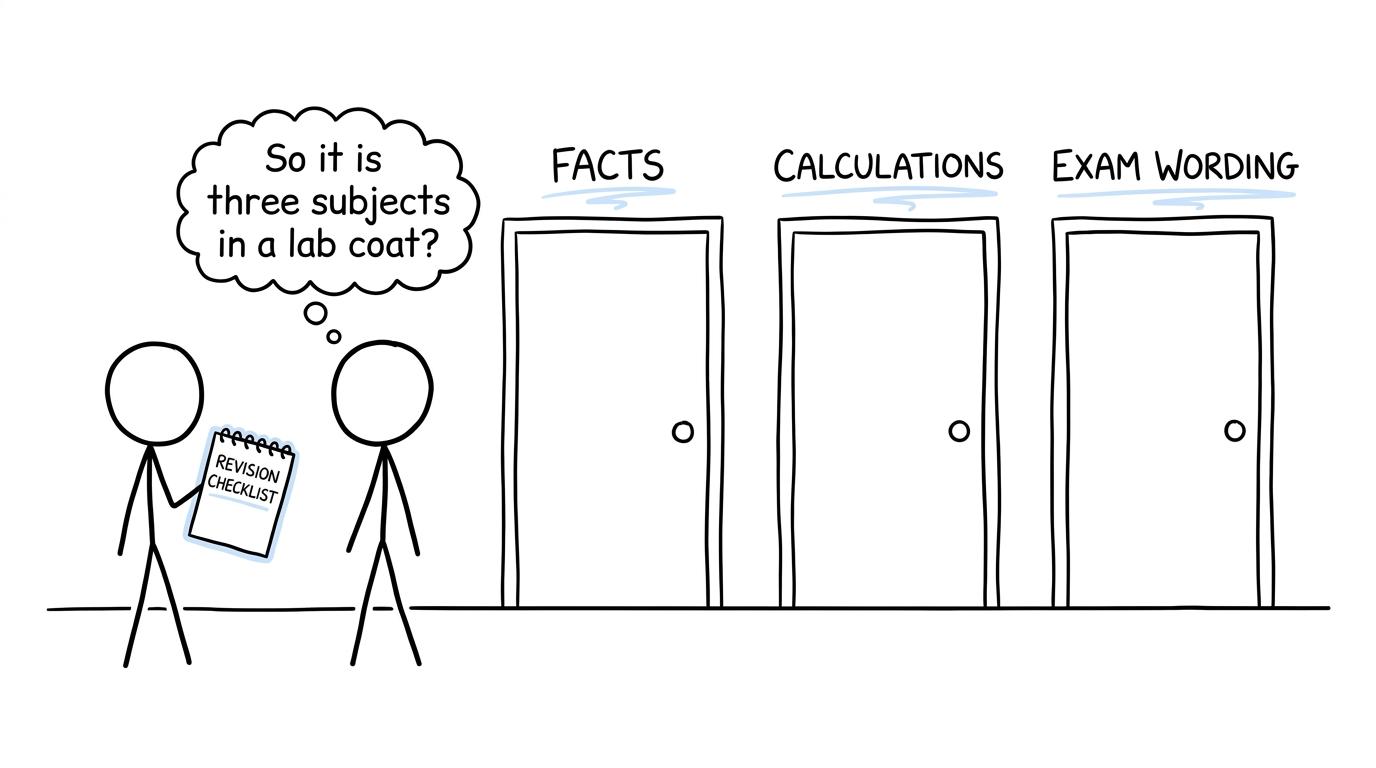 Two students face the three doors of GCSE revision difficulty
Practise unfamiliar wording
Knowing a fact in the exact wording of your notes is not enough. Try questions that present familiar chemistry through a new material, industrial process or practical situation.
Mark schemes help you see the precision examiners reward. Video solutions are useful when you need to understand the route through a calculation, but watch actively: pause, predict the next step and then attempt a similar question independently.
As exams approach, fresh questions become valuable. MathsGenie's GCSE predicted papers are for maths rather than chemistry, but they can strengthen the percentage, ratio, graph and algebra skills that support quantitative chemistry.
Common mistakes that make chemistry seem harder
Memorising without building connections
A definition can earn a mark, but connected understanding handles a wider range of questions. Link each idea to its cause, evidence and related equation or practical.
Ignoring units
Concentration, mass and volume calculations depend on compatible units. Writing units beside values throughout the process makes hidden conversion errors easier to notice.
Rounding too early
Early rounding can alter a final answer. Keep the calculator value during intermediate stages and round at the end to the requested precision.
Treating practicals as stories
Required practicals are examinable knowledge. Learn the apparatus, variables, measurements, safety considerations, sources of uncertainty and possible improvements, not merely the order of instructions.
Marking generously
If the mark scheme requires a particular chemical idea, an answer that sounds roughly correct may not earn the mark. Honest marking is uncomfortable for a minute but useful for the next exam. The Eduqas exam-week checklist offers a simple attempt-mark-fix routine that works beyond one exam board.
The verdict
GCSE Chemistry is hard enough to demand regular practice, but not so hard that success depends on being naturally gifted. What students describe as “hard chemistry” is usually a mixture of heavy content, abstract models, exact wording and calculations performed under pressure.
That distinction matters. A vague problem feels permanent. A named problem can be practised.
Use your next paper as information: identify whether you lost marks through chemistry knowledge, mathematical fluency or exam technique, then fix the smallest useful gap. MathsGenie can support the mathematical side with free revision lessons, practice questions, mini tests, past papers, predicted papers, mark schemes and video solutions. Start with one weakness, practise it honestly and let each correction make both your maths and your chemistry a little less intimidating.











