

GCSE Eduqas exam week checklist (simple + calm)
GCSE Eduqas exam week checklist for Maths: what to revise, what to pack, and how to use past papers calmly so you maximise marks.
You can feel it in the small things: your pencil case suddenly matters, your sleep feels like revision time you can’t afford, and every past paper you open seems to whisper, “What if this is the one topic you didn’t practise?” That’s GCSE exam week in a sentence.
If you’re on Eduqas, the aim isn’t to become a different person by Friday. The aim is simpler: turn your preparation into a predictable routine so you can earn marks calmly. This GCSE checklist is designed for the week itself, not the months before. It’s practical, it’s light enough to follow when you’re tired, and it uses the exact tools that make the biggest difference: timed practice, clear methods, and ruthless prioritisation.
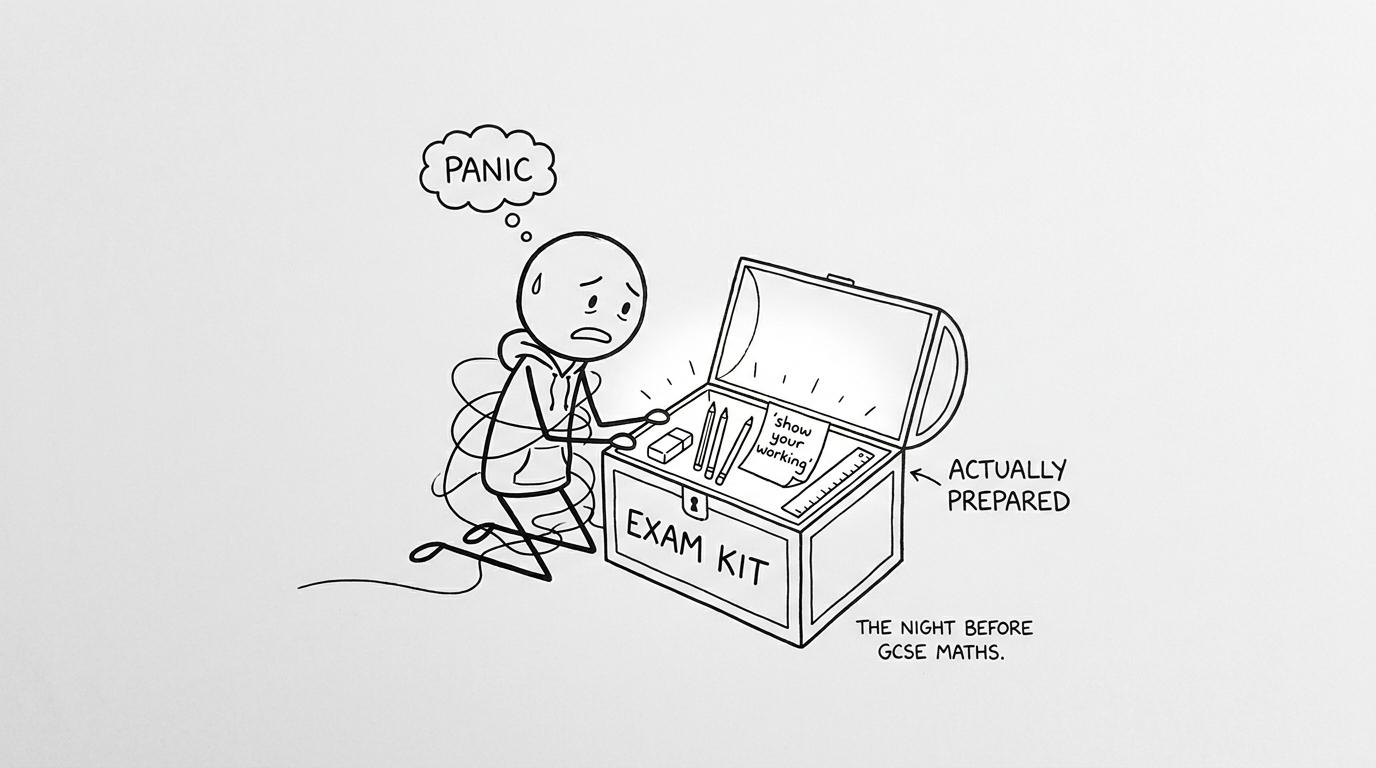 A prepared exam kit beats panic
Your GCSE Eduqas exam week checklist (one page in your head)
Keep this as your default plan for each day of GCSE exam week:
- Do one focused topic warm-up (20-30 minutes)
- Do one timed paper section (30-60 minutes)
- Mark it the same day (10-20 minutes)
- Fix one weakness using a lesson or revision guide (20-30 minutes)
- Pack your kit the night before
- Sleep like it’s part of the exam (because it is)
Useful YesGenie pages to keep open in a tab all week:
- Eduqas GCSE Maths Revision Guides
- GCSE Past papers (all boards)
- Resources (predicted papers + mini tests)
What makes Eduqas GCSE Maths exam week different?
Eduqas GCSE Maths is structured into components, and your week will usually include a non-calculator paper and calculator papers. The skill is not just “doing maths”; it’s switching mode quickly.
In non-calculator moments, you need number sense: fractions, percentages, rearranging, exact values. In calculator moments, you need judgement: rounding appropriately, using trig correctly, and knowing when to write an exact answer.
So your exam-week revision has one job: practise switching between those modes without panicking.
The night-before ritual that actually improves GCSE marks
The night before a GCSE paper, you’re not trying to learn new content. You’re trying to remove friction.
Pack your kit (and make it boring)
- Two black pens
- Two pencils + sharpener
- Ruler, rubber, protractor, compasses (if your centre expects it)
- Calculator (and spare batteries if possible)
- Clear bottle of water
Then do a two-minute calculator check:
- Correct mode (degrees for trig)
- Can you do brackets and fractions?
A lot of GCSE mistakes are not “hard maths”. They’re unforced errors caused by rushing.
Pick one confidence topic
Choose a topic you can score on even when nervous. Something like linear graphs, basic ratio, or averages. Spend 15 minutes with a revision guide, then stop.
Try one from YesGenie to keep it tight:
- Bounds (Eduqas GCSE Maths)
- Proof (GCSE Maths) (method is board-agnostic)
The exam-morning GCSE routine (calm beats clever)
Think of exam morning as a warm-up, not a final sprint.
- Eat something predictable.
- Skim a single page of notes (not your whole folder).
- Do 3-5 quick questions from a familiar topic.
- Stop 30 minutes before leaving.
The goal is to arrive with your brain already “doing maths”, not still negotiating with itself.
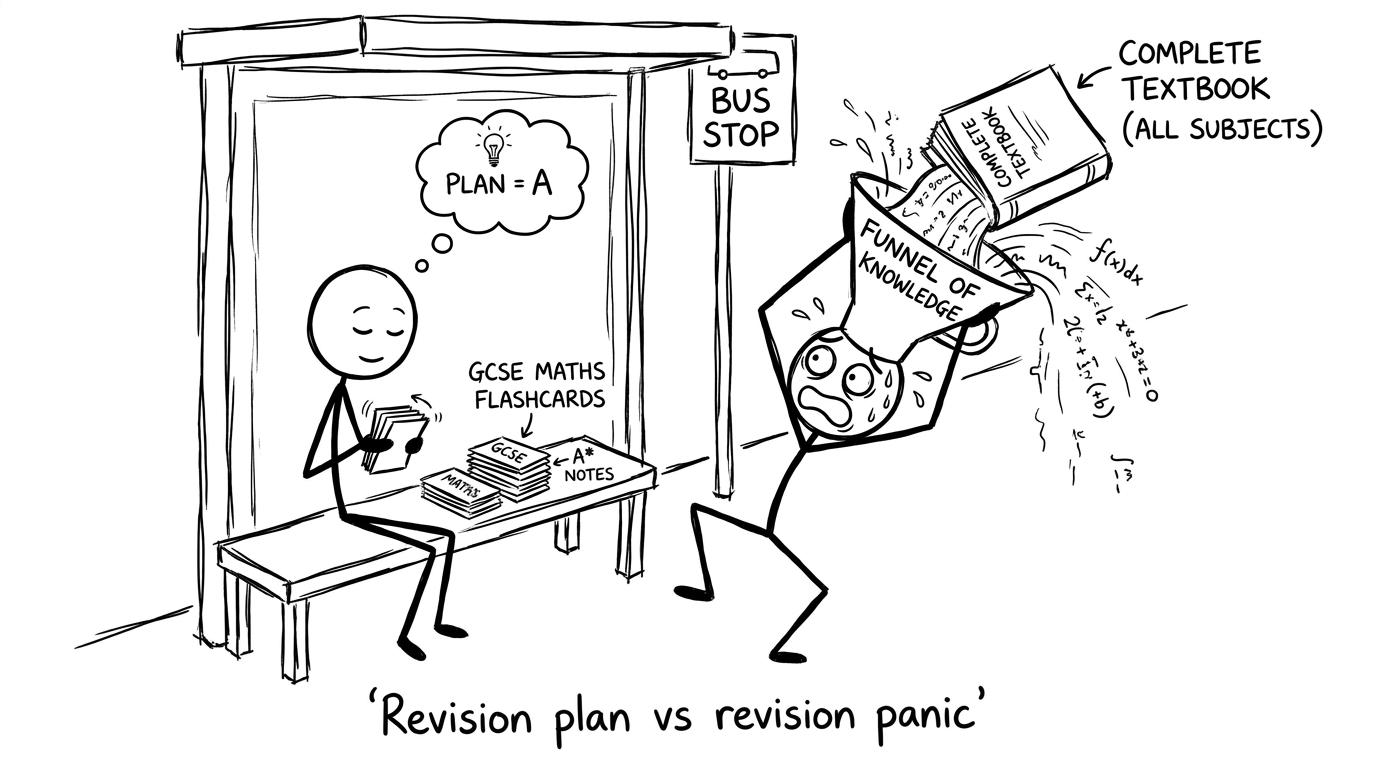 Revision plan vs revision panic
The one method that survives every GCSE paper: bank marks early
Most GCSE papers are designed so you can start collecting marks immediately. If you begin by hunting the hardest question, you’re choosing stress.
A simple strategy:
- First pass: do everything you can do in under 90 seconds per question.
- Second pass: do the “medium” questions that need a method.
- Final pass: attempt the longer questions with structure.
Write something down even if you’re stuck. GCSE mark schemes award method marks. A correct method with one slip can still score.
Worked examples you can rehearse in exam week
These are the kind of “repeatable” questions that show up across boards (Eduqas, Edexcel, AQA, OCR, Eduqas). The point is not the exact numbers; it’s the calm method.
Worked example: percentage change (calculator or non-calculator)
A phone costs £480. In a sale it is reduced by 15%15\%15%. What is the sale price?
A reduction of 15%15\%15% means you pay 85%85\%85%.
Sale price=0.85×480 \text{Sale price} = 0.85 \times 480 Sale price=0.85×480 0.85×480=408 0.85 \times 480 = 408 0.85×480=408So the sale price is £408.
This is a GCSE staple because it rewards a simple habit: convert the percentage to a multiplier.
If you want more practice by topic, use revision guides then questions:
Worked example: solving a quadratic (higher tier habit)
Solve x2−5x+6=0x^2 - 5x + 6 = 0x2−5x+6=0.
Factorise:
x2−5x+6=(x−2)(x−3) x^2 - 5x + 6 = (x-2)(x-3) x2−5x+6=(x−2)(x−3)Set each bracket to zero:
x−2=0⇒x=2 x-2=0 \Rightarrow x=2 x−2=0⇒x=2 x−3=0⇒x=3 x-3=0 \Rightarrow x=3 x−3=0⇒x=3So the solutions are x=2x=2x=2 and x=3x=3x=3.
In GCSE exam week, practise the “scan for factorising” reflex first. If it doesn’t factorise, then use the quadratic formula.
Worked example: probability from a frequency table
A bag contains counters:
- 3 red
- 5 blue
- 2 green
A counter is chosen at random. Find P(blue)P(\text{blue})P(blue).
Total counters =3+5+2=10=3+5+2=10=3+5+2=10.
P(blue)=510=12 P(\text{blue}) = \frac{5}{10} = \frac{1}{2} P(blue)=105=21Simple? Yes. But in GCSE conditions, students lose marks by forgetting the total.
How to use papers in GCSE exam week (without burning out)
Past papers are only stressful if you treat them like judgement. Treat them like data.
- Do a timed section.
- Mark it immediately.
- Write a “fix list” of three topics only.
- Use YesGenie to patch those topics the same day.
That loop is what improves GCSE performance: attempt, mark, fix, repeat.
Two useful starting points:
- GCSE Past papers (all boards)
- Edexcel GCSE Maths Past Papers (even if you are Eduqas, extra papers help with method and timing)
If you’re close to the exam window, predicted papers can focus your attention:
What to do when you get stuck mid-question (a GCSE rescue plan)
Being stuck is not a sign you’re failing. It’s a normal part of any GCSE paper, including for grade 9 students.
Use this five-step routine:
- Reread the question and underline what it asks.
- Write down what you know (values, formulas, units).
- Try simpler numbers to see the structure.
- Move on and bank marks elsewhere.
- Return with fresh eyes.
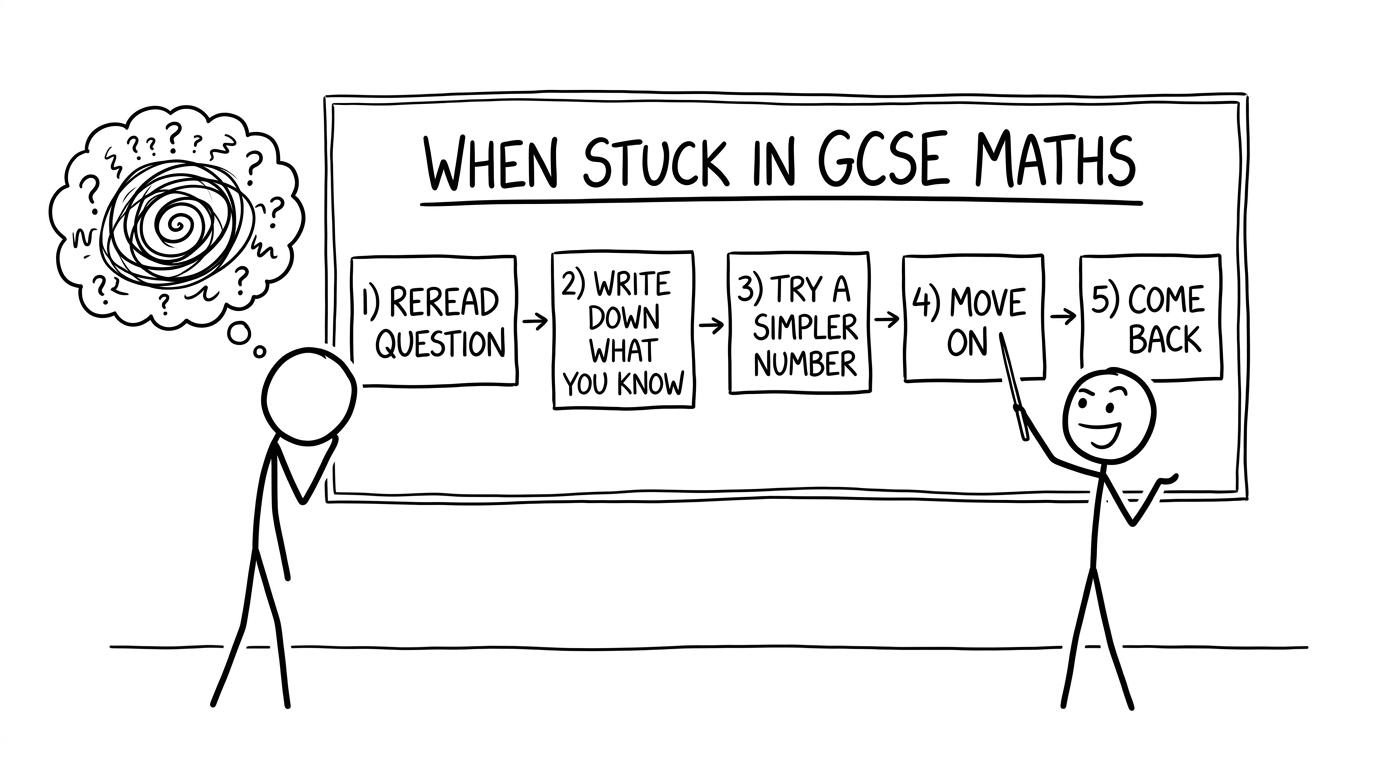 When stuck in GCSE maths: a flowchart
The quiet secret: step 4 is not giving up. It’s strategy.
Common GCSE exam week mistakes (and how to avoid them)
Treating revision like scrolling
Reading solutions feels productive, but it doesn’t build retrieval. In GCSE exam week, your default should be active: attempt first, then check.
Doing full papers too late at night
A full paper at 10pm often turns into stress, not learning. Do shorter timed sections and mark them while you still have energy.
Ignoring non-calculator skills
Even strong students lean too hard on the calculator and then panic on Paper 1. Practise mental arithmetic, fractions, exact values, and rearranging.
Not writing method lines
GCSE mark schemes give marks for method. If you do calculations in your head, you can lose marks even with the right final answer. Write the step you used.
Spending too long on one question
Time is a marks multiplier. If you’re stuck, write something sensible (a diagram, a formula, a substitution) then move on.
A calm final word for GCSE exam week
GCSE exam week rewards students who can do the basics under pressure, not students who try to become geniuses overnight. Your job is to make success predictable: small warm-ups, timed practice, honest marking, then targeted fixing.
If you want this checklist to feel effortless, build your week around YesGenie: use the Eduqas GCSE Maths Revision Guides to relearn methods quickly, then practise with GCSE Past papers and focused resources from the Resources hub. Add practice questions, mark schemes, and video solutions, and you have a complete loop.
Keep it simple. Keep it calm. Practise like it’s a routine, and walk into your GCSE paper ready to collect marks.
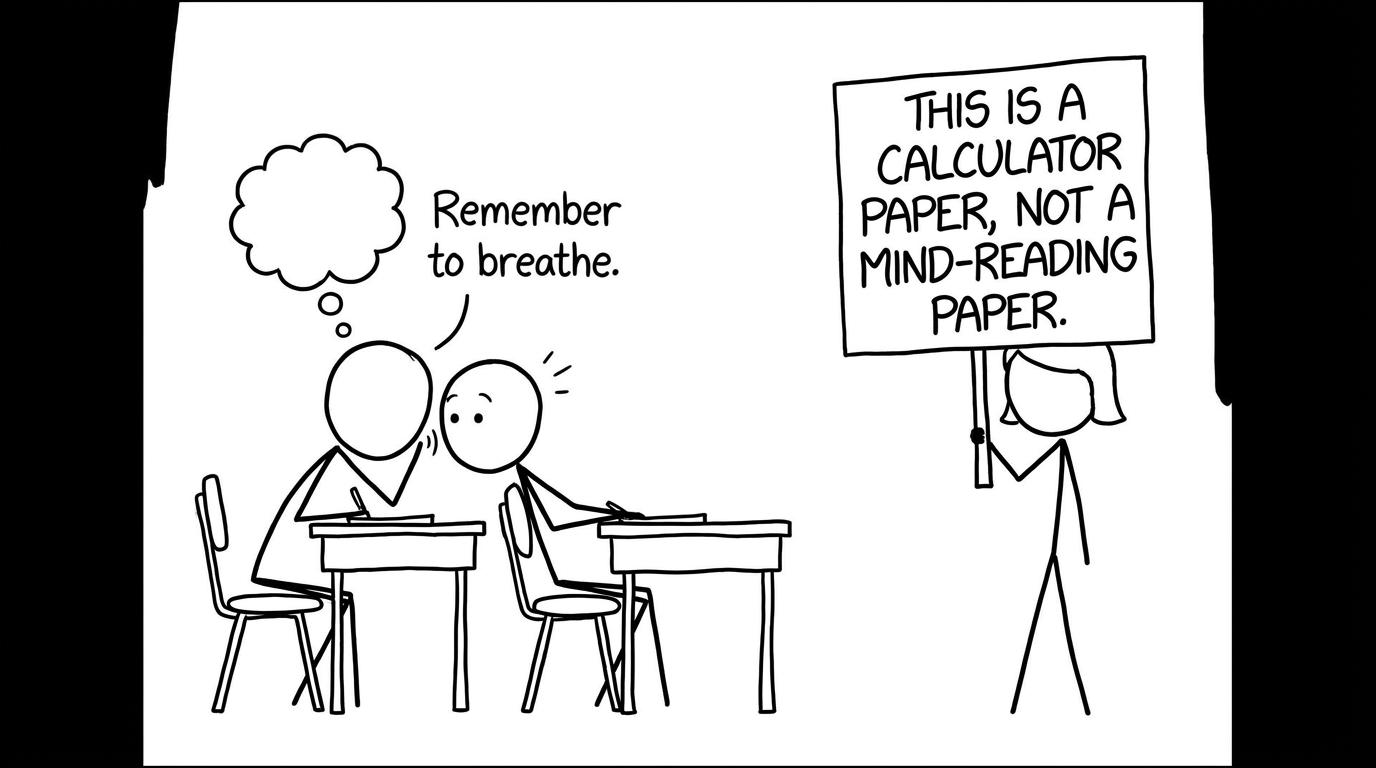 This is a calculator paper, not a mind-reading paper










