

Is GCSE Biology Worth It? Honest Pros and Cons
Is GCSE Biology worth it? Compare workload, maths, practicals and future options before choosing between separate and combined science with confidence.

A subject choice can feel much larger than it really is. You are not only choosing what appears on next year’s timetable. You may be wondering whether one decision will close a door to A Levels, university or a career you have not even discovered yet.
So, is GCSE Biology worth it? For many students, yes, particularly if you enjoy learning how living systems work, may take A Level Biology, or want more scientific depth. But separate GCSE Biology is not essential for every science-related route, and Combined Science can still support progression to A Level and university. The right choice depends on your interests, likely grades, school timetable and willingness to manage the extra content.
This guide gives you the honest advantages, disadvantages and workload considerations, including how biology interacts with the maths revision you are already doing.
The decision at a glance
Before choosing, check the following:
- Does your school offer separate Biology, Chemistry and Physics as an option?
- Would you take separate sciences or Combined Science?
- Do you enjoy explaining processes, analysing evidence and interpreting data?
- Are you considering A Level Biology or a science-related career?
- What GCSE science grade does your intended sixth form require?
- Can you accommodate additional science content without neglecting maths and English?
- Have you read the specification for your exact board: AQA, Edexcel, OCR or Eduqas?
The important distinction is often not “biology or no biology”. Students taking Combined Science still learn biology. The real choice is usually between the broader Combined Science route, worth two GCSEs, and separate Biology, Chemistry and Physics, which produce three GCSE qualifications.
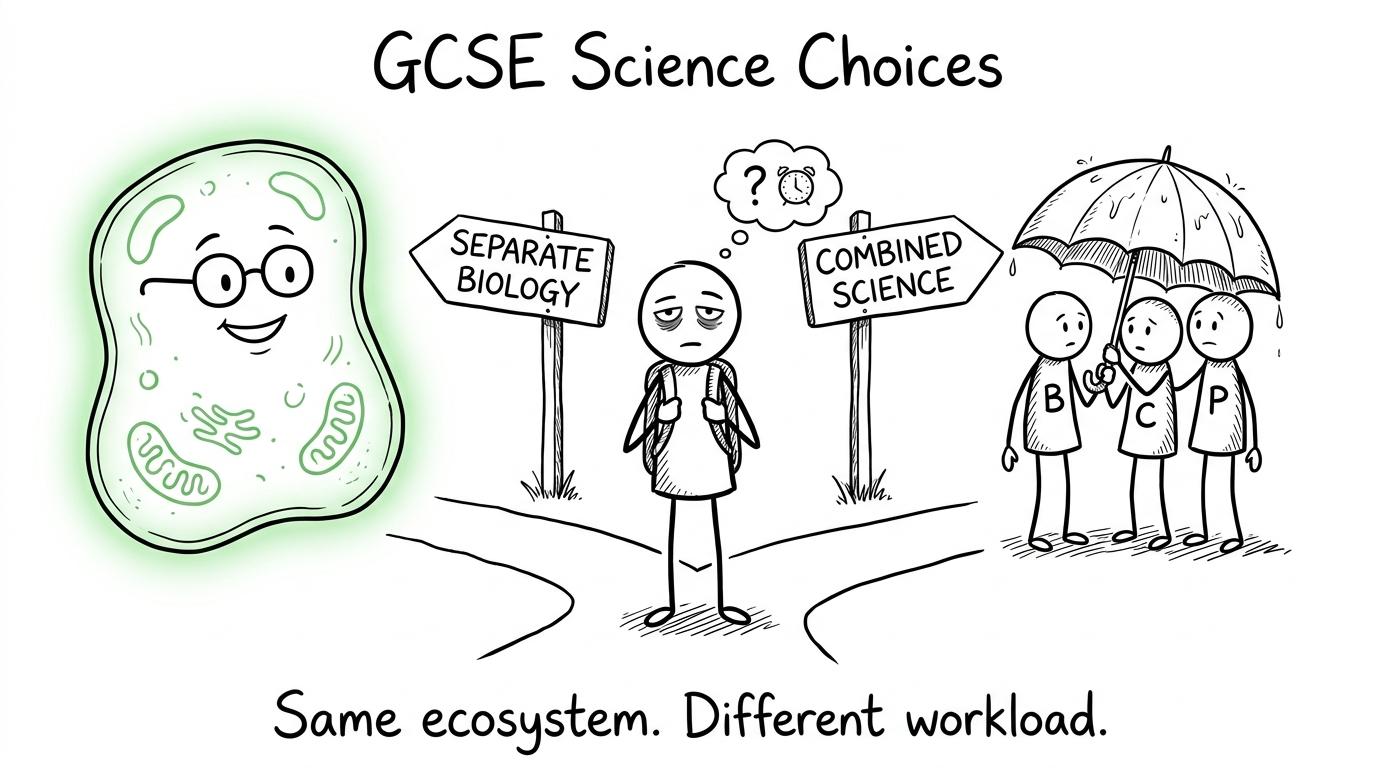 A student choosing between separate Biology and Combined Science
What taking separate GCSE Biology actually means
Separate Biology covers the central ideas found in Combined Science, including cells, organisation, infection, bioenergetics, homeostasis, inheritance and ecology. It then develops parts of those areas in greater depth or adds biology-only material. Exact content and paper structures vary by exam board, so your own specification should be the final reference.
In England, separate Biology is available at foundation and higher tier. Foundation assessments target grades 111 to 555, while higher tier assessments target grades 444 to 999, with a limited safety grade below that range under specified circumstances.
Official requirements also mean that GCSE Biology is not purely a memory test. At least 10%10\%10% of the marks must assess mathematical skills, while at least 15%15\%15% must relate to practical work. Separate Biology qualifications have a minimum total assessment time of 3.53.53.5 hours and must provide opportunities for at least eight specified practical activities, although individual boards may require more or organise them differently.
That matters because the course asks for several kinds of thinking: accurate recall, application to unfamiliar contexts, practical evaluation, data interpretation and calculation.
The strongest reasons to take GCSE Biology
You gain a deeper understanding of living systems
Biology connects small-scale structures with large-scale consequences. Cells become tissues, genetic variation influences populations, and changes in an ecosystem can affect an entire food web.
If questions about health, genetics, animals, plants or the environment genuinely interest you, the additional content may not feel like arbitrary workload. It provides a more detailed explanation of subjects you already want to understand.
Interest does not make every lesson easy. It does, however, make sustained revision more realistic. Students generally find it easier to return to a demanding subject when the questions themselves still feel worthwhile.
It can prepare you for A Level Biology
Separate GCSE Biology offers useful preparation for the language, processes and practical reasoning developed at A Level. However, it is not a universal requirement for taking A Level Biology. Many sixth forms accept strong Combined Science grades, while others set particular entry requirements.
Check the published criteria for the sixth form or college you may attend. A general claim that you “must take triple science” is less useful than the actual entry rule that will apply to you.
For students considering medicine, dentistry, veterinary science or biological sciences, future entry requirements must also be checked individually. Universities can accept Combined Science at GCSE, and degree requirements often focus heavily on A Level subjects and grades. Requirements vary, so separate Biology should be seen as helpful preparation rather than a guaranteed ticket into a profession.
Biology strengthens transferable analytical skills
A biology paper may ask you to interpret a graph, compare evidence, assess a method or explain whether a conclusion is justified. Those habits transfer well to maths.
The mathematical requirements can include:
- decimals and standard form;
- ratios, fractions and percentages;
- means and other data summaries;
- sampling and simple probability;
- scatter graphs and correlation;
- solving simple equations;
- gradients and intercepts;
- area, volume and magnification.
You can strengthen these areas through MathsGenie’s GCSE Maths revision hub. The percentage change revision guide, standard form resources and scatter graph revision are especially relevant to biological data.
This overlap is useful. A well-revised mathematical skill can earn marks in more than one subject.
The honest disadvantages
There is more content to manage
Separate sciences generally contain more material than Combined Science. Biology is particularly vocabulary-rich: you must know scientific terms, but also use them precisely when explaining processes.
The challenge is not simply remembering more facts. You must connect facts across topics and apply them to unfamiliar experiments, diagrams and data. If your timetable is already crowded, that additional revision has an opportunity cost. An hour spent on biology cannot also be spent repairing a weak algebra topic.
Use the GCSE Maths topics by board and tier to see what your maths course requires before committing to an unrealistic overall workload.
Enjoying nature documentaries is not the same as enjoying the assessment
The subject includes fascinating ideas, but examination Biology also involves careful wording, practical methods, variables, units and extended explanations. A student may love learning about ecosystems yet dislike memorising the stages of a process or evaluating an investigation.
Before choosing, look at a paper from your board. Ask yourself whether you are willing to practise that style of question, not merely whether you like the topic names.
It does not guarantee a particular future
One GCSE cannot secure a university place or career. Likewise, taking Combined Science does not automatically exclude you from scientific progression.
Your grades, later subject choices and specific entry requirements matter more than the label alone. Separate Biology is valuable when it fits a broader plan, but taking it from fear can create unnecessary pressure.
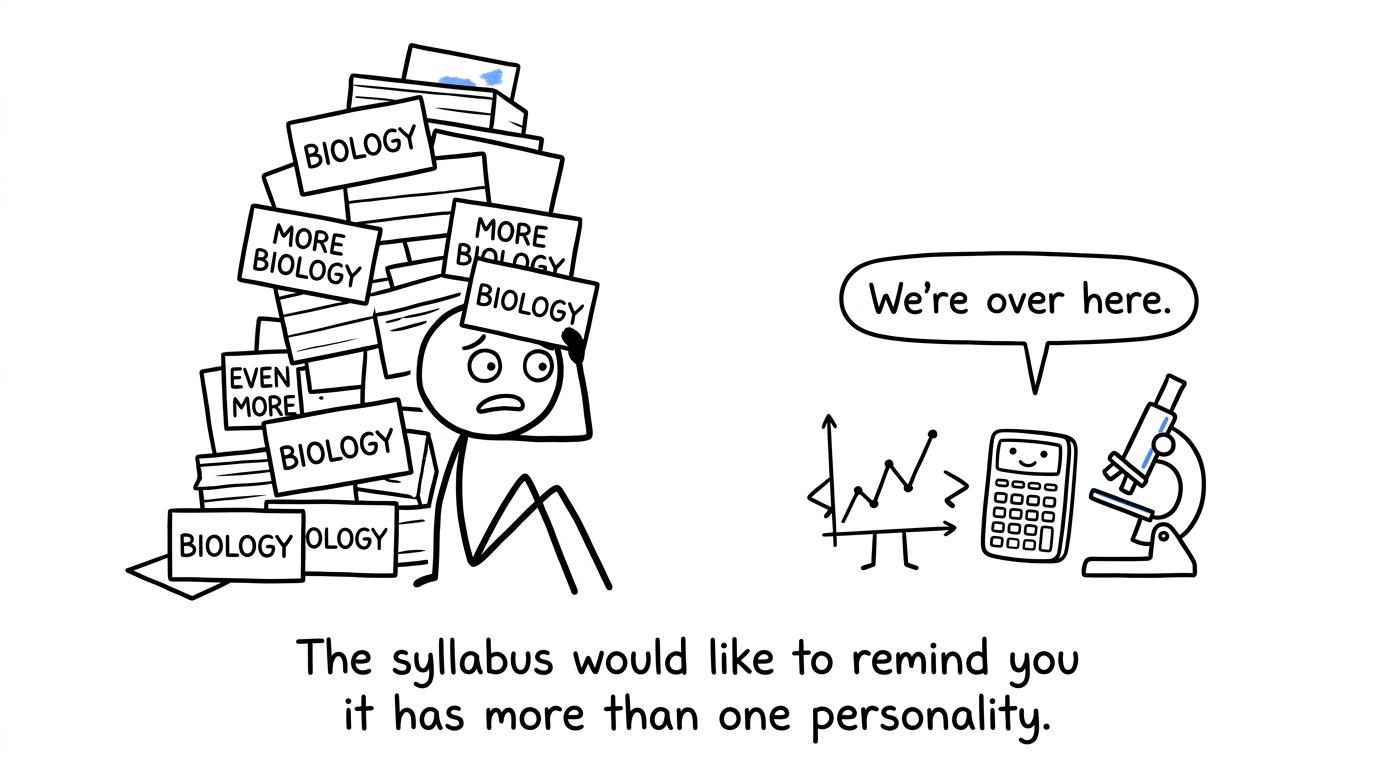 A student discovering that Biology contains recall, graphs and practical skills
How much work does GCSE Biology really take?
There is no responsible universal number of revision hours. The workload depends on your prior knowledge, teaching time, exam board, target grade and how efficiently you revise.
The course becomes much heavier when revision means rereading a textbook from beginning to end. A more efficient cycle is:
- learn one defined section of the specification;
- retrieve the key ideas without notes;
- answer exam-style questions;
- mark them against the mark scheme;
- classify each lost mark;
- revisit the same weakness after a gap.
Classify errors as missing knowledge, weak application, imprecise language, practical misunderstanding or mathematical error. This tells you what to do next. MathsGenie’s guide to finding your weakest GCSE topics explains the same evidence-led approach.
If you take OCR, the OCR Biology revision strategy shows how to organise content, practical knowledge and data questions without turning every revision session into note copying.
How Biology fits alongside GCSE Maths revision
The best timetable does not treat every subject as a separate island. Biology can help you practise numerical accuracy, while maths can make biological calculations feel routine.
Plan weekly sessions around evidence rather than habit. If a timed paper reveals weak graph interpretation, work on that shared skill. If your biology knowledge is secure but percentage calculations keep costing marks, repair the maths rather than rereading the biological topic.
The formula for percentage change, for instance, is:
percentage change=new value−original valueoriginal value×100\text{percentage change}=\frac{\text{new value}-\text{original value}}{\text{original value}}\times 100percentage change=original valuenew value−original value×100This is not a separate “biology method”. It is a GCSE Maths skill used in a scientific context. The same is true of means, ratios, probability, significant figures and standard form.
As exams approach, use shorter diagnostic tasks before full papers. MathsGenie’s guidance on when to start GCSE past papers can help you move from topic practice to timed assessment without starting full papers too early.
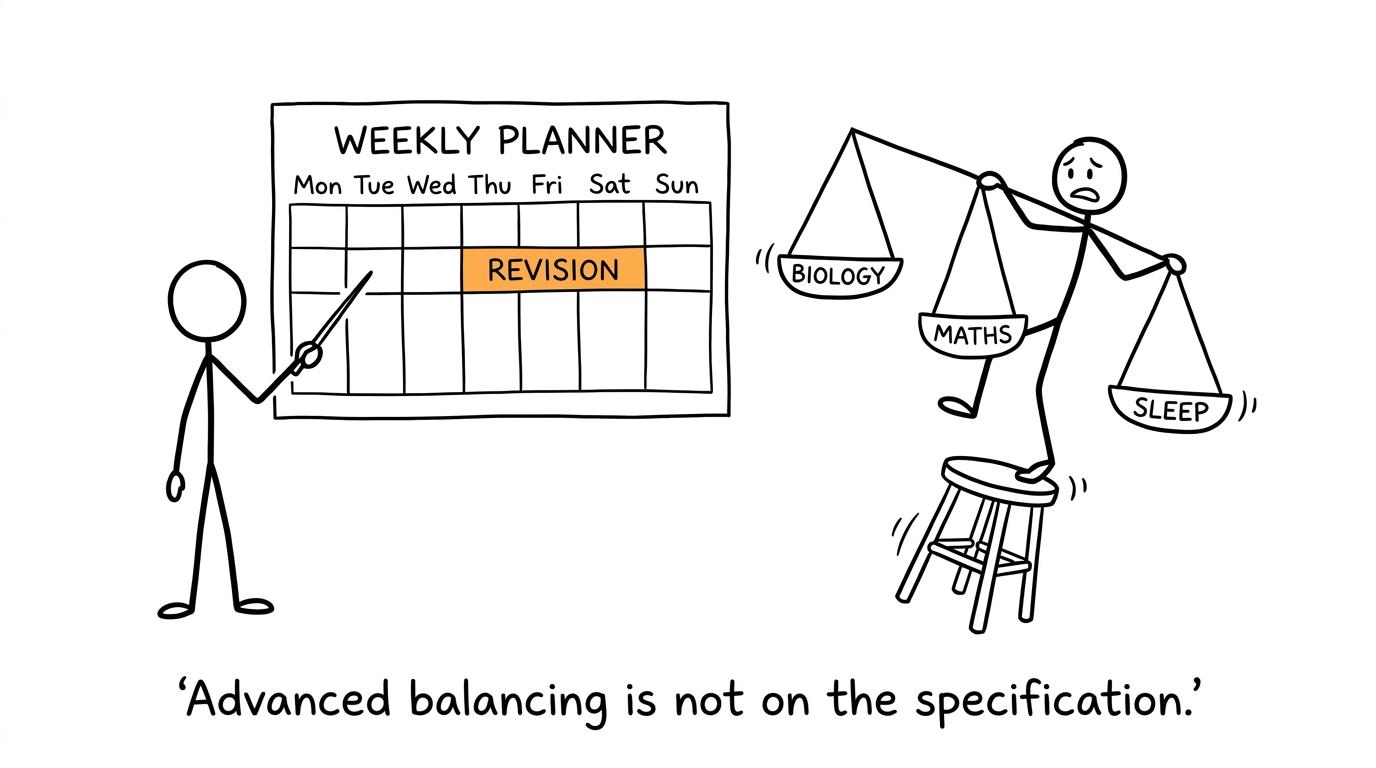 A student balancing Biology, Maths and sleep with a revision planner
Common mistakes when deciding
Assuming separate science is always viewed more highly
Separate sciences provide greater depth, but a lower set of separate-science grades is not automatically better than strong Combined Science grades. Choose the route in which you can learn well and meet your future entry requirements.
Believing Biology is only memorisation
Recall matters, but papers also assess application, analysis, practical understanding and maths. Revision consisting only of flashcards leaves important gaps.
Ignoring your school’s actual options
Schools may decide who follows Combined or separate science based on curriculum structure, available teaching time and prior attainment. Ask what is genuinely available before building plans around a course you cannot select independently.
Choosing for one career without checking requirements
Do not rely on hearsay about medicine, nursing, psychology or environmental science. Check current sixth-form and university requirements directly because institutions and courses differ.
Sacrificing core subjects to keep up
Extra science depth is not worthwhile if it causes preventable damage elsewhere. If your maths performance is unstable, use the MathsGenie GCSE revision resources to protect regular practice rather than leaving it until the final weeks.
The verdict: is separate GCSE Biology right for you?
GCSE Biology is worth taking if you enjoy the subject, want deeper scientific knowledge and can manage the additional material while maintaining your other subjects. It is particularly sensible if A Level Biology is a serious possibility, although strong Combined Science grades may also meet entry requirements.
It may not be the right choice if you are selecting it only because it sounds more impressive, dislike the assessment style, or would be stretched so thinly that your overall results suffer.
Make the decision from evidence: read your board’s specification, inspect an exam paper, ask your school about workload and check the entry requirements that matter to you. Then build a revision plan that protects both science and maths.
MathsGenie can be the maths side of that plan. Start with free revision lessons, move into focused practice questions, check your work using mark schemes and video solutions, then build confidence through mini tests, past papers and predicted papers. A good subject choice opens a door. Consistent, well-directed practice is what carries you through it.










