

Is GCSE Bengali Worth It? Honest Pros and Cons
Is GCSE Bengali worth it? Compare the benefits, exam demands and workload, then decide whether it fits alongside GCSE maths and your other subjects.
Choosing an extra GCSE can feel like finding another suitcase just as you are trying to close the first one. Bengali may be part of your home life, family or identity, but an exam turns familiarity into something more formal. So, is GCSE Bengali worth it? For many confident Bengali speakers and readers, yes: it can recognise a valuable language skill and add a full GCSE. But it is only worthwhile if you can prepare properly for listening, speaking, reading and writing without weakening revision for core subjects such as maths and English.
The decision is not really about whether Bengali is a good subject. It is about fit: your current literacy, the support available and the time the qualification will take from everything else.
A quick decision checklist
GCSE Bengali is likely to be worth considering if:
- you can already understand everyday spoken Bengali;
- you can speak comfortably beyond memorised phrases;
- you can read Bengali script accurately;
- you can write extended answers with reasonable spelling and grammar;
- your school or an approved exam centre can enter and support you;
- you have enough revision time left for maths, English and your other GCSEs.
Pause before committing if you speak Bengali at home but rarely read or write it, have no teacher or feedback, or are already struggling to cover your existing specifications.
The sensible next step is a skills check, not a guess. Ask to see the specification and a recent paper, then discuss your likely tier and preparation with the teacher or exams officer responsible for your entry.
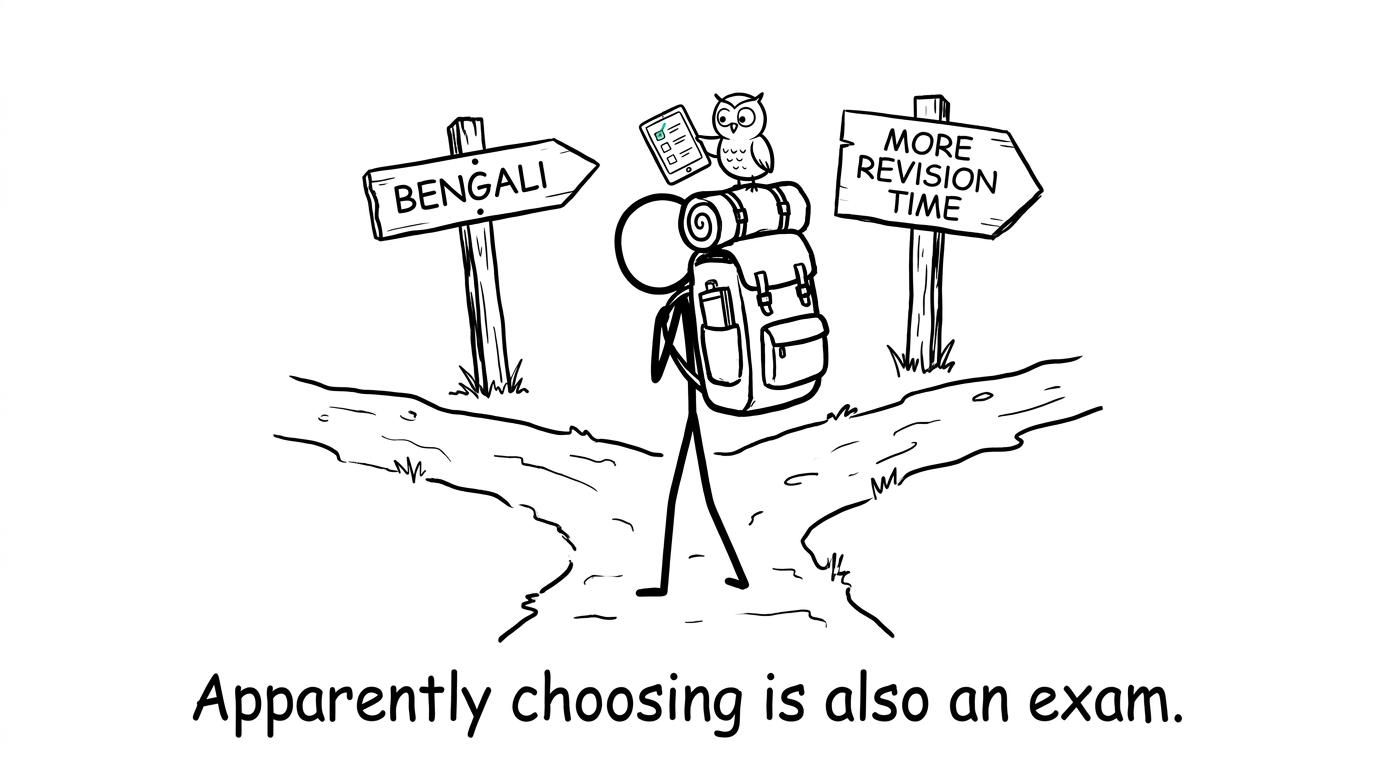 A student choosing between Bengali and more revision time
What does GCSE Bengali involve?
The current AQA GCSE Bengali qualification, specification code 863886388638, is a linear GCSE. Students complete all assessments in the same summer series and take four components:
| Component | Weighting | What it assesses |
|---|---|---|
| Listening | 25%25\%25% | Understanding and responding to spoken Bengali |
| Speaking | 25%25\%25% | Communicating and interacting in Bengali |
| Reading | 25%25\%25% | Understanding written Bengali, including translation into English |
| Writing | 25%25\%25% | Producing written Bengali and translating into Bengali |
It has Foundation and Higher tiers. Foundation targets grades 111 to 555, while Higher targets grades 444 to 999. All four components must be taken at the same tier.
The content covers identity and culture; local, national, international and global interests; and current and future study and employment. That means being able to discuss more than family routines. You may need language for technology, festivals, social issues, travel, education and future plans.
Assessment arrangements can change over time, and an International GCSE in Bengali or Bangla is not automatically the same qualification. Confirm the exact awarding body, specification and entry route with your school before planning revision.
The strongest reasons to take GCSE Bengali
It gives formal recognition to a real skill
A language used at home can become almost invisible. You may not think of it as an academic strength because it feels ordinary. A GCSE provides recognised evidence that you can communicate across several skills rather than simply hold an informal conversation.
AQA GCSE Bengali is a full grades 999 to 111 qualification. Government qualification data also includes it in current key stage 444 performance information. That does not make it more important than your core GCSEs, but it does mean it is a genuine qualification rather than an informal language certificate.
It can deepen your command of the language
Speaking Bengali and studying Bengali are related, but they are not identical. Exam preparation can develop accurate script, broader vocabulary, formal registers and the ability to discuss unfamiliar topics.
This may strengthen communication with relatives and Bengali-speaking communities. It can also preserve a skill that becomes harder to develop once school, work and other commitments become busier.
Existing fluency may reduce the learning curve
If you already listen, speak, read and write regularly, much of the underlying language may be familiar. Your preparation can then focus on exam technique, topic vocabulary and accuracy instead of learning everything from the beginning.
That advantage should not be exaggerated. A fluent speaker can still lose marks through weak spelling, limited formal vocabulary or answers that do not address every bullet point. Familiarity gives you a head start, not a guaranteed grade.
It may complement future interests
Bengali can be relevant to community work, education, interpreting, translation, public services, journalism and international interests. No single GCSE determines a career, and requirements vary between courses and employers. Still, combining language ability with strong English and maths can create a useful profile.
The most reliable value is simpler: you finish school with stronger literacy in a language that matters to you.
The honest disadvantages
Home fluency may hide gaps
The greatest trap is assuming that speaking Bengali makes the GCSE easy. Some students use a regional variety at home, rely on English words in conversation or have had little practice reading formal passages. None of this makes their Bengali less meaningful, but it can create an exam gap.
Writing usually exposes that gap fastest. You need sufficient accuracy, range and organisation to communicate clearly under timed conditions. Translation also demands careful meaning rather than word-by-word substitution.
Finding support can be difficult
Not every school teaches GCSE Bengali. Some schools may facilitate an entry without offering regular lessons, while others may not have an appropriate examiner or timetable for the speaking assessment. External tuition may involve travel, cost or extra weekend commitments.
Ask early about teaching, mock assessments, speaking practice, entry deadlines and fees. Do not build your plan around assumptions about what your school can arrange.
It still consumes revision time
An extra GCSE is not free simply because you know the language. You may need to learn vocabulary, practise extended writing, complete listening tasks and receive feedback on speaking. There is no universal number of hours because the workload depends heavily on your starting point.
This matters for students preparing for maths. An extra qualification becomes poor value if it repeatedly replaces work on algebra, ratio, geometry or exam papers that you genuinely need. Start from the free GCSE Maths Revision hub and identify whether your current maths workload is secure before adding another subject.
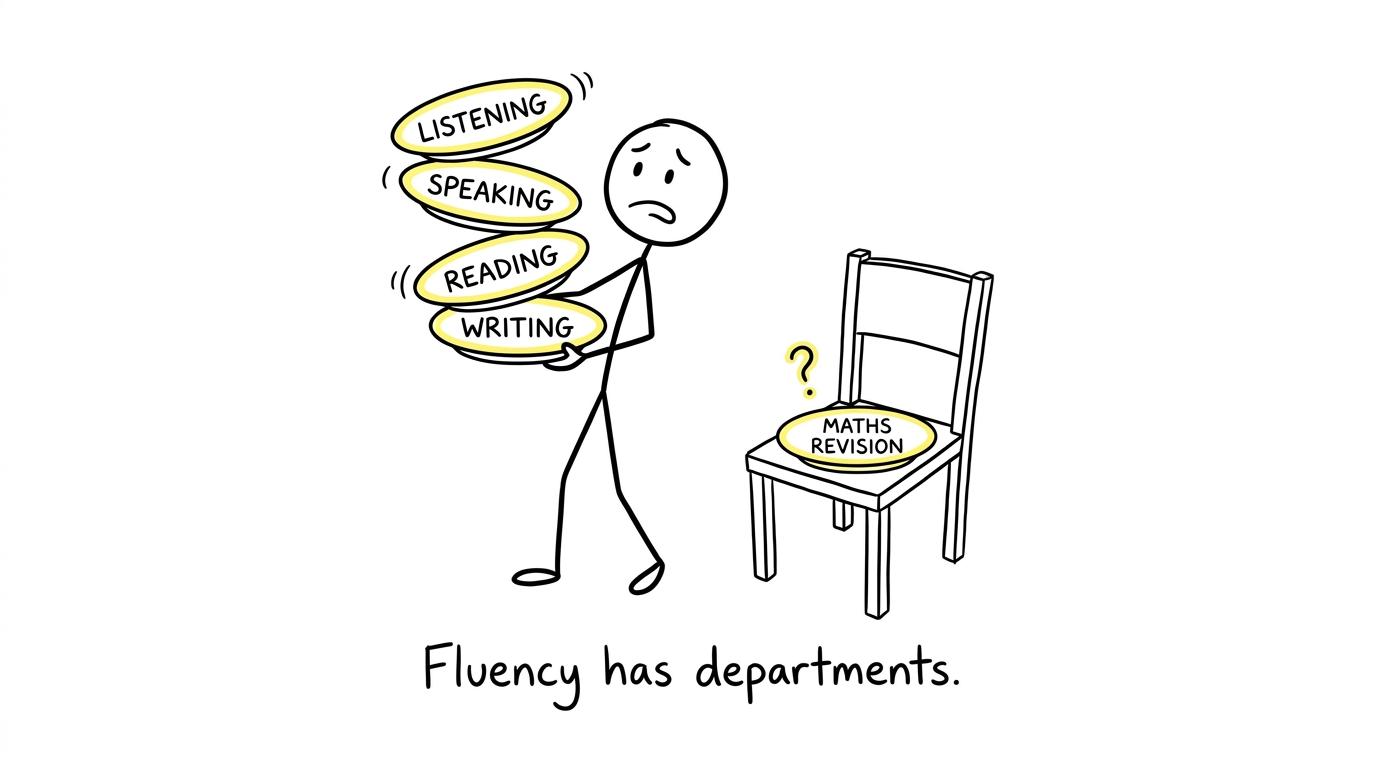 A student balancing the four Bengali skills and maths revision
How much work will GCSE Bengali actually take?
Think in terms of gaps rather than hours. Before deciding, assess yourself in four separate areas:
- Listening: Can you follow different speakers discussing school, technology, travel and social topics?
- Speaking: Can you respond spontaneously, justify opinions and move between time frames?
- Reading: Can you understand formal script without depending on context for every sentence?
- Writing: Can you produce organised, accurate responses under timed conditions?
If all four are secure, preparation may be relatively contained. If speaking is strong but literacy is weak, the course can require substantial, regular work. A paper completed under realistic conditions and reviewed by a qualified teacher will tell you more than confidence alone.
Protect your maths time by planning both subjects together. The GCSE maths revision timetable guide explains how to combine topic work, marking and timed practice without creating an unrealistic week. If you are not ready for full papers, follow the phased approach in when to start GCSE past papers.
How to decide without regretting it later
Check the practical details first
Ask your school or centre:
- Which qualification and specification will I take?
- Will I be entered for Foundation or Higher tier?
- Who will teach me and assess my speaking?
- Will I receive marked writing and speaking feedback?
- Are there entry fees or sessions outside the normal timetable?
- Can I see a past paper before committing?
These answers can matter more than the subject title. A supported entry and an unsupported entry are very different experiences.
Compare the opportunity cost
Look honestly at your current subjects. If maths is absorbing significant revision time, use MathsGenie's free revision lessons and questions to identify the scale of your gaps. Students taking Edexcel can also use the guide to efficient Edexcel GCSE maths revision, while CCEA students can find board-specific resources in the CCEA GCSE Maths Revision hub.
A useful question is not, “Could I pass Bengali?” It is, “Can I prepare for Bengali while still doing the work required for my other target grades?”
Run a short trial
Before making a final commitment, try a limited period of realistic preparation. Complete sections from an official past paper, attempt timed writing and hold a practice conversation covering specification themes. Ask a teacher to identify your weakest component.
The trial should produce evidence: what needs improving, what support exists and whether the weekly workload is sustainable. Enthusiasm matters, but evidence makes the decision calmer.
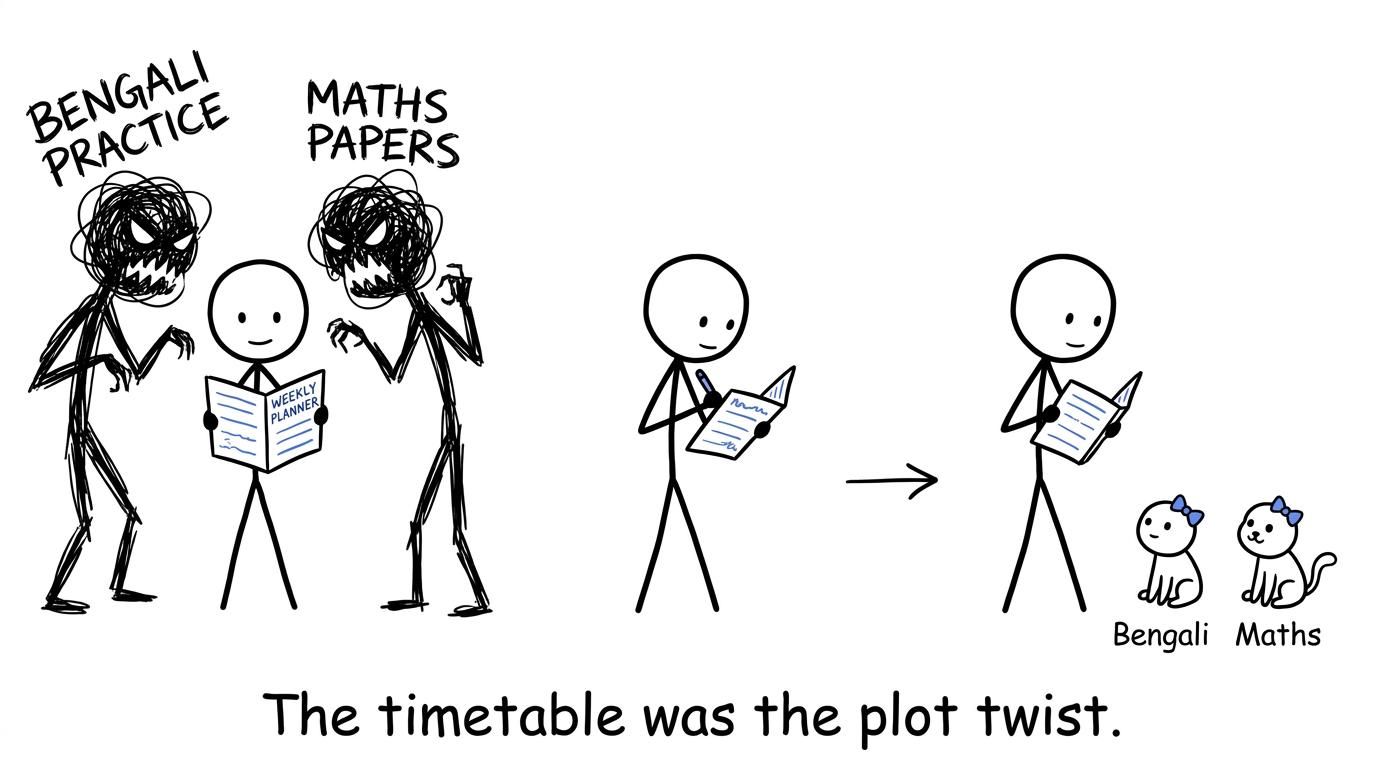 A revision timetable taming two friendly workload monsters
Common mistakes when choosing GCSE Bengali
Treating conversation as complete exam readiness
Everyday speaking does not prove that reading and writing are secure. Test all four skills separately before judging the likely workload.
Choosing it only because it seems like an easy grade
No GCSE grade is automatic. The best reason to take Bengali is that your skills and available support make success realistic, not that somebody has described it as easy.
Ignoring the exact qualification
GCSE, International GCSE and different specifications can have different papers and assessment structures. Revise from the materials for the qualification on your entry confirmation.
Starting formal writing too late
Writing improves through feedback and correction. Memorising generic paragraphs shortly before the exam is less reliable than building accurate responses across the required themes.
Sacrificing core-subject revision
An additional GCSE should add value rather than create avoidable gaps elsewhere. Use mini tests, practice questions and mark schemes to keep track of maths weaknesses instead of assuming they will resolve themselves.
So, is GCSE Bengali worth it?
GCSE Bengali is worth taking when three things align: you have a strong enough starting point, reliable exam support and room in your revision timetable. It can recognise bilingual ability, improve literacy and add a meaningful qualification. It is less attractive when reading and writing require major rebuilding, support is uncertain or the workload threatens essential progress in maths and English.
Make the choice from evidence. Check the specification, attempt real assessment material and ask for informed feedback. Then give every subject a clear place in your week.
For maths, begin with the MathsGenie GCSE revision hub. Use revision lessons and practice questions to repair topic gaps, mini tests to check recall, and past papers with mark schemes and video solutions to develop exam technique. Nearer the exams, predicted papers can sharpen your preparation. A good subject choice should make your plan clearer and MathsGenie gives you the free tools to keep maths firmly on track.











