

Is GCSE Bengali Hard? What Students Really Say
Is GCSE Bengali hard? Get a straight answer on speaking, writing, home fluency, tiers and revision, plus a realistic plan alongside GCSE maths.
The unsettling thing about taking a home language at GCSE is that everyone assumes it will be easy. You may speak Bengali with relatives every day, yet still hesitate when asked to read a formal passage, spell accurately or discuss environmental issues under exam conditions.
So, is GCSE Bengali hard? The straight answer is: it can be challenging, even for students who speak Bengali at home, but it is manageable if you can read and write the script and prepare for the exact assessment tasks. Home fluency gives you a valuable head start. It does not automatically provide formal vocabulary, accurate writing or exam technique.
Public student discussions about GCSE Bengali are relatively sparse, so sweeping claims such as “everyone finds it easy” are not credible. The discussions that are available commonly focus on finding suitable resources, preparing for speaking and bridging the gap between conversational Bengali and the standard language expected in an exam. That pattern also makes sense when compared with the official assessment structure.
The quick difficulty checklist
GCSE Bengali is likely to feel more manageable if you can already:
- read Bengali script without translating letter by letter
- write complete sentences with reasonably secure spelling
- understand Bengali spoken at different speeds
- use vocabulary beyond family conversation
- express opinions and give reasons
- practise speaking without relying on memorised paragraphs
It is likely to feel harder if you mainly speak a regional or informal variety at home, rarely write in Bengali, or are entering the qualification with very little teaching support.
The key distinction is simple: speaking a language and sitting an examination in it are related skills, not identical ones.
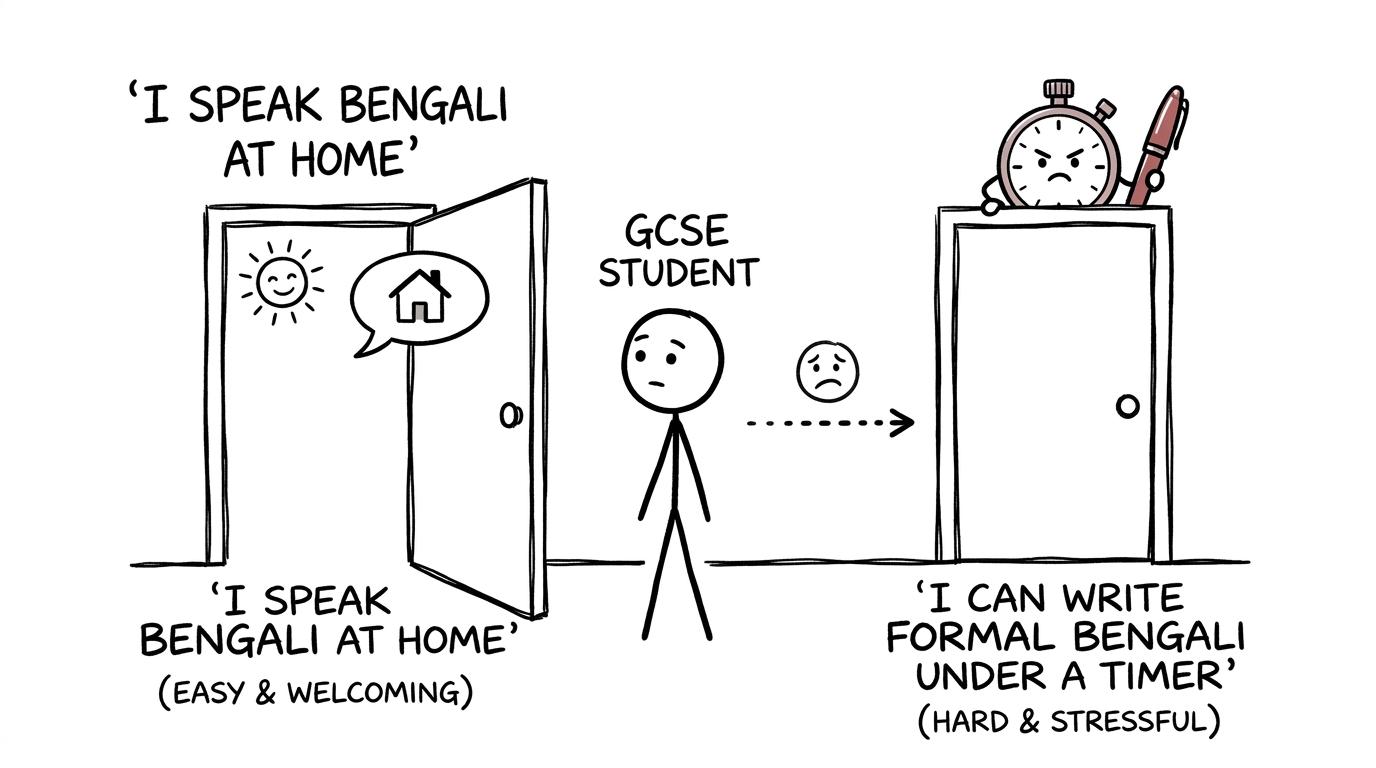 A student discovers that home fluency and formal exam writing lead through rather different doors
What does GCSE Bengali actually assess?
The current AQA GCSE Bengali specification assesses four skills:
- listening
- speaking
- reading
- writing
Each skill contributes approximately 25%25\%25% of the qualification. It is a linear GCSE, so the assessments are completed at the end of the course in the same exam series.
Students enter either Foundation or Higher tier for all four skills. Foundation targets grades 111 to 555, while Higher targets grades 444 to 999. This is different from choosing a separate tier for each paper.
The content is broader than everyday conversation. Topics include identity and culture, technology, free time, customs, local and global issues, travel, education and employment. A student who chats confidently about food and family may still need to learn how to discuss pollution, voluntary work or future career plans.
Be careful with qualification names. AQA GCSE Bengali and Pearson Edexcel International GCSE Bangla are different qualifications with different assessment arrangements. Ask your school which specification and tier you are taking before downloading resources or planning revision. OCR and Eduqas are familiar names in GCSE maths, but that does not mean they provide the Bengali qualification your school has entered.
What students' concerns reveal about the real difficulty
There is no large, representative survey telling us exactly how Bengali candidates rate the subject. Online comments are anecdotal and should be treated that way. Still, the questions students ask reveal several genuine pressure points.
Home Bengali may differ from exam Bengali
A student can be fluent in family conversations while being less comfortable with the standard form expected in formal speaking and writing. Regional vocabulary, pronunciation and sentence patterns may not always match the language used in textbooks, recordings and mark schemes.
This does not make home Bengali “wrong”. It means the exam requires an additional register. The challenge is similar to moving from informal spoken English to a carefully structured English Language response: familiarity helps, but the context changes what counts as a strong answer.
Writing is often the hidden obstacle
Speaking can disguise gaps because listeners use context, gesture and shared knowledge. Writing exposes them. You must recall the script, choose spellings, organise ideas and use grammar accurately without help from the listener.
Higher-tier writing also demands more developed responses and translation. Students aiming for the top grades need range and accuracy, rather than a collection of safe sentences repeated for every topic.
If writing feels disproportionately difficult, that is not evidence that you are “bad at Bengali”. It usually means your receptive and spoken knowledge is ahead of your written production. That gap can be trained.
Listening removes control
In conversation, you can ask somebody to repeat or explain. In a listening assessment, you must follow the recording and identify the information the question requires. Unfamiliar voices, pace and topic vocabulary can make a familiar language feel suddenly less familiar.
Regular listening practice is therefore essential, including material beyond the voices you hear at home. The aim is not simply to understand the general topic. It is to retrieve precise details while reading questions and managing time.
Speaking feels harder when it is assessed
The AQA speaking assessment includes a role-play, a photo-card task and a general conversation. Students have preparation time, but the conversation must still sound responsive rather than like a script being recited.
Pressure changes performance. Someone who speaks naturally at home may freeze when an answer is being marked. The best preparation is repeated, realistic practice: answer unseen questions, extend responses, offer opinions and recover calmly when you do not understand something immediately.
So how hard is it compared with other GCSEs?
There is no honest universal ranking. GCSE Bengali may require less initial language learning for a fluent home speaker than a language started from the beginning at school. Yet it can demand more independent preparation if lessons and revision materials are limited.
Your personal difficulty depends mainly on three gaps:
- the literacy gap between speaking and writing
- the register gap between home language and formal standard Bengali
- the exam gap between knowing Bengali and knowing how marks are awarded
Grade boundaries do not prove that a subject is easy. They are set after the papers have been taken and can change between exam series. For context, AQA Bengali is marked on a scaled total of 240240240. In June 2025, the Higher boundaries were 202202202 for grade 999, 152152152 for grade 777 and 102102102 for grade 555. The Foundation grade 555 boundary was 129129129. You can check the latest figures on the MathsGenie AQA GCSE Bengali grade boundaries page.
Those figures describe one exam series. They do not predict your result, and they certainly do not replace practice.
How to make GCSE Bengali feel easier
The most effective plan separates language knowledge from exam performance.
Diagnose all four skills honestly
Give listening, speaking, reading and writing separate confidence ratings. Then test those judgements with specification-matched assessment material from your teacher or exam board.
A student who says “Bengali is fine” may discover that speaking is strong but timed writing is fragile. That is useful information. Revision becomes much easier once the weakness has a name.
Build topic vocabulary in complete phrases
Avoid learning isolated words only. Learn vocabulary inside short, reusable phrases that include opinions, reasons, comparisons and time frames. Review both recognition and recall: seeing a word and understanding it is easier than producing it independently.
Organise vocabulary around the specification themes. Family language alone will not cover technology, social issues, the environment, education and careers.
Practise production, not just recognition
Reading notes creates familiarity, but exams require retrieval. Write from memory. Record spoken answers. Translate short passages. Listen once without pausing, then check what you missed.
Use a simple cycle:
- attempt an exam task
- mark it or obtain teacher feedback
- identify one precise weakness
- practise that weakness
- repeat the task later without notes
This is the same disciplined loop that makes maths revision effective. The GCSE MathsGenie revision hub organises maths into revision lessons, practice questions and assessment resources because improvement usually comes from short feedback cycles, not passive rereading.
Rehearse speaking as interaction
Prepare ideas, not a single rigid script. For each topic, practise giving an opinion, supporting it with a reason, referring to another time frame and asking a relevant question.
Ask a teacher or confident Bengali speaker to vary the wording. If you can only answer one memorised version of a question, the knowledge is not yet flexible enough.
Balancing Bengali with GCSE maths revision
Bengali may be an additional qualification, but it competes for the same limited evenings as maths, science and English. The answer is not to abandon maths for a week and then abandon Bengali the next. Use small, repeatable sessions.
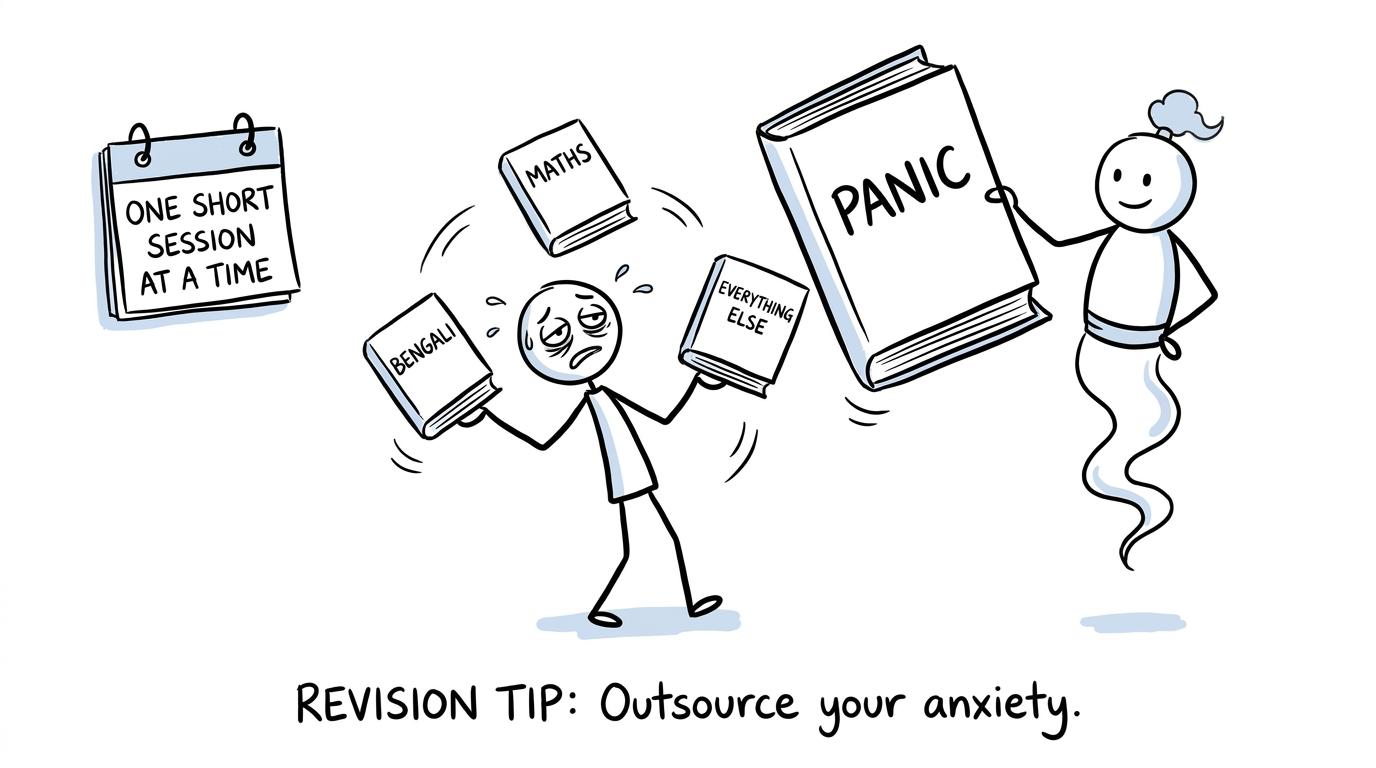 A student tries to juggle Bengali, maths and everything else while revision panic is quietly removed
A practical weekly rhythm could include several short Bengali sessions for vocabulary, listening and speaking, alongside protected maths sessions. The MathsGenie GCSE revision timetable guide explains how to combine topic practice with timed papers without making every evening feel endless.
On especially busy days, use the MathsGenie 202020-minute maths revision routine to keep maths moving while Bengali receives more attention. A short maths mini test is better than losing contact with the subject completely. The Edexcel GCSE maths mini tests are useful for focused, timed practice if that is your board.
As exams approach, use GCSE maths past papers with mark schemes to protect your exam technique. Then add fresh questions from the GCSE predicted papers collection. Predicted papers should supplement official past papers, not replace them.
The purpose of a revision planner is not to fill every empty hour. It is to stop one worrying subject from consuming all the others.
Common mistakes when preparing for GCSE Bengali
Assuming home fluency guarantees a high grade
Conversation is an advantage, not a complete revision plan. Test reading, spelling, translation and formal vocabulary early.
Revising the wrong qualification
GCSE Bengali and International GCSE Bangla do not share identical papers. Confirm your awarding body, specification and tier with your school.
Memorising one answer per topic
A perfect paragraph may collapse when the examiner changes the question. Learn flexible language and practise responding to unfamiliar prompts.
Ignoring weaker skills
Because the four AQA skills each carry approximately 25%25\%25%, a serious weakness cannot simply be hidden behind confident speaking. Give extra time to the weakest component while maintaining the others.
Treating grade boundaries as targets
Boundaries change. Practise for the quality of response required by the specification and mark scheme rather than aiming at a past raw mark.
Letting Bengali revision replace maths completely
Maintain maths with short, active sessions. A mini test, a focused worksheet or part of a paper keeps methods retrievable. If you need a wider structure, the MathsGenie one-month GCSE maths revision plan provides a realistic progression from diagnosis to timed practice.
The honest conclusion
GCSE Bengali is not automatically easy because you hear or speak Bengali at home. For many students, the difficult parts are formal writing, accurate spelling, unfamiliar listening and producing flexible answers under assessment pressure. For students with secure literacy and regular exposure to standard Bengali, it can be very manageable.
The most useful question is therefore not simply whether GCSE Bengali is hard. Ask which part is hard for you. Diagnose that skill, practise it under exam conditions and seek feedback before the gap becomes urgent.
Meanwhile, keep maths steady. Use MathsGenie as your free revision base for revision lessons, practice questions, mini tests, past papers, predicted papers, mark schemes and video solutions. Choose one Bengali task and one maths task today. Small, finished sessions build more confidence than a perfect plan that never begins.











