Is GCSE Bengali EBacc Eligible? What It Means
Is GCSE Bengali EBacc eligible? Yes. Learn how it fills the language pillar, what else you need, and how to balance subject choices with maths revision.
Choosing GCSE options can feel oddly permanent. One form asks you to compress your interests, strengths and future plans into a handful of boxes. Then unfamiliar terms such as “EBacc” make the decision sound even more complicated.
If you searched is GCSE Bengali EBacc, the short answer is yes: an approved full-course GCSE in Bengali can count towards the language pillar of the English Baccalaureate in England. It does not complete the EBacc by itself. You must also enter the required qualifications in English, maths, science and either history or geography.
That distinction matters. Bengali can be the right language for the EBacc, but only when the exact qualification is eligible and your complete subject combination covers every pillar.
The quick EBacc checklist
Before making or changing your options, confirm the following:
- You are taking both GCSE English language and GCSE English literature.
- You are taking GCSE maths.
- Your science route meets the EBacc requirements.
- You are taking GCSE history or geography.
- You are entered for an approved full-course GCSE in Bengali.
- Your school or examination centre can provide the necessary teaching, assessment and entry arrangements.
- You have checked the current Department for Education eligible-qualifications list for your examination year.
The EBacc applies as an English school performance measure. Arrangements and terminology elsewhere in the UK may differ, so students in Wales, Scotland or Northern Ireland should follow the guidance relevant to their qualification system.
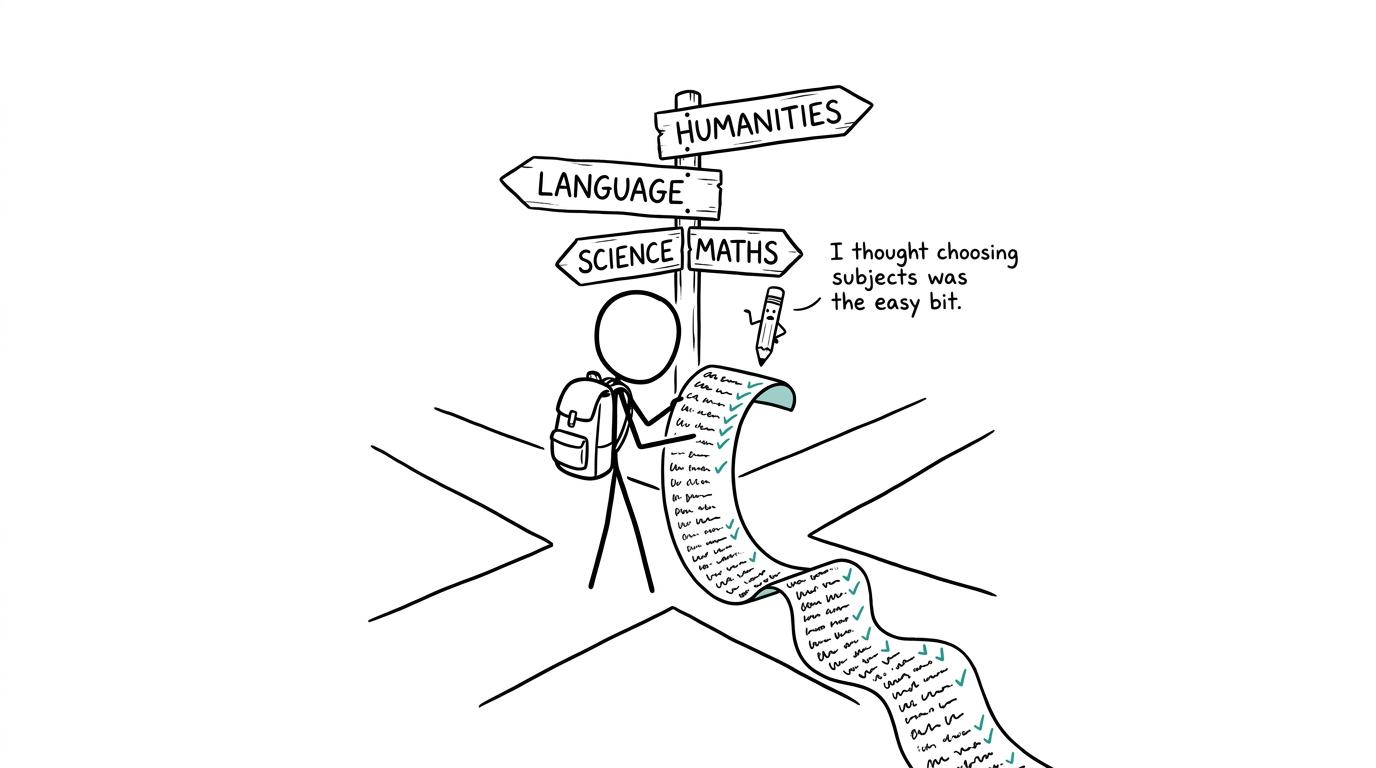 A student facing a surprisingly complicated GCSE options crossroads
Why GCSE Bengali counts towards the EBacc
The language pillar is not limited to French, German and Spanish. Department for Education guidance allows eligible modern and ancient language qualifications to count, including less widely taught languages such as Bengali.
AQA currently offers GCSE Bengali. Its full-course qualification has foundation and higher tiers, although you should always confirm the specification, entry code and examination series with your school. A GCSE in Bengali is different from a similarly named International GCSE in Bangla, so the title “Bengali” or “Bangla” alone is not enough to establish EBacc eligibility.
This is the practical rule:
The qualification must appear on the approved EBacc list for the year in which it is counted.
Ask your examinations officer or head of languages to confirm the exact awarding organisation and qualification number. This is particularly important if you are entering through another school, a community language programme or a private examination centre.
What the EBacc actually is
The English Baccalaureate is not a separate course, examination or certificate. It is a combination of academic subjects and a measure used in England to report pupils’ entry and attainment at Key Stage 4.
Its five pillars are:
| EBacc pillar | Required subject route |
|---|---|
| English | GCSE English language and GCSE English literature |
| Maths | GCSE mathematics |
| Science | Combined science or an eligible combination of separate sciences |
| Humanities | GCSE history or GCSE geography |
| Languages | An eligible modern or ancient language qualification |
Taking Bengali can therefore satisfy the language part. It cannot replace history or geography, and it does not replace either English qualification.
For the EBacc attainment measure at grade 555 or above, the relevant grades across all five pillars must meet the required standard. Simply entering the subjects is different from achieving the attainment threshold. Schools also report an EBacc average point score, which reflects performance across the pillars rather than creating a new qualification for the pupil.
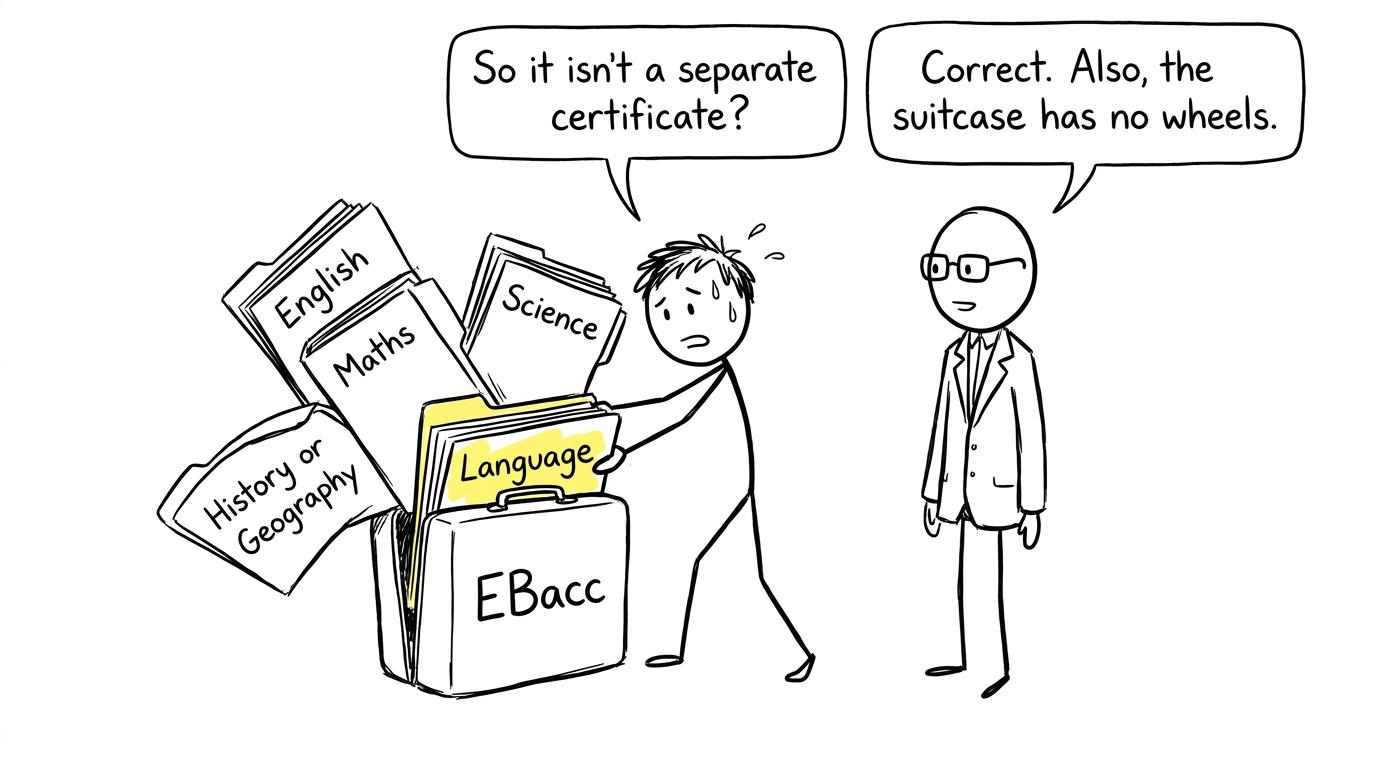 A student packing the five EBacc subject pillars into a suitcase
What GCSE Bengali means for your school options
A subject can count towards the EBacc even when your school does not teach it as a normal timetabled option. Eligibility and availability are separate questions.
Some schools may teach Bengali directly. Others may support an entry for students who already read, write, listen and speak the language confidently. In some areas, teaching or assessment may be arranged through another centre. None of these arrangements should be assumed.
Before selecting Bengali, ask:
- Does the school offer lessons, or only examination entry?
- Which exam board and specification will I take?
- Who will prepare me for each assessed skill?
- Where will any speaking assessment take place?
- Are there deadlines, fees or travel arrangements for an external centre?
- Will Bengali occupy one of my option blocks or be taken additionally?
- Does my remaining timetable include history or geography?
Being fluent in everyday conversation can provide a strong foundation, but a GCSE assesses more than informal speaking. You need to understand the specification, write accurately for different purposes, interpret written and spoken material, and work under examination conditions.
The sensible choice is not automatically the subject that sounds easiest. It is the subject for which you can access proper preparation and produce reliable performance across the assessment.
Does choosing Bengali affect GCSE maths?
Bengali does not change your GCSE maths specification, tier or exam board. Whether you sit Edexcel, AQA, OCR or Eduqas, your maths preparation remains a separate part of the EBacc.
Yet subject choices do affect your time. A language requires regular retrieval and practice, while maths improves through repeated problem-solving. Both are difficult to rescue with passive revision in the final week.
Start by checking your board and tier against the GCSE maths topics by exam board and tier. Foundation tier provides access to grades 111 to 555, while higher tier provides access to grades 444 to 999. Your Bengali tier does not determine your maths tier; each entry should reflect your performance in that subject.
A balanced weekly routine might include:
- short Bengali vocabulary or grammar retrieval on several days;
- two focused maths topic sessions;
- one timed maths mini test or paper section;
- immediate marking and correction;
- a longer review of the weakest subject at the weekend.
You can create a realistic structure with the GCSE maths revision timetable guide. If you are unsure where to begin, follow the best order for learning GCSE maths topics rather than selecting topics randomly.
Keep maths secure while managing another language
The best revision plans reduce decisions. They tell you what to do next before tiredness gets a vote.
Use MathsGenie's free GCSE and A Level maths revision to choose one weak topic, watch the revision lesson and complete the related practice questions. Then check whether the method survives without help.
For a shorter assessment, use the Edexcel GCSE maths mini tests. Students following another board can still use overlapping mathematical content for additional practice, but board-specific papers should remain the main source for examination format and wording.
When you move to full papers, do not merely count your total mark. Identify why each mark disappeared. The guide to using GCSE past papers properly explains how to turn errors into targeted revision.
Nearer the examinations, Edexcel GCSE maths predicted papers can add fresh timed practice. Predicted papers are revision tools, not promises about exact questions. Use their mark schemes and video solutions to find gaps, then return to the appropriate lesson and practice questions.
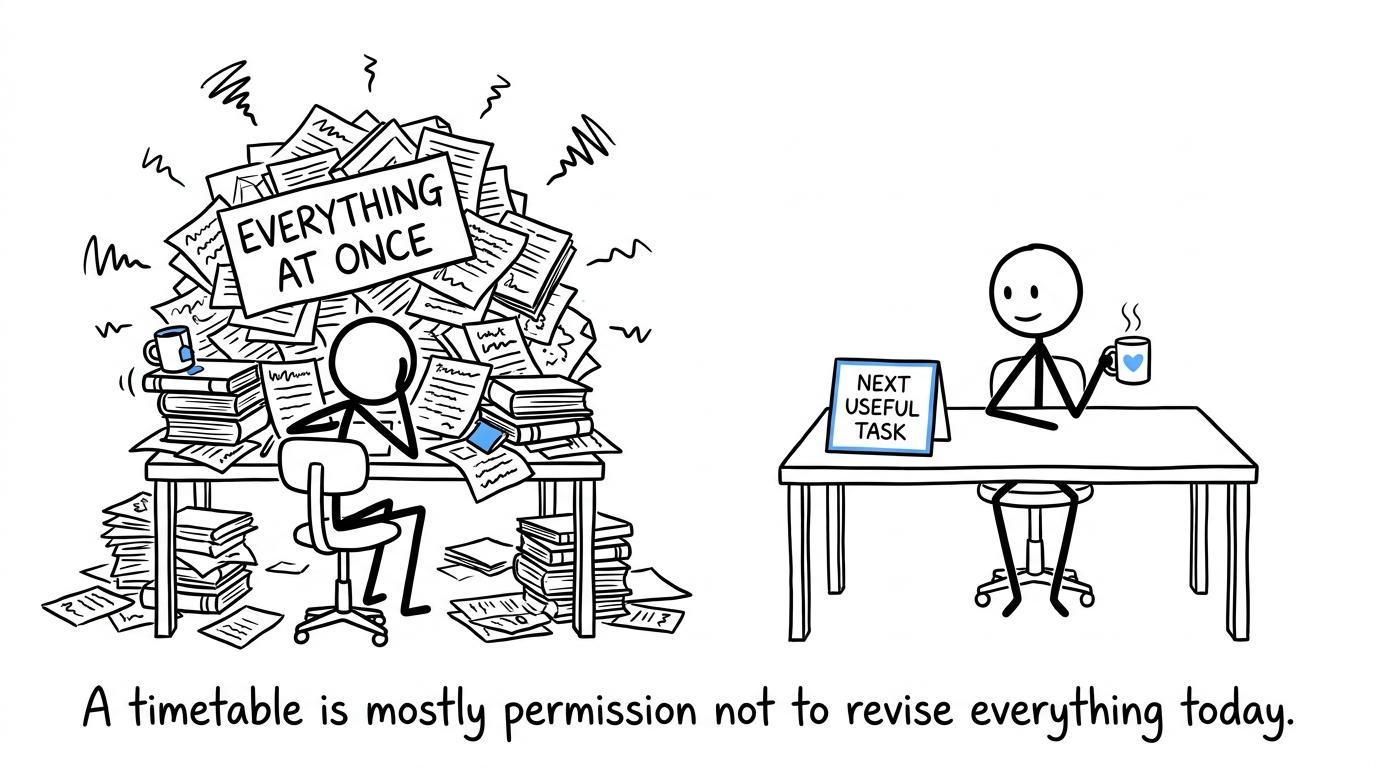 Two revision desks showing why one useful task beats everything at once
Common mistakes when considering Bengali and the EBacc
Assuming the EBacc is a separate qualification
You do not enrol on an additional EBacc course. Your combination of eligible GCSE entries determines whether you enter the measure.
Thinking any Bengali or Bangla qualification must count
GCSE, International GCSE and other language qualifications are not interchangeable. Check the exact qualification against the approved list for the relevant year.
Forgetting the humanities pillar
Bengali can cover the language pillar, but you still need history or geography. Religious studies, business and other valuable options do not replace that requirement.
Confusing entry with attainment
Taking all the subjects means entering the EBacc combination. Achieving the grade 555 threshold across the pillars is a different measure.
Assuming home fluency guarantees a high grade
Conversation at home does not automatically provide examination writing, formal vocabulary, translation accuracy or timed technique. Review the specification and complete appropriate past-paper practice.
Letting option research replace revision
Understanding your timetable is important, but it should not consume every evening. Once the decision is clear, return to the work that produces marks. The one-month GCSE maths revision plan offers a useful structure when examinations are approaching.
Make the choice from evidence, not assumptions
GCSE Bengali can be part of the EBacc and can satisfy its language pillar. What matters next is detail: the approved qualification, your school’s entry arrangements, the rest of your subject combination and your readiness for the assessment.
Speak to your options adviser, languages department and examinations officer before relying on Bengali for the EBacc. Once your subjects are settled, protect the compulsory part of the combination with consistent maths revision.
MathsGenie gives you a clear place to do that. Use the free revision lessons to understand each method, practice questions and mini tests to build accuracy, and past papers, predicted papers, mark schemes and video solutions to prepare for examination conditions. Make one useful decision about your options, then make the next useful decision about today’s revision.