Is GCSE Astronomy Harder Than Before?
GCSE astronomy harder than before? Compare past and current assessments, maths demands and exam pressure, then build a focused revision plan with MathsGenie.
A difficult Astronomy paper can make the subject feel as large and unmanageable as the universe it describes. There are unfamiliar terms, enormous distances, observational methods and calculations competing for your attention. So, is GCSE astronomy harder than before?
The short answer is: the current qualification is genuinely more demanding in some important ways, but it has not simply become harder every year. The major change came with the reformed Pearson Edexcel GCSE, first taught in 2017 and first examined in 2019. Assessment moved entirely into written examinations, more content was introduced and mathematical and observational skills received explicit weightings. However, the old course had its own pressures, particularly assessed observational coursework.
Understanding that distinction matters. If the course feels difficult, it does not mean you are failing. You may simply be meeting a qualification that expects knowledge, calculation, application and evaluation to work together.
The answer at a glance
- The current Pearson Edexcel GCSE Astronomy is assessed through two written papers worth 100100100 marks each.
- The previous qualification used one written examination for 75%75\%75% of the grade and controlled assessment for the remaining 25%25\%25%.
- At least 20%20\%20% of marks in the current written examinations must assess mathematical skills.
- At least 15%15\%15% of the total examination marks assess knowledge and application of observational skills.
- Current students still complete at least one unaided and one aided observation, but the observations themselves do not contribute marks directly to the final grade.
- The qualification remains untiered, so there is no separate foundation or higher paper.
- Pearson stated when the reformed course was introduced that new topics were intended to provide greater challenge.
That makes the present course more exam-heavy and, in several respects, more challenging. But comparing old and new raw marks alone cannot tell you that every modern paper is harder.
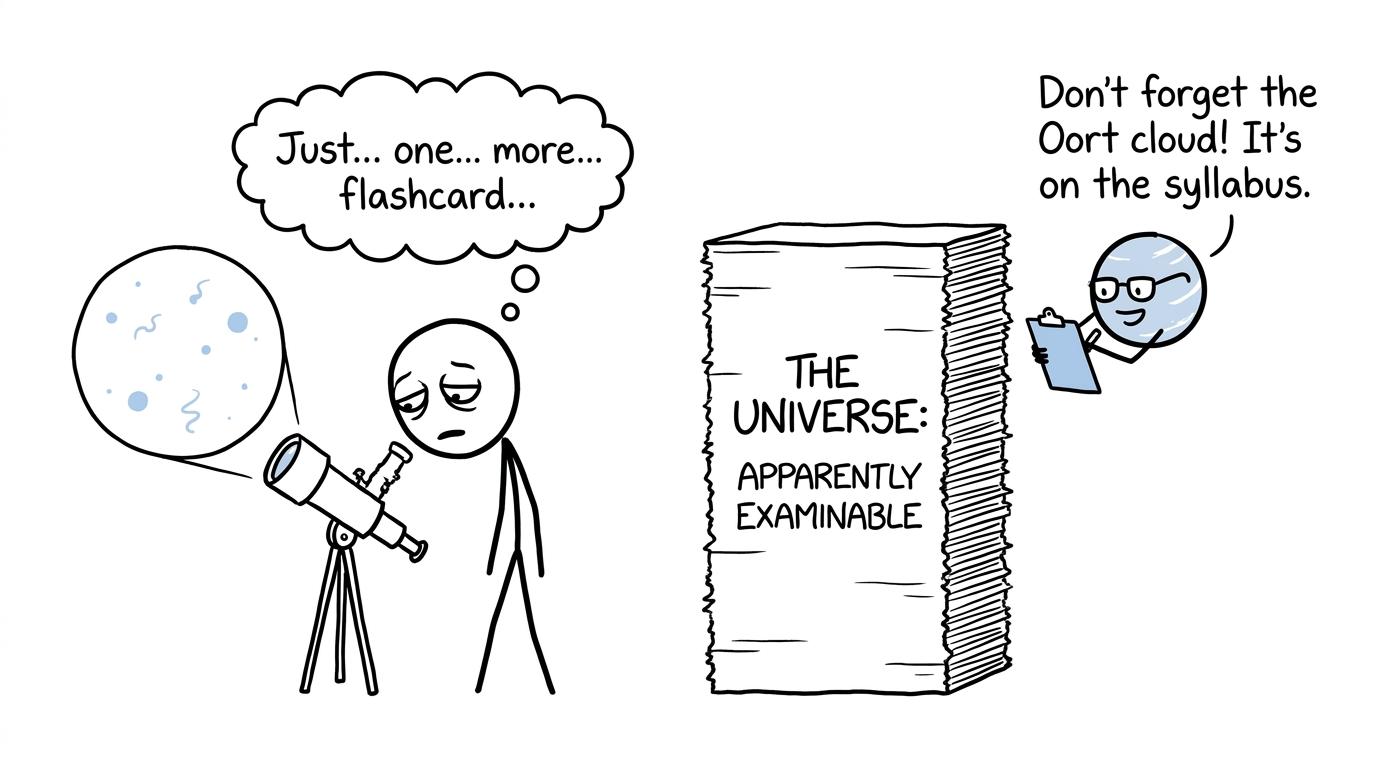 A student discovers that the universe is apparently examinable
What changed in GCSE Astronomy?
The clearest comparison is between the Pearson Edexcel specification used from 2009 and the reformed grades 9-1 specification used for assessment from 2019.
| Feature | Previous qualification | Current qualification |
|---|---|---|
| Grading | A* to G | 9 to 1 |
| Written examinations | One untiered paper lasting 2 hours | Two untiered papers, each lasting 1 hour 45 minutes |
| Examination marks | 120120120 marks | 200200200 marks in total |
| Examination weighting | 75%75\%75% | 100%100\%100% |
| Controlled assessment | Two observations worth 25%25\%25% | No marked coursework or controlled assessment |
| Observations | One aided and one unaided task, internally marked | At least one aided and one unaided observation, not directly marked towards the grade |
| Course structure | Examination plus controlled assessment | Linear, with both papers taken at the end of the course |
The total written examination time increased from 2 hours to 3 hours 30 minutes. That does not automatically prove that each individual question is harder, but it does mean students must demonstrate the entire course through examinations rather than earning part of the grade through internally assessed work.
The current papers also cover different halves of the specification. Paper 1, Naked-eye Astronomy, assesses the first eight topics. Paper 2, Telescopic Astronomy, assesses the remaining eight. Both papers can include multiple-choice questions, short answers, calculations, graphs and extended open responses.
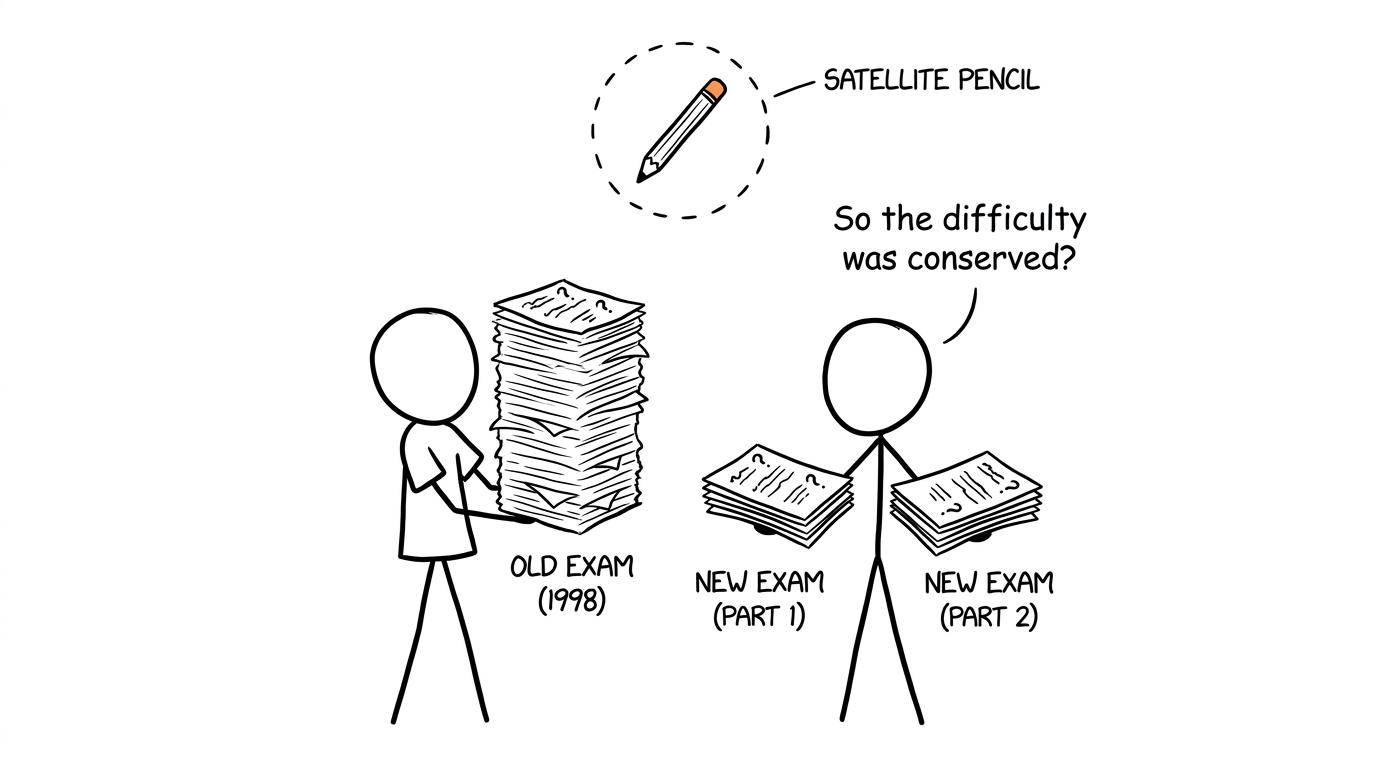 Students wonder whether exam difficulty has been conserved
Why GCSE Astronomy can genuinely be harder now
More depends on examination performance
Under the previous specification, controlled assessment contributed 25%25\%25% of the qualification. Students designed, completed, analysed and evaluated two observations under controlled conditions.
That work was demanding, but it gave students a different route to marks. The present qualification places the full grade on two end-of-course examinations. A student may understand practical astronomy well, yet still need to communicate that understanding accurately under timed conditions.
This concentrates risk. There is less opportunity for carefully prepared assessed work to balance an unexpectedly difficult examination day.
The reformed specification added challenge
Pearson’s report on the first 2019 assessment explained that most content remained similar to the previous course, while new topics were introduced to provide greater challenge. The current specification contains 161616 topics spanning the Earth-Moon-Sun system, planetary motion, stellar evolution, exoplanets, galaxies and cosmology.
The challenge is not just remembering a longer list. Questions may require students to connect ideas across topics, interpret unfamiliar information or decide whether an observational method is suitable.
Application matters as much as recall
The official assessment objectives divide the qualification into:
- AO1: knowledge and understanding, weighted at 40%40\%40%
- AO2: application of knowledge and understanding, weighted at 40%40\%40%
- AO3: analysis, evaluation and conclusions, weighted at 20%20\%20%
Only part of the course rewards direct recall. A large share asks you to use what you know in a context that may not look exactly like your notes.
This is why rereading can create false confidence. A definition may feel familiar on the page, but the examination might ask you to apply it to data, compare two methods or justify an improvement.
Why it may only feel harder
A qualification can feel more difficult without changing from one summer to the next. Several features of Astronomy amplify that feeling.
There is no foundation tier
GCSE Astronomy is untiered. Every candidate sits the same papers, including questions designed to distinguish across the full grades 9-1 range.
That is different from GCSE Maths with AQA, Edexcel, OCR or Eduqas, where students normally enter foundation or higher tier. Astronomy students will encounter demanding questions even if their target grade is more modest. You are not expected to find every question equally accessible.
The scale of the subject is unfamiliar
Everyday intuition is useful when estimating the length of a room. It is less useful when thinking about stellar distances, angular size or timescales extending far beyond human experience.
Astronomy therefore relies on mathematical representations. Large and small quantities are often expressed as
a×10n,1≤a<10.a \times 10^n, \qquad 1 \leq a < 10.a×10n,1≤a<10.If powers of ten are insecure, an astronomy problem can appear scientifically confusing when the real obstacle is numerical fluency. MathsGenie’s standard form revision guide and standard form practice resources can help separate the maths difficulty from the astronomy difficulty.
Old and current grades are not directly interchangeable
The move from A*-G grades to grades 9-1 was part of wider GCSE reform. A grade 9 is not simply a renamed A*, and raw mark boundaries can vary between examination series.
A lower boundary in one year does not prove that the whole qualification has permanently become harder. Awarding processes are intended to account for differences in paper demand. The more reliable comparison is the structure and specification, not isolated mark totals shared online.
The maths that makes Astronomy manageable
At least 20%20\%20% of the current examination marks assess mathematical skills. Strengthening GCSE Maths can therefore make Astronomy feel noticeably more controlled.
Prioritise:
- standard form and powers of ten
- substitution and rearranging formulae
- ratio, scale and proportional reasoning
- angles, bearings and basic geometry
- interpreting tables and graphs
- gradients and rates of change
- significant figures, units and sensible rounding
- calculator accuracy and multi-step working
Do not revise these as disconnected procedures. Practise identifying the operation hidden inside a scientific description. The question may provide more information than you need, so selecting relevant data is part of the skill.
The GCSE Maths revision hub lets you choose your exam board and build these foundations through revision lessons, questions and worksheets. If several skills feel insecure, the best order for learning GCSE Maths topics provides a sensible route from number fluency to graphs and geometry.
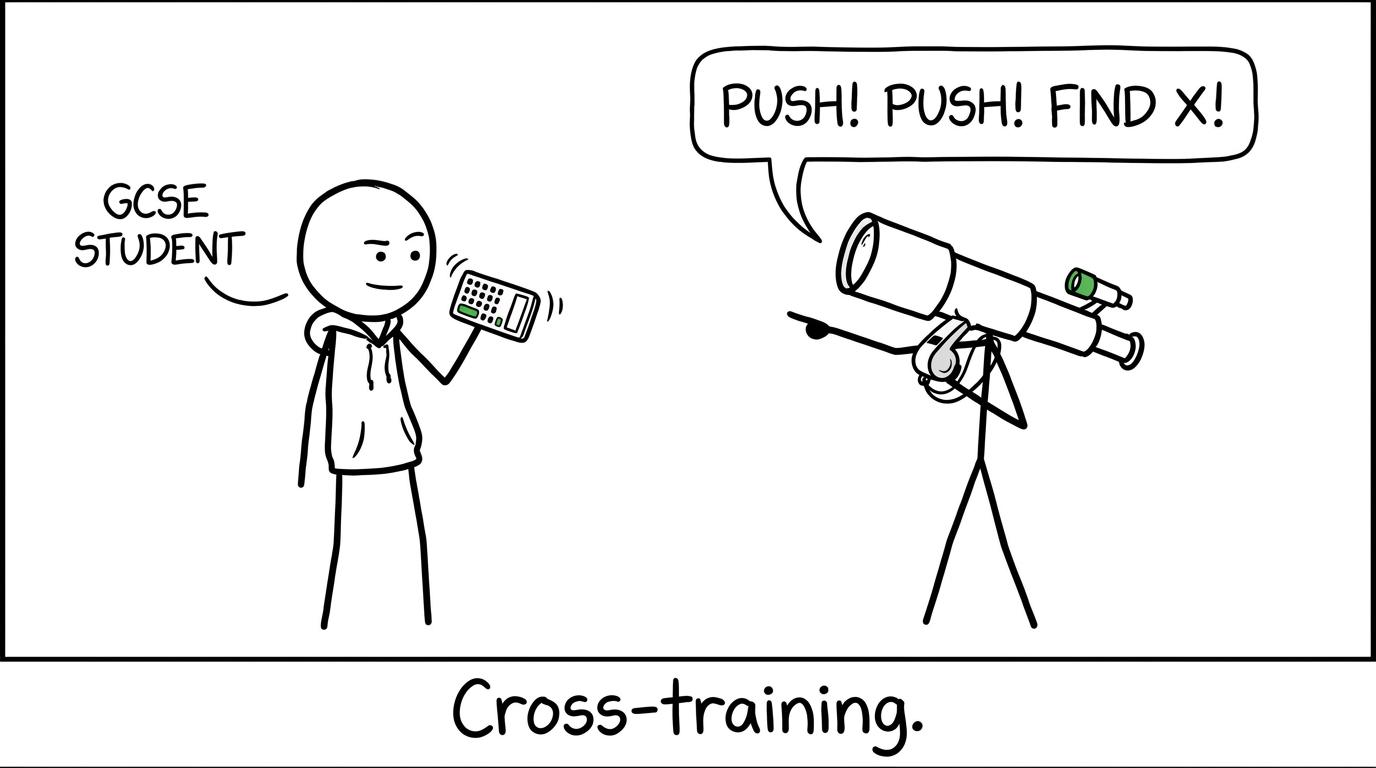 A calculator and telescope try cross-training
A practical revision strategy
Separate knowledge from performance
Create two lists. The first should contain astronomy content you cannot explain confidently. The second should contain exam skills that cost marks, such as interpreting graphs, evaluating methods or handling standard form.
This prevents a common mistake: revising the entire topic when only one supporting skill is weak.
Use observations as examination preparation
Although observations are no longer directly marked towards the final grade, they are not optional decoration. The current course requires aided and unaided observational work, and observational knowledge is assessed in the examinations.
For each activity, be ready to explain:
- what was observed and why
- which equipment or method was used
- what variables or conditions affected the result
- likely sources of uncertainty
- how the procedure could be improved
- whether the conclusion is supported by the evidence
The experience becomes valuable when you can reason about it, not merely remember completing it.
Build a paper-and-repair cycle
Use current Astronomy materials supplied by Pearson or your school because old-specification papers do not match the present assessment structure. After each timed section, classify lost marks as knowledge, application, maths, observation, communication or time management.
Then repair the exact weakness. MathsGenie’s GCSE Maths worksheets are useful when an Astronomy paper exposes a numerical gap. The approach in how to use past papers properly also transfers well: sit, mark, diagnose, repair and retest.
If you are preparing for Astronomy alongside Maths, use a realistic schedule rather than allowing the more unusual subject to consume every evening. The GCSE one-month revision plan shows how to combine focused topic work with timed practice.
Common mistakes when judging and revising the course
Assuming two papers automatically mean twice the difficulty. The assessment time increased, but the content is divided between papers. Structure, question demand and assessment weighting matter more than paper count alone.
Using old papers without checking the specification. Pre-reform questions can provide extra practice, but the old paper structure and controlled assessment rules no longer represent the current qualification.
Treating observations as irrelevant because they are not marked directly. Observational skills still account for at least 15%15\%15% of examination marks.
Memorising facts while avoiding calculations. Mathematical skills account for at least 20%20\%20% of the written assessment, so weak number work cannot safely be left until the final week.
Confusing a hard question with a hard grade boundary. Untiered papers must contain questions across a broad range of demand. Finding the final questions difficult is not evidence that you have failed.
Rounding too early or omitting units. Keep full calculator values during multi-step calculations, round at the end and check that the final unit answers the question.
So, is GCSE Astronomy harder than it used to be?
Compared with the previous Pearson Edexcel qualification, the current GCSE is harder in identifiable ways: it is fully examination-assessed, contains additional challenge, requires substantial application and places explicit emphasis on maths and observational reasoning.
But the story is not simply that Astronomy gets harder every year. Some of the feeling comes from an untiered paper, unfamiliar scales and the need to combine several skills at once. Those are trainable problems.
Begin by checking the current specification with your teacher. Use current Astronomy papers to diagnose subject knowledge, then use MathsGenie to repair the mathematics beneath it. Start at the GCSE Maths revision hub, practise weak topics with lessons and questions, and use mark schemes and video solutions to understand where marks are earned. For your Maths exams, add Edexcel predicted papers, mini tests and past papers when you are ready for timed practice.
The universe remains large. Your revision plan does not need to be.