

Is GCSE Arabic Useful Without A-level?
GCSE Arabic useful without A-level? Explore its skills, EBacc value, college entry impact and how to balance Arabic with GCSE maths revision.
There is a particular kind of doubt that appears when revision time becomes scarce. You look at Arabic vocabulary on one side of your desk, a GCSE maths paper on the other, and wonder whether one subject matters more because you plan to continue it.
So, is GCSE Arabic useful without A-level Arabic? Yes. It remains a recognised GCSE, can contribute to the language component of the English Baccalaureate, may count towards a sixth form or college's general GCSE entry requirements, and demonstrates communication across listening, speaking, reading and writing. You do not need to take the subject at A-level for the qualification to retain its value.
That does not mean it should automatically dominate your timetable. Its practical value depends on your future plans, likely grade and local college requirements. The sensible question is not simply, "Will I continue Arabic?" It is, "What can this qualification contribute, and how should I revise for it alongside the subjects I need next year?"
The short answer: what GCSE Arabic gives you
If you complete GCSE Arabic but do not continue it, you can still gain:
- a full GCSE qualification on your academic record;
- evidence of listening, speaking, reading and writing ability;
- progress towards the language component of the EBacc;
- another potentially relevant GCSE for college entry totals;
- cultural and linguistic knowledge you can use outside formal education;
- experience of recalling information, interpreting unfamiliar material and communicating precisely.
The important qualification is that sixth forms and colleges set their own admissions rules. Some count any recognised GCSE towards a required total. Others specify particular subjects, grades or conditions for community languages. Always read the published criteria and ask the admissions team if the wording is unclear.
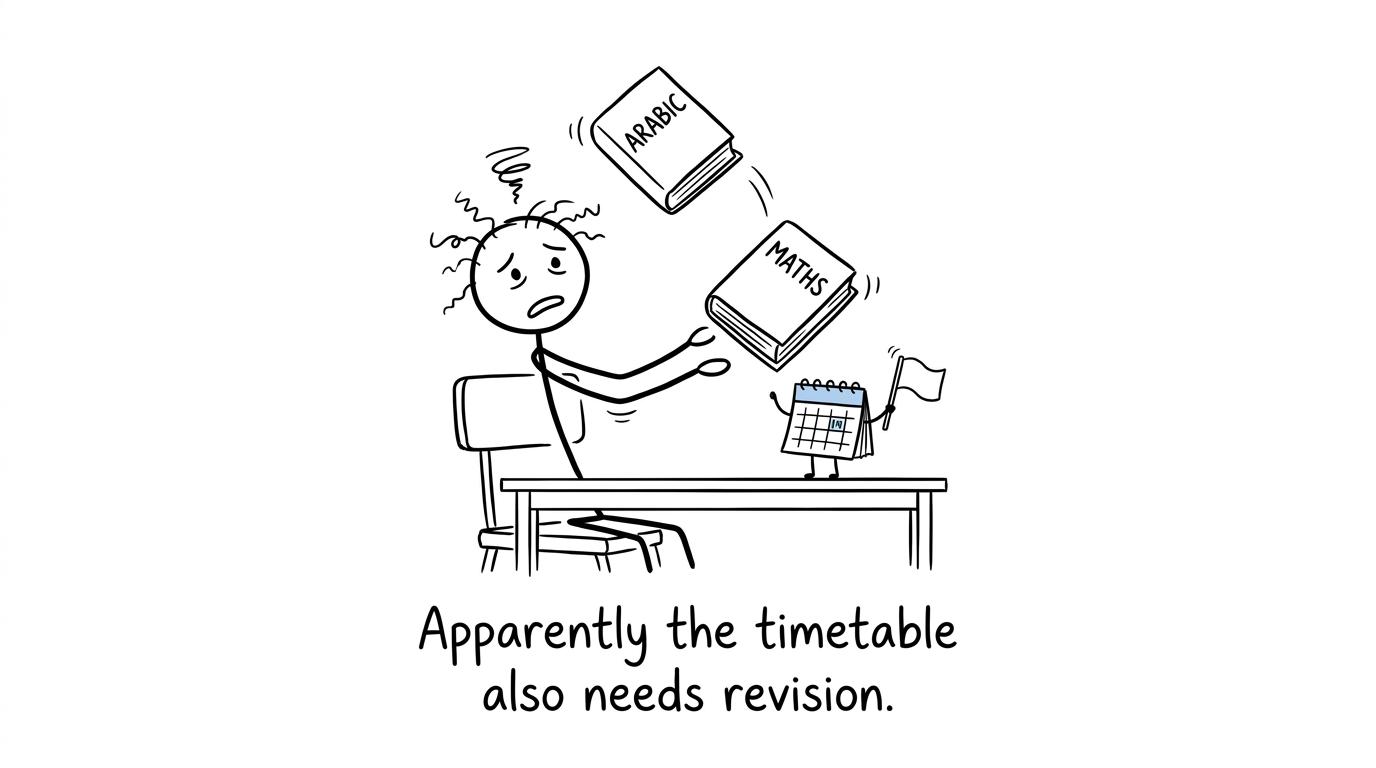 A GCSE student balancing Arabic and maths revision while the calendar gives up
GCSE Arabic is still a complete qualification
Not continuing a subject does not erase what you achieved in it. Most students do not take every GCSE subject to A-level. A GCSE records attainment at that stage of education; it is not a promise to specialise forever.
For the Pearson Edexcel GCSE Arabic specification used for the summer 202620262026 series, students are assessed in four areas:
- listening;
- speaking;
- reading;
- writing.
Each area contributes 25%25\%25% of the qualification. Students enter either foundation or higher tier across all four papers rather than mixing tiers. The qualification therefore reflects a broad set of language abilities, not only vocabulary recall or conversational confidence.
Arabic can also fulfil the language component of the EBacc. The EBacc is not a separate certificate or qualification, but a group of GCSE subjects identified by the government: English language and literature, maths, sciences, geography or history, and a language. Taking Arabic at GCSE can satisfy that language element when the qualification is eligible for the relevant examination year.
This is useful context, but it should not become a source of anxiety. Your individual GCSE grades and next-step entry requirements usually matter more directly than the EBacc label alone.
Skills that remain useful after the final Arabic paper
A subject can be useful even when its content is not used every day. Much of education works this way. The lasting benefit is often the kind of thinking you have practised.
Communication under pressure
Speaking and writing assessments require you to express an idea within limits. You have to select suitable vocabulary, organise your response and recover when the perfect word does not arrive immediately.
That discipline can support classroom presentations, interviews and written applications. It does not guarantee better performance elsewhere, but it gives you meaningful experience of communicating when preparation and accuracy both matter.
Careful reading and interpretation
Reading Arabic requires close attention to context, structure and detail. Listening asks you to distinguish relevant information from surrounding language. Those habits are valuable whenever a task contains unfamiliar wording.
There is a useful connection with GCSE maths here. Many lost maths marks begin before any calculation: a student overlooks a condition, misreads the unit or answers a different question. Language revision will not teach you algebra, but the habit of reading carefully is worth carrying into every exam.
Use the GCSE Maths Revision hub to practise applying that attention to real questions across Edexcel, AQA, OCR, Eduqas and other boards.
Memory, retrieval and consistency
Vocabulary and grammatical structures have to be retrieved repeatedly. That process encourages regular, active revision rather than passive rereading.
The same principle works in maths. Watching a method can make it feel familiar, but practice questions reveal whether you can retrieve and apply it independently. MathsGenie's guide to building a GCSE maths revision timetable explains how to combine topic learning, marking and timed practice without letting revision become an endless list.
A connection to people and culture
For some students, Arabic is connected to family, community, travel, faith or personal identity. For others, it is an additional language learned primarily at school. Either way, formal assessment can deepen literacy and cultural understanding.
You may never take an Arabic examination again and still use the language in conversation, reading, travel or future work. A-level is one route to continued development, not the only route.
Can GCSE Arabic help with college requirements?
Potentially, yes, but there is no single national admissions rule covering every sixth form and college.
Providers commonly publish a general GCSE profile for entry, followed by additional requirements for individual courses. A-level Mathematics, for example, may require a particular grade in GCSE Mathematics. Other courses may specify English language, science or a related subject.
GCSE Arabic may count as one of the recognised qualifications within the overall profile. However, policies vary. A provider may:
- count it like another GCSE;
- require the examination to have been taken through an approved centre;
- apply a rule concerning home or community languages;
- focus primarily on English, maths and subjects related to the chosen course.
Do not rely on assumptions or a friend's application from a previous year. Check the current entry requirements for every provider you are considering. If Arabic is important to meeting the required total, ask for written confirmation that it will count.
English and maths often receive special attention in post-161616 education. Students who have not achieved the required standard in those subjects may face further study requirements, while individual courses can set higher thresholds. This is one reason your maths preparation should remain protected even when Arabic feels more comfortable.
Should you prioritise Arabic or GCSE maths revision?
This is not really a contest between subjects. It is a decision about where the next revision session can make the greatest difference.
Prioritise using four questions:
- Which subject is required for your intended college course?
- Where are you currently losing the most marks?
- Which upcoming assessment is closest?
- Can a short, focused session repair a specific weakness?
If GCSE maths is required for your next step and your current grade is below the entry threshold, it deserves deliberate attention. Begin with topic practice rather than repeatedly sitting full papers. Once your methods are secure, build timing and stamina with exam questions.
The guide to when you should start GCSE past papers helps you choose between mini tests, topic questions and complete papers. If you take AQA, the AQA GCSE Maths past papers include papers and mark schemes for structured practice.
Arabic revision can sit alongside this. A short vocabulary retrieval session uses a different kind of concentration from a demanding maths paper. Alternating the two may be more manageable than spending an entire evening on either one.
A balanced revision approach
A calm plan gives each session a job.
For Arabic, separate the four assessed skills. Vocabulary alone is not complete preparation. Include listening practice, spoken responses, reading and timed writing, following the guidance from your school and exam board.
For maths, use a repeatable cycle:
- identify one weak topic;
- review the method through a revision lesson;
- complete practice questions without prompts;
- mark them carefully;
- record the exact cause of each lost mark;
- revisit the skill before it fades.
Past papers become valuable when you review them properly. MathsGenie's guide to using GCSE past papers effectively shows how to turn errors into specific next actions. Edexcel students can also use the Edexcel GCSE maths revision strategy to combine topic work, mini tests and predicted papers.
Protect consistency rather than chasing a heroic timetable. A realistic plan repeated over several weeks is more useful than one exhausting weekend followed by avoidance.
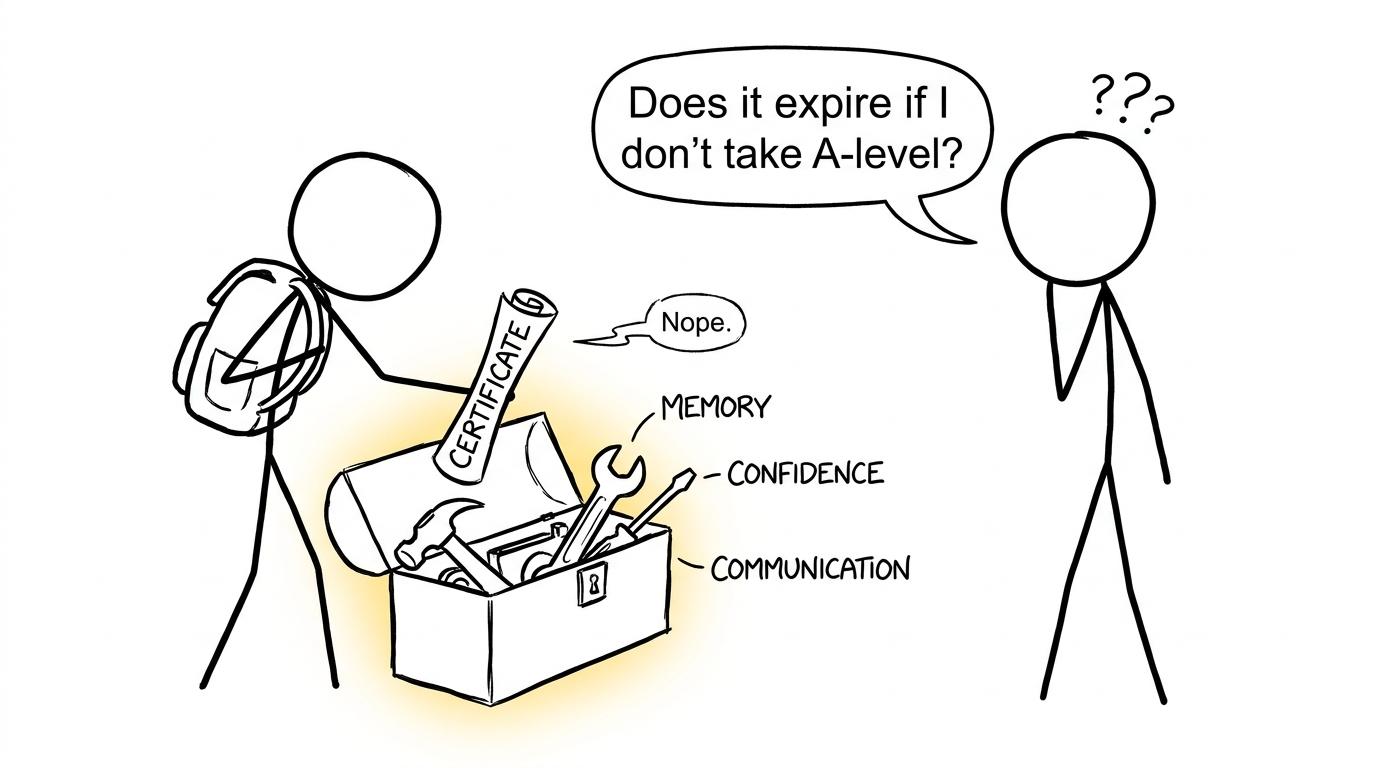 A GCSE Arabic certificate sitting in a toolbox of lasting skills
When GCSE Arabic may be especially valuable
The qualification may carry particular practical value if:
- it strengthens the overall GCSE profile required by a chosen provider;
- it completes the language element of your EBacc subject combination;
- you want formal evidence of Arabic proficiency at GCSE level;
- the language has personal, community or future employment relevance;
- you might return to formal language learning later.
Its usefulness is less about predicting one job title and more about preserving options. Qualifications are often small doors rather than fixed destinations.
If you later choose A-level Mathematics instead, Arabic has not been wasted. You have simply decided which subject to specialise in next. MathsGenie supports that transition through free revision resources and Edexcel A-level Maths past papers when the time comes.
Common mistakes when judging the value of GCSE Arabic
Assuming it only matters if you take A-level
A GCSE stands as a qualification in its own right. Progression to A-level can deepen your knowledge, but it is not required to make the GCSE valid.
Believing every college counts it identically
Entry policies differ. Check whether Arabic counts towards the total number of GCSEs required and whether any additional conditions apply.
Choosing revision time only by enjoyment
It is natural to revise the subject that feels safest. Your timetable should also reflect weak areas, examination dates and the grades required for your next step.
Treating fluency as automatic exam success
Being comfortable speaking Arabic does not necessarily mean every assessed skill is equally secure. Reading, formal writing, translation and examination technique still require preparation.
Neglecting maths because another GCSE may raise the total
An additional GCSE can strengthen your profile, but it does not replace a specified maths requirement. Protect time for the subjects your intended course explicitly needs.
Your qualification is not wasted
GCSE Arabic remains useful without A-level because it records genuine attainment, develops broad language skills and may support your overall GCSE profile. Its precise admissions value depends on the sixth form or college, so check current requirements rather than guessing.
Then bring the question back to what you can control: the next revision session. Give Arabic enough attention to perform honestly, and protect the maths grade that may be central to your next step.
Start with the free MathsGenie GCSE maths resources. Use revision lessons to repair weak topics, practice questions and mini tests to build recall, and past papers with mark schemes and video solutions to understand where marks are won. Nearer the exams, predicted papers can sharpen your preparation.
A useful qualification opens an option. A thoughtful revision plan helps you reach it.










