Imposter Syndrome: Top Set GCSE Modern Hebrew
Imposter syndrome top set GCSE Modern Hebrew explained: why capable students feel behind, how to test the evidence and practical ways to regain confidence.

Being placed in a high-attaining class should feel reassuring. Yet it can have the opposite effect. Suddenly, fluent speakers sound effortless, confident answers arrive before yours, and every hesitation feels like evidence that you slipped into the wrong room.
If you are searching for imposter syndrome top set GCSE Modern Hebrew, the short answer is this: feeling out of your depth is probably not unusual, but there is no reliable research measuring how common it is in this particular subject and set. What researchers do know is that impostor feelings occur among adolescents and high-achieving students. They involve doubting your ability or attributing success to luck despite evidence that you are capable.
That feeling is real. Its conclusion, that you do not belong, may not be.
A quick reality check
Before treating discomfort as proof of inability, remember:
- Top set is a school grouping, not an official GCSE assessment category.
- Your classmates may have very different experiences of Modern Hebrew.
- Confident speaking does not guarantee equally strong reading or writing.
- One difficult lesson gives you information about a skill, not a verdict on your ability.
- The most useful response is specific practice, honest feedback and evidence of progress.
- Persistent anxiety deserves support from a teacher, parent, carer or another trusted adult.
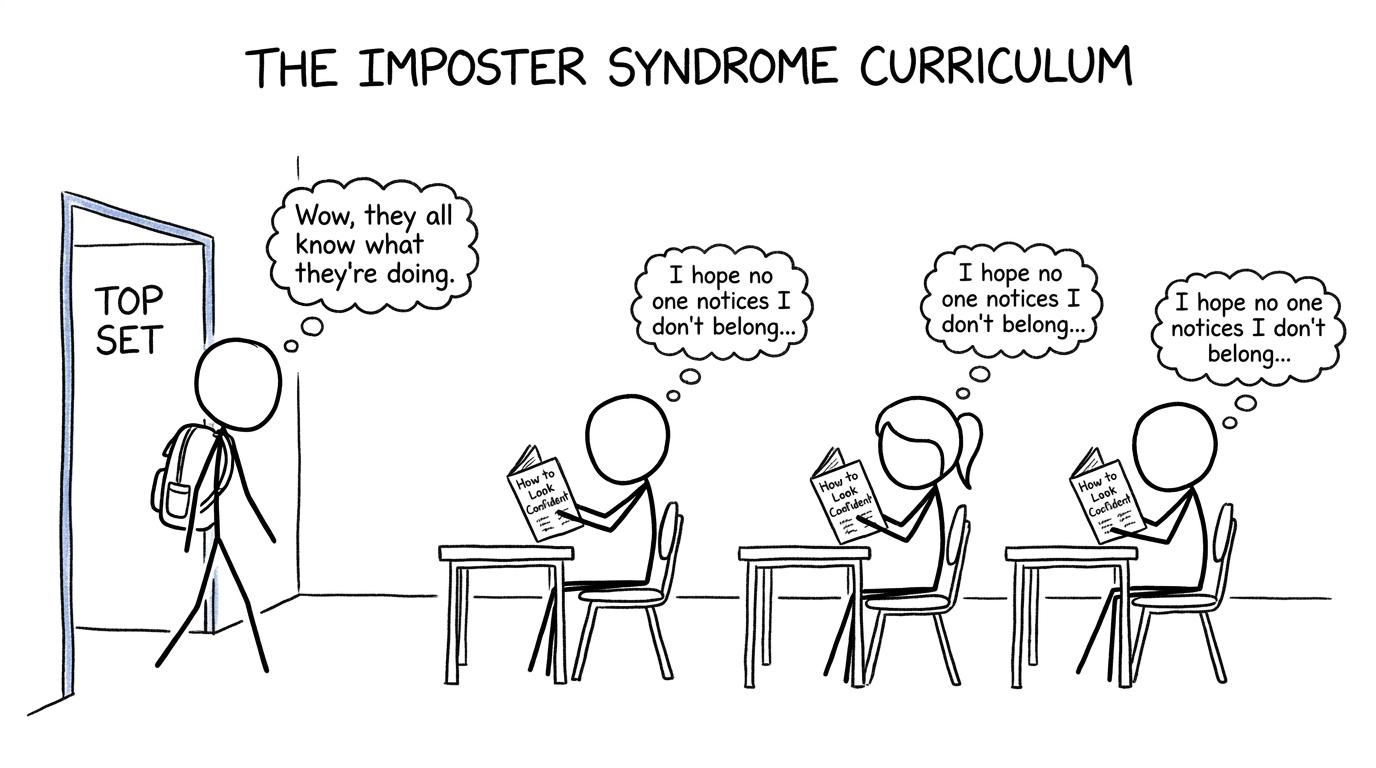 A top-set class in which every apparently confident student secretly has the same worried thoughts
Why top set can make capable students feel behind
Ability is easiest to judge badly when the comparison group changes.
Imagine being one of the strongest runners in a year group and then joining a club filled with other strong runners. You have not suddenly become slower. The reference point has moved. Top-set classrooms can produce the same effect: skills that once seemed distinctive begin to look ordinary because everyone around you has strengths of their own.
Researchers describe the impostor phenomenon as persistent self-doubt despite objective evidence of achievement. A systematic review found it across varied student and professional populations, although reported prevalence differed greatly according to the group and measurement method. Research involving adolescents also suggests that these feelings can appear before adulthood and are associated with factors such as perfectionism, low self-esteem and limited social support.
That evidence supports a careful conclusion: impostor feelings among high-attaining teenagers are credible and recognised, but nobody can honestly give a subject-specific percentage for top set GCSE Modern Hebrew.
Modern Hebrew makes comparison especially unreliable
Students can arrive at GCSE Modern Hebrew through very different routes. One student may hear the language regularly at home. Another may read confidently because of previous education but find spontaneous conversation difficult. Someone else may have learnt much of the course in school and developed strong exam technique without sounding as fluent in informal discussion.
These are different profiles, not a simple ranking from “good” to “bad”.
A student who speaks quickly may still lose marks by missing a writing bullet point. A quieter student may understand texts accurately and construct carefully controlled answers. Classroom fluency is visible; private uncertainty is not. That imbalance makes comparison feel more conclusive than it is.
What the GCSE actually measures
For AQA GCSE Modern Hebrew, specification code 8678, students are assessed in listening, speaking, reading and writing. Each component contributes 25%25\%25% of the qualification. Foundation tier covers grades 111-555, while higher tier covers grades 444-999, and all four assessments must be taken at the same tier.
A school's “top set” label does not appear in that assessment structure. It does not award marks, change a mark scheme or require every student to have identical strengths. Your actual task is to develop the four assessed skills at the tier entered by your school.
This distinction matters because impostor thinking is vague: “Everyone is better than me.” Exam preparation must be precise: “I am losing marks when I infer meaning in listening questions” or “My writing needs a wider range of structures.”
Vague fear cannot tell you what to practise. A marked task can.
Signs that self-doubt is distorting the evidence
Impostor feelings often appear through repeated thinking patterns rather than a single dramatic moment. You might:
- assume a good mark was caused by an easy paper or lucky questions;
- treat one mistake as proof that your previous successes were misleading;
- avoid answering unless you are certain of being correct;
- compare your weakest skill with another student's strongest;
- over-revise familiar material because attempting harder work feels risky;
- believe that needing feedback means you should not be in the set;
- dismiss praise while treating criticism as completely accurate.
None of these automatically means you have a mental health condition. “Imposter syndrome” is commonly used to describe a pattern of feelings and beliefs; it is not itself a formal diagnosis. The practical question is whether the pattern is preventing you from participating, revising effectively or recognising genuine progress.
What actually helps
Confidence rarely arrives first. More often, it follows repeated evidence that you can begin a task, respond to feedback and improve.
Replace global judgement with a skills audit
Do not ask, “Am I good at Modern Hebrew?” That question is too broad to produce a useful answer.
Instead, divide your revision into listening, speaking, reading and writing. Within each area, record:
- what you can already do reliably;
- where marks are currently lost;
- the next small action;
- when you will check the skill again.
The same method works particularly well for GCSE maths. MathsGenie's guide to finding your weakest GCSE topics shows how to turn lost marks into a focused practice list rather than a judgement about intelligence.
Keep an evidence log
After a marked task, write down three things:
- the mark or feedback received;
- one skill that worked;
- one precise improvement for next time.
The aim is not forced positivity. It is accurate accounting. If your mind remembers every hesitation but forgets every successful translation, your internal record is incomplete.
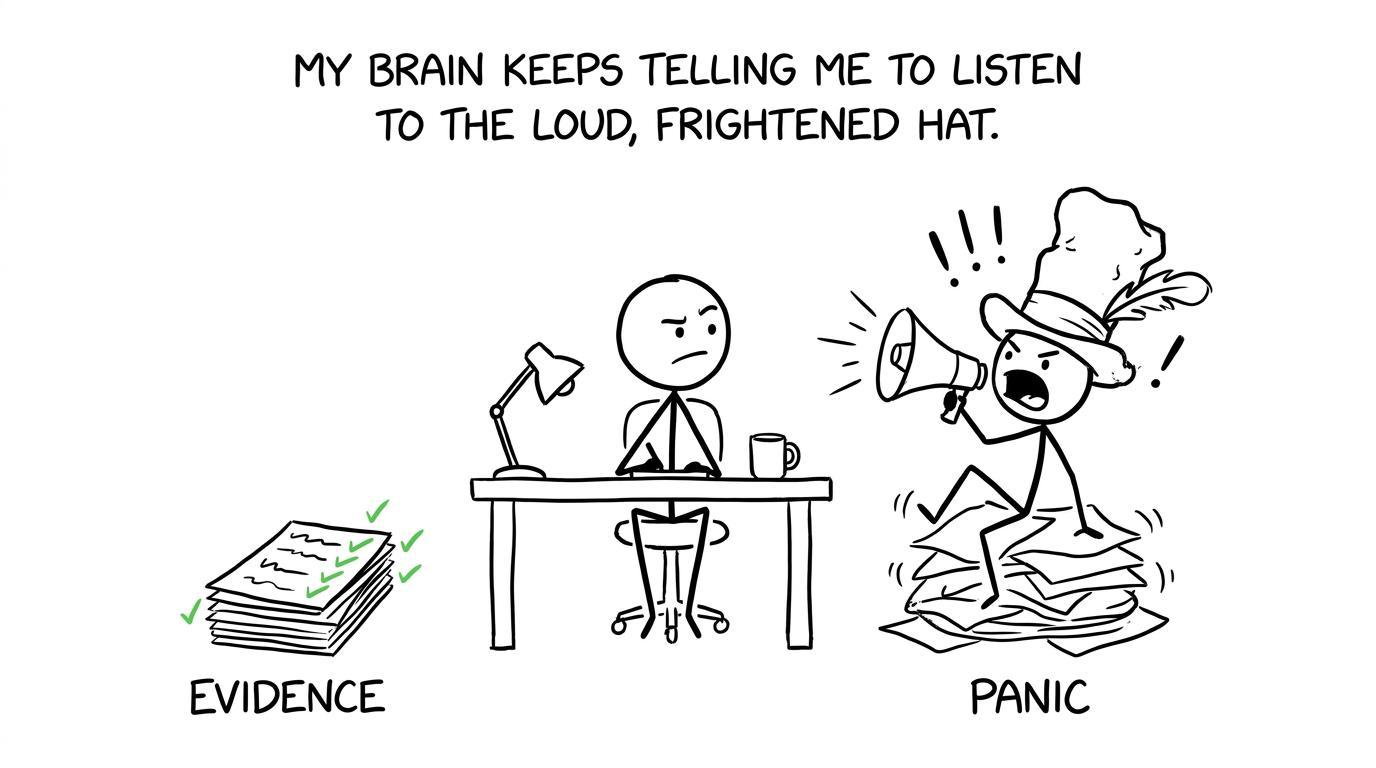 A student's evidence pile quietly defeating panic with marked practice sheets
Practise being imperfect in public
Speaking a language requires decisions before certainty is available. If you wait until every sentence feels flawless, you lose opportunities to retrieve vocabulary, receive correction and become more flexible.
Choose manageable participation goals: answer once, ask one question or volunteer a prepared sentence. Success means completing the action, not sounding effortless. Accuracy can improve through feedback; avoidance supplies no feedback at all.
Ask for calibrated feedback
Tell your teacher what you are noticing. A useful question is: “Which two skills suggest I am working securely at this level, and which one should I prioritise next?”
This invites evidence rather than reassurance alone. Your teacher can also explain why you were placed in the set and whether the gap you perceive is real, temporary or limited to one component.
Use small, repeatable revision sessions
An anxious student often reacts by trying to revise everything. That creates more evidence of unfinished work.
A calmer plan gives each session one purpose. MathsGenie's 20-minute GCSE maths revision routine offers a useful structure: recall, practise, mark and choose the next step. You can apply the same rhythm to vocabulary retrieval, a short listening task or a planned speaking response.
For maths preparation, use the free GCSE maths revision hub to choose lessons and practice questions at the right level. If forgotten content is feeding your self-doubt, the GCSE plan for retaining maths content explains how spaced retrieval and later re-testing build more dependable recall.
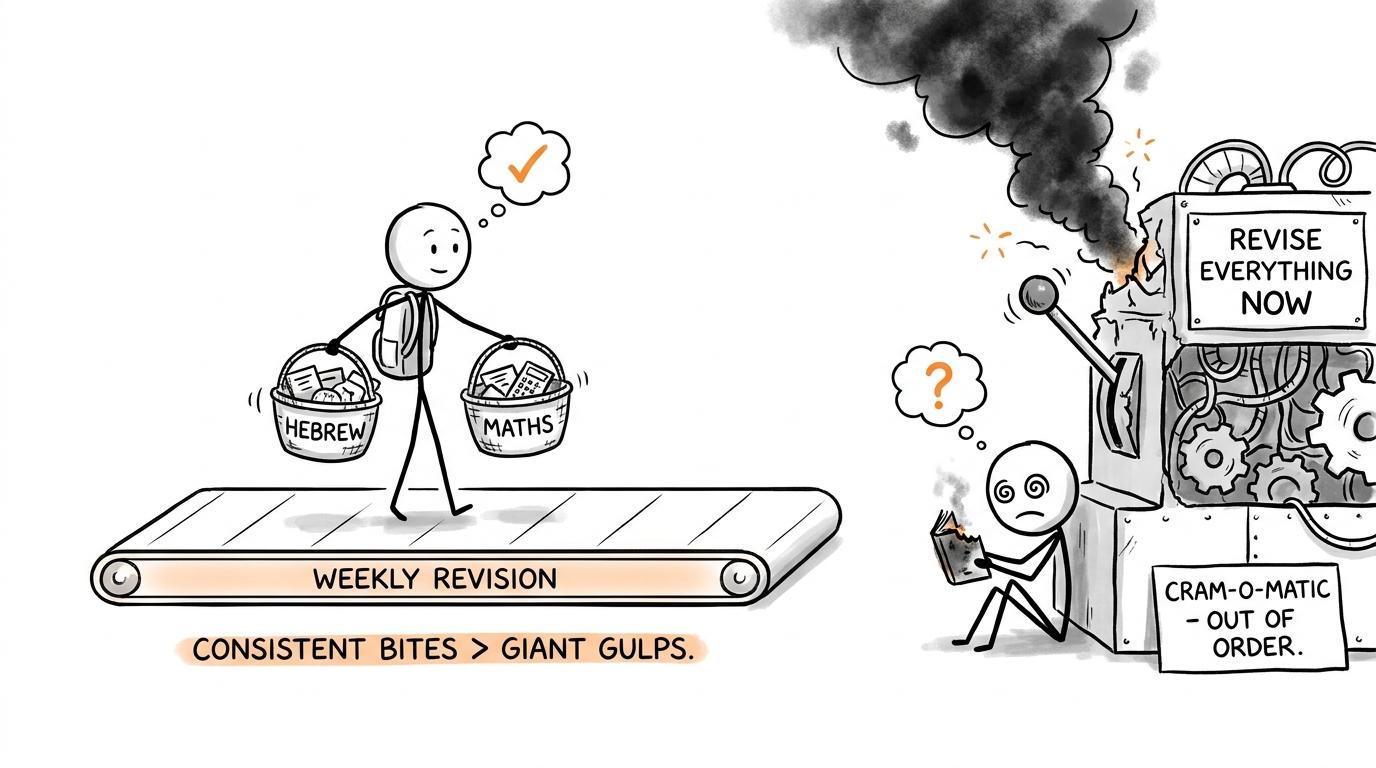 A calm revision conveyor belt outperforming the machine that tries to revise everything immediately
Protect maths revision from the same comparison trap
Students preparing for several GCSEs can carry the same belief from one classroom into another. “I am behind in Hebrew” quietly becomes “I am not a top-set person” and then “I cannot do higher-tier maths.” That leap is emotional, not evidential.
Use separate records for separate subjects. In maths, a timed paper and its mark scheme provide better evidence than where classmates say they are revising. MathsGenie's Edexcel GCSE maths past papers let you practise under realistic conditions and inspect how marks are awarded. The guide to using past papers properly explains how to diagnose errors, repair priority topics and reattempt difficult questions.
Use the MathsGenie revision planner to balance subjects across the week. Revision lessons and practice questions should build individual skills; mini tests can check short-term recall; past papers test performance across a whole specification; predicted papers provide fresh exam-style rehearsal near the final run-in. Each resource answers a different question, so using all of them as endless tests of worth defeats their purpose.
Common mistakes when responding to imposter feelings
Trying to prove yourself through overwork
Longer revision is not automatically better revision. Exhaustion can weaken concentration and make ordinary errors feel alarming. A focused task, immediate marking and a planned stop are usually more informative than an unstructured evening.
Avoiding past papers until you feel confident
A paper is not a final judgement. It is a diagnostic tool. Start with a section, mini test or untimed attempt if necessary, then build towards full conditions. MathsGenie's guide to when to start GCSE past papers explains how to increase challenge gradually.
Treating every classmate as the finished product
You hear their answers, not their preparation, uncertainty or corrections. Compare current work with your own earlier work instead.
Turning feedback into identity
“Your response needs more detail” describes a response. It does not mean “you do not belong in top set”. Translate every comment into an action you can complete.
Keeping severe anxiety private
Exam nerves are normal, but support is important if anxiety or low mood is persistent, severe or interfering with sleep, school or everyday life. Speak to a trusted adult, teacher, pastoral lead, school counsellor or GP. Asking for help is not evidence that you are incapable; it is a sensible response when the problem has become larger than revision technique.
You do not need to feel certain before you improve
Top set can create an odd illusion: because the room contains many capable students, everyone except you must feel secure. Usually, you can see their performance but not their private doubts.
The honest answer to whether imposter syndrome is common in top set GCSE Modern Hebrew is that no subject-specific prevalence figure exists. Still, wider research shows that impostor feelings can affect adolescents and high achievers. Your next step is therefore not to argue with every anxious thought. It is to gather better evidence.
Ask for specific feedback. Track skills separately. Practise in small units. Let mistakes identify the next task rather than define you.
For your maths exams, make MathsGenie's free GCSE revision resources your starting point. Use revision lessons and practice questions to repair gaps, mini tests to check recall, then past papers, mark schemes, video solutions and predicted papers to build exam confidence. You do not have to feel as though you belong before beginning. Consistent, well-marked practice is how that belief catches up.