Imposter Syndrome in Top Set GCSE Art and Design
Imposter syndrome top set GCSE Art and Design explained: why capable students feel out of place, what helps, and how to protect maths revision time too.
A place in a high-attaining Art and Design class can feel like proof that you belong. Strangely, it can also make you wonder whether you belong at all. Other sketchbooks look fuller, other ideas sound more original, and everyone else appears to understand the assignment without effort.
If you are experiencing imposter syndrome in top set GCSE Art and Design, you are not necessarily in the wrong class. Imposter feelings involve doubting your ability or attributing success to luck despite evidence that you are capable. Research confirms that these feelings can occur during adolescence, although there is no reliable figure showing how many top-set GCSE Art and Design students experience them specifically.
The short answer is that feeling out of your depth is likely more familiar than it looks. What helps is not empty reassurance, but clearer evidence: understanding the assessment objectives, asking for precise feedback, recording progress and protecting enough time for your other subjects, including maths.
A quick checklist for recognising imposter feelings
You may be dealing with imposter-style thinking if you regularly:
- assume your place in the class was a mistake;
- dismiss positive feedback as kindness or luck;
- compare your unfinished experiments with someone else's polished outcome;
- avoid ambitious ideas because failure might reveal your supposed lack of talent;
- overwork every page because nothing feels good enough;
- interpret one disappointing mark as evidence that you were never capable;
- feel unable to ask for help because a top-set student should already know what to do.
Any one of these reactions can happen occasionally. The important question is whether the pattern is damaging your confidence, workload or wellbeing.
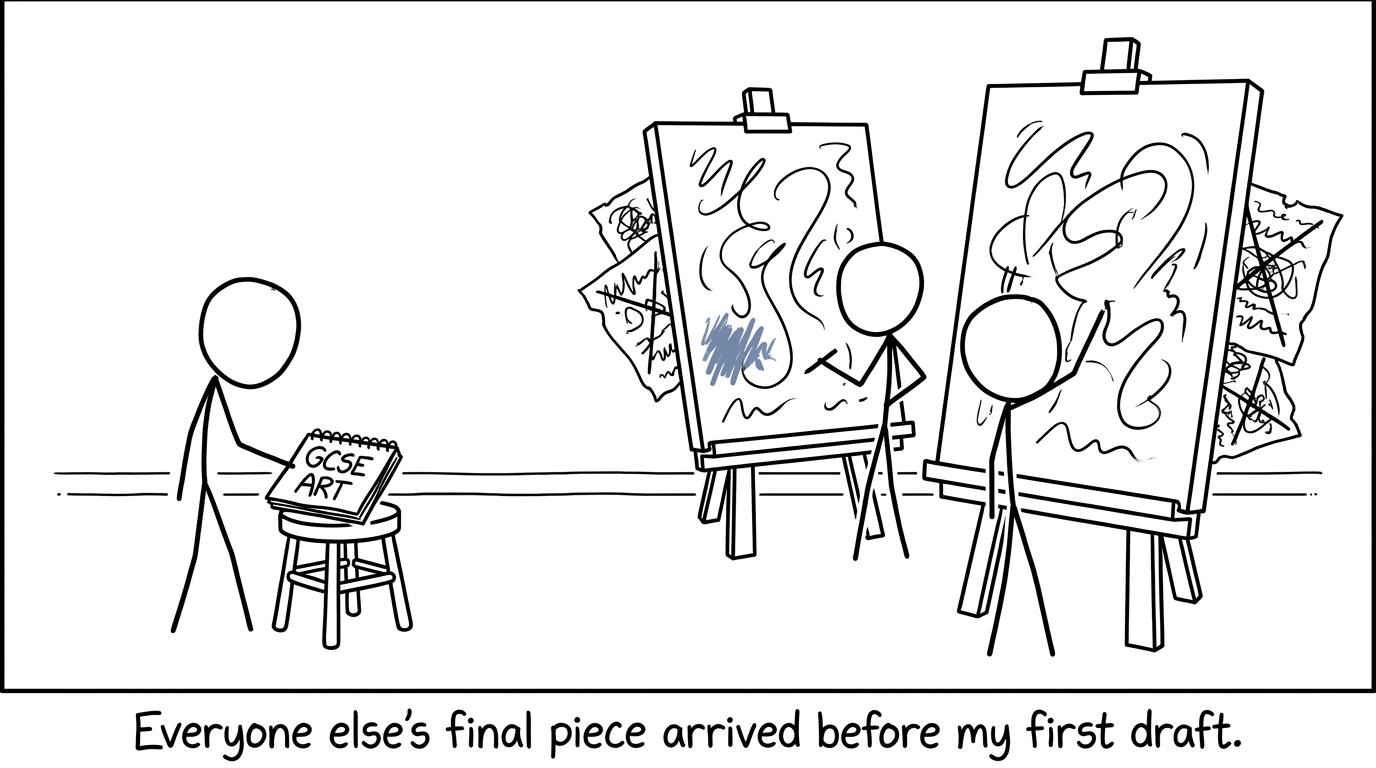 A student compares a small draft with classmates' giant canvases while their messy pages remain hidden
Why top set can make self-doubt louder
“Top set” is a school grouping rather than an official category used by AQA, Edexcel, OCR or Eduqas. Some schools set Art and Design classes by prior attainment, while others use mixed-attainment groups or organise classes by specialism. Consequently, there is no national dataset for imposter syndrome within top-set art classes.
The environment can still create recognisable pressures.
Your comparison group suddenly changes
A student who once felt unusually strong may enter a class where almost everyone produces confident work. Their ability has not disappeared. The reference point has changed.
This also happens in higher-tier maths. A difficult question can make a capable student feel weak because everyone nearby is attempting the same demanding material. Your position within a strong group is not a direct measurement of what you know.
Art exposes unfinished thinking
In maths, a correct method can often be checked against a solution or mark scheme. Art and Design is more open-ended. You must investigate sources, experiment, refine ideas and make personal decisions. That uncertainty is part of the subject, but it can feel like incompetence when you expect confidence to arrive before the work begins.
You also see classmates working in real time. You may notice their successful composition without seeing the discarded photographs, awkward first studies or teacher conversations behind it. Comparison therefore uses incomplete evidence.
Praise can become pressure
Being described as “naturally talented” sounds positive, yet it can create a fragile rule: talented people should produce excellent work quickly. When a project becomes difficult, the student may conclude that the label was wrong.
A healthier interpretation is that difficulty is evidence of a demanding process. Experimentation is not a detour from assessed work. It is part of it.
What GCSE Art and Design actually rewards
Imposter feelings often speak in vague terms: “I am not creative enough” or “Everyone is better than me.” Assessment objectives offer something more useful because they describe evidence rather than identity.
Across GCSE Art and Design specifications, the four Ofqual assessment objectives are equally weighted:
- AO1: develop ideas through investigations and demonstrate critical understanding of sources;
- AO2: refine work through appropriate exploration and experimentation;
- AO3: record ideas, observations and insights as work progresses;
- AO4: present a personal and meaningful response that realises intentions.
Each objective contributes 25%25\%25% of the assessment. In the familiar structure used by boards such as AQA and Eduqas, the portfolio contributes 60%60\%60% and the externally set assignment contributes 40%40\%40% of the qualification. Always check the current specification and instructions provided by your own school and exam board.
This structure matters psychologically. You are not being assessed on whether you look like an artist, work without feedback or produce a perfect first attempt. Development, recording and refinement all leave assessable evidence.
A technically impressive final piece cannot automatically replace weak investigation or an undocumented process. Equally, a rough experiment is not proof of failure if it helps you test a material, reject an approach and make a better-informed decision.
What actually helps with imposter syndrome
Separate feelings from evidence
“I feel behind” is a real feeling, but it is not yet a factual conclusion. Ask what evidence supports it and what evidence complicates it.
Useful evidence might include teacher feedback, completed assessment objectives, improved technical control and decisions you can now explain. Keep a short progress record containing:
- feedback you received;
- changes you made because of it;
- techniques you can now use more confidently;
- project decisions that are genuinely your own;
- work that demonstrates each assessment objective.
This is not a scrapbook of compliments. It is a record that makes progress harder to dismiss.
Ask smaller feedback questions
“Is this good?” usually produces a broad answer. Ask questions linked to the work instead:
- Is the connection between this source and my idea clear?
- Which experiment gives the strongest evidence for AO2?
- Does my annotation explain the decision rather than merely describe the image?
- What is the most important gap to address next?
Specific feedback turns anxiety into an action. Asking for it does not expose you as an imposter; responding to feedback is part of becoming more independent.
Replace perfection with purposeful refinement
Perfectionism can make every sketchbook page feel permanent. Yet refinement requires versions. Decide what an experiment is meant to test, perhaps composition, colour, scale, texture or material and judge it against that purpose.
“Not suitable for this outcome” is a more accurate conclusion than “bad”. One describes a decision. The other attacks the person who made it.
Talk before the problem becomes enormous
Research into imposter feelings commonly points towards reflection, supportive conversations, mentoring and keeping records of achievements as useful approaches. Tell your art teacher, form tutor, pastoral lead or another trusted adult if self-doubt is making you hide work, miss deadlines or spend unreasonable hours trying to make everything flawless.
If stress or anxiety is affecting sleep, everyday life or your ability to cope, seek support rather than treating it as a revision problem alone. A parent, carer, school safeguarding or pastoral team, GP or appropriate mental health service can help you find the right next step.
Protecting maths revision when art expands to fill the week
Art coursework has visible edges but no obvious natural stopping point. There is always another detail to refine. Maths revision can then be postponed because its tasks feel less urgent, even when the examinations are approaching.
The solution is not to care less about art. It is to give both subjects boundaries.
Use the GCSE maths revision hub to select a specific topic rather than writing “revise maths” on a to-do list. A defined session might contain one revision lesson, a short set of practice questions and immediate marking.
The MathsGenie GCSE revision timetable guide can help you build repeatable sessions around coursework deadlines. If deciding what to revise creates more anxiety, follow the best order for learning GCSE maths topics and prioritise the gaps revealed by your own work.
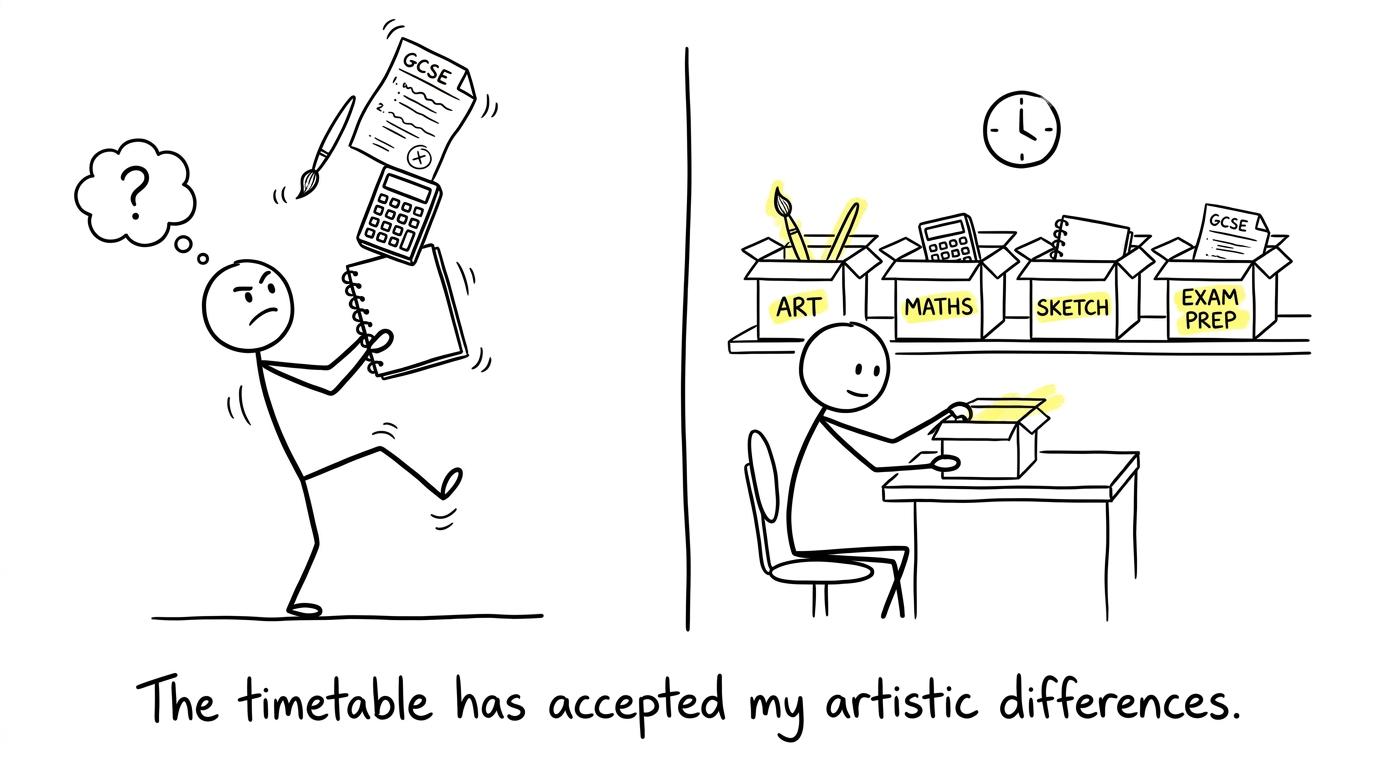 A student stops juggling art and maths resources and gives each one a place in the timetable
Short, bounded tasks are particularly useful during busy art weeks. Edexcel GCSE maths mini tests provide focused practice without requiring an entire evening. Students following another board should use resources matching their own specification and tier.
As examinations approach, move from topic work to timed practice. The guide to when to start GCSE past papers explains how to build up gradually, while the Edexcel GCSE maths past papers page brings together papers, mark schemes and solutions.
A calm sequence is:
- learn or revisit one method;
- answer practice questions;
- mark the work honestly;
- identify one precise mistake;
- return to it after a gap;
- use mini tests, past papers and predicted papers when the foundations are secure.
This routine replaces the vague question “Am I good at maths?” with a better one: “What can I improve next?” The same shift helps in art.
Common mistakes when trying to overcome imposter feelings
Waiting to feel confident before starting
Confidence often follows action rather than preceding it. Begin with a small investigation, a material test or a short maths practice set. The aim is evidence of movement, not an instant transformation in mood.
Using overwork as proof that you belong
Long hours can temporarily quiet self-doubt, but they can also damage sleep, concentration and revision in other subjects. More work is not automatically better evidence. Ask which assessment objective or learning gap the task addresses.
Treating every classmate as a benchmark
Different students have different strengths, resources, prior experiences and working speeds. Compare your current work with your own earlier decisions, then use assessment criteria and teacher feedback to judge what should change.
Hiding unfinished work
Students sometimes avoid feedback until a piece looks impressive. That removes the opportunity to correct direction while correction is still manageable. Show development early enough for advice to be useful.
Revising only what feels comfortable
In maths, repeatedly answering familiar questions can create reassurance without repairing weak areas. Use mark schemes, video solutions and mistakes from timed papers to choose the next topic. The one-month GCSE maths revision plan offers a practical structure when time is limited.
Your place does not require constant proof
Feeling uncertain in a strong Art and Design class does not show that you gained your place by accident. Often, it shows that you are working among capable peers in a subject where the thinking remains visible and the answer is rarely obvious at the beginning.
Return to evidence. Check the assessment objectives. Ask one precise question. Set a stopping point for coursework. Then give maths its own protected space.
MathsGenie makes that final step straightforward and free: start with a revision lesson, practise with topic questions, check your work using mark schemes and video solutions, and build towards mini tests, past papers and predicted papers. You do not need to feel completely confident before beginning. You need one useful next action and a routine that lets the evidence accumulate.