

How to Use Retrieval Practice for GCSE Maths
How to use retrieval practice for GCSE Maths with a sample week, feedback routine and honest advice on using active recall for stronger exam revision.
Rereading can create a comforting feeling: the page looks familiar, so the topic must be secure. Then the book closes, an exam question appears, and the method seems to vanish.
Understanding how to use retrieval practice for GCSE Maths means reversing that process. Instead of repeatedly putting information into your head, you try to bring it out. You answer questions without notes, check the result, repair mistakes and return to the topic later.
Imagine a student called Sam. This is a hypothetical example, but the problem is familiar. Sam spends an evening highlighting notes on simultaneous equations. Everything makes sense while the worked examples are visible. Two days later, Sam cannot decide whether to use elimination or substitution. The revision felt productive, but it did not test whether the method could be recalled independently.
Retrieval practice gives Sam a more honest signal.
The retrieval practice checklist
A useful GCSE maths retrieval session follows a simple cycle:
- Choose a small topic or mixed set of topics.
- Put notes and worked solutions away.
- Attempt questions from memory.
- Mark every answer and inspect the working.
- Correct errors using a different colour.
- Record what caused each mistake.
- Return to the topic after a gap.
- Gradually include unfamiliar and mixed exam questions.
This is not simply doing more questions. It is attempting them before receiving help, then using feedback deliberately.
What the research says
Retrieval practice is often called the testing effect. A systematic review published in 2021 examined retrieval practice in real schools and classrooms and found that it consistently benefited learning across different subjects, ages and classroom conditions. Research also suggests that corrective feedback matters, particularly when the first attempt is unsuccessful.
Spacing strengthens the approach. Retrieving a method after some forgetting has occurred is harder than repeating it immediately, but that difficulty can support longer-term retention. Maths-specific studies, particularly in higher education, have found benefits from spaced retrieval for retaining mathematical knowledge.
There is an important qualification. GCSE Maths is not a vocabulary test. Remembering the quadratic formula is useful, but students must also recognise when to use it, substitute accurately and interpret the result. Evidence for retrieving learned knowledge is strong; evidence that retrieval automatically transfers to very different, unfamiliar problems is more mixed.
The practical conclusion is modest but valuable: use retrieval to secure facts, procedures and problem types, then combine it with varied exam practice. Retrieval is part of effective maths revision, not a replacement for explanation, feedback or problem-solving.
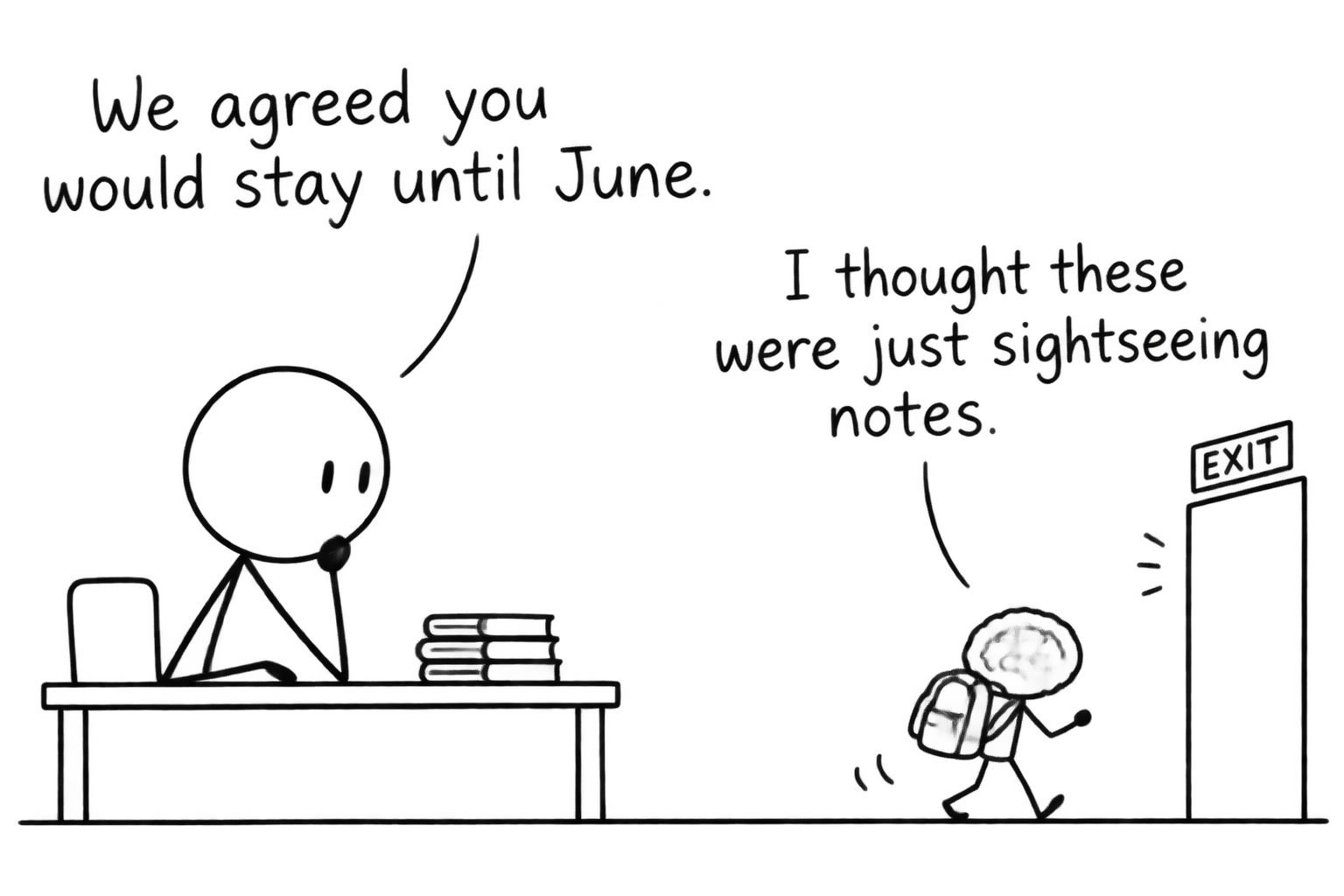 A student's brain attempts to leave revision early
How retrieval practice works in maths
Retrieve more than formulas
A formula flashcard can test whether you remember a rule, but mathematical knowledge has several layers. For a topic such as circle theorems, retrieve:
- the theorem itself;
- the diagram features that signal it;
- the reason needed for a proof;
- the steps required to apply it;
- a complete question without notes.
For algebraic fractions, you might first write the rules from memory, then simplify an expression, then attempt an equation in which the relevant method is not announced.
Sam therefore stops asking, “Do I remember seeing this?” and starts asking, “Can I produce and apply it without help?”
Use questions as the retrieval prompt
For GCSE Maths, questions usually provide better retrieval practice than pages of written blurting. Start with a few short questions from the GCSE Maths revision hub, where resources are organised by exam board. Attempt them on blank paper before looking at a revision lesson, mark scheme or video solution.
If you cannot begin, pause and write down whatever you do know. That might be the relevant formula, a diagram, or the first operation. Then check the explanation and complete a fresh question. Copying a finished solution is review; solving the next one independently is retrieval.
Mark for causes, not just scores
A mark of incorrect tells you very little. Label the cause instead:
- Knowledge gap: you did not remember a fact or method.
- Recognition gap: you knew the method but did not spot when to use it.
- Process error: the approach was right, but the algebra or arithmetic failed.
- Exam error: you misread the question, rounded too early or omitted working.
Use mark schemes and video solutions to find the first point where your reasoning changed course. MathsGenie’s guide to stopping forgotten maths content explains how spaced practice and feedback can fit together.
Return after a gap
Do not declare a topic complete because you answered it correctly once. Retrieve it again several days later, then place it in a mixed set. Mixing topics forces you to identify the method rather than relying on the page heading.
The principle is also explored in this guide to spacing revision and protecting rest. Rest is not the enemy of memory. The gap is part of what makes later retrieval meaningful.
A sample week of retrieval practice revision
This sample week assumes short, focused sessions. Adjust the topics to your tier, exam board and current weaknesses.
| Day | Retrieval task | Feedback and follow-up |
|---|---|---|
| Monday | Attempt six questions on fractions without notes. | Mark them, classify mistakes and redo two incorrect questions. |
| Tuesday | Write key angle facts from memory, then answer four angle questions. | Check reasons as well as final answers. Add weak facts to Friday’s review. |
| Wednesday | Complete a mixed mini test containing fractions, angles and algebra. | Identify whether errors came from recall, recognition or execution. |
| Thursday | Rest from these topics or revise another subject. | Leave the maths retrieval gap intact. |
| Friday | Reattempt Monday’s weak question types using fresh questions. | Use a lesson or video solution only after the independent attempt. |
| Saturday | Complete part of a past paper under timed conditions. | Use the mark scheme and create a short repair list. |
| Sunday | Retrieve three methods from the repair list and solve one question on each. | Choose next week’s topics from the evidence, not from preference. |
You can place these sessions inside the broader structure in the GCSE Maths revision timetable guide.
If setting up the gaps and return dates feels like another revision task, build the week in the Revision Planner so the plan has somewhere consistent to live.
Common retrieval practice mistakes
Looking too soon
Struggle is useful only within reason, but opening the solution after a few seconds removes the retrieval attempt. Give yourself enough time to choose a method and begin. If you remain stuck, use a small hint rather than revealing the complete solution immediately.
Repeating identical questions
An immediate repeat can show that you followed a correction, but it may only test short-term memory. Use fresh numbers, rearranged diagrams and mixed questions. Later, move towards GCSE past papers and exam questions so that identifying the topic becomes part of the task.
Treating every error as forgetting
A wrong answer does not always mean the method was forgotten. Careless signs, calculator input and misunderstood wording require different repairs. Diagnose before scheduling more practice.
Retrieving what is not understood
Retrieval strengthens knowledge you have learned; it does not replace the first explanation. If Sam has never understood completing the square, repeated failed attempts are unlikely to teach it efficiently. Sam should use a clear revision lesson, examine a worked method, practise with support and only then attempt independent retrieval.
Making every session feel like an exam
Retrieval practice should often be low stakes. Mini tests and timed papers matter, but short untimed checks are useful too. Constant pressure can turn every gap into evidence of failure when it should be information about what to revise next.
Build retrieval into your revision schedule
Sam’s real improvement is not a miraculous grade jump. It is a change in information. Rereading told Sam what looked familiar; retrieval revealed what could actually be produced, applied and repaired.
You now have the same weekly structure, but knowing the cycle is easier than following it consistently. Exams have fixed dates, and each unplanned week removes another chance to revisit weak topics. Build your retrieval schedule in the Revision Planner, place independent attempts before feedback, and map your return sessions through to exam day.















