

GCSE Further Maths: Revise Every Day or Rest?
GCSE Further Maths: revise every day or rest? Use spacing, retrieval, sleep and planned breaks to improve retention without exhausting yourself.
A revision streak can feel reassuring. Each crossed-off day seems to prove that you are moving closer to the grade you want. Then one evening you are tired, every algebraic expression looks unfamiliar, and taking a break feels dangerously like falling behind.
If you are searching “gcse further maths revise every day or rest”, the short answer is this: do not force a demanding Further Maths session every day. Retention is generally better served by focused sessions spaced across the week, active recall and sufficient sleep. Some students like a brief daily habit, but planned rest days should remain part of the schedule.
The aim is not to protect an unbroken streak. It is to remember methods and apply them accurately in the exam.
The quick revision checklist
A balanced GCSE Further Maths plan should include:
- focused revision on around 444 to 666 days each week as a flexible starting point;
- at least one genuine rest day when your wider timetable allows it;
- repeated contact with important topics across different days;
- questions completed without looking at notes first;
- immediate checking with solutions or mark schemes;
- a record of errors and a later attempt at similar questions;
- regular sleep rather than late-night cramming;
- timed papers only when you have time to mark and review them properly.
This is not a universal prescription. Your school workload, exam dates and current understanding matter. The useful principle is that frequency should support quality, not replace it.
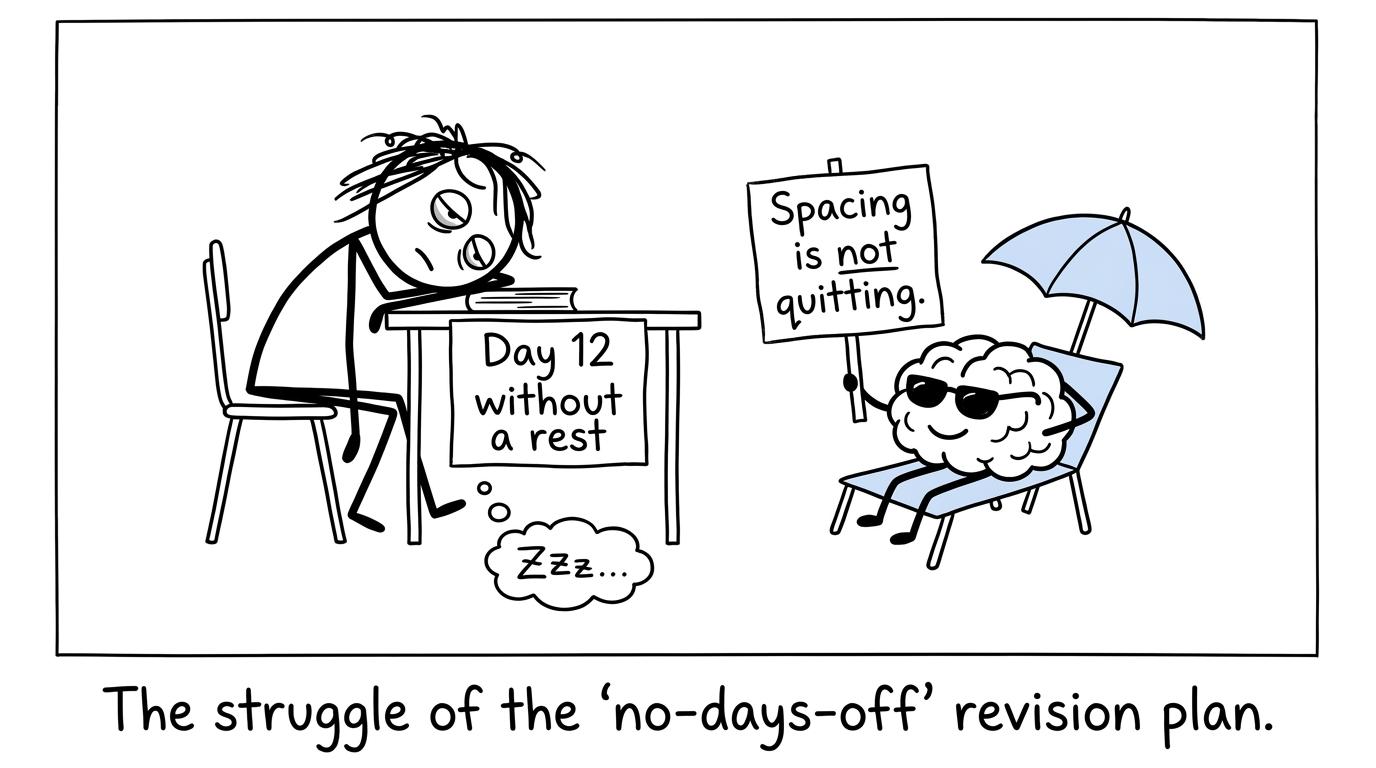 A tired student discovers that spacing is not quitting
Why revising every day is not automatically better
More revision can help when it creates more useful practice. But seven tired sessions are not necessarily better than five attentive ones.
Research on learning consistently supports spacing practice over time rather than concentrating the same amount of work into one long block. A recent meta-analytic review focused specifically on mathematics found a small-to-medium overall benefit for spaced rather than massed practice. The important idea is simple: returning to a topic after a gap makes you reconstruct the method instead of merely recognising what you have just seen.
That slight struggle is useful. A method can feel fluent immediately after watching a video because it is still in working memory. Two days later, attempting a fresh question reveals whether it has become retrievable knowledge.
Daily revision can still work if the sessions are short, varied and sustainable. The problem begins when “every day” becomes:
- repeating questions while mentally exhausted;
- reading solutions without attempting anything;
- sacrificing sleep to preserve a streak;
- spending hours on a favourite topic while avoiding weak areas;
- continuing after concentration has clearly collapsed.
Consistency matters. So does recovery.
How retention actually improves
Spacing creates useful gaps
Spacing means revisiting a skill on separate days. You might learn or review a topic, return to it after a short interval, and test it again later in mixed practice.
You do not need a complicated algorithm. A simple pattern might be:
- first contact: review the method and complete focused questions;
- next contact: retrieve the method before opening notes;
- later contact: meet the topic inside a mixed or timed set;
- final contact: revisit it if your marking exposes another gap.
The interval should be long enough for retrieval to require effort, but not so long that every return becomes complete relearning. Weak topics normally need earlier contact than secure ones.
MathsGenie’s guide to stopping forgotten GCSE maths content explores this learn, retrieve and retest cycle in more detail.
Retrieval should lead the session
Retrieval practice means trying to produce knowledge or a method from memory. In Further Maths, that usually means doing questions rather than repeatedly reading notes.
Mathematics research supports spacing particularly clearly. Evidence for retrieval practice in maths is more nuanced than it is in some fact-based subjects, but attempting questions remains essential because it provides diagnostic information. It tells you whether you can select and execute a method independently.
Begin a session with closed notes. If you become stuck, use a MathsGenie GCSE revision lesson or video solution, then close it and attempt another relevant question. Help should restart thinking, not replace it.
Sleep belongs inside the plan
Sleep is not empty time between revision sessions. Research links sleep with the consolidation of learning and memory. For a student, the practical message is not that one perfect night guarantees recall. It is that repeatedly trading sleep for late revision is a poor bargain.
If your choice is between another unfocused hour and stopping at a sensible time, sleep will often protect tomorrow’s concentration as well as the learning already completed. A rest day can also create the gap that makes your next retrieval attempt meaningful.
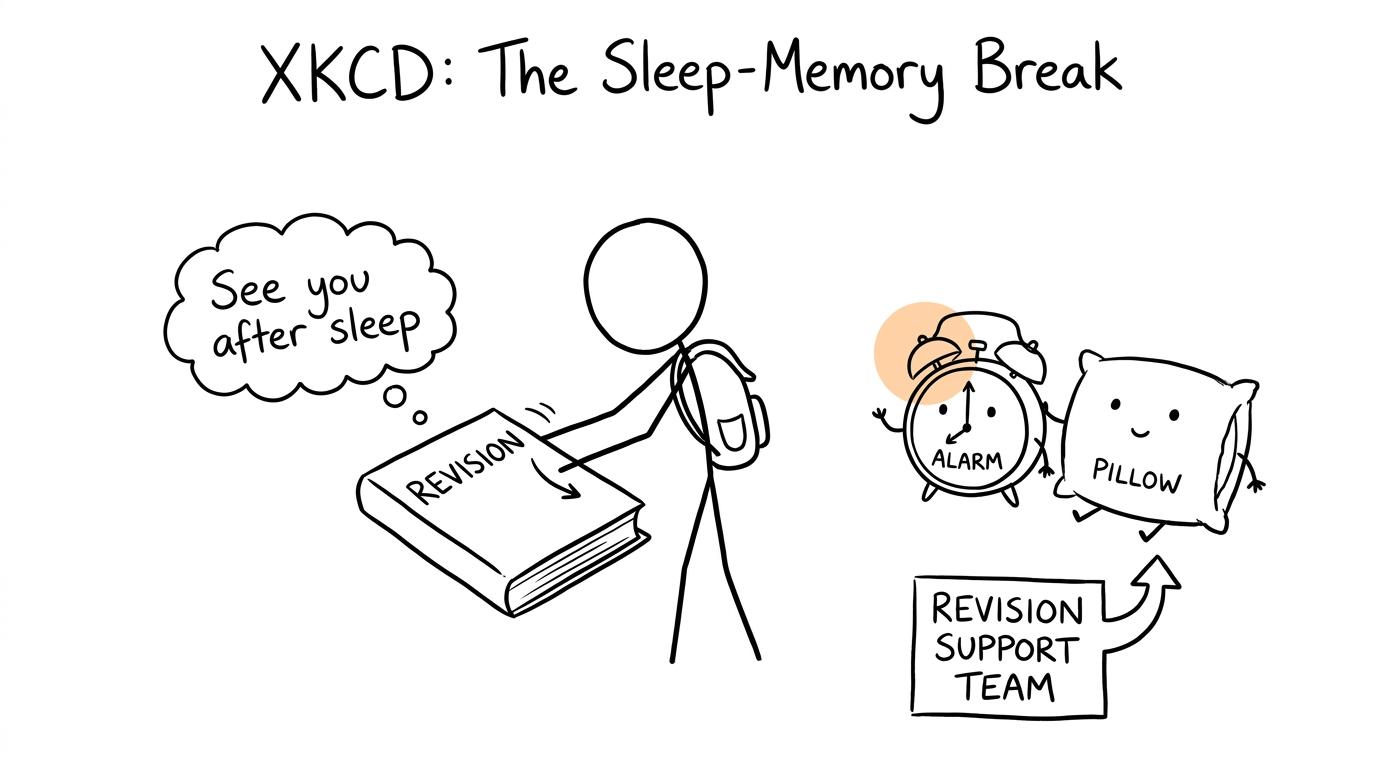 A revision book recruits sleep as part of the support team
Should a rest day mean no maths at all?
It can. A full day away from Further Maths is not a failure, particularly when you are balancing GCSE English, science, humanities and your main GCSE Maths course.
There are two sensible versions of rest:
A complete rest day
Do no Further Maths. Exercise, spend time with other people, pursue something unrelated and maintain your normal sleep routine. This is valuable when you feel mentally drained or your concentration has been deteriorating across several sessions.
A low-load day
Keep a tiny point of contact without holding a full session. You might check your next task, organise an error log or spend a few minutes recalling topic names. Do not turn this into a disguised hour of difficult questions.
A low-load day may suit students who find routines calming. A complete rest day may suit students who become guilty or obsessive about maintaining a streak. The right choice is the one that leaves you able to work properly next time.
A balanced weekly GCSE Further Maths schedule
A practical week should alternate learning, retrieval and exam practice. For example:
- Monday: focused topic revision and practice questions;
- Tuesday: a different topic, followed by a brief recall of Monday’s method;
- Wednesday: rest or a low-load day;
- Thursday: mixed questions containing earlier topics;
- Friday: focused repair of errors found on Thursday;
- Saturday: a mini test, paper section or full paper when appropriate;
- Sunday: rest, with only planning for the next week.
This is a template, not a rule. During a busy school week, three high-quality sessions may be more realistic. Near an exam, you might work on more days while shortening individual sessions. MathsGenie’s 20-minute maths revision routine is useful when time is limited.
Your qualification also matters. “GCSE Further Maths” can refer to different courses, including CCEA GCSE Further Mathematics and Level 222 Further Mathematics qualifications offered elsewhere. Content and assessment arrangements vary, so check the exact specification and paper structure given by your school. CCEA students can use the dedicated CCEA GCSE Further Maths past papers.
Do not assume that foundation and higher tier arrangements from ordinary GCSE Maths automatically apply to your Further Maths qualification.
Measure output rather than days
A streak records attendance. It does not show what you retained.
Better evidence includes:
- questions attempted without support;
- marks gained under timed conditions;
- errors correctly classified;
- previously missed questions answered later;
- topics recalled after several days;
- improved accuracy when topics are mixed.
After a test, write down the topic, why the mark was lost and the next action. Then schedule a fresh attempt rather than repeatedly copying the original solution. The guide to finding your weakest GCSE topics can help turn marks into a focused plan.
For shorter checks, use Edexcel GCSE Maths mini tests where the content supports your course. For exam stamina, browse the wider MathsGenie past-paper library. Always prioritise papers matching your actual qualification, board and specification.
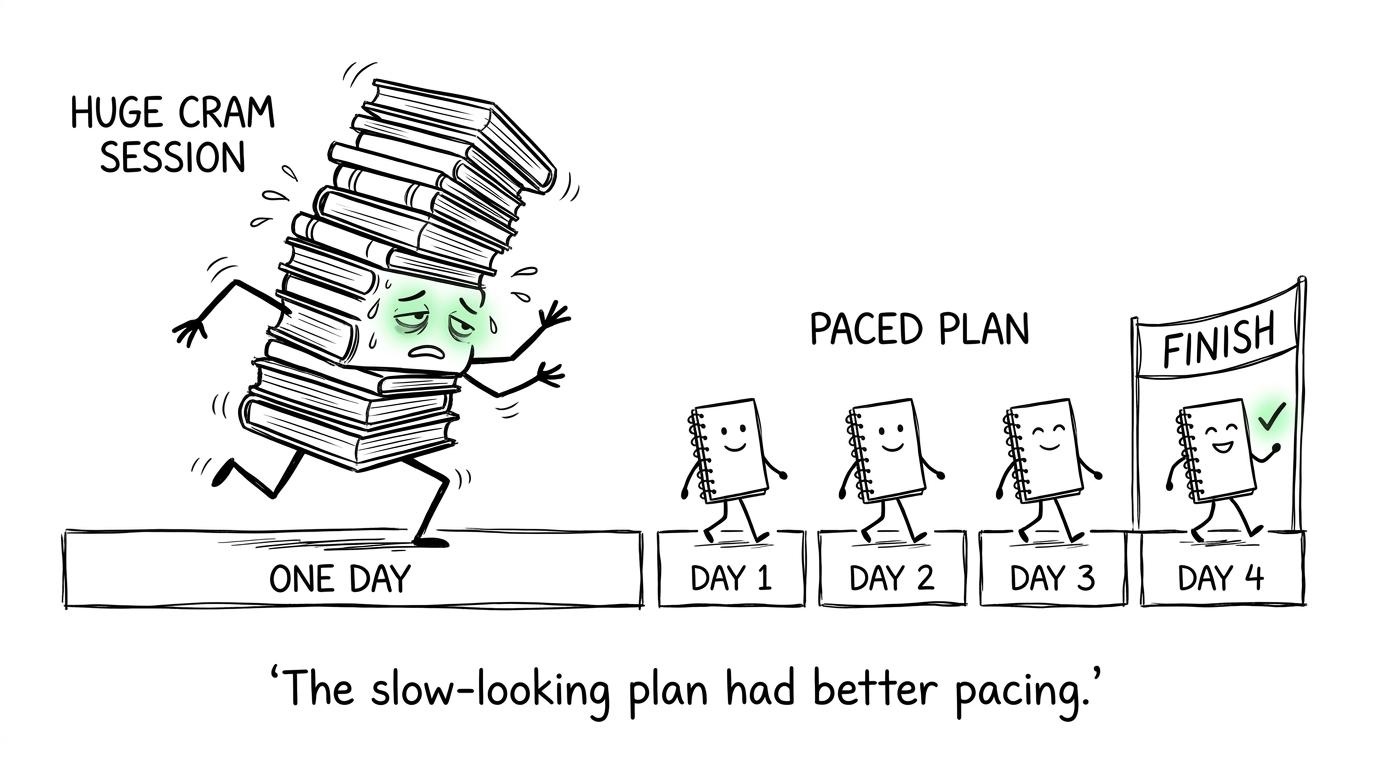 The well-paced revision plan calmly overtakes the exhausted book pile
When daily revision may be useful
Short daily contact can be effective during a limited period, especially if:
- the exam is close;
- you have several weak topics to revisit;
- each session has a precise purpose;
- you continue to sleep properly;
- some days are deliberately lighter;
- you are not neglecting your other subjects.
The key distinction is between daily contact and daily intensity. A short retrieval check on one day can sit between two demanding sessions. It keeps a routine without pretending that your attention is unlimited.
Use a GCSE revision planner and one-week planning approach to place demanding sessions where you have the most energy. Schedule rest in advance. Planned rest feels purposeful; accidental exhaustion feels like failure.
Common mistakes when planning Further Maths revision
Treating rest as a reward
Rest is part of a sustainable system, not something you earn only after perfect revision. If breaks depend on finishing an unrealistic list, they will disappear precisely when you need them.
Cramming one topic once
A long evening on matrices, functions or calculus may create short-term confidence. Without later retrieval, that confidence can fade. Divide the available time across several contacts.
Revising only comfortable topics
Familiar questions feel productive because progress is smooth. Use marked work to direct attention towards the methods actually costing marks.
Completing papers without reviewing them
A paper generates evidence. The improvement comes from marking, diagnosing and retesting. MathsGenie’s guide to using GCSE past papers properly explains this complete loop.
Using resources from the wrong course
Further Maths specifications are not interchangeable. Confirm your awarding body and qualification title before choosing papers. Main GCSE Maths resources can strengthen shared algebra and geometry, but they should supplement rather than replace course-specific material.
Letting revision remove sleep
A late session may add time while reducing attention, accuracy and next-day readiness. Set a stopping time before beginning.
Build a rhythm you can trust
The best answer to whether you should revise GCSE Further Maths every day or rest is not found in the longest possible timetable. It is found in a repeatable cycle: learn, attempt, mark, rest, retrieve and retest.
Start by choosing one weak topic on MathsGenie’s free GCSE Maths revision hub. Use a revision lesson or video solution only as much as needed, complete practice questions without support, and mark them honestly. Schedule the topic to return after a gap. As the exam approaches, add mini tests, suitable past papers and predicted papers, always checking against mark schemes.
Then take the rest day you planned. Not because the exam matters less, but because remembering the mathematics matters more.










